


More news on this day
Months of elevated fuel prices and higher airfares are starting to reshape how people move, with travellers adjusting not only where they go, but how often and by what mode.
Get the latest news straight to your inbox!
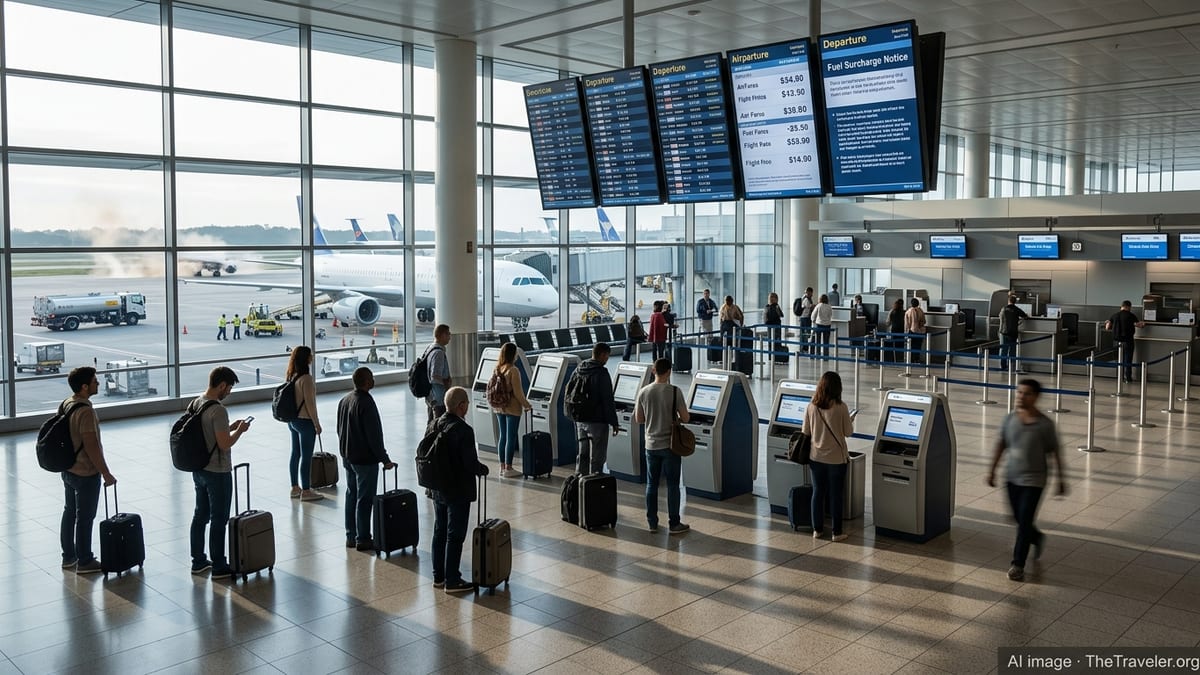
Fuel Costs Ripple Through Airfares and Holiday Budgets
Higher jet fuel and gasoline prices in 2026 are feeding through to transport and holiday costs, according to recent coverage across the aviation and consumer sectors. On key transatlantic and other long haul routes, industry reports indicate that airlines have introduced fuel surcharges and raised base fares to compensate for more expensive fuel. In several European and North American markets, long haul tickets for peak summer departures are reported to be significantly more expensive than a year ago, even where overall inflation has cooled.
Consumer price data referenced in recent U.S. and European reporting points to a renewed uptick in airfares after a period of relative stability. While some domestic routes have seen modest fare declines over the past year as capacity returned, the latest analyses suggest that carriers are now trimming flight frequencies and focusing on yield, which in turn supports higher prices on busy routes. Travel industry commentary also notes that hotel stays, car rentals and dining costs remain elevated, magnifying the impact of fuel on end-to-end trip budgets.
Retail fuel prices are squeezing road travel too. In parts of the United States, average gasoline prices during spring climbed well above the levels seen at the same point last year, partly linked to geopolitical tensions in oil-producing regions. European motorists have also faced higher pump prices, particularly on motorway networks leading to popular coastal and alpine destinations. For many households, the cumulative effect is to make traditional weeklong or multi-stop holidays feel less attainable.
Economic research published in late 2025 and early 2026 indicates that energy price volatility is likely to remain a feature of the travel landscape. Sector outlooks point to fuel as one of the most unpredictable cost lines for airlines and tour operators, with shifts in crude oil and refined product markets feeding through to ticket prices, package deals and ancillary fees.
Travellers Trade Long Hauls for Shorter, Closer-to-Home Breaks
Faced with higher door-to-door costs, many travellers are not abandoning leisure trips entirely but recalibrating them. Recent consumer surveys cited in U.S. and European media suggest that a growing share of households are opting for destinations closer to home, replacing long haul holidays with regional city breaks or domestic road trips that require less fuel and fewer nights away.
North American coverage of the upcoming summer season describes a pattern in which travellers still “want to get away” but are more likely to book long weekends than two-week international itineraries. Reports highlight families choosing drivable beaches, lakes and national parks over overseas resorts, in part to avoid both expensive flights and uncertainty around additional fuel surcharges. Similar trends are being noted in parts of Europe, where rail-accessible coastal towns and mountain regions are drawing visitors who might previously have flown to other continents.
Budget pressures are particularly acute for middle income travellers. Recent polling and anecdotal accounts suggest that some households are postponing major trips, waiting to see whether airfares or fuel prices ease later in the year. Others are splitting one large annual holiday into several shorter, lower-cost getaways, spreading fuel and accommodation expenses over time while still maintaining a sense of escape.
Industry analysts say this pivot toward closer and shorter trips is already influencing tourism flows. Secondary cities, less reliant on long haul air connectivity, are reporting steadier demand, while some long haul leisure routes that boomed immediately after pandemic-era restrictions have seen growth level off as costs rise.
Rail, Buses and Shared Mobility Gain Ground
Rising fuel costs are also accelerating a shift in how people choose to travel, not just how far. Coverage from North America and Europe indicates that trains and intercity buses are attracting travellers who might previously have defaulted to short haul flights or solo car journeys. In markets with extensive rail networks, high speed and night trains are being promoted as cost-stable alternatives that are less directly exposed to aviation fuel price spikes.
Reports from Canada and parts of Europe point to increased interest in rail passes and advance-purchase tickets as travellers look for predictable pricing. Some operators have introduced promotional fares to capture demand from price-sensitive flyers, while others emphasize that their operating costs are less tightly linked to volatile jet fuel markets. Intercity coach companies, which typically offer lower headline fares than airlines, are also marketing themselves as a hedge against unpredictable fuel surcharges in the air sector.
Within cities and resort areas, shared mobility is becoming part of the response to higher fuel prices. Publicly available information from transport authorities and mobility platforms suggests that travellers are leaning more on metro systems, trams, bike share and ride pooling services instead of renting cars for the entire duration of a trip. In several tourist-heavy destinations, local media report that visitors are choosing accommodation with better transit access in order to avoid high parking and fuel costs.
The net effect is a gradual rebalancing of modal share. While aviation remains essential for long distance journeys, rail and road-based mass transit appear to be capturing a larger slice of regional and domestic travel, particularly among younger and more budget-conscious travellers who are comfortable mixing modes on a single itinerary.
Business Travel and Corporate Policies Tighten
Higher fuel and fare levels are also reshaping corporate travel patterns. Consulting and financial services analyses published in 2025 and 2026 describe companies that are taking a more selective approach to air travel, particularly on routes where fares have risen fastest. Internal travel guidelines are increasingly encouraging staff to combine meetings into fewer, longer trips rather than multiple single-day hops, in order to reduce both ticket and hotel costs.
Research by corporate travel management firms indicates that average trip length for business travellers has inched higher, while the number of separate journeys in a year has fallen for many organizations. At the same time, adoption of videoconferencing tools remains high, allowing some meetings to move online altogether. Survey data cited by business media suggests that finance leaders believe a significant portion of pre-pandemic travel could be permanently replaced by virtual alternatives, especially for internal company events.
Where trips are still considered essential, cost controls are becoming more visible. Reports note greater scrutiny of cabin class, advance-booking windows and the choice of departure airports, with travel managers steering employees toward lower-cost options and off-peak days. In Europe and parts of Asia, corporate travel policies are also pushing staff toward rail on short sectors where journey times are competitive with air, particularly as high speed rail expands.
These corporate shifts feed back into airline network and revenue strategies. As business demand becomes more concentrated on fewer, higher-value trips, carriers are adjusting schedules and fare structures accordingly, often focusing premium products on routes where willingness to pay remains strongest despite fuel-related cost pressures.
Sustainability Concerns Intersect With Cost Pressures
Energy prices are not the only factor influencing changing travel habits. Environmental considerations, particularly around aviation emissions, are intersecting with cost concerns in shaping consumer choices. Policy and industry reports over the past year highlight that sustainable aviation fuel, a key component of long term decarbonization plans, remains considerably more expensive than conventional jet fuel, contributing to structural cost challenges for airlines.
Economic research from major insurers and consultancies suggests that as governments roll out climate policies and carbon pricing, airlines and other transport providers will face sustained pressure on energy-related costs. Some of these costs are likely to be passed on through fares and surcharges, reinforcing travellers’ incentives to limit discretionary flying or to choose lower-emission modes such as electrified rail where available.
Surveys of younger travellers in Europe and North America point to a growing willingness to factor both carbon impact and price into destination and mode decisions. Many report favouring fewer but longer trips, combining work and leisure in so-called “bleisure” itineraries to reduce the number of long haul flights over a year. Others are experimenting with “slow travel,” choosing overland routes even when flying might be faster, in order to reduce emissions and exposure to volatile airfares.
For the travel industry, the intersection of fuel costs and climate expectations is prompting investment in efficiency measures, from newer aircraft and optimized flight paths to improved rail rolling stock and bus fleets. While such initiatives aim to contain operating expenses over time, the short term picture suggests that travellers should expect energy-related costs to remain a central factor in how, where and how often they choose to move in the years ahead.