


Riyadh’s King Khalid International Airport (RUH) can feel overwhelming after a long flight, especially if you are trying to find your Uber, Careem or a taxi for the first time. This guide walks you through where to meet your ride at each terminal, how to use the apps smoothly on arrival, what you can realistically expect to pay into the city, and how taxis and other options compare in 2026.
Get the latest updates straight to your inbox!
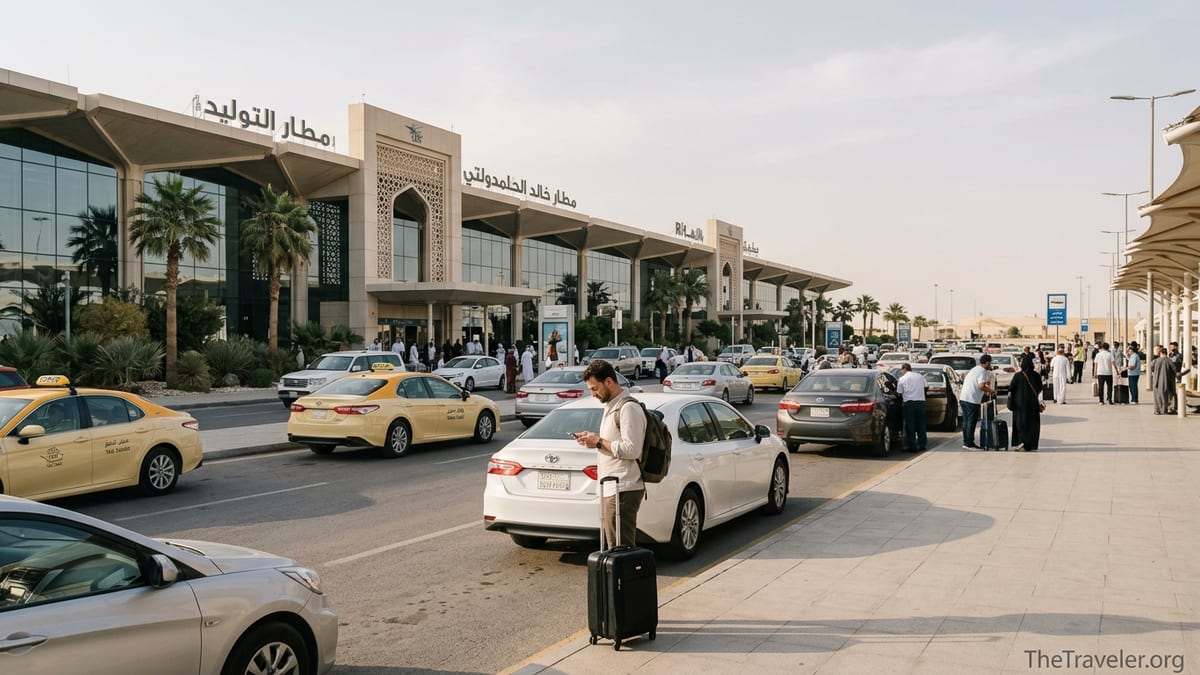
Know Your Airport: Terminals, Layout and Connectivity
King Khalid International Airport sits about 35 kilometers north of central Riyadh and is made up of several terminals clustered along a spine of roads and parking lots. Terminals 1, 2 and 3 are housed in one long building, while Terminal 4 is attached for international flights and Terminal 5 is a separate, newer domestic terminal on the south side of the complex. This layout matters because your ride-hailing pickup area will depend on which building you exit after baggage claim.
Terminals 1, 2, 3 and 4 handle most international flights, including many major Gulf, Asian and European airlines, while Terminal 5 is used heavily by Saudia and Flyadeal for domestic routes. When you book your flight to Riyadh, note your arrival terminal on the itinerary so that when you land you can choose the right pickup point inside Uber or Careem. Many drivers will message you in the app to confirm which terminal door or column you are standing near.
The airport is connected to the city by highways heading toward central districts such as Olaya, the Diplomatic Quarter and the King Abdullah Financial District. Travel time to popular hotel areas in central Riyadh usually ranges from 30 to 50 minutes by car, depending on traffic and time of day. For example, a mid-evening ride from Terminal 3 to a hotel near Kingdom Centre on Olaya Street often takes about 35 minutes if the ring road is flowing smoothly.
Alongside cars, there is an expanding metro network that serves airport stations for Terminals 1–2, Terminals 3–4 and Terminal 5. Ride-hailing apps and taxis remain the most common choice, but you may find yourself combining the metro for part of the journey with a short Uber or Careem ride from a downtown station to your hotel or office.
Uber & Careem at RUH: How the Apps Work on Arrival
Both Uber and Careem operate legally at King Khalid International Airport under agreements with the airport operator, which means you can expect dedicated pickup areas rather than ad hoc curbside stops. As soon as you have your luggage and exit customs into the public arrivals hall, you can open your preferred app using the airport’s free Wi‑Fi or your roaming data. In Uber, select King Khalid International Airport as your pickup, then confirm the correct terminal. In Careem, the app will usually auto-detect your terminal, but you can adjust it manually if needed.
In practice, many travelers wait until they are physically close to the pickup curb to request a ride, to avoid the driver arriving before they do. The walk from baggage claim to the outside curb is usually less than five minutes in Terminals 1–4 and slightly longer in Terminal 5 due to the wider forecourt. If you request a ride while still waiting at the baggage carousel, keep an eye on the timer in the app and message your driver with a quick note such as “Still collecting bags, 10 minutes” to reduce the risk of cancellation.
Payment in both apps can be set to credit card, debit card or local payment methods, and many visitors link an international Visa or Mastercard before travel. If you prefer to pay cash, check in the app that the “cash” option is available in Riyadh, as policies can shift. Drivers generally appreciate when you confirm payment type in the chat, especially for late-night pickups after midnight when demand spikes and they are more selective about requests they accept.
To avoid confusion, always check the license plate and car model on your app screen before getting into any vehicle. At busy times, especially around 22:00 to 01:00 when many flights land from Europe and Asia, several white sedans can queue at the same curb. Reading the final three or four digits of the plate and confirming the driver’s name out loud is a simple but important security step.
Terminal-by-Terminal Pickup Zones and Meeting Points
Each terminal at Riyadh Airport has clearly marked outdoor lanes for private cars, ride-hailing services and taxis. Signage inside the terminal typically uses icons of a car and the words “Ride Hailing” or “App Taxi” in English and Arabic. While exact column numbers can change as the airport updates its layouts, Uber and Careem maintain in-app maps that show the current recommended door and lane for pickup at your terminal.
For Terminals 1, 2, 3 and 4, arrivals are located on the lower roadway. After passing through customs, you exit into the public arrivals hall and follow signs to “Arrivals Curb” or “Ride Hailing.” You will typically step outside through sliding glass doors, then cross one short lane reserved for private pickups to reach an outer lane where many Uber and Careem drivers stop. As a concrete example, a common meeting point for app rides at Terminal 3 is near one of the numbered columns roughly in the middle of the arrivals curb, which the driver will often reference in the chat such as “I am at column 33–34.”
At Terminal 5, which serves most domestic flights, ride-hailing pickups usually occur at the arrivals level along the main curb, again in a lane distinct from the official yellow airport taxis and hotel shuttles. If your driver cannot directly access the inner lane due to congestion, they may ask you to walk a short distance toward the parking entrance or a particular column marker. Travelers arriving from Jeddah or Dammam in the evening often report that it takes about five minutes of walking from baggage claim to reach a quieter spot where the driver can stop without blocking the main flow of traffic.
If you are ever uncertain, use the app’s built-in “call” or “chat” function to ask your driver for a simple reference point. Local drivers are used to meeting first-time visitors and may say something like “Come out of Door 3, then walk right to the end, I am near the big digital screen,” or “I am at departures level, door 8, can you come up one floor.” It is common in Riyadh for pickups to be shifted between arrivals and departures levels depending on crowding, so do not hesitate to clarify which level you should go to.
Pricing, Examples and How Surge Works in Riyadh
Fares for Uber and Careem trips from Riyadh Airport to the city center vary by time of day, traffic and demand. In normal off-peak conditions, a standard UberX or equivalent Careem Economy ride from Terminal 3 to a mid-range hotel in the Olaya business district might typically cost the equivalent of around 70 to 110 Saudi riyals. During lighter traffic, such as mid-morning on a weekday, you may see quotes at the lower end of that range, while late-night or peak-arrival windows can push prices higher due to surge pricing.
As a real-world example, a traveler arriving on a Friday afternoon might open the Uber app in the arrivals hall and see an estimated fare of about 80 riyals for UberX to a serviced apartment near King Abdullah Financial District, with a pick-up time of eight minutes. The same route later that night, when several long-haul flights arrive within a short window, could jump to around 120 riyals if surge pricing is active and estimated arrival time for a driver stretches to 12 or 15 minutes.
Larger vehicles such as UberXL or Careem Max, which can carry more passengers and luggage, are priced higher but still often compare favorably to private hotel transfers. For instance, a family of four with three large suitcases heading from Terminal 5 to a hotel near the Diplomatic Quarter might pay around 130 to 170 riyals for a larger ride-hailing vehicle, while a pre-booked hotel car for the same group could be quoted at 250 to 400 riyals depending on the property and service level.
Both apps will show whether surge pricing is in effect through colored zones on the map or a small multiplier on the fare estimate. If prices look unusually high and you are not in a hurry, one strategy is to wait 10 to 15 minutes in the arrivals hall, then recheck. At Riyadh Airport, short-lived spikes often settle down as more drivers complete drop-offs and become available for pickups, especially around the top of the hour when flights are scheduled to land.
Luggage, Group Travel and Late-Night Arrivals
When you book a ride from the airport, think carefully about your luggage and group size. A standard sedan in UberX or Careem Economy can typically handle two adults with two large checked bags and one or two smaller carry-ons. If you are carrying bulky items like trade-show equipment, golf clubs or several large suitcases for a longer stay, choose a larger category such as UberXL or a spacious Careem option to avoid a stressful repacking session at the curb.
For example, two colleagues arriving for a conference with one checked suitcase each and laptop bags could comfortably share an UberX from Terminal 4 to the Riyadh Front Exhibition & Conference Center, splitting a fare of perhaps 90 to 120 riyals. By contrast, a group of four friends on a weekend break, each with a medium suitcase and backpack, would likely find those bags difficult to fit into a standard sedan and would be better served by selecting a higher-capacity option directly in the app.
Late-night arrivals are common in Riyadh, with many international flights landing after midnight. Uber and Careem both operate 24/7, but driver availability can fluctuate. At 02:00, you may see wait times stretch beyond 15 minutes, or certain vehicle categories might temporarily show as unavailable. In those cases, it can be useful to have a backup plan such as the official airport taxi rank, especially if you are traveling with children or are very tired after a long-haul journey.
Safety remains a priority at all hours. Stick to well-lit, signed pickup areas and avoid accepting offers from individuals who approach you inside the terminal or near the doors offering an unofficial taxi or ride for a “good price.” Instead, rely on the apps or the marked taxi queue, where vehicles are regulated by the airport authority and journeys are recorded.
Official Airport Taxis and Other Alternatives
Alongside Uber and Careem, Riyadh Airport maintains official taxi ranks outside each terminal, where licensed yellow taxis line up to carry arriving passengers into the city. These taxis typically operate with regulated base fares and per-kilometer rates set by local authorities, and many display fare information inside the vehicle. While exact prices can vary, a ride to central districts such as Olaya or Al Malaz often ends up in a similar range to, or slightly higher than, a standard app-based trip, depending on traffic and any surcharges.
For travelers who prefer not to use ride-hailing apps, these taxis provide a straightforward option: you simply follow the “Taxi” signs after exiting customs, join the queue and tell the dispatcher or driver your destination. As a practical example, a solo traveler arriving at Terminal 2 without a local SIM card might choose an airport taxi to reach a hotel near the Diplomatic Quarter, expecting to pay roughly comparable to an app-based fare but benefiting from not needing mobile data or an account setup on arrival.
Many upscale hotels in Riyadh offer pre-booked private transfers, often using black sedans or SUVs. These services are typically the most expensive option, but they provide a meet-and-greet inside the terminal and can be convenient for first-time visitors, VIPs or those carrying sensitive equipment. A business traveler staying at a five-star hotel on Olaya Street might be quoted a flat rate significantly higher than an Uber or Careem ride, but gains the certainty of a driver waiting with a sign and assistance with luggage from the moment they clear customs.
Car rental is another alternative, with several international and local brands maintaining desks at the airport. This can be cost-effective if you plan to drive extensively across Riyadh or to other cities in Saudi Arabia. However, visitors should be comfortable with local driving norms and navigation, and remember that parking in busy downtown areas can be challenging at peak times. Some companies even allow vehicles to be picked up at Terminal 5 and returned to a city-center branch, making it possible to combine an initial Uber or taxi ride from the airport with a later car rental once you are rested.
App Tips, Payment, Connectivity and Cultural Notes
To make the most of Uber and Careem at Riyadh Airport, set up your accounts before you travel. Add at least one working payment method and save your hotel or accommodation address in the app favorites. This way, when you land you can simply tap the saved location rather than typing long Arabic street names while juggling luggage. It is also a good idea to enable in-app notifications, so you see messages and driver updates even if your phone screen is locked.
Connectivity at RUH is generally reliable, with free airport Wi‑Fi accessible in the terminals. However, Wi‑Fi signal can weaken near the outer curbs, so consider requesting your ride while you are still inside, then stepping out to meet the driver. Many visitors also purchase an eSIM or local SIM card for Saudi Arabia, which can be activated on arrival at kiosks in the arrivals hall and makes using ride-hailing apps, maps and translation tools throughout your stay far easier.
When it comes to payment, both Uber and Careem support electronic transactions that charge your card or in-app wallet automatically at the end of the trip. If you prefer to tip your driver, cash in small denominations is generally appreciated, although tipping is not mandatory. For business travelers, you can download trip receipts from the app and submit them with your expense reports, which is typically accepted by companies for journeys from the airport to client sites or hotels.
Saudi Arabia is welcoming an increasing number of international visitors, and drivers around Riyadh Airport are accustomed to passengers who do not speak Arabic. Basic English is common, but it can be helpful to have your destination written out in both English and Arabic in the app notes or on your phone screen, particularly if you are heading to a residential address or a smaller business that may not be well known. Dress is generally modest, though not strictly enforced for foreigners, and courteous greetings such as “Salaam alaikum” are appreciated.
The Takeaway
Using Uber, Careem or an official taxi from Riyadh’s King Khalid International Airport in 2026 is usually straightforward once you know where to go and what to expect. The key steps are to confirm your arrival terminal, follow signs to the ride-hailing or taxi zones, and use the app to match your driver’s car and license plate before getting in. With typical journey times of 30 to 50 minutes into central Riyadh and fares that compare well with many hotel transfer services, ride-hailing has become a practical default for both business and leisure travelers.
Whether you are landing at Terminal 1 from a regional flight or stepping into Saudi Arabia for the first time at Terminal 4 after a long-haul journey, planning your onward transport will help your trip start smoothly. Save your accommodation address in the app, think about how much luggage you have, and be prepared for occasional price surges at peak arrival times. If app rides are busy or you prefer a more traditional option, the official taxi queue and pre-booked hotel cars remain reliable alternatives.
As Riyadh continues to grow and host more events, from major conferences to entertainment festivals, the choices for airport transfers will likely expand further. For now, understanding the pickup zones, pricing patterns and simple on-the-ground realities at RUH will give you the confidence to step out of the terminal, open your chosen app and get into the city with minimal hassle.
FAQ
Q1. Can I use Uber and Careem at all terminals of Riyadh Airport?
Yes. Uber and Careem operate at King Khalid International Airport across the main terminals, including the international terminals and the domestic Terminal 5, with dedicated pickup areas that may vary slightly by terminal.
Q2. How much does an Uber or Careem from Riyadh Airport to the city center usually cost?
In typical conditions, a standard ride from the airport to central areas such as Olaya often falls in an approximate range that is broadly comparable to a regulated airport taxi, with exact amounts depending on traffic, timing and surge pricing.
Q3. Where exactly do I meet my driver after landing?
After collecting your luggage and clearing customs, follow signs to the arrivals curb or ride-hailing area. Your app will show the precise pickup spot, and your driver may message you with a reference such as a specific door or column number.
Q4. Is it better to request the ride before or after I collect my luggage?
Most travelers request a ride after they have their bags and are walking toward the exit, to avoid drivers arriving too early and canceling. If you request earlier, keep your driver informed by chat.
Q5. What if I arrive very late at night?
Uber and Careem run 24/7, but wait times can be longer during the very early hours. If drivers are scarce or prices surge sharply, you can use the official airport taxi rank as a backup option.
Q6. How much luggage fits in a typical UberX or Careem Economy car?
A standard sedan usually fits about two large suitcases plus smaller bags comfortably. If you have more luggage or bulky items, request a larger vehicle category in the app.
Q7. Do I need cash to pay for rides from Riyadh Airport?
No. You can pay with a card stored in the Uber or Careem app and receive a digital receipt. Cash may still be possible in some cases and is useful for tipping, but it is not essential.
Q8. Are airport taxis more expensive than Uber or Careem?
Official airport taxis often price similarly to or slightly higher than app-based rides for comparable routes. Exact totals depend on traffic, time of day and any surcharges or waiting time.
Q9. Is it safe to take ride-hailing cars from Riyadh Airport?
Using Uber or Careem from the signed pickup zones is generally considered safe, as trips are tracked in the app. Avoid unlicensed drivers who approach you inside the terminal offering informal rides.
Q10. What should I do if I cannot find my driver at the pickup point?
Use the app’s call or chat function to describe your location, including terminal, door number and nearby signs. If the driver cannot reach you, cancel in the app and request another car from a clearly marked ride-hailing or taxi area.