


More news on this day
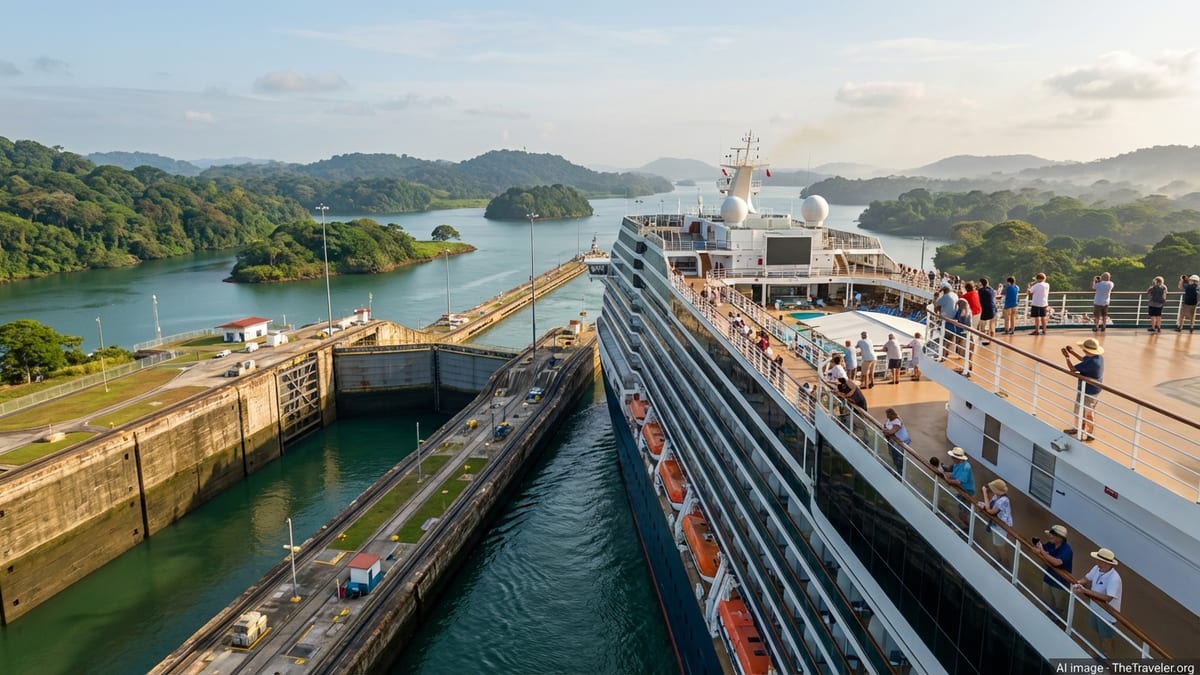
Royal Caribbean’s forthcoming Discovery class ships are being designed to fit through the Panama Canal, a key capability that is expected to expand the line’s deployment options across the Americas.
Get the latest news straight to your inbox!
A New Mid-Sized Class With Global Reach
Royal Caribbean first confirmed plans for the Discovery class in early 2026, positioning the ships as a new platform that sits between its largest vessels and its older, smaller tonnage. Publicly available information indicates that at least two Discovery class ships have been ordered from the Chantiers de l’Atlantique yard in France, with delivery of the first vessel targeted for 2029.
Unlike the Icon and Oasis classes, which are too large for the Panama Canal, Discovery class has been conceived from the outset with canal transit in mind. Reports from cruise industry publications describe a ship that will be similar in overall size to the existing Quantum class but with dimensions adjusted to meet the constraints of the locks and the air draft limits at the Bridge of the Americas.
This design approach is expected to give Royal Caribbean a versatile workhorse that can move seasonally between regions without relying on lengthy repositioning routes around South America or via other oceans. The ability to cross between the Atlantic and Pacific through the canal is emerging as one of the core strategic attributes of the new class.
Cruise analysts note that the project marks a return to a more flexible, globally deployable ship profile, echoing earlier Panamax-friendly classes that helped the brand develop a presence in a range of markets before the rise of today’s mega-ships.
Why Canal Transit Matters for Itineraries
Making Discovery class compatible with the Panama Canal is expected to open a series of itinerary combinations that are more challenging for larger vessels. Industry coverage suggests that Royal Caribbean is eyeing Alaska in summer and Caribbean or Latin American deployments in winter, with the canal serving as a direct bridge between seasons.
For guests, this could translate into one-way canal voyages linking ports in Florida or the Gulf of Mexico with homeports on the U.S. West Coast or Central America. The ships may also be able to offer extended repositioning cruises that pair a full or partial canal transit with visits to smaller ports along both coasts of the Americas.
Travel trade reports point out that canal-capable ships can also reach niche destinations that are off-limits to the largest vessels, broadening the variety of ports Royal Caribbean can feature on longer voyages. This flexibility is particularly valuable as demand grows for itineraries that combine marquee hubs with less visited coastal towns.
Panama Canal compatibility additionally gives the company a hedge in network planning. If demand or port access changes in one region, a ship that can quickly switch oceans provides more options for redeployment without requiring major schedule overhauls across the fleet.
Designing Within Panama Canal Constraints
Building a modern cruise ship to fit the Panama Canal involves balancing guest amenities with strict dimensional limits. Technical discussions in trade and enthusiast coverage emphasize two key factors: beam and air draft. The beam must be narrow enough for the canal’s locks, while air draft, the height from the waterline to the highest point of the ship, must remain below the maximum permitted to pass under the Bridge of the Americas.
Reports indicate that Royal Caribbean is applying lessons learned from previous Panamax-friendly classes, while incorporating contemporary design elements that have proven popular on its newer ships. That may result in a more compact profile than the largest vessels, but with a focus on open deck spaces, varied dining, and entertainment offerings tailored to longer, more destination-focused itineraries.
Industry analysis suggests that Discovery class is likely to fall in the mid-sized category by today’s standards, large enough to accommodate Royal Caribbean’s signature experiences yet small enough to access ports and waterways that mega-ships cannot. The canal requirement appears to be a defining parameter in that balance, influencing everything from superstructure design to lifeboat placement and funnel configuration.
Shipyard and company statements also highlight the role of efficiency and environmental performance, noting that the class will build on advances in energy use and emission reduction seen in recent generations of cruise ships. Operating efficiently on longer routing patterns that include the canal is seen as a commercial as well as regulatory imperative.
Implications for the Competitive Cruise Landscape
The decision to prioritize Panama Canal transit on a new class has implications beyond Royal Caribbean’s own deployment map. Cruise industry observers view Discovery class as a response to a broader market shift, where guests increasingly seek itineraries that combine iconic destinations with more unusual routes and longer voyages.
By offering canal-capable ships with modern amenities, Royal Caribbean is positioning itself to compete more directly in segments where mid-sized, globally mobile vessels have traditionally been favored. This includes extended seasonal programs in Alaska, the Pacific coast of the Americas, and complex repositioning cruises that appeal to repeat cruisers.
Travel trade reporting also points out that the new class may encourage other lines to revisit the balance between very large ships optimized for a handful of marquee regions and more versatile hardware that can move flexibly between markets. As canal transit continues to feature prominently in marketing and itinerary planning, the ability to send a high-profile newbuild through the waterway could become a differentiator.
For ports along canal routes, the arrival of Discovery class could translate into higher-profile calls and increased passenger volumes, particularly if the ships are scheduled on series of one-way sailings that use different homeports at each end of the canal. Local tourism stakeholders are expected to watch closely as more details on deployment emerge in the coming years.
What Comes Next for Discovery Class
While the first Discovery class ship is not expected to debut until 2029, the decision to design for Panama Canal transit provides an early glimpse into how Royal Caribbean intends to use the vessels. Further information about exact dimensions, interior concepts, and confirmed routes is anticipated as construction milestones approach at Chantiers de l’Atlantique.
Published coverage indicates that the initial order includes two ships, with options for additional units that could follow if the design proves successful. This staggered introduction would allow Royal Caribbean to refine deployment strategies based on guest demand and operational experience, including how best to integrate regular canal transits into the wider fleet schedule.
In the meantime, cruise watchers are focused on how Discovery class will complement Royal Caribbean’s largest ships. The expectation across industry commentary is that the new class will not replace mega-ships on marquee routes, but rather add a more agile tool for exploring regions where the canal and smaller ports play a central role.
With the Panama Canal built into the design brief from the start, Discovery class is emerging as a symbol of how cruise ship planning is evolving, combining large-ship features with a form factor tailored to one of the world’s most strategically important waterways.