


More news on this day
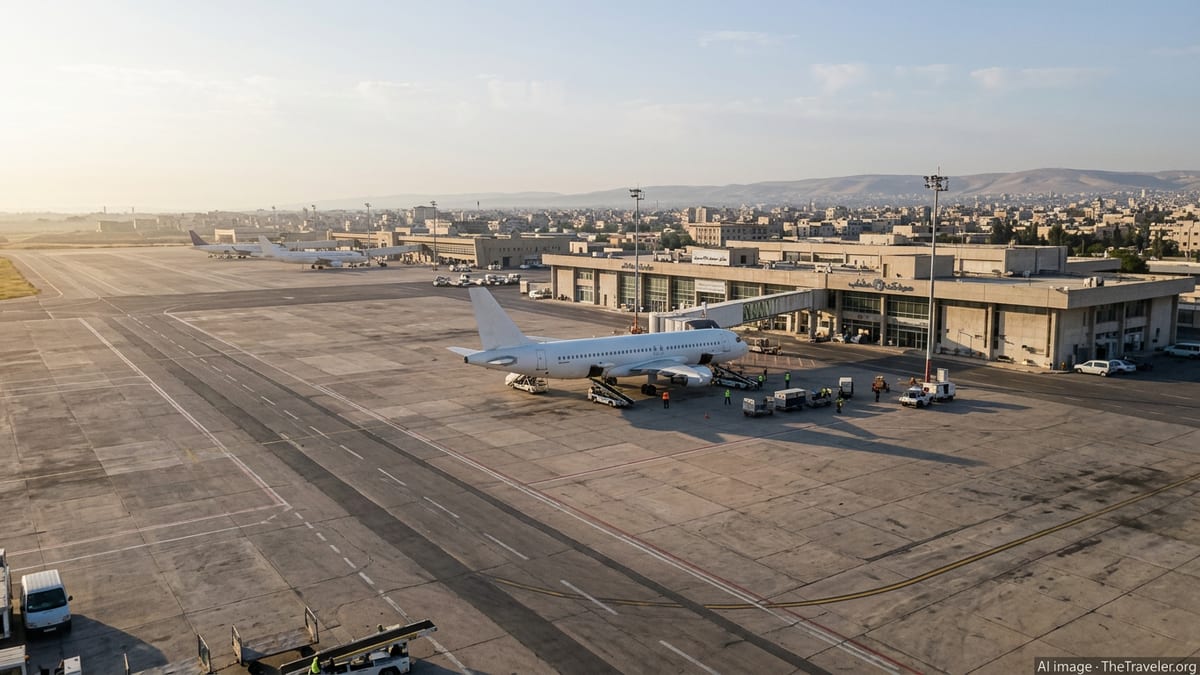
The resumption of direct commercial flights between Moscow and Damascus is emerging as one of the clearest symbols of a cautious rapprochement between Russia and Syria’s new authorities, underscoring how air links are being used to signal political intent in a country still recalibrating its foreign ties after the fall of Bashar al Assad.
Get the latest news straight to your inbox!
Air Connectivity as a Barometer of Political Change
The return of Moscow–Damascus services comes roughly a year and a half after Assad’s departure from Syria and the installation of a transitional leadership under President Ahmed al Sharaa. In the chaotic months immediately after Assad’s flight into exile, commercial links through Damascus International Airport largely collapsed, and international carriers stayed away amid regulatory uncertainty and security concerns. Published aviation data for 2025 describes only an inhibited recovery, with limited connectivity and a stop start pattern as the new government worked to restore basic operations.
By early 2026, traffic figures and timetables pointed to a gradual reopening. Announcements from Syrian aviation authorities and Russian carriers indicated that scheduled services between Moscow and Damascus would resume, framed as part of broader efforts to normalise civil aviation and reconnect Syria with key partners. Damascus International Airport, heavily damaged and repeatedly shut during the civil war, was repositioned by the transitional government as a gateway for reconstruction, trade and diaspora travel.
In this context, the restoration of flights to the Russian capital carries a weight that extends beyond passenger volumes. Air links are a visible, easily understood indicator of where political relations stand. After a period in which Syria’s new leadership appeared to hold Moscow at arm’s length, the decision to allow renewed direct connectivity signals that ties, while no longer based on the personal alliance with Assad, are stabilising into a more pragmatic partnership.
The move also fits a broader pattern observed in 2025 and 2026, in which Syria has cautiously re engaged with multiple partners at once, from Western governments to regional powers. Airspace and route permissions have become tools in this balancing act, with each new service reflecting both commercial demand and the evolving diplomatic map.
Russia Seeks to Preserve Influence Without Assad
For Moscow, the symbolism of a Russian aircraft once again landing regularly at Damascus International is significant. Analytical coverage after Assad’s fall described a period of despondency in Russian policy circles, as the loss of a long standing client regime appeared to undercut years of military and diplomatic investment in Syria. Think tank assessments in late 2024 and 2025 argued that Russia’s prestige had taken a clear hit, even as its military foothold on the Syrian coast remained intact.
Over the following year, Russian policy shifted from a defensive posture to an attempt at adaptation. Publicly available reports describe a sequence of visits by Russian delegations to Damascus to renegotiate the status of bases, discuss economic cooperation and explore forms of security coordination with the new authorities. Analysts note that Moscow’s messaging has emphasised respect for Syria’s sovereignty and a readiness to work with the post Assad leadership, an important narrative shift from its earlier insistence on Assad’s indispensability.
Resuming direct flights fits this repositioning. Commercial links support Russia’s remaining economic interests in Syria, including construction, energy and logistics contracts, while also maintaining people to people ties with communities that once relied on Russia as a travel and education destination. For the Kremlin, every scheduled flight is a reminder that Russia has not been pushed out of the Levant, despite its alignment with a deposed ruler.
At the same time, the new pattern of flights underscores the limits of Russian leverage. Commentaries from regional research institutes suggest that Damascus is deliberately avoiding a return to the one sided dependency that characterised much of the Assad era. Instead, Moscow is being offered a place in a crowded field of partners rather than the privileged access it once enjoyed.
Damascus Balances Between Moscow and the West
The Moscow–Damascus route is reviving at a moment when Syria is tentatively reopening to Western capitals. Policy analysis from Middle East focused organisations highlights major steps taken by Washington and European partners in 2025 and 2026, including partial lifting of sanctions, the appointment of envoys and the upgrading of diplomatic representation in Damascus. These moves have created new political and economic incentives for the Syrian leadership to pursue a diversified foreign policy.
Within this landscape, renewed flights to Moscow function as one strand in a wider web of connectivity that also includes growing links to Gulf states, Turkey and, increasingly, Western Europe. Aviation specialists note that airlines and governments often use route launches or capacity increases to telegraph warming relations, even when formal political agreements lag behind. In Syria’s case, each newly permitted destination offers clues about how Damascus seeks to position itself.
By allowing Russian carriers and possibly a revived Syrian national airline to operate into Moscow, the transitional government appears to be sending a calibrated message. Syria is willing to maintain working relations with Russia, but on terms shaped by a leadership that now also counts the United States and key European states as partners. Analysts argue that this hedging strategy aims to prevent any single outside power from monopolising influence while attracting investment, aid and security cooperation from multiple directions.
The practical impact on travel is also notable. The restored connection offers a direct route for Syrian students, traders and migrant workers with ties to Russia, as well as for Russian businesspeople involved in reconstruction projects. Tourism remains constrained by security perceptions and infrastructure gaps, but industry observers see potential for niche religious and cultural travel in the medium term if conditions stabilise.
Economic Stakes: Trade, Reconstruction and Transit
The revival of flights between Moscow and Damascus is closely connected to the economic agenda both sides are trying to advance in the aftermath of the war and regime change. Prior to Assad’s ouster, Russia had secured concessions and memoranda of understanding in sectors ranging from hydrocarbons and phosphates to port management and power generation. Many of these agreements were thrown into question by the political transition, prompting a renegotiation process that is still unfolding.
Economic think tanks tracking Syria report that Russian companies are now seeking more modest, targeted roles in reconstruction projects, often in partnership with regional firms. Direct air services are important enablers of this shift, lowering transaction costs for project managers, engineers and financiers who need to move quickly between the two capitals. Flights also support smaller scale commerce, such as imports of Russian manufactured goods and Syrian agricultural products.
For Damascus, reliable air links to Russia provide leverage in discussions with Western donors and investors. The Syrian leadership can point to ongoing Russian engagement as evidence that alternatives exist if Western support proves conditional or slow. At the same time, the government appears mindful of the need to reassure Western partners that Russian involvement will not undercut new regulatory frameworks or governance commitments.
Regional transport planners additionally see a potential role for Damascus as a transit node between parts of Eurasia and the Middle East, especially if security conditions improve along overland corridors. In that scenario, routes connecting Moscow to Syria could feed passengers onward to Gulf and African destinations, reviving some of the hub ambitions that existed before the war, albeit on a more restrained scale.
Security and Symbolism in the Skies
Beyond economics and diplomacy, the return of flights carries clear security overtones. Russia remains a key external actor in Syria’s security architecture, even if its influence has narrowed. Analyses from security institutes describe ongoing discussions over training, limited arms supplies and intelligence sharing, all designed to ensure that Russian military facilities in Syria remain viable while the new leadership consolidates control.
In this sense, the Moscow–Damascus air link is part of a broader pattern in which aircraft movements are watched as indicators of security cooperation. Observers have pointed to previous instances in which Russian military planes shuttled between the two countries to deliver equipment or relocate personnel linked to the former regime. The re emergence of scheduled civilian services helps normalise this aerial corridor, even as military flights continue at a lower profile.
The route also resonates domestically in both societies. In Syria, a Russian airliner on the tarmac can recall both the years of heavy Russian involvement in the conflict and the more recent reality of a leadership that survived without Assad. For many Syrians, it may embody a tension between a desire to break with the past and a recognition that Russia still matters to the country’s security and economy. In Russia, coverage of renewed flights offers an opportunity for state aligned media to present Syria as a case where Moscow remains an indispensable player despite political setbacks.
Ultimately, the reactivation of Moscow–Damascus flights illustrates how civil aviation routes can double as geopolitical signposts. Each departure and arrival reflects a complex mix of commercial calculations, security considerations and diplomatic messaging, offering the travel industry a front row seat to Syria’s redefined relationship with one of its most consequential former patrons.