


Italy is widely perceived as a relatively safe country by international standards, but families evaluating a relocation decision need a more granular view. Understanding national crime trends, the differences between large metropolitan areas and smaller provincial cities, and the specific risks that affect children and caregivers is essential for an informed move. This briefing examines current data on crime in Italy, highlights regional and urban variations, and identifies patterns that matter most for family safety.
National Crime Profile: How Safe Is Italy Overall for Families
Italy records comparatively low levels of violent crime relative to many Western countries. According to the most recent European and national statistics, Italy’s intentional homicide rate is around 0.5 to 0.6 per 100,000 inhabitants, placing it among the safer countries in the European Union and markedly below rates seen in North America. In absolute terms, police recorded just over 330 to 340 homicides annually in recent years, in a country of roughly 59 million residents. This means that lethal violence against strangers is statistically rare in everyday life.
Non-fatal violent offenses such as robbery and assault exist but occur at modest rates compared with other large European states. Data from Italy’s national statistics institute indicates robbery victimization at roughly 1 to 1.5 per 1,000 inhabitants, with a gradual decline over the past decade. While specific annual figures may fluctuate, the multi-year trend shows decreasing serious violence and stable or falling burglary levels at the national scale.
From a family perspective, this national profile suggests that routine life in most Italian communities is not dominated by violent crime. For many relocating families from higher-crime environments, daily activities such as walking to school, using public transport and visiting neighborhood parks often feel comparatively secure. However, national averages mask significant differences between metropolitan centers and smaller cities, and they do not fully capture crimes that occur within the home or online, which are particularly relevant for children.
It is also important to distinguish between objective risk and perceived risk. Surveys of Italian residents show that fear of crime has generally declined over the last decade, even as media attention to individual incidents remains high. Many Italians report feeling reasonably safe in their neighborhood, though concern tends to rise in large city suburbs and in some southern regions.
Key Crime Types Relevant to Families
For families, the most relevant crime categories are not limited to headline-grabbing homicides. Everyday safety is more affected by property crime, public-order offenses, gender-based violence and offenses against minors. Italy’s main urban centers report high volumes of pickpocketing and bag-snatching, particularly in crowded public transport nodes and tourist districts. These crimes are highly concentrated in a few city cores and are often opportunistic rather than violent.
Domestic violence and intimate partner abuse remain a central family-safety concern. National reports show that a substantial share of female homicide victims are killed by current or former partners, often within the home. Police data and victim-support services highlight that many cases occur in households with children, exposing minors to direct or indirect violence. Italy has progressively expanded reporting channels, shelters and legal protections, which has increased the visibility of these offenses, but underreporting is still believed to be significant.
Crimes against minors, including mistreatment within the family, sexual violence, exploitation and child pornography, are monitored closely by Italian authorities and child-protection organizations. Recent analyses suggest that roughly 6,000 to 7,000 crimes against minors are reported each year nationwide, equating to an approximate average of around 15 to 20 reported offenses per day. The majority involve abuse, ill-treatment or sexual crimes, and girls are disproportionately affected in sexual offense categories. These figures underscore that, as in many countries, the greatest risks to children often arise in familiar environments rather than on the street.
Cyber-related risks are also increasing. Surveys of Italian adolescents indicate that cyberbullying, online harassment and exposure to harmful digital content are perceived as major threats. For relocating families, this points to the importance of digital safety practices, cooperation with schools and awareness of Italian reporting mechanisms for online abuse, even when physical neighborhood crime is comparatively low.
Regional and City-Level Patterns: Where Risk Is Concentrated
Crime in Italy is geographically uneven. Large metropolitan provinces such as Milan, Rome, Turin and Florence report far higher total crime rates per 100,000 inhabitants than smaller provincial capitals or rural areas. Rankings compiled from Interior Ministry data show that Milan consistently appears at or near the top for total recorded offenses, with more than 7,000 reported crimes per 100,000 inhabitants in a recent year. Rome follows with just over 6,000 per 100,000, and Florence records a similar order of magnitude. These figures include all registered offenses, from pickpocketing to serious violence.
By contrast, several smaller provinces record less than one-third of the crime incidence found in the largest cities. Locations such as Treviso in the northeast, Potenza in the south and Oristano in Sardinia are frequently cited as among the safest provincial capitals, with total reported crime in the low 2,000s or even around 1,500 per 100,000 inhabitants. For families prioritizing low exposure to street and property crime, these mid-sized or smaller cities often present a more reassuring profile than the major hubs.
Regional differences within Italy also matter. Northern regions host both some of the country’s highest-crime metropolitan areas and some of its most orderly smaller cities. The south and islands historically show higher levels of organized crime presence and certain forms of extortion or racketeering, but not necessarily higher rates of day-to-day street violence in all localities. Many southern provincial capitals have moderate recorded crime levels and a strong sense of community oversight in residential neighborhoods.
Families should also be aware that tourist intensiveness magnifies specific crime types. Cities with heavy visitor flows, such as Rome, Florence, Venice, Milan and Naples, register disproportionate levels of theft and pickpocketing in their historic centers. This does not necessarily translate into high risk in residential districts outside the core, which often have very different safety patterns from the areas seen by short-term visitors.
Relatively Safer Italian Cities and Urban Profiles for Families
There is no single definitive list of Italy’s safest cities, because safety depends on the crime indicators chosen and on individual family preferences. However, consistent patterns appear when comparing recorded offenses per 100,000 inhabitants. Provinces such as Oristano, Belluno, Treviso, Sondrio, Pordenone and Potenza often rank among the areas with the lowest crime incidence nationwide. These locations share several characteristics useful to relocating families: smaller populations, limited mass tourism, and predominantly residential or regional-service economies.
Many medium-sized cities in the north and center of Italy also offer a favorable balance of urban amenities and safety. Examples include Parma, Trento and Bolzano, which typically report below-average levels of violent and property crime and have reputations for strong local governance and community cohesion. In these cities, families often find well-maintained public spaces, relatively low visible disorder, and active local involvement in school and neighborhood life. While petty theft still occurs and certain districts can be more problematic, the general risk environment is moderate.
By contrast, very large metropolitan areas such as Milan, Rome, Turin, Naples and Palermo demand more situational awareness. In Milan, theft, burglary and robbery rates are among the highest in the country, particularly in central districts, railway stations and nightlife zones. Rome faces similar challenges around transport hubs and crowded tourist areas. Naples and Palermo, while often stigmatized in international media, present a more complex picture: they struggle with organized crime and some neighborhood-level street crime, yet many residential zones experience relatively low levels of everyday violence and strong informal social control.
Families considering a move to any large Italian city should conduct district-level research rather than evaluating safety at the metropolitan scale alone. Within the same city, there can be a substantial difference between high-crime central or peripheral zones and quieter residential quarters that resemble small towns in terms of daily life and perceived security.
Crimes Against Minors and Domestic Environments
For parents, the question of safety extends inside the home, school and digital spaces. Italian police reports and child-protection organizations stress that crimes against minors frequently involve perpetrators known to the victim. Recent national data indicate that yearly reports of crimes against minors number in the several thousands, with an average that approximates 15 to 20 recorded cases per day across the country. The largest categories are mistreatment within the family, sexual abuse, violation of family support obligations and neglect or abandonment of minors or incapacitated persons.
Gender distribution is uneven across offense types. In sexual violence and aggravated sexual violence involving minors, the majority of identified victims are female. For other crimes linked to family neglect or failure to provide support, victimization is more balanced between boys and girls. These patterns highlight that violence and abuse in Italy, as elsewhere, are deeply intertwined with gender dynamics and family contexts rather than purely with street crime.
Italian authorities have strengthened legislative tools and institutional responses in this area. The country maintains dedicated juvenile courts, child-protection services at the municipal and regional level, and specialized units within the police dealing with crimes against minors and domestic violence. Numerous anti-violence centers and hotlines are available, and schools often collaborate on awareness campaigns about abuse, bullying and digital risks. However, experts point out that underreporting remains high, especially in small communities where social stigma or dependence on the abuser discourage formal complaints.
For relocating families, this means that evaluating safety should involve both the external environment and the strength of local support systems. Access to trusted pediatricians, psychologists, school counselors and local associations can be as important as the neighborhood crime rate. Families may also wish to become familiar with Italian reporting channels, including national hotlines and municipal social services, so that they understand where to turn if concerns about abuse or neglect arise.
Perception of Safety, Social Cohesion and Practical Risk Management
Italian surveys on the perception of safety show a gradual decline in fear of crime over the past decade, with fewer citizens reporting that they feel at high risk of being victims of robbery, assault or sexual violence. Nonetheless, a substantial minority, around one quarter of respondents in recent nationwide studies, describe their neighborhood as at risk of crime or express worry about walking alone after dark. Concerns are higher among women, older adults and residents of large cities.
Social cohesion is a key factor distinguishing safer-feeling areas. Small and medium-sized towns with stable populations and dense informal networks often exhibit both lower recorded crime and higher perceived safety. Residents know their neighbors, children play in semi-supervised environments, and informal surveillance of streets and courtyards is common. In some urban peripheries, by contrast, socio-economic disadvantage, physical decay and weak ties between residents contribute to higher levels of disorder and occasional anti-social behavior, even when serious violent crime remains rare.
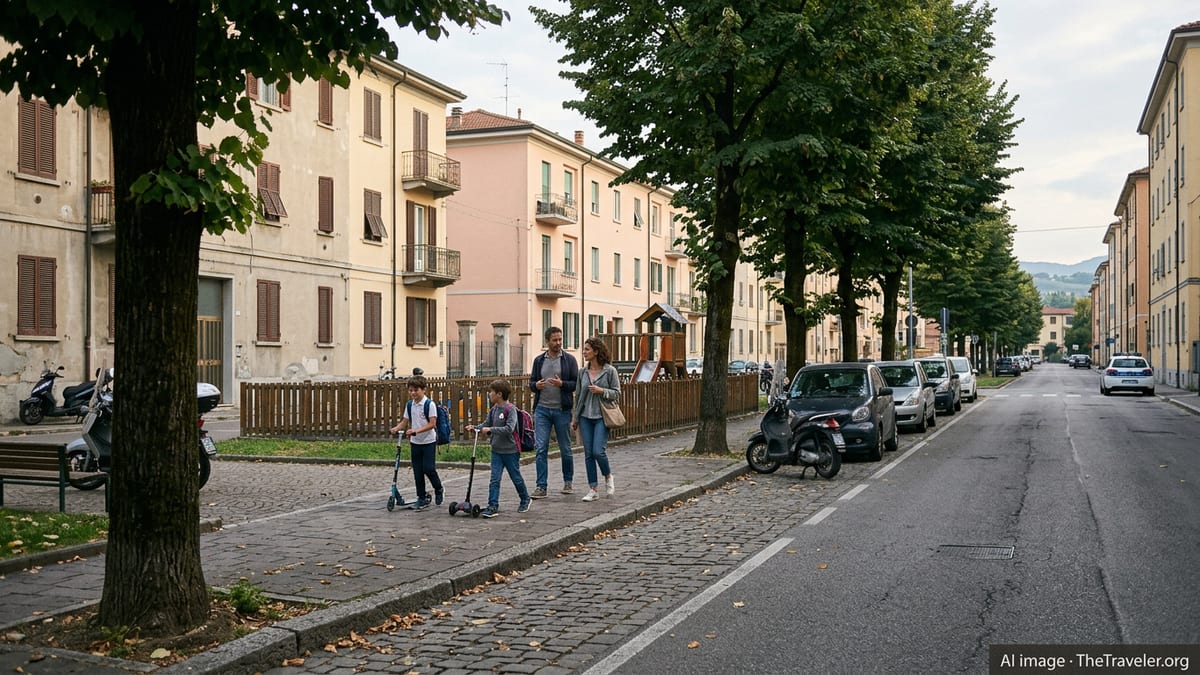
For families arriving from abroad, practical safety management in Italy typically revolves around standard urban precautions rather than extreme measures. Basic practices such as avoiding the display of valuables in crowded places, being attentive on public transport, and choosing well-lit routes at night significantly reduce exposure to petty crime. Many neighborhoods in Italian cities, especially those with high proportions of families and older residents, maintain a village-like atmosphere where evening strolls, playground visits and local events are common and generally safe.
It is important to recognize that Italy’s public institutions, including the national police, municipal police and carabinieri, maintain a visible presence in most urban areas. Response times and effectiveness can vary by locality, but the overall framework of law enforcement coverage is dense. Combined with active neighborhood associations and parental networks around schools, this institutional presence contributes to an environment where serious threats to family safety are in most cases contained or mitigated.
The Takeaway
For families evaluating relocation, Italy offers a comparatively favorable safety environment, particularly when viewed against global benchmarks of violent crime. National homicide rates are low, serious assaults and robberies occur at modest levels, and many provincial and medium-sized cities present consistently low overall crime incidence. At the same time, the country’s largest metropolitan centers concentrate property crime, petty theft and some forms of street violence, requiring more careful neighborhood selection and routine caution.
The most significant risks to children in Italy, as in many countries, are often found within domestic and familiar settings. Crimes against minors, domestic violence and gender-based violence remain critical concerns that are less visible in standard city crime rankings. Families should therefore assess both the external urban environment and the strength of local support systems, including schools, healthcare providers and social services, when judging overall safety.
Ultimately, Italy can be considered a realistic option for families who prioritize security, provided that relocation decisions are made at the city and district level rather than based solely on national averages. A focus on smaller and medium-sized cities with strong social cohesion, combined with normal urban safety practices and attention to domestic well-being, can provide a secure everyday context for raising children in the Italian setting.
FAQ
Q1. Is Italy generally safe for families compared with other European countries?
Italy records a relatively low homicide rate and moderate levels of violent crime compared with many European peers, making it broadly safe for family life by regional standards.
Q2. Which Italian cities are considered relatively safer for families?
Smaller and medium-sized provincial capitals such as Treviso, Oristano, Potenza, Belluno and some cities in the northeast often show lower overall crime rates and calmer residential environments.
Q3. Are major cities like Milan and Rome unsafe for children?
Milan and Rome have higher levels of theft and other reported crime, especially in central and tourist areas, but many residential districts within these cities remain relatively safe and family-oriented.
Q4. How common are crimes against minors in Italy?
Police data indicate several thousand crimes against minors reported each year, averaging roughly 15 to 20 reported cases per day nationwide, mainly involving family mistreatment and sexual offenses.
Q5. Is street violence a significant risk for teenagers in Italian cities?
Serious street violence against teenagers is statistically uncommon, though fights, harassment and occasional robberies do occur, particularly around nightlife zones and some suburban areas.
Q6. How does organized crime affect everyday family safety?
Organized crime in Italy is primarily involved in economic and illicit markets; its direct impact on typical family daily life is limited, though it can influence certain neighborhoods and local governance.
Q7. Are Italian schools and public spaces around them generally safe?
Schools and their surrounding areas are usually safe, with incidents more likely to involve bullying or petty theft than serious violence, and many municipalities employ local police near schools at peak hours.
Q8. What practical steps can relocating families take to improve safety in Italy?
Choosing a residential neighborhood with strong community ties, using standard urban precautions, engaging with school and parent networks, and understanding local emergency contacts all enhance safety.
Q9. Are rural areas in Italy significantly safer than cities?
Rural and small-town areas generally record lower crime levels than major cities, but access to services and emergency response times may differ, so safety should be weighed alongside practical needs.
Q10. How reliable are Italian crime statistics for evaluating where to live?
Official police and statistics institute data provide a solid indication of trends and city differences, but underreporting and local variation mean that on-the-ground observations and local advice remain important.