


Landing at Santiago’s Arturo Merino Benítez International Airport can feel hectic, especially after a long-haul flight. The arrivals hall is busy, drivers call out offers and you may be tired, jet-lagged or managing luggage and family. Choosing the right taxi in those first ten minutes is one of the most important safety decisions of your trip. This guide explains how to use official airport taxis at SCL, where to find the counters, what prices to expect, and how to protect yourself from informal or unregulated drivers.
Get the latest updates straight to your inbox!
How Airport Taxis Work at Santiago (SCL)
Arturo Merino Benítez Airport, usually referred to as SCL or Santiago Airport, has a controlled system for ground transportation. Inside the terminal you will find official counters for regulated taxi and transfer companies. These companies operate under concessions and are monitored by Chilean authorities, which means clearer pricing, better oversight and safer service than informal drivers waiting outside the building.
Most foreign visitors use two types of vehicles on arrival. The first are official taxis, which work either with fixed prices by zone or with a meter once you leave airport property. The second are transfer services or ride-hailing style vehicles booked through an official desk or app, often using cars or vans operated by registered companies. Services like TransVIP and ETAXI promote themselves specifically as regulated airport providers, and you will see this branding on their counters and vehicles.
Chile’s Ministry of Transport and the Subsecretaría de Prevención del Delito have both highlighted the risk of irregular or pirate taxis around the airport, prompting regular enforcement operations in the SCL area. These campaigns focus on stopping unlicensed drivers and checking that authorized vehicles carry the proper identification and documents. For travelers, it is a clear signal that you should stick to official counters and marked vehicles instead of accepting offers from individuals in the arrivals hall or parking lots.
In practice, the system is straightforward if you know what to look for. You exit customs, walk past a row of clearly branded booths, choose a company and service type, pay or confirm the fare, then receive a receipt and instructions for meeting your driver. Only after that do you exit to the curb or parking area. If anyone approaches you with a taxi offer before you reach those counters, you can safely ignore them.
Finding the Official Taxi Counters
The most important safety step at Santiago Airport is to book at an official counter before you leave the restricted arrivals area. After baggage claim and customs in the international terminal, you walk into a public hall where you will immediately see multiple transport desks on both sides. These are usually just beyond the sliding doors from customs, before you reach the main crowd of greeters and shops.
Counters for regulated services such as TransVIP and ETAXI typically have bright logos, uniformed staff and clear signs in Spanish and English indicating “Taxi” or “Transfer.” On a typical evening you might find several counters clustered between exits 3 and 4 of the terminal, each with line ropes and a screen or printed board listing approximate prices to common neighborhoods like Providencia, Las Condes or Santiago Centro.
Domestic arrivals also feed into areas with official transport counters. If you have a connecting flight or arrive from another Chilean city, follow the signs to baggage claim and then to the public exit. Look for the same style of branded desks before you step fully into the open hall. If you are unsure, you can ask any airport information desk for “taxis oficiales” or “transporte autorizado,” and staff are accustomed to pointing foreign travelers directly to the official counters.
A useful practical tip is to keep walking forward with your luggage trolley and avoid stopping to talk to anyone who approaches you on the way. People selling tours, SIM cards or informal transport may stand right beyond customs and try to intercept you with offers. The safest approach is to politely say “no, gracias,” continue to the line of permanent counters, and only discuss transport once you are at a fixed, clearly identified desk.
Prices, Payment and Real-World Fare Examples
Official airport companies at Santiago generally use fixed prices from the airport to specific parts of the city, especially for central neighborhoods. While exact amounts change over time with fuel costs and contracts, recent traveler reports show that daytime fixed fares to central areas often fall in the range of 25,000 to 35,000 Chilean pesos for a standard car, which is roughly in the area of 25 to 35 US dollars depending on exchange rates. For example, one visitor shared that they paid around 28,000 pesos from SCL to a downtown hotel, while another reported a quote of about 33,000 pesos to reach a residential area in the east of the city.
These fixed prices usually cover a trip of around 20 to 30 kilometers from the airport to areas like Bellas Artes, Lastarria, Providencia or Las Condes in normal traffic. If you are traveling farther, such as to Maipú or to outlying suburbs, the counter staff may calculate a higher flat price or switch to a per-kilometer rate. You can always show the exact hotel address on your phone or a printed confirmation and ask the agent to confirm the total price before you pay.
Payment is typically handled at the counter before you leave the terminal. Most official providers at Santiago Airport accept major credit and debit cards, including Visa and Mastercard, as well as cash in Chilean pesos. Paying by card inside the terminal is strongly recommended, because it reduces the risk of disputes over change or late price changes once you reach your destination. It also ensures you receive a printed or digital receipt, which is helpful if you need to make a complaint later.
Travelers sometimes worry about hidden fees for luggage or extra passengers. In general, fixed fares from the airport already include standard checked bags and hand luggage. You may pay more if you request a larger vehicle such as a van for a family group or if you are traveling in the early hours during holidays, but this should be clear at the counter. If you feel unsure, ask the staff directly: “¿Este precio incluye todo, maletas y peajes?” so that you know the total amount in advance.
Safety, Identification and Avoiding Informal Drivers
Chile has invested resources in reducing irregular transport around Santiago Airport, with joint inspections by the Ministry of Transport, police and consumer protection agencies. These operations focus on identifying unlicensed vehicles, fake taxis and drivers who solicit passengers inside the terminal or in adjacent parking areas. For visitors, this means that the safest choice is always to use only vehicles linked to a counter or confirmed app booking, never those arranged in casual conversation with a stranger.
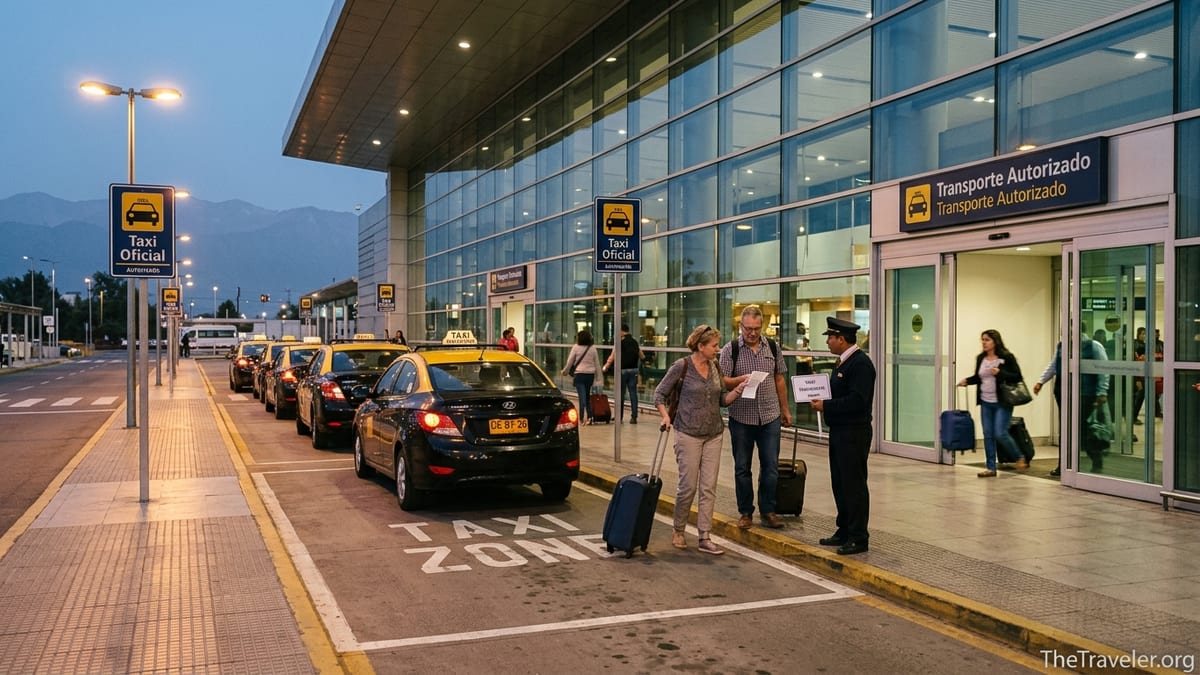
Official taxis and transfer vehicles should have visible identification. In Santiago, legal taxis are typically painted black with a yellow roof, with a municipal permit and license plate that match the documents carried by the driver. Many airport-contracted vehicles also display the company name on the doors or in the windshield, and drivers often wear badges or uniforms. If a car appears unmarked, lacks any company logo and the driver cannot show identification when asked, you should refuse the ride and return to the terminal to speak with staff at an official desk.
Common warning signs of an informal driver at SCL include people who approach you inside the terminal saying “taxi, taxi” or “cheap ride,” drivers who offer to beat the fixed price from the counters by a large margin, and cars waiting in random corners of the parking lot instead of at the marked pickup points. There have been anecdotal cases where visitors accepted such offers and later reported being overcharged heavily, sometimes paying almost double the typical official fare for a similar distance.
If you feel pressured or uncomfortable, you can step back into the terminal or walk toward a brighter, more crowded area. Airport security and Carabineros officers regularly patrol the curb and parking access roads, and they are used to assisting travelers who are unsure about a vehicle. You can simply say, “No estoy seguro si este taxi es oficial,” and they will usually direct you to the authorized pickup zones and counters.
Luggage, Groups and Late-Night Arrivals
Most visitors to Santiago arrive with at least one checked suitcase, and official taxis at the airport are prepared for this. Standard sedans can usually handle two to three checked bags plus hand luggage. If you are traveling as a couple or solo with typical vacation luggage, a regular taxi is normally sufficient. For families, ski trips to the Andes, or travelers with sports equipment, it is better to request a larger car or minivan at the counter so that all bags can be placed safely in the trunk or cargo area.
When you book, be honest about how many bags you have and whether any items are oversized, such as ski bags, surfboards or musical instruments. This helps the dispatcher assign an appropriate vehicle and avoids situations where the driver tries to charge extra at the curb because the luggage does not fit easily. If the counter agent suggests a van and you worry about cost, ask them to confirm the total price for your whole group, which often ends up cheaper per person than separate cars.
For late-night or early-morning arrivals, official taxis are often the most practical and safest option, especially if you are heading to residential neighborhoods where public transport is limited after midnight. Even when the airport is quiet, the counters inside usually remain staffed during periods of heavy international traffic. If you arrive very late and find fewer desks open, look for the ones still lit and operating, or ask airport information for which authorized provider is on duty overnight.
At night it is even more important to avoid drivers who approach you with unsolicited offers, as visibility is lower and there are fewer people around. Choose well-lit pickup areas close to the terminal doors, stay with your luggage at all times and wait until you can clearly identify your vehicle’s license plate and company markings. Many travelers value the peace of mind of having a pre-booked taxi or transfer waiting, particularly if they are arriving alone or with children after long flights from Europe or North America.
Booking Ahead, Apps and Alternative Options
Although you can safely arrange a taxi on arrival, some travelers prefer to book ahead to avoid decisions after a long flight. Many regulated providers serving Santiago Airport offer online booking or dedicated apps where you can schedule a pickup, input your flight number and receive a confirmation of the estimated fare. Services like ETAXI emphasize that they use fully regulated taxis and allow passengers to pay by card, while long-established transfer companies like TransVIP have both counters in the terminal and online reservation options.
Pre-booking can be especially useful if you are landing at a very busy time, such as national holidays, or if you are traveling in a group that needs a van. In those cases you can email your hotel in advance and ask which official service they recommend, or whether they have a trusted partner. Many hotels in central Santiago have set arrangements with specific airport taxi or transfer companies and can add the charge to your room or provide a receipt for business travel.
Some ride-hailing services also operate legally in Chile, and there have been reports of certain platforms obtaining authorization to serve the airport directly. Regulations and availability can change, so it is wise to check current guidance shortly before your trip. In any case, if you plan to use an app, make sure the app confirms the pickup location inside the official ground transport area, and always verify the driver’s name, plate and vehicle model before getting in. Avoid any driver who approaches you and asks you to cancel the app trip and pay in cash.
If you are traveling light and during daytime hours, you may consider shuttle buses from the airport to key transit hubs like the Pajaritos metro station. These buses are cheaper than taxis and popular with budget travelers and locals. However, if it is your first time in Santiago, if you are carrying multiple suitcases, or if you are arriving late at night, a regulated taxi booked through an official counter remains the safest and most straightforward option.
What to Expect During the Ride and On Arrival
Once you have booked your taxi at the counter, staff will either walk you to a nearby exit or give you clear instructions such as “salida 4” where a coordinator will direct you to the next available vehicle. Check that the car and driver match the ticket or card you were given. It is perfectly acceptable to double-check the destination verbally with the driver before the car leaves the curb.
The drive from the airport to central Santiago usually takes between 20 and 40 minutes depending on traffic and the location of your hotel or apartment. Much of the route is along highways and wide avenues. It is common for the driver to pass one or more toll points between the airport and the city, but for fixed-fare services these tolls are normally included in the price quoted at the counter. If you have any doubts, you can ask the driver at the start whether the tolls are included, using a phrase like “¿Está incluido el peaje en el precio?”
During the ride, keep your valuables like passports, electronics and cash in a small bag that stays on the seat beside you rather than in the trunk. This is less about distrust and more about practicality, particularly if you accidentally leave the vehicle in a hurry or misplace a receipt. Most airport taxi drivers in Santiago are used to foreign visitors and may offer basic conversation in English, but you are not expected to chat if you prefer to rest.
On arrival at your accommodation, make sure the car stops at a well-lit spot near the entrance. If you paid at the airport counter already, you usually do not need to exchange any money with the driver, though it is polite to offer a small tip in pesos if you were happy with the service. If payment is due at the end of the ride, confirm the total on the meter or on the driver’s handheld device, pay with your chosen method and keep the receipt. If something seems wrong with the amount, it is better to raise the question calmly on the spot than to leave unhappy.
The Takeaway
Santiago’s Arturo Merino Benítez Airport can feel hectic, but its taxi system is manageable and safe if you follow a few clear rules. Always book your ride at an official counter inside the terminal or through a verified app, confirm the total price before you leave, and ignore unsolicited offers from strangers. Official taxis and transfer services are regulated, identified and regularly inspected, making them far safer and more predictable than informal alternatives.
Expect to pay a fixed fare in the approximate range of 25,000 to 35,000 pesos for a standard taxi to many central neighborhoods, with higher prices for distant areas or larger vehicles. Payment by card at the counter is widely accepted and recommended, and standard luggage is typically included. For late arrivals or first-time visitors, arranging a regulated taxi or transfer is often the simplest way to reach your accommodation without stress.
By understanding where the counters are located, how prices work and what a legal taxi looks like, you can step out of Santiago Airport with confidence. That means beginning your time in Chile focused on the Andes skyline, the food and the culture, rather than worrying about whether you chose the right ride into town.
FAQ
Q1. Where exactly can I find official taxi counters at Santiago Airport?
Official taxi and transfer counters are located just after you exit customs into the arrivals hall, before you fully reach the public crowd, with branded desks on both sides of the corridor.
Q2. How much does an official taxi from SCL to downtown Santiago usually cost?
Recent travelers typically report fixed fares in the approximate range of 25,000 to 35,000 Chilean pesos for a standard car to central areas, depending on distance and time.
Q3. Can I pay for my airport taxi by credit card?
Yes. Most official airport taxi and transfer counters accept major credit and debit cards, and paying at the counter by card is one of the safest options.
Q4. Are taxis from Santiago Airport safe at night?
Official taxis and transfers booked inside the terminal are generally considered safe at night. Late arrivals should avoid informal offers and use only regulated services with visible identification.
Q5. How do I recognize a legal taxi at Santiago Airport?
Legal taxis usually have black bodies with yellow roofs, official license plates, company markings or logos and drivers who can show identification or wear uniforms linked to airport providers.
Q6. Do official taxis charge extra for luggage?
For fixed-fare trips from the airport, normal suitcases and hand luggage are usually included. You may pay more only if you request larger vehicles for big groups or oversized items.
Q7. Should I pre-book a taxi or is it fine to arrange one on arrival?
Both are possible. Many travelers simply book at the counters on arrival, while others pre-book online or through hotel partners, which can be useful at very busy times or late at night.
Q8. Are ride-hailing apps allowed to pick up passengers at Santiago Airport?
Some app-based services operate legally, but rules and access can change. If you use an app, always confirm the official pickup point and verify the driver and vehicle details before boarding.
Q9. What should I do if an unofficial driver approaches me in the arrivals area?
Politely decline, walk toward the official counters or information desk and, if necessary, ask airport staff or security to direct you to authorized taxis or transfers.
Q10. Is it better to take a taxi or the bus from Santiago Airport?
Buses are cheaper and work well for light daytime travel to transit hubs, but official taxis or transfers are usually safer and more convenient for first-time visitors, heavy luggage or late-night arrivals.