


Providencia is one of Santiago’s most convenient areas for visitors, with major business towers, consulates, restaurants and mid to upscale hotels clustered around key metro stations. Whether you are landing at Arturo Merino Benítez International Airport (SCL) for meetings near Costanera Center or checking into a boutique hotel off Avenida Pedro de Valdivia, choosing the right route into town will save both time and stress. This guide compares official airport taxis, Uber and Cabify, shared and private transfer vans, and the airport bus plus metro combination, with practical examples tailored to business travelers and tourists, including advice for heavy traffic and late-night arrivals.
Get the latest updates straight to your inbox!
Understanding the Route: SCL to Providencia
Arturo Merino Benítez International Airport sits roughly 20 to 25 kilometers northwest of Providencia, depending on your exact hotel address. In normal traffic, a direct drive to areas like Metro Tobalaba, Los Leones or Pedro de Valdivia takes about 25 to 35 minutes. At peak rush hour on weekdays, particularly between 7:30 and 9:30 in the morning or 5:30 and 8:00 in the evening, the same trip can stretch to 45 minutes or more as the main highways into the city slow down near central Santiago.
Most routes from the airport to Providencia use the Costanera Norte expressway, then connect to streets such as Av. Andrés Bello or Av. Providencia. For example, a taxi heading to a hotel next to Costanera Center, such as one of the large business hotels surrounding the mall, will usually come in on Costanera Norte, exit near Tobalaba or La Concepción, and continue along the Mapocho river on Andrés Bello before turning into the local grid. For a smaller hotel closer to Metro Manuel Montt, drivers often exit a little earlier or later and cut through local streets like Condell or Antonio Varas.
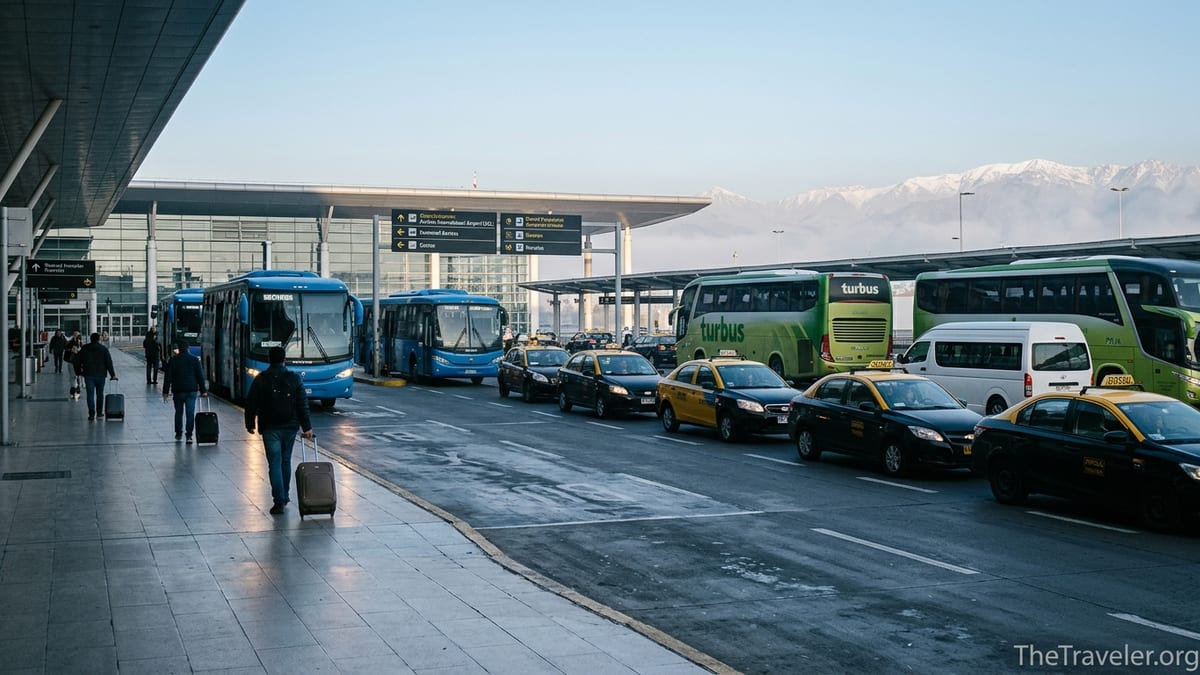
Because there is no metro station directly at the airport as of 2026, every public transport option involves at least one leg by road. The blue Centropuerto and green TurBus Aeropuerto coaches connect the airport’s bus terminal to major metro and bus hubs such as Pajaritos, Los Héroes and Alameda, from where you continue into Providencia by metro or connecting bus. Business travelers staying close to Line 1 stations like Tobalaba, Los Leones, Pedro de Valdivia or Manuel Montt can expect one straightforward transfer from bus to metro before walking a few blocks to their hotel.
When planning your arrival, it helps to think in terms of budget, luggage and schedule. A solo traveler with a small suitcase landing at midday may be perfectly comfortable taking the airport bus to Pajaritos, then Line 1 metro into Providencia. A team of colleagues arriving with multiple checked bags and laptops for meetings at one of the glass towers on Apoquindo, on the other hand, will almost always be better off arranging an official taxi or pre-booked van that drops them directly at their office entrance or hotel driveway.
Official Airport Taxis: Simple and Predictable
Official taxis are the most straightforward option from SCL to Providencia, particularly after a long-haul flight or if you do not speak Spanish confidently. Inside the arrivals hall you will find several official taxi counters offering both metered taxis and fixed-fare services. Many travelers opt for the fixed-fare option to avoid worrying about traffic variability; you simply state your destination zone, pay at the counter and receive a voucher before being guided to your car outside.
Fares change over time, but recent examples shared by travelers suggest a typical fixed fare to central neighborhoods such as Providencia or nearby Las Condes often falls somewhere in the equivalent of 25 to 35 US dollars, depending on exchange rate and the specific provider. In practice, that might mean paying around 22,000 to 30,000 Chilean pesos for a sedan-sized vehicle to a hotel near Costanera Center or a serviced apartment by Metro Los Leones. For larger groups or heavy luggage, you can request a larger vehicle or taxi van at the counter, which increases the price but is often still economical when split between three or four people.
One advantage of official taxis is their clear, legal status at the airport. Drivers are registered and operate from designated ranks right outside the terminal. This removes the need to walk to parking lots or follow complicated app instructions while tired. For business travelers carrying laptops and important documents, that sense of order and traceability is often worth the premium over more improvised solutions. A typical executive arriving on a morning flight from São Paulo, for example, can be in a taxi within 10 to 15 minutes of clearing customs, heading straight to a meeting near Metro Tobalaba with no need to handle local cash on the spot if they have pre-paid at the counter.
As in many airports, you will likely see some informal drivers inside the terminal offering rides. For safety and predictability, it is strongly recommended to ignore these offers and use only the official counters or clearly marked taxi ranks. Sticking to official providers is especially important if you arrive very late or are traveling alone, as they maintain formal complaint channels and have a visible presence inside the airport building.
Uber, Cabify and App-Based Rides: Comfort with Caveats
Ride-hailing apps such as Uber, Cabify, DiDi and similar services operate widely in Santiago and are popular for moving around the city, including the Providencia business district. However, their status at the airport is more complex. Cabify has an official concession to operate at SCL, offering both private vehicles and shared vans that you can book through the app or at counters in the arrivals area. Uber and some other platforms are active in practice, but they do not hold the same official position inside the terminal, which affects where and how you meet your driver.
In recent first-hand reports, travelers describe using Uber or non-official app cars by walking to the airport’s parking areas or designated ride-share meeting points, rather than being picked up directly outside the terminal doors. For instance, a visitor landing late in the evening might request an UberX in the app and be instructed to meet near a specific parking row or elevator bank instead of the main curb. This can work well if you already know the airport layout or are comfortable following the map inside the app, but it may feel confusing if you are jet-lagged or juggling luggage and family members.
Cabify’s official airport service, by contrast, is designed to be as straightforward as a traditional taxi. You can pre-book a private ride to a Providencia address such as a hotel on Av. Providencia near Metro Manuel Montt, or join a shared van where you travel with other passengers heading to central neighborhoods like Providencia, Las Condes or Ñuñoa. Travelers describe walking to the Cabify desk in the arrivals hall, paying there, being told where to wait just outside, and being escorted to a van within roughly 10 to 20 minutes. For a solo traveler willing to share, the per-person cost of a shared van is often significantly lower than a private taxi while still delivering door-to-door service.
Using ride apps also provides price transparency before you commit. On a typical weekday afternoon, a quoted UberX fare from the airport to a mid-range hotel near Metro Los Leones might appear in the range of 15,000 to 25,000 pesos, fluctuating with traffic and demand. Cabify and DiDi often display similar ranges. Price surges can occur during storms, peak commuting hours or major events, which might push prices above official taxi rates. Business travelers who value receipts in a specific format or who must comply with corporate travel policies may prefer Cabify’s official airport service or pre-arranged transfers, both of which can issue formal receipts in Chilean pesos suitable for expense reports.
Transfer Vans and Shuttles: Good for Groups and Budgets
Shared and private transfer vans are a middle ground between the flexibility of a private car and the low cost of the airport bus. Providers such as Transvip, Cabify’s van service and other official airport partners offer counters inside the arrivals area, where you can walk up, provide your destination in Providencia and be assigned to either a shared or private vehicle. Websites and apps also allow advance booking, which can be reassuring if you land late or during busy holiday periods.
For example, a family of four arriving from North America with two large suitcases and two smaller bags might choose a shared van service to an apartment near Plaza Pedro de Valdivia. Instead of juggling children and luggage on the bus and metro, they pay a per-person rate at the counter and wait while the provider groups them with other passengers headed in the same general direction. The van might first drop travelers at hotels near the civic center downtown, then proceed to Providencia, reaching the apartment an hour or so after leaving the airport depending on how many stops are involved.
Private vans are particularly attractive for small corporate groups. A regional sales team flying in for meetings at an office tower near Metro Tobalaba can pre-book a private van that seats eight to ten people, ensuring everyone and their presentation materials arrive together. The per-person cost often compares favorably with ordering multiple taxis or ride-hail cars, and the group benefits from centralized coordination. The driver meets them at a specified meeting point, often with a sign or via a pre-agreed WhatsApp contact, and drives directly to the office entrance or the business hotel lobby.
Operational details such as precise prices and waiting times vary with provider and season, so it is wise to check current conditions shortly before travel. As a general pattern, shared vans are slower but cheaper per person, while private vans and shuttles offer a good balance of comfort, predictability and total cost for business groups, large families or travelers carrying equipment like camera gear or trade-show materials.
Airport Bus plus Metro: Cheapest for Light Luggage
The airport buses, mainly Centropuerto and TurBus Aeropuerto, provide the most economical structured route from SCL into the city. Both use a dedicated bus terminal area between the international and domestic terminals. Buses run frequently during the day, typically every 10 to 15 minutes at busy hours, and less often very late at night or early in the morning. You can pay in Chilean pesos with cash or card at the sales counters, and recent published ticket prices indicate that a one-way bus fare is only a few thousand pesos, often equivalent to less than 3 or 4 US dollars at recent exchange rates.
Centropuerto and TurBus follow slightly different routes, but both connect the airport to downtown and the wider Santiago transport network. Centropuerto’s main corridor includes stops at Pajaritos and Los Héroes. Pajaritos is particularly important if you plan to jump directly onto Line 1 of the metro, which runs east to west across Santiago and serves key Providencia stations such as Salvador, Manuel Montt, Pedro de Valdivia, Los Leones and Tobalaba. A typical budget-conscious traveler might take Centropuerto from the airport to Pajaritos, walk upstairs to the metro platforms, tap a prepaid Bip card at the gate, and ride Line 1 east to Pedro de Valdivia before walking five to ten minutes to a guesthouse on a quiet side street.
The metro fare is separate from the bus ticket and varies slightly by time of day. As of early 2026, adult metro fares generally sit under 1,000 pesos per ride, with off-peak periods slightly cheaper and rush-hour periods slightly more expensive. To use the metro, you need a rechargeable Bip card, which you can buy and top up at staffed metro stations such as Pajaritos or Los Héroes; the same card also works on city buses. If you are staying in Santiago for several days of sightseeing or meetings, purchasing a Bip card on your first ride into town will make moving around Providencia much easier.
For tourists and backpackers with light luggage, the bus plus metro combination is an excellent way to get a feel for the city immediately and keep costs very low. The trade-off is that you must handle stairs, crowds and occasional platform congestion, particularly on weekdays around 8:00 to 9:00 in the morning or 6:00 to 7:30 in the evening. Rolling suitcases fit on the bus and metro without issue, but very large or multiple bags can make the journey uncomfortable, and you will need to keep close watch on your belongings, as you would in any busy urban transit system.
Traffic Patterns, Timing and Choosing the Right Route
Santiago’s traffic is variable but broadly predictable. On weekdays, the morning rush toward the city tends to build between about 7:30 and 9:30, and the evening rush heading back out of central districts peaks from roughly 5:30 to 8:00. If your flight lands at 8:00 in the morning on a Tuesday and you are staying near Metro Tobalaba, a taxi or app-based ride may take 45 minutes or more, especially if there is rain or an incident on Costanera Norte. The same trip on a Sunday morning typically takes closer to 25 minutes with very light traffic.
For business-travel planning, a conservative rule is to allow 1 to 1.5 hours door to door from the airport to Providencia during peak times, including time to clear immigration and customs. For example, if you are scheduled to present at a conference in a hotel ballroom near Costanera Center at 11:00, aim for flights landing no later than 8:30, and consider pre-booking a taxi or private car with a meet-and-greet service. That way, even with a line at passport control and some congestion on the expressway, you have a comfortable buffer.
The bus plus metro route is less sensitive to highway traffic until you reach Pajaritos, but you will feel crowding on the metro during rush hours. A traveler landing at 7:00 on a weekday morning who takes Centropuerto at 7:30 may reach Pajaritos around 8:00, just as Line 1 is approaching peak density. In those conditions, boarding with large bags can be difficult, and it might be worth waiting for a less crowded train or switching plans to a taxi or ride app from Pajaritos instead of continuing underground.
Weather also plays a role. In the dry winter months when Santiago can experience fog and rain, travel times on the expressways may lengthen, and drivers can be more cautious. Summer heat, by contrast, rarely affects schedules, although air conditioning in some vehicles and buses varies in strength. When timing is critical, for example catching a video call from a hotel room not long after landing, prioritize direct, pre-booked transport over the cheapest alternatives to reduce uncertainty.
Hotel Zones and Practical Drop-Off Points in Providencia
Providencia is a long, narrow commune stretching from the edge of the historic center eastward toward the more modern business districts. For visitors, the most relevant zones lie along and around Line 1 of the metro. The Tobalaba and Los Leones area, near the Costanera Center complex and many corporate offices, is a prime business location. Here you will find large chain hotels, serviced apartments and office towers, all with easy access to the metro and main roads. Taxis and ride-share drivers typically drop passengers on streets such as Encomenderos, Roger de Flor or Nueva Tobalaba, which are one-way and can be busy during office hours but are well known to professionals who drive this route daily.
Further west, the Pedro de Valdivia and Manuel Montt zones are popular with tourists and independent travelers. These areas feature mid-range hotels, boutique properties in converted houses and a lively restaurant scene along streets like Manuel Montt, Condell and Román Díaz. For a visitor staying in a guesthouse a few blocks south of Av. Providencia, a taxi or Cabify driver may prefer to drop on the main avenue and let you walk the last block or two rather than navigating narrower residential streets; if you are carrying heavy luggage or have mobility needs, it is worth clearly stating that you need door-to-door drop-off when you book or when you speak to the driver.
At the western edge of Providencia closer to Baquedano and the border with Bellavista, there are additional lodging options that appeal to travelers interested in nightlife and cultural attractions. Here the streets can be narrower and busier with pedestrians in the evenings. Some hotels near Parque Bustamante or Plaza Italia provide their guests with specific taxi directions or suggested drop-off intersections, such as “corner of Merced and Vicuña Mackenna,” to make arrivals smoother. Whatever your final address, it helps to keep a screenshot of your hotel name and address in Spanish, including the commune name “Providencia,” to show drivers who may not speak much English.
For business travelers with early meetings, consider choosing a hotel within easy walking distance of the closest metro station and on a relatively quiet side street. This allows you to use taxis or ride apps at arrival and departure, while relying on the metro for predictable cross-town travel during your stay. For instance, staying in a hotel one block off Av. Apoquindo near Metro Tobalaba or just behind Av. Providencia near Metro Los Leones gives you quick access to both corporate offices and the wider city without needing a car for every trip.
Late-Night and Early-Morning Arrivals: Safety and Service Hours
Many long-haul flights to Santiago land late at night or very early in the morning. If you arrive around or after midnight, your transport priorities shift slightly. Safety and the availability of services take precedence over saving a few thousand pesos. While Centropuerto and other buses may operate limited night schedules, frequencies are lower and the connection to the metro is not immediately useful because the metro system typically closes around midnight and reopens early in the morning.
In these off-peak hours, official taxis, pre-booked private cars and official shared vans inside the terminal become the most practical solutions. Travelers have reported taking pre-arranged services such as Transvip or Cabify’s airport vans at 1:00 or 2:00 in the morning without difficulty, with representatives waiting inside the terminal even when shops are closed. Arranging these services before your trip ensures that, even if your flight is delayed, you have a confirmed booking that can be adjusted to your new arrival time within a certain flexibility window.
Using ride-hailing apps informally at night is possible in practice, but there are trade-offs. Because some platforms are not officially recognized within the immediate curbside area, drivers may ask you to walk to parking lots or less supervised areas for pickup. While many travelers do this without incident, it is a less controlled environment than the taxi ranks just outside the terminal doors. If you are traveling alone, are unfamiliar with the city, or are carrying visible valuables like camera equipment or laptops, sticking to clearly signposted, official providers is advisable.
Hotel front desks in Providencia are accustomed to late check-ins and can also assist with onward transport. If your flight lands very late and you are concerned about language barriers, consider emailing your hotel in advance to ask whether they can arrange a car service. Sometimes this means they simply book one of the same official providers on your behalf, but it ensures the driver knows your exact hotel and that the front desk expects your arrival around a certain time.
The Takeaway
Getting from Santiago’s airport to Providencia is straightforward once you match your transport choice to your budget, schedule and comfort level. Official taxis and airport-contracted services like Cabify’s vans and Transvip provide the smoothest, most predictable experience, especially if you arrive during off-peak hours or on a tight schedule for business meetings. They cost more than the bus plus metro combination but deliver door-to-door convenience and formal receipts.
The airport buses, linked with Santiago’s efficient metro, are ideal for budget travelers, solo tourists and backpackers with light luggage who arrive during the day and want an immediate taste of local daily life. By connecting through hubs like Pajaritos and riding Line 1 to stations such as Los Leones or Pedro de Valdivia, you can reach most hotel areas in Providencia at a fraction of the cost of a private car.
Ride-hailing apps remain a flexible tool once you are in the city, but their use at the airport involves some extra logistics. Cabify’s official presence streamlines things, while other apps may require more walking and coordination. In all cases, planning ahead, carrying your hotel details in Spanish and allowing generous time buffers during rush hour will make your first journey into Providencia, whether for work or leisure, a smooth start to your stay in Santiago.
FAQ
Q1. How long does it usually take to get from Santiago Airport to Providencia?
In normal traffic, a direct drive from the airport to most areas of Providencia takes around 25 to 35 minutes. During weekday rush hours or in bad weather, it is safer to assume 45 minutes or more, especially if you are heading to busy business zones near Costanera Center or Metro Tobalaba.
Q2. What is the easiest option if I arrive late at night?
If you land around or after midnight, the easiest and safest options are official airport taxis or pre-booked services such as Cabify’s official vans or other authorized shuttles operating inside the terminal. These providers maintain desks in the arrivals area, and staff will guide you directly to your vehicle without needing to walk to distant parking lots.
Q3. Is Uber allowed to pick up passengers at Santiago Airport?
Uber and other ride-hailing apps do operate in Santiago, and many travelers use them to and from the airport, but they do not have the same official status inside the terminal as providers like Cabify. In practice this often means meeting your driver in designated parking areas rather than directly at the curb, following instructions in the app. Cabify, by contrast, has an official airport concession and can coordinate pickups from inside the arrivals area.
Q4. How much should I expect to pay for a taxi from the airport to Providencia?
Prices vary with provider and exchange rates, but a typical fixed fare with an official taxi from SCL to central Providencia often falls in a band roughly equivalent to 25 to 35 US dollars. The exact amount in pesos will change over time, but you can expect something in the range of low to mid tens of thousands of pesos for a standard sedan, with higher prices for larger vehicles or premium services.
Q5. Is the airport bus plus metro safe for solo travelers?
The airport buses and Santiago’s metro are widely used by locals and visitors and are generally considered safe during operating hours, especially in the daytime. As a solo traveler you should take the usual big-city precautions: keep your bags close, avoid displaying valuables and stay aware of your surroundings, particularly at busy stations like Pajaritos and on crowded Line 1 trains during peak times.
Q6. Can I pay for transport with a credit or debit card?
Many official taxi counters, bus companies and shuttle providers inside the airport accept international credit or debit cards, although acceptance can vary by terminal area and network. The metro and city buses require a rechargeable Bip card, which you can buy and top up with cash or card at major stations such as Pajaritos or Los Héroes. It is still useful to carry some Chilean pesos, especially for small purchases or in case a card terminal is offline.
Q7. Which Providencia area is best for business travelers?
Business travelers often prefer the eastern end of Providencia near Tobalaba and Los Leones, close to the Costanera Center complex and major office towers along Apoquindo and Andrés Bello. This area offers large chain hotels, modern serviced apartments and quick access to Line 1 of the metro, making it easy to attend meetings in both Providencia and neighboring Las Condes.
Q8. How do I buy a Bip card for the metro when coming from the airport?
If you take the airport bus into the city, the simplest option is to get off at Pajaritos or another major interchange and look for the metro station ticket office. There you can buy a Bip card for a small initial cost and load credit onto it. Once you have the card, you tap it at metro gates and on city buses throughout your stay in Santiago.
Q9. Are shared airport vans a good option for families?
Shared airport vans are often an excellent option for families, especially those with children and multiple suitcases. Services like Transvip and Cabify’s vans offer a per-person fare that is usually cheaper than booking multiple taxis, while still providing door-to-door service to apartments or hotels in Providencia. The main trade-off is travel time, as the van may make several stops before reaching your accommodation.
Q10. Should I pre-book my transfer or decide on arrival?
Pre-booking is recommended if you arrive very late, during a busy travel season, or on a tight business schedule. Having a voucher or reservation number in hand reduces stress and ensures a car or van is waiting for you. If you land in the middle of the day with no time pressure, it is reasonable to compare options at the airport, such as walking up to an official taxi counter, a shuttle desk or the bus terminal and choosing based on current prices and queues.