


More news on this day
Nearly 1,500 flights have been cancelled across Saudi Arabia since October 10 after a series of missile and drone attacks on major airports, severely disrupting domestic and international travel at the height of the autumn pilgrimage and business season.
Get the latest news straight to your inbox!
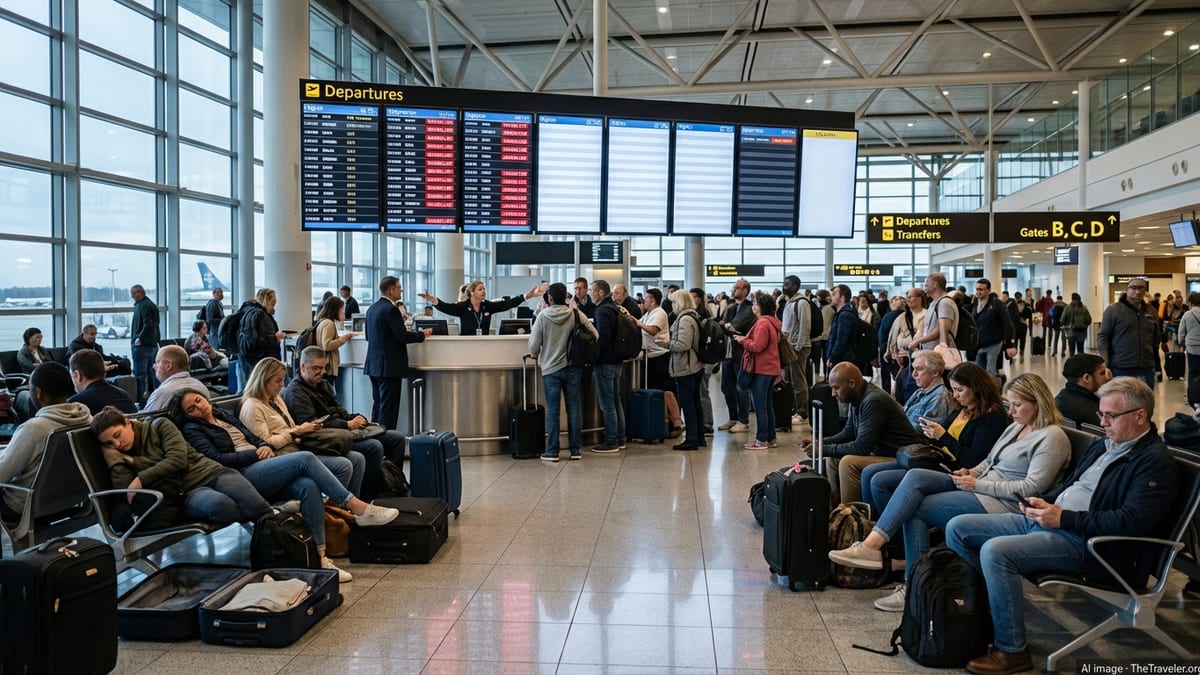
Wave of attacks shuts key Saudi aviation hubs
Published coverage indicates that the disruption began on October 10, when a missile strike on a passenger terminal at Riyadh’s King Khalid International Airport killed at least a dozen people and wounded hundreds more, forcing all flights to be diverted or cancelled. In the days that followed, additional projectiles reportedly hit parts of the Riyadh complex and other aviation facilities, turning the normally busy hub into a largely empty sky.
Analyses of aviation data show that on October 11 Riyadh cancelled virtually all scheduled movements, with one report citing a 99.7 per cent cancellation rate for departures and arrivals. Air-traffic tracking platforms and aviation consultancies describe a cascading effect as airlines halted services into the capital and Saudi authorities restricted operations while safety inspections and damage assessments took place.
The attacks were not confined to Riyadh. Industry briefings and local media reports state that Jeddah’s King Abdulaziz International Airport on the Red Sea and Dammam’s King Fahd International Airport in the Eastern Province have also faced temporary shutdowns, delays and diversions following separate incidents and heightened security alerts. Together, the three gateways handle the bulk of the kingdom’s international traffic and a large share of religious pilgrimage journeys.
Across the network, figures cited by travel and passenger-rights platforms suggest that close to 1,500 flights were cancelled between October 10 and 12, with more than 1,600 additional services delayed. The General Authority of Civil Aviation has released partial tallies confirming extensive disruption across at least 16 commercial airports, while further cancellations have already been filed for October 14.
International airlines suspend Saudi routes
The shock to Saudi aviation has rippled rapidly through global airline networks. According to data compiled by aviation analysts and financial news services, several European carriers have halted flights to Riyadh for at least a week, with some extending suspensions until the end of October as they reassess the risk profile of Saudi airspace.
Reports indicate that Lufthansa Group has cancelled all Riyadh services until October 16, while Air France and its partners have paused routes to the Saudi capital for a longer period. A planned launch of a new long-haul route by a major North American airline has been postponed until March 2027, reflecting concerns around both security and traveler demand.
Carriers from the Gulf and wider Middle East are also adjusting schedules. Coverage in regional business outlets shows that Etihad Airways has cancelled all flights between Abu Dhabi and Riyadh until at least October 19 and has trimmed frequencies to Jeddah and Dammam. Low-cost and regional operators based in the United Arab Emirates and Bahrain have listed multiple cancellations on routes to secondary Saudi cities, while some South and Southeast Asian airlines have suspended certain Jeddah and Riyadh rotations used heavily by migrant workers and pilgrims.
The uncertainty extends to connecting traffic. Booking advisories from online travel agencies and frequent-flyer forums note that some itineraries previously routed through Riyadh are being rebooked via Jeddah, Dammam or non-Saudi hubs, often at short notice. Passengers are being urged in public advisories to verify their flight status directly with airlines and not to proceed to the airport without written confirmation of operating services.
Pilgrim and expatriate travel hardest hit
The timing of the attacks has compounded their impact. The disruptions have struck during a busy period for Umrah, the non-obligatory pilgrimage that attracts visitors to the holy cities of Mecca and Medina throughout the year. Many groups from Europe, North America, South Asia and Africa transit through Jeddah or Riyadh on package itineraries booked months in advance, with tightly coordinated hotel and ground-transport arrangements.
Regional travel media report that hundreds of Bangladeshi nationals found themselves stranded in Riyadh after the first major strike, with onward flights cancelled and alternative routes in short supply. Similar stories have emerged for pilgrims and workers from India, Pakistan and North African countries, many of whom hold non-refundable accommodation bookings in Mecca or contracts that require them to report for work on fixed dates.
Saudi residents and expatriates are also grappling with sudden changes to travel plans. Social-media posts and expatriate forums describe families postponing leisure trips, students struggling to reach universities abroad, and workers rerouting through alternative Gulf or Turkish hubs, sometimes at significant additional cost. Travel advisers caution that while some airlines are offering fee-free changes or refunds, others are applying standard fare rules, leaving passengers dependent on individual carrier policies.
For those still determined to travel into the kingdom, Jeddah appears to be absorbing some of the displaced demand as its operations remain more stable than Riyadh’s, although delays and schedule changes are widely reported. Medina’s Prince Mohammad bin Abdulaziz Airport, further from the main areas of tension, is also being used as an alternative entry point for certain pilgrimage itineraries.
Safety notices and airspace warnings for overflights
The disruption is not limited to point-to-point travel into Saudi Arabia. Notices to air missions issued by international regulators and summarized in aviation-industry publications warn that attacks on airport infrastructure raise broader questions about the safety of overflights at various altitudes. A recent bulletin from a major Western aviation authority cautioned that missile and drone activity could pose potential risks throughout all phases of flight, including aircraft transiting Saudi airspace without landing.
In response, some non-Saudi carriers appear to be adjusting routings on flights between Europe, Asia and Africa, lengthening flight times slightly in order to keep a wider margin from areas of perceived risk. Analysts note that while large parts of Saudi airspace remain technically open, corporate security departments and pilot unions often take a conservative stance in volatile environments, especially when civilian infrastructure has already been struck.
Diplomatic missions are also updating their guidance. A recent alert from the United States mission in Saudi Arabia, for example, advised citizens that further attacks on airports were possible and highlighted the likelihood of sudden airspace closures, service suspensions and diversions. The alert recommended that those already in the country maintain flexible itineraries and stay in close contact with their airlines for real-time updates.
Travel-insurance and passenger-rights organizations stress that travelers should retain all documentation related to cancellations and delays, including written confirmation from airlines about the cause of disruption. Such records can be important when seeking refunds, alternative transport, or compensation where applicable under local or international aviation rules.
What travelers should expect in the coming days
Looking ahead, aviation analytics firms cited in regional business reports anticipate further cancellations in the short term, particularly on services touching Riyadh. Data for October 14 already show several hundred flights scrubbed in advance, as airline schedulers factor in ongoing security checks, damage repair and crew-rostering challenges arising from aircraft and staff stranded in the wrong locations.
Domestic connectivity within Saudi Arabia is under strain, especially for routes linking regional cities to the three main hubs. Nonetheless, operations at some secondary airports, including Gassim, appear relatively less affected, with only a small proportion of scheduled flights cancelled so far. Travelers with flexibility are being advised by travel agents to consider itineraries using such airports, while recognizing that onward ground transport times and costs may be higher.
For international visitors, observers say the most prudent approach over the next week is to build in extra time and contingency plans. This may include booking fully flexible tickets where possible, ensuring that accommodation can be changed without heavy penalties, and monitoring both airline channels and official travel advisories on a daily basis. Those whose trips are not time-sensitive may find it simpler to postpone travel until there is clearer visibility on airport security and flight schedules.
Saudi Arabia’s long-term aviation ambitions, including its drive to develop Riyadh as a major global transfer hub and expand religious tourism, face a significant test as the kingdom works to restore confidence in the safety and reliability of its air gateways. How quickly flight schedules stabilize, and whether further attacks occur, will shape traveler sentiment and airline planning in the weeks ahead.