


More news on this day
Saudi Arabia’s busiest airports are grappling with a fresh aviation shock, as 248 flight cancellations and 575 delays in a single 24 hour period ripple through Riyadh, Jeddah and Dammam, stranding travelers and amplifying wider Middle East disruption linked to the Iran war and regional airspace congestion.
Get the latest news straight to your inbox!
Major Saudi Hubs Buckle Under Regional Pressure
Publicly available flight tracking data and regional media coverage indicate that flight operations at King Khalid International in Riyadh, King Abdulaziz International in Jeddah and King Fahd International in Dammam have come under acute strain, with hundreds of services disrupted in what travelers are describing as a rolling aviation crisis for summer 2026. The tally of 248 cancellations and 575 delays captures only a snapshot of a wider pattern of irregular operations affecting domestic connectors and long haul routes alike.
The disruption follows months of mounting stress on Gulf aviation as airspace closures, missile alerts and shifting military corridors reshape traditional east west routes. Analysis by aviation consultancies and policy groups has highlighted Saudi Arabia’s role as one of the remaining large corridors for commercial traffic after repeated shutdowns and capacity reductions at airports elsewhere in the region, placing additional burden on the kingdom’s air traffic control and ground infrastructure.
Saudi Arabia’s own network has grown rapidly in recent years, with official statistics showing rising movements through Riyadh, Jeddah and Dammam. That growth, combined with an extraordinary summer of geopolitical tension, has left airlines operating on thinner margins for delay recovery. When weather issues, security checks or crew scheduling problems arise, knock on effects are more likely to cascade into widespread cancellations.
Regional news coverage and travel advisories from foreign governments have repeatedly warned of the potential for sudden timetable changes in and around Saudi Arabia, particularly on routes skirting conflict areas or overflying contested airspace. In practice, this has translated into rolling timetable revisions that are often only visible to passengers a few hours before departure.
Iran War Fallout and Airspace Bottlenecks
The latest wave of cancellations and delays is unfolding against the backdrop of the Iran war that began in late February 2026, which has reshaped commercial routes across the Middle East. Research on the conflict’s economic impact notes that multiple key air corridors have been closed or heavily restricted, forcing airlines to adopt longer routings, burn more fuel and tighten crew schedules as they detour around high risk zones.
Strategic analysis from transport and consulting firms points out that with several hubs either damaged or operating at reduced capacity, Saudi airspace has emerged as one of the few remaining large scale east west pathways still broadly available for civil aviation. While this has kept a substantial volume of flights moving through the kingdom, it has also contributed to congestion in Saudi skies and at its main terminals, increasing the likelihood of stack holding, missed slots and missed connections when conditions deteriorate.
Corporate alerts from global logistics providers and tax and mobility advisers in recent months describe Saudi Arabia as simultaneously a critical transit corridor and a pressure point in its own right, with references to saturated air traffic control, selective delays and a fluid operational environment. These assessments align with the spike in irregular operations now visible on passenger services, particularly those feeding into and out of Riyadh and Jeddah.
The broader regional picture has also weighed on Saudi schedules. Airspace disruptions in neighboring Kuwait, Bahrain and the United Arab Emirates have displaced traffic and diverted aircraft into Saudi airports at short notice, complicating gate allocation, ground handling and crew planning. This interdependence means that a closure or missile alert hundreds of kilometers away can still translate into longer queues and rolling delays inside Saudi terminals.
Traveler Experience: Crowded Terminals and Missed Connections
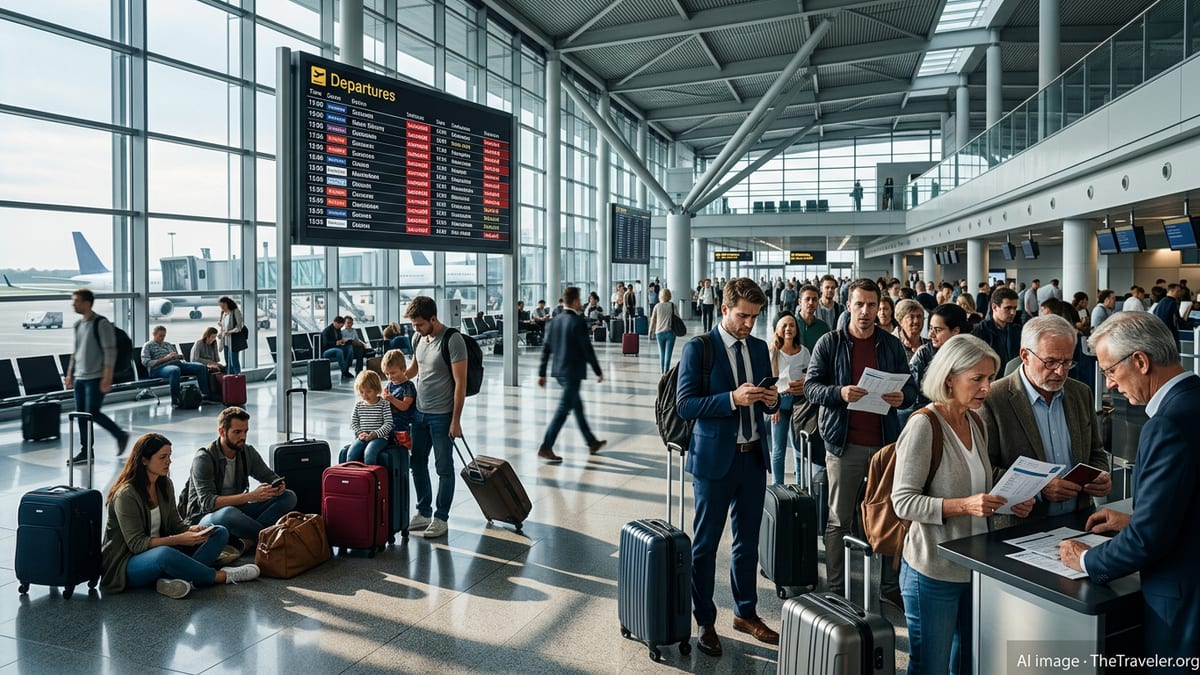
For passengers, the statistics of 248 cancellations and 575 delays have translated into crowded departure halls, rebooking lines and overnight stays in airport hotels. Domestic Saudi travelers connecting between Riyadh, Jeddah and smaller cities report longer processing times at check in and security, as well as last minute gate changes and boarding holds when incoming aircraft arrive late from disrupted routes.
Earlier in the summer, travel reporting from within the kingdom documented days where dozens of domestic and regional services in and out of Riyadh and Jeddah ran significantly behind schedule, with some flights cancelled outright after lengthy waits. Those episodes highlighted how quickly terminal congestion can build when several departures slip outside their assigned slots, stretching seating capacity, food and beverage outlets and onward ground transport connections.
Social media posts and consumer advice columns have since urged travelers to allow extra time at Saudi airports, travel with flexible tickets where possible and keep a close eye on airline apps. Some travel insurers have updated guidance to emphasize the importance of documenting delays and maintaining receipts for hotels and meals in case of later compensation or claims, particularly on itineraries that touch multiple Gulf hubs.
For those transiting Saudi Arabia on long haul journeys between Asia, Europe and Africa, the combination of regional airspace disruption and local congestion has increased the risk of missed connections. Long queues at immigration or transfer security can erase what once seemed like comfortable layover windows, especially on days when arrival banks from multiple carriers coincide.
Official Guidance and What Passengers Can Do
Foreign travel advisories, including recent updates from European governments, now caution that flights to and through Saudi Arabia and neighboring states may be subject to sudden schedule changes, periodic airspace closures and route diversions. Publicly available documents advise travelers to monitor local developments closely, register with consular services when appropriate, and maintain contingency plans for extended stays if onward connections fail.
Global courier and logistics companies, in their supply chain bulletins, similarly describe the situation in Saudi Arabia as fluid, citing selective delays at major airports while noting that core infrastructure remains operational. These notices stress that airline schedules and routings can change at short notice as carriers react to evolving security assessments and air traffic control instructions.
For individual passengers, practical steps include regularly checking flight status on airline websites or mobile apps, opting in to SMS or email alerts, and verifying terminal and gate information before leaving for the airport. Where possible, travelers can also reduce exposure by avoiding extremely tight connections in Riyadh, Jeddah or Dammam, particularly when itineraries involve onward legs crossing or skirting conflict zones.
Consumer advocates recommend that passengers familiarize themselves with the relevant passenger rights framework for their itinerary, which may involve Saudi regulations as well as protections from the airline’s home jurisdiction. Keeping records of boarding passes, delay notifications and incidental expenses can be important if a claim is later filed for compensation or reimbursement.
Outlook for Saudi Aviation in a Volatile Region
While the immediate focus for travelers is on getting to their destinations, the current episode of 248 cancellations and 575 delays also raises broader questions about resilience in Saudi Arabia’s aviation system. The kingdom has ambitious plans to grow its aviation and tourism sectors significantly in the coming years, including major airport expansion projects and the launch of new carriers.
Analysts note that the present crisis is testing how existing infrastructure and operational frameworks cope under stress, from air traffic management and contingency routing to passenger handling and communication. The experience of summer 2026 may accelerate investment in additional runway capacity, terminal upgrades and digital tools designed to provide more accurate, real time information to travelers.
At the same time, regional security dynamics suggest that airspace volatility is likely to remain a feature of Middle East aviation in the near term. As long as the Iran war and associated tensions continue to affect major corridors and hubs, Saudi Arabia’s role as both a destination and a critical transit bridge will keep its airports on the front line of global disruption.
For now, publicly available information points to a system that is still functioning but heavily strained, with periodic spikes in cancellations and delays such as the latest count of 248 grounded flights and 575 late departures. For travelers planning to pass through the kingdom’s major hubs, flexibility, preparation and close monitoring of schedules have become essential parts of the journey.