


More news on this day
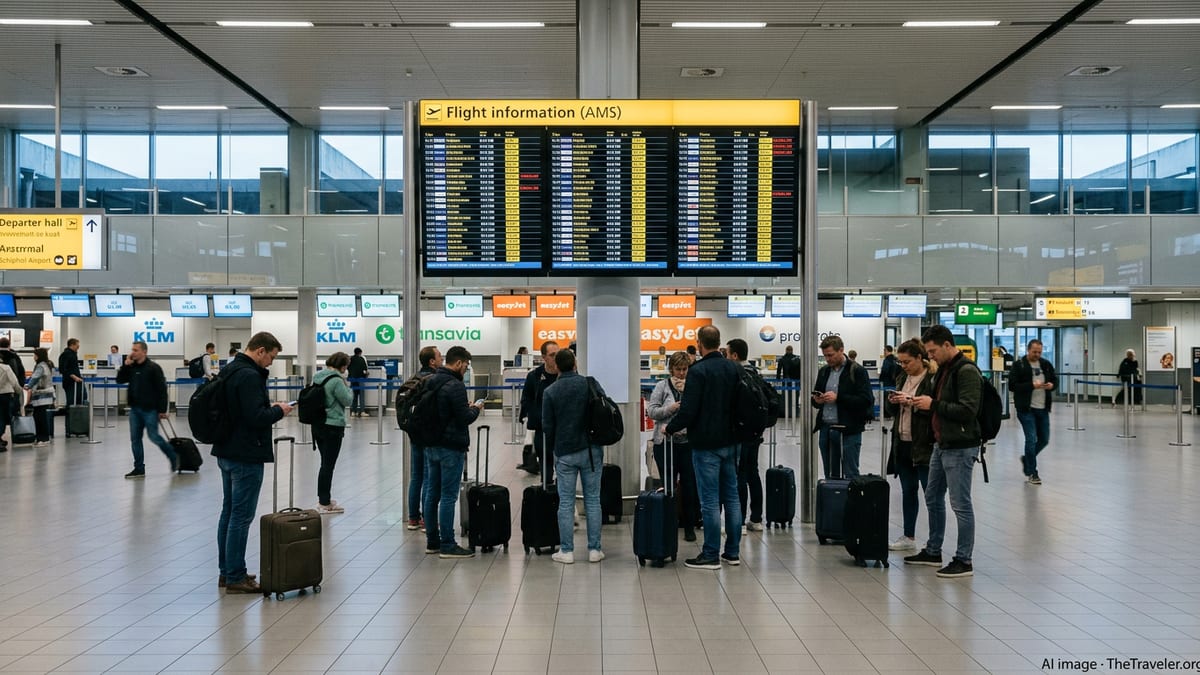
Hundreds of travelers were stranded at Amsterdam Schiphol Airport on July 6, 2026, after more than 30 key flights operated by KLM, Air France, Delta, easyJet, and other carriers were abruptly canceled, disrupting busy routes to major European capitals and US gateways.
Get the latest news straight to your inbox!
Major Cancellations Hit Europe and US Routes
Publicly available flight information from Amsterdam Schiphol shows that at least 31 departures were canceled across multiple airlines, affecting services to London, Paris, Madrid, Barcelona, Los Angeles, Houston, Washington, and other key destinations. The disruption involved a mix of short haul and long haul routes, compounding the impact on both leisure and business travelers at the height of the summer season.
The latest wave of cancellations follows a broader pattern of operational turbulence at Schiphol in recent weeks, as carriers including KLM, Air France, Delta, and easyJet have struggled to keep schedules intact amid high demand and tight capacity. Recent published coverage has highlighted a series of smaller disruption events through June, where clusters of flights to London, Washington, and Houston were withdrawn within short time frames, already stretching rebooking options for many travelers.
On July 6 in particular, the cancellations hit several high profile routes linking Amsterdam with Barcelona, Madrid, London Heathrow, London City, and Paris Charles de Gaulle, alongside long haul connections to Los Angeles, Houston, and Washington Dulles. These routes serve as vital links between the Netherlands and some of Europe’s and North America’s busiest hubs, meaning that a relatively small number of canceled flights translated into sizable numbers of stranded passengers.
Although full passenger counts for the affected flights have not been released, aircraft deployed on these routes typically carry several hundred people each. Industry-focused reports estimate that the cancellation of more than 30 departures at a major hub in peak season is likely to affect thousands of individual journeys once missed connections and onward travel are taken into account.
Knock On Effects Across Airline Networks
The situation at Schiphol on July 6 did not arise in isolation. Over recent days, travel industry outlets have documented a broader build up of strain across European and transatlantic networks, with delays and cancellations reported at other key hubs and a series of rolling disruptions contributing to mounting backlogs.
Earlier in July, Schiphol had already seen hundreds of delays and a smaller wave of cancellations involving KLM, Delta Air Lines, British Airways, Lufthansa, easyJet and others, affecting flights to London, New York, Paris, Dubai, Frankfurt, Barcelona, and Rome. These earlier events left many travelers dealing with missed connections, overnight stays, and rebooked itineraries, and they reduced the flexibility airlines typically use to absorb fresh disruption.
Additional pressure has been reported at airports in Spain, where Madrid and Barcelona have experienced elevated levels of delays and cancellations as knock on effects from hubs such as London Heathrow, Frankfurt, and Amsterdam ripple through the wider network. Recent operational issues at New York’s JFK, where dozens of flights were canceled and hundreds delayed heading into the same weekend, further reduced the margin for error on transatlantic routes that share aircraft and crew rotations with services out of Schiphol.
Industry observers note that when multiple hubs are under strain at the same time, airlines have fewer spare aircraft and crew available to reposition, making it more likely that localized problems will escalate into widespread schedule cuts. In this context, the decision to cancel more than 30 flights from Amsterdam on a single day reflects not only conditions on the ground in the Netherlands but also broader pressures across partner networks in Europe and North America.
Stranded Passengers Face Long Queues and Limited Options
Travel reports from Schiphol on July 6 describe crowded terminals, long customer service queues, and departure boards filled with cancellations and multi hour delays. Many passengers arrived expecting routine journeys to London, Paris, Madrid, and Barcelona, only to find that their flights had been withdrawn or significantly rescheduled with little warning.
For those booked on long haul services to Los Angeles, Houston, and Washington, the disruption has been particularly challenging. These flights typically operate only once or twice per day, and alternative same day options via other hubs such as Paris, London, or Frankfurt can quickly sell out when demand spikes. As a result, some travelers have had to accept next day departures or more complex itineraries involving additional connections.
Publicly shared accounts from recent disruption episodes at Schiphol indicate that passengers often face hours of uncertainty while airlines work through rebooking backlogs. Because the latest cancellations add to a series of earlier schedule changes in June and early July, seats on later flights are already limited, and the pool of available hotel rooms near the airport is under pressure.
Families beginning holidays, business travelers heading to time sensitive meetings, and connecting passengers returning home all find themselves competing for scarce rebooking options. In some cases, travelers are choosing to reroute via nearby airports or switch to rail for shorter European sectors, particularly to cities such as London, Paris, and Brussels where high speed links are available.
Passenger Rights and What Travelers Can Do
Under European passenger rights regulations, travelers whose flights are canceled or heavily delayed may be entitled to assistance such as meals, refreshments, and hotel accommodation where necessary, along with rebooking or refunds. Consumer rights organizations also point out that, depending on the cause of the disruption and the length of delay, some passengers on affected routes may qualify for financial compensation.
Specialist passenger rights platforms tracking the situation at Schiphol in recent weeks have highlighted that many of the recent cancellations have been described as operational, rather than the result of extraordinary circumstances such as severe weather or airspace closures. Where this is the case, and when notice periods and delay thresholds are met, travelers may have stronger grounds for compensation claims under the applicable rules.
Travel experts recommend that passengers keep boarding passes, booking confirmations, and any written communication from airlines that reference reasons for cancellations or delays. This documentation can be important when submitting formal complaints or claims after returning home.
In the immediate term, travelers are advised to check the status of their flights frequently using airline apps, airport information pages, and departure boards, since schedules can change at short notice. Those with nonessential trips or flexible plans may wish to consider rebooking outside the current peak period to reduce the risk of becoming caught up in further disruption as airlines and airports work to stabilize operations.
Outlook for the Coming Days
With summer travel demand remaining high across Europe and North America, aviation analysts caution that the disruption seen at Amsterdam Schiphol on July 6 could foreshadow further irregular operations in the weeks ahead. Airlines are running near capacity on many routes, leaving limited room to accommodate passengers who are displaced when flights are cut.
Forecasts suggest that continued pressure on air traffic control resources in parts of Europe, combined with tight staffing and aircraft availability at some carriers, will keep schedules fragile. Any localized weather events or technical issues at major hubs like Amsterdam, London, Paris, or Frankfurt have the potential to trigger fresh waves of delays and cancellations.
For travelers planning to pass through Schiphol and other busy hubs, the latest events serve as a reminder to build extra time into itineraries, particularly when making connections to long haul flights. Purchasing flexible tickets, considering earlier departures, and monitoring flight status closely in the days before travel can help reduce the risk of severe disruption.
Airlines operating at Schiphol are expected to continue adjusting timetables and aircraft allocations in the short term as they work through the backlog created by recent cancellations. While gradual stabilization is possible if conditions improve, the current pattern of rolling disruption means that a degree of uncertainty is likely to persist for passengers flying to and from the Netherlands this summer.