


More news on this day
Southwest Airlines is sharpening its focus on business travelers, rolling out new loyalty rewards, upgraded digital tools, and future cabin changes that are expected to make corporate trips on the carrier more flexible and data driven.
Get the latest news straight to your inbox!
Corporate Loyalty: Rapid Rewards Business Gains Traction
Southwest has been expanding Rapid Rewards Business, a corporate-focused extension of its long-running passenger loyalty program, as it looks to compete more aggressively for managed travel budgets. Publicly available information shows that Rapid Rewards Business allows companies to earn points on eligible employee travel booked through designated corporate channels, including the airline’s SWABIZ portal, airline partner APIs, and major global distribution systems. Those points can be applied to future business trips or other travel needs, effectively returning some of the travel spend back to the employer.
The structure gives both sides of the corporate relationship an incentive to consolidate with the airline. Individual travelers continue to earn their own Rapid Rewards points in personal accounts, while the company simultaneously accrues a separate balance tied to its corporate identification number. Industry observers note that this dual-earning format mirrors similar schemes at full-service competitors but is relatively new for a carrier historically known for a more leisure-heavy customer base.
Program details highlighted in corporate-facing materials indicate that qualifying flights include tickets paid with cash and certain flexible payment options, while reward tickets, group travel, and companion pass journeys are excluded. For travel managers, the ability to track spend and accumulate points at the company level is positioned as a key benefit, particularly for firms that previously viewed Southwest primarily as a point-to-point leisure carrier.
Southwest has also introduced meeting and event specific offerings through its corporate channels, promoting dedicated support and tailored discounts for conferences and large corporate gatherings. These tools are intended to make it easier for travel planners to steer high-volume itineraries to the carrier while keeping a clearer record of savings and benefits.
Enhanced Fare Benefits for High-Value Business Customers
Alongside its corporate loyalty push, Southwest continues to refine the benefits included with its higher fare products, which are frequently purchased for business travel. Regulatory filings and investor materials describe Business Select as the airline’s top-tier published fare, combining priority boarding near the front of the A group, the highest Rapid Rewards earning rate per dollar spent, and a complimentary premium drink coupon on the day of travel when lawfully permitted. The fare also includes inflight internet access on equipped aircraft, a feature that remains central for travelers who need to stay connected during work trips.
Anytime fares sit below Business Select but preserve much of the flexibility that corporate policies typically require. They are fully refundable as flight credits when plans change, an attribute that many companies specify in their travel guidelines to avoid sunk costs on unused tickets. Internal policy changes noted in recent disclosures show that when travelers do not cancel in time, funds tied to these flexible fare types now convert to flight credits instead of being forfeited, which may help corporate buyers preserve value.
The airline’s investor presentations also point to a growing focus on upselling higher-yield fare products, including new premium seating options that are being prepared as part of a move to assigned seating. While the details of the final product set are still being implemented, the planned combination of premium seats, bundled benefits, and differentiated fare attributes is expected to create clearer choices for business travelers who prioritize schedule control and comfort over the lowest price.
These changes arrive as Southwest works to improve overall revenue performance. Higher-value business itineraries have historically provided a buffer against economic cycles for large airlines, and additional perks built around flexibility, earning potential, and onboard productivity are a central part of Southwest’s effort to win a larger share of that segment.
Digital Tools and Data Access for Travel Managers
Southwest is pairing its fare and loyalty adjustments with a suite of digital tools intended to give corporate clients better visibility into their travel programs. Corporate travel pages emphasize dedicated account management for contracted customers, including support for budgeting, analytics, and program rollouts. The airline highlights that its team can compare features across distribution channels so that companies understand what capabilities are available whether they book through SWABIZ, a global distribution system, or via direct connections.
Recent documentation points to continued investment in self-service technology for travel coordinators. A new group travel platform is being phased in to bring more automation to organizing larger movements of employees, while a data-sharing interface branded for business travel is designed to feed near real-time information back to corporate systems. These tools are positioned as ways for companies to track unused tickets, policy compliance, and traveler behavior more easily, complementing the points earned through Rapid Rewards Business.
On the traveler side, the carrier is overhauling its mobile app and digital experience, with testing underway on redesigned home screens and more personalized views of trip details. For business flyers, the aim is to surface gate changes, same-day options, and ancillary selections more clearly, minimizing time spent navigating menus during tight connections or busy travel days.
Southwest’s approach to digital upgrades reflects a broader shift across the airline sector, in which data clarity and speed of rebooking have become as important to corporate buyers as traditional discounts. By promoting tools that integrate more cleanly with travel management companies and booking platforms, the airline is seeking to match the level of control that business clients expect from long-established network carriers.
Cabin Redesign and Assigned Seating to Reshape Business Experience
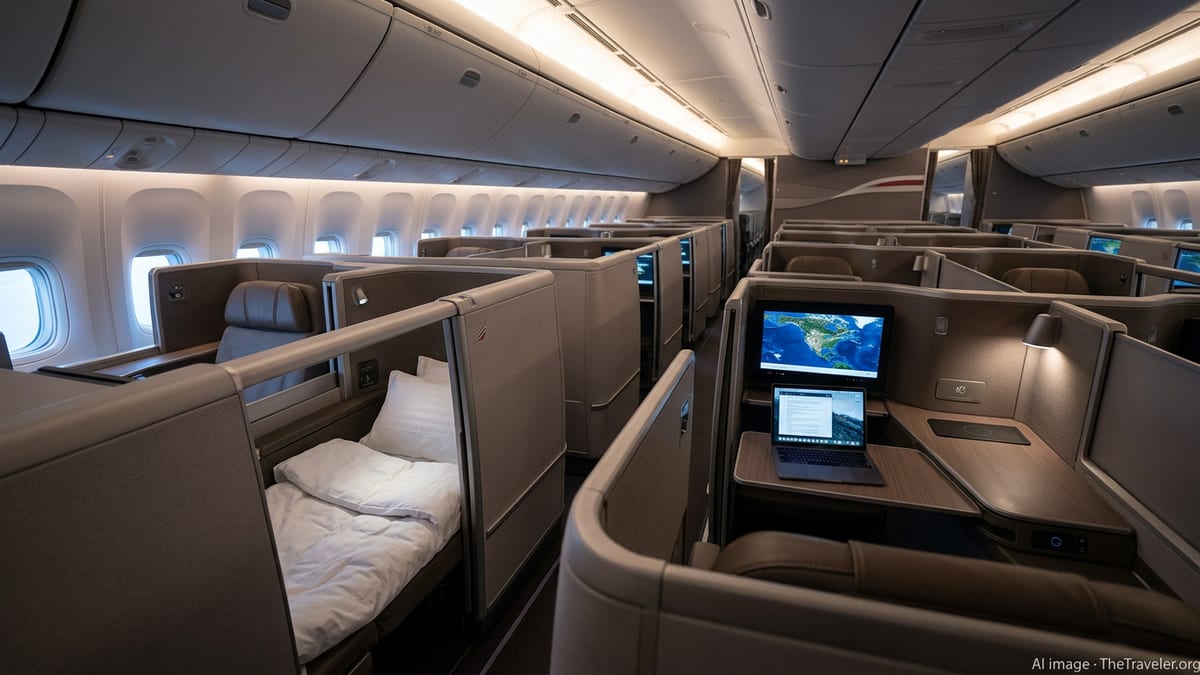
Beyond loyalty and technology, Southwest is in the midst of a significant transformation of its onboard product that could alter how business travelers experience the airline. Company reports and public statements outline a move away from the long-standing open seating model toward assigned seats, with new premium seating options to follow. The carrier has indicated that flights with assigned seating will be available for travel beginning in 2026, accompanied by a redesigned cabin layout.
The new configuration is being described as offering greater choice, including seats with extra legroom and other enhanced attributes. For frequent business travelers accustomed to planning their work in the air, the ability to lock in a preferred location at booking may remove some of the uncertainty that accompanied Southwest’s previous first-come, first-served boarding system. It also aligns the airline more closely with competitors that already segment the cabin into distinct comfort tiers.
Southwest materials further indicate that elements of its loyalty program and co-branded business credit cards will be updated to match the new seating framework. Cardholders with certain premium business products are expected to receive expanded seating and baggage-related perks, reinforcing links between corporate purchasing decisions and on-the-day travel benefits for employees.
Analysts note that the shift to assigned seating and premium options could support higher yields from business routes while preserving core differentiators such as the airline’s single-class cabin and extensive domestic network. The success of these changes for corporate customers will likely depend on how clearly the new benefits are communicated and how seamlessly they are integrated into the booking tools used by travel managers.
Competitive Positioning in the Business Travel Market
Southwest’s evolving strategy comes at a time when business travel patterns are still stabilizing after several years of disruption and shifts toward remote work. Larger network carriers have been emphasizing international connectivity, premium cabins, and corporate contracts that bundle lounge access and status benefits. Southwest, by contrast, is leaning on its domestic footprint, simple fare structure, and new corporate programs as it looks to capture more short-haul and midcontinent business demand.
Industry commentary suggests that the airline’s appeal to business travelers will hinge on how effectively Rapid Rewards Business, enhanced fares, and assigned seating can be combined into a coherent value proposition. Frequent travelers often weigh convenience at their home airport, schedule frequency, and loyalty program utility in tandem, rather than examining each element separately. Southwest’s decision to increase visibility on third-party search platforms and to deepen partnerships with travel management companies is part of an effort to ensure that its options appear in those evaluations more consistently.
At the same time, the airline is under pressure from investors to improve financial results, which adds urgency to attracting higher-yield corporate traffic. The rollout of new fees, premium seating, and basic fares sits alongside promises to reward the most loyal customers and provide more flexibility for companies that commit to the brand. How business travelers respond to this new mix of benefits and trade-offs will likely be a central factor in the airline’s performance over the next several years.