


More news on this day
American Airlines is launching a large-scale cabin overhaul that will add more premium seats, restore seatback entertainment screens and expand high-speed Wi-Fi across its fleet as the carrier intensifies its focus on higher-spending travelers.
Get the latest news straight to your inbox!
Major retrofit program targets narrowbody workhorses
According to recent company statements and financial reporting, American is preparing a sweeping interior upgrade for hundreds of single-aisle aircraft, including Airbus A319 and A320 jets and Boeing 737s that form the backbone of its domestic network. The reconfiguration is designed to create more revenue-generating premium space at the front of the cabin while preserving overall capacity.
Published coverage indicates that the airline plans to add at least one extra row of first class on many A319 and A320 aircraft, along with additional extra-legroom seats in the main cabin. Those changes are aimed at business travelers and frequent flyers willing to pay more for comfort, as well as leisure customers trading up from standard economy.
Retrofit work on the existing fleet is expected to begin later this decade, with most programs ramping up from 2028 and continuing into the early 2030s. At the same time, newly delivered Boeing and Airbus jets will arrive from the factory with the updated interiors already installed, gradually standardizing the onboard experience.
Industry analyses note that American is using the cabin redesign to help close a profitability gap with Delta Air Lines and United Airlines, both of which have invested heavily in premium products and ancillary revenue over the past several years.
Seatback screens return alongside high-speed connectivity
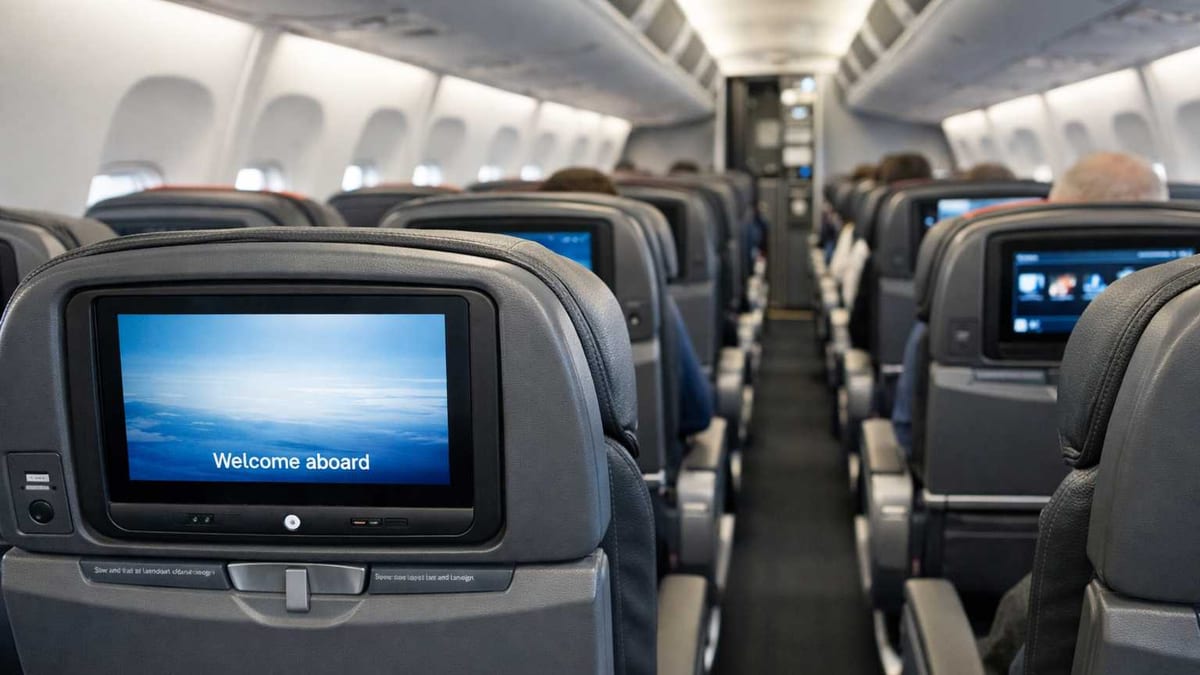
In a notable shift, American plans to bring back seatback entertainment screens across its narrowbody fleet after years of relying primarily on passengers’ own devices for streaming. Reports indicate the new screens will offer 4K resolution, Bluetooth connectivity for wireless headphones and integrated power options such as USB-C charging.
The airline expects the screens to debut on new Boeing and Airbus deliveries starting in 2028, with a parallel program to retrofit existing aircraft. The goal is a largely screen-equipped narrowbody fleet in the early 2030s, reversing an earlier strategy that saw monitors removed from many cabins to save weight and maintenance cost.
High-speed satellite Wi-Fi is a central part of the upgrade. Publicly available information shows that American has already committed to expanding next-generation inflight connectivity on hundreds of narrowbody jets, with plans for coverage on virtually all mainline flights by the middle of the decade. The move is intended to support streaming, real-time messaging and work applications throughout the cabin.
Analysts note that combining faster Wi-Fi with refreshed entertainment hardware gives American more flexibility to personalize content, deliver real-time flight information and eventually integrate new retail and loyalty features into the onboard experience.
Premium focus extends to widebodies and regional jets
The push toward more premium seating is not limited to domestic narrowbodies. American has been rolling out new long-haul business-class suites on its Boeing 787-9 aircraft and has signaled plans to reconfigure other widebodies with higher concentrations of premium seats in the coming years.
Fleet documentation and investor materials show that the carrier is progressively shifting its international mix toward cabins with more lie-flat business suites and premium economy rows, reducing the share of standard economy on many long-haul routes. This aligns with broader industry trends in which airlines seek higher yields from a smaller number of more valuable seats at the front of the aircraft.
On the regional side, American has also outlined an interior refresh for its dual-class regional jets, bringing them closer to mainline standards. These aircraft are slated to receive updated seats, in-seat power and expanded satellite Wi-Fi coverage, with completion targeted by early 2026. The aim is to create a more seamless experience for travelers connecting between smaller markets and major hubs.
For frequent flyers, the changes mean that more short-haul and regional flights will offer first class, extra-legroom economy and consistent connectivity, rather than the more basic layouts that historically characterized many commuter routes.
Competitive pressures and loyalty strategy
American’s cabin investment comes as large U.S. airlines compete intensely for premium travelers, particularly on business-heavy routes and high-demand leisure corridors. Market commentary suggests the airline is seeking to narrow a “wide profit gap” with Delta and United by boosting revenue per seat and offering a more clearly differentiated product at the front of the plane.
The premium expansion dovetails with ongoing changes to American’s AAdvantage program, where elite status, upgrades and ancillary spending have become increasingly central to the business model. With more first class and extra-legroom rows, the airline gains more inventory to sell outright or use to reward high-value customers, especially on domestic and transcontinental flights.
Travel-industry observers point out that the strategy reflects a broader shift away from uniform cabins toward more stratified interiors, where airlines can charge varying price points for relatively small differences in space and amenities. More premium seats, especially those paired with robust Wi-Fi and high-quality entertainment, are viewed as key tools in attracting corporate contracts and affluent leisure travelers.
At the same time, the focus on premium products raises questions about how seat density and comfort will evolve in standard economy. While American has indicated that it intends to preserve overall capacity, aviation analysts will be watching closely to see whether legroom or personal space changes as rows are reconfigured to make room for the expanded premium cabins.
What travelers can expect in the coming years
For passengers, the tangible impact of American’s upgrades will emerge gradually as more aircraft pass through the retrofit process and new jets enter the fleet. Travelers on key domestic routes are likely to see additional first class seats, more main cabin extra rows and a growing share of flights offering both power at every seat and fast, gate-to-gate connectivity.
Longer term, the return of seatback screens combined with upgraded Wi-Fi could reshape how travelers pass the time in flight. Instead of choosing between a provided screen or their own device, passengers may be able to use both in tandem, with synchronized content, personal profiles and tailored recommendations tied to their AAdvantage accounts.
For now, American’s plans underscore how rapidly expectations for the onboard experience are shifting. As more travelers work and stream video in the air, cabin design is becoming a critical competitive battleground, and airlines are betting that investments in premium seats and connectivity will pay off in loyalty and revenue over the next decade.