


More news on this day
U.S. Transportation Secretary Sean Duffy has unveiled a new artificial intelligence platform designed to reduce flight delays across the United States, while repeatedly stressing that human controllers will remain in charge of the nation’s airspace.
Get the latest news straight to your inbox!
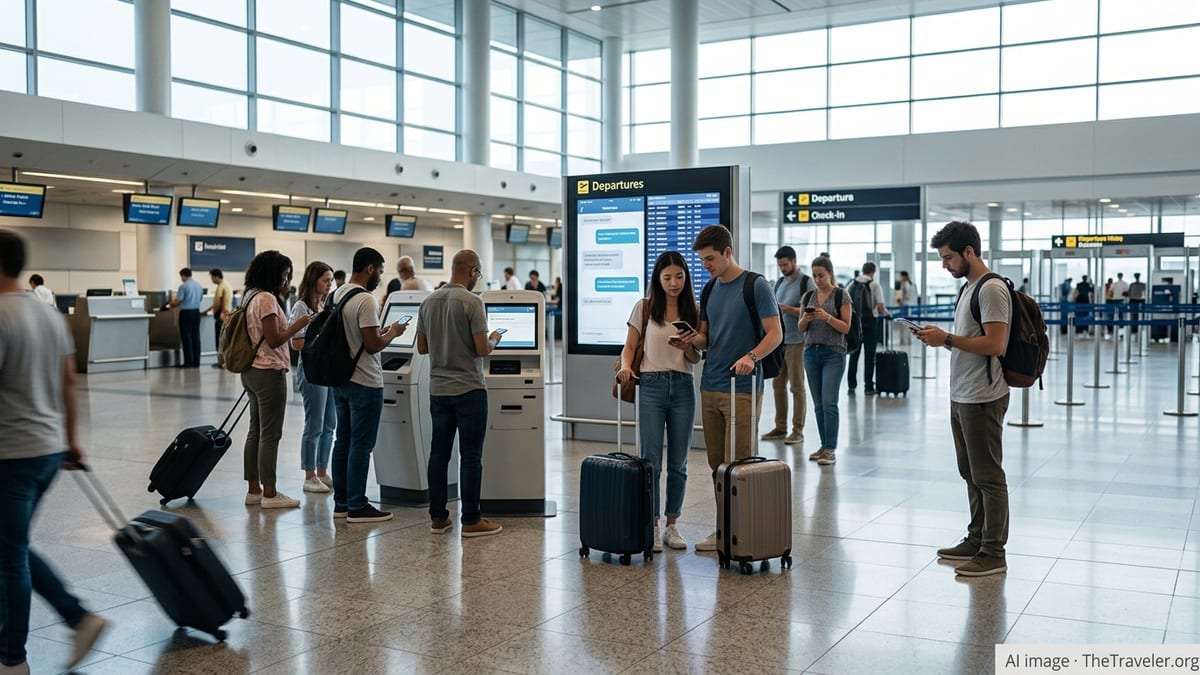
AI-Supported SMART Platform Launches in Washington Airspace
According to recent coverage of the rollout, the Federal Aviation Administration has begun live testing of the Strategic Management of Airspace, Routes and Trajectories platform, known as SMART, in the busy Washington region. The initial deployment covers Ronald Reagan Washington National, Washington Dulles International and Baltimore/Washington International airports, with a 90 day evaluation window tied to real world airline operations.
Publicly available descriptions of SMART indicate that the platform centralizes roughly 200 streams of operational data, including weather systems, filed and active flight plans, air and ground traffic flows, airport capacity constraints and staffing levels at air traffic control facilities. An AI supported engine then analyzes those inputs to highlight where demand is likely to exceed capacity and where bottlenecks or reroutes may be needed well before they appear on departure boards.
Transportation officials have framed the tool as a response to several years of high profile disruptions driven by storms, staffing shortages and aging systems. While the new platform cannot repair cut fiber lines or prevent separate technology failures in the broader aviation network, it is being promoted as a way to help controllers see congestion building hours in advance and adjust flows before delays cascade across the system.
The Washington area was chosen as the first test market in part because it hosts a complex mix of short haul, long haul and government related aviation activity, along with three major commercial airports that frequently appear on delay statistics during peak travel periods and East Coast weather events.
“It’s Always Going To Be A Human” Managing U.S. Airspace
As interest and concern about artificial intelligence in critical infrastructure have grown, Duffy has used the SMART launch to draw a clear line about who controls U.S. skies. In public remarks during the debut, he emphasized that the platform is a decision support system, not an automated air traffic controller, and stated that it is always going to be a human who manages American airspace.
Publicly available information about the system’s design underscores that assurance. SMART does not issue clearances to pilots or change air traffic procedures on its own. Instead, it generates suggested reroutes, altitude changes or flow management options that are reviewed by FAA specialists and local facility leadership before any changes are implemented in the live system.
That human in the loop approach reflects long standing global aviation practice, where software can recommend strategies for balancing demand and capacity, but licensed controllers remain responsible for safety and for direct instructions to aircraft. Analysts note that with traffic volumes projected to rise over the next decade, tools that help humans see the big picture more clearly are being prioritized over fully automated control concepts.
For travelers, the distinction is important because it speaks to how risk is managed. The FAA has consistently framed SMART as a way to reduce delay minutes and wasted fuel rather than as a shortcut around existing safety margins. Any changes driven by the platform are expected to move through established traffic management procedures that airlines and controllers already use today.
How SMART Could Change the Passenger Experience
SMART’s core promise for passengers lies in its predictive capability. By processing hundreds of data feeds in parallel, including forecasts of storms, projected arrival peaks at key hubs and staffing availability, the platform is designed to identify trouble spots before they become ground stops and mass cancellations.
Reports on the system’s architecture describe scenarios in which SMART flags that multiple banks of flights are scheduled to arrive at the same airport in overlapping windows while thunderstorms are likely to narrow usable airspace. In those cases, the tool can recommend modest reroutes, adjusted departure times or different cruising altitudes to smooth flows so that fewer aircraft reach the same choke point at the same moment.
If the technology performs as advertised and is adopted widely by traffic managers and airlines, travelers could see fewer days where a line of storms in one region triggers nationwide ripples of missed connections and overnight delays. Instead, airlines might receive advanced guidance to slow or resequence certain departures, shift routings earlier in the day or use alternative en route paths that keep traffic within safe but more efficient parameters.
However, early coverage also highlights that the benefits will not appear overnight. Duffy has cautioned that travelers are unlikely to see a transformed holiday season in the first months of operation. The real test will come as the FAA and industry compare delay statistics over the next several peak travel periods to determine whether the platform is delivering measurable improvements in on time performance and schedule reliability.
Industry Reaction, Cost and Rollout Beyond Washington
Published reports indicate that the SMART initiative is part of a broader FAA modernization drive backed by several hundred million dollars in federal funding focused on congestion relief and technology upgrades. Estimates cited in recent coverage place the program’s total price tag in the high hundreds of millions of dollars when development, integration and nationwide deployment are included.
Initial reaction from airlines has been mixed but cautiously supportive. Prior reporting suggests that some carriers were skeptical earlier in the year about how an AI supported system would interact with established procedures and dispatch tools already used by flight operations centers. Those concerns reportedly eased after the agency clarified that SMART would provide alternative route options through existing channels rather than alter controller responsibilities or impose new rules on airlines.
As for expansion, FAA statements and industry analyses point to a phased rollout, with additional regions expected to join after the Washington test period if the platform demonstrates stable performance and delivers congestion reductions without creating new operational complications. Large hub airports in other delay prone corridors are viewed as likely candidates for subsequent phases, although specific locations and dates have not been formally detailed.
For now, the program’s backers are positioning SMART as one important lever among several, alongside increased controller hiring, facility upgrades and surface traffic management improvements. Observers note that all of these elements will need sustained funding and attention if the agency hopes to significantly reduce the chronic delays that have become a recurring feature of peak travel seasons in the United States.
Balancing Innovation and Public Trust in Aviation AI
The SMART launch is emerging as a test case for how far artificial intelligence can be integrated into national airspace management while maintaining passenger confidence. Aviation is one of the most tightly regulated and risk averse sectors in transportation, and public opinion research has often shown that travelers are wary of any suggestion that algorithms might replace experienced human controllers or pilots.
Duffy’s messaging, and the FAA’s documentation, are aligned around framing SMART as an advanced analytics tool that surfaces options, not decisions. By highlighting the continued centrality of human judgment and by operating within existing safety rules, the department appears to be trying to thread the needle between innovation and reassurance.
Specialists following the rollout point out that accountability will ultimately rest on transparent performance data. Metrics such as aggregate delay minutes, cancellation rates during major weather events and controller workload measures over the next several seasons will indicate whether the platform is providing tangible benefits without unintended side effects.
For the travel industry, the stakes are significant. If the Washington trial shows that AI supported planning can prevent the kind of cascading disruptions that have stranded thousands of passengers in recent years, pressure is likely to grow for broader adoption and sustained investment. If the results are ambiguous, SMART could become another aviation technology experiment that delivered promising demos but struggled to scale. Either way, the next phase of testing will be closely watched by airlines, airports and travelers who are hoping that sophisticated data tools, paired with experienced humans, can finally make flying a little more predictable.