


I thought I knew Battery Park. For years it was a place I hurried through on my way to the Statue of Liberty ferry or the Bowling Green subway, a transit corridor framed by ticket sellers, security lines and a blur of harbor views. It was only when I forced myself to slow down, step away from the queues and walk the waterfront at my own pace that the view from Battery Park changed completely. What had been background scenery became one of the most quietly astonishing urban landscapes in New York City.
Get the latest updates straight to your inbox!
From Transit Zone to Waterfront Sanctuary
The southern tip of Manhattan is one of the busiest crossroads in the city. On a typical morning, commuters spill out of the Bowling Green and South Ferry subway stations, cruise passengers roll their luggage toward the Staten Island Ferry, and visitors queue at Castle Clinton for Statue City Cruises tickets to Liberty and Ellis Islands. It is easy to let that current carry you along, eyes on signs and security checkpoints rather than the harbor itself.
My own routines reinforced that rush. I knew exactly which path to take from the 4 train at Bowling Green to the security tent for the Statue of Liberty ferry, how to sidestep the unofficial ticket sellers, where to grab a quick pretzel from a cart near the park entrance. In that mindset, the Battery was just staging ground: a place you passed through as quickly as possible to reach the “real” attractions offshore.
On a late spring afternoon, though, I arrived early for a ferry and decided not to join the line right away. Instead of heading straight for Castle Clinton’s sandstone ring, I walked past it toward the water, following the curve of the seawall. Within minutes, the clamor of the ticket plaza thinned out. A light breeze off New York Harbor, carrying salt and diesel and something almost floral from the lawns, cut through the city noise. For the first time in years, I was not in a hurry at the very tip of Manhattan.
That simple decision to slow down recalibrated everything I thought I knew about the park. Distances that had felt like obstacles when I was rushing became invitations: a bench facing the harbor, a path shaded by plane trees, a tiny overlook where an older couple was sharing a paper cup of coffee and pointing out passing tugs. The geography of Battery Park did not change. My relationship with it did.
Learning to Read the Harbor, Not Just Photograph It
Most people arrive in Battery Park with a mental checklist: get a close-up photo of the Statue of Liberty, maybe with the Verrazzano-Narrows Bridge in the distance; capture a skyline shot pointing back toward One World Trade Center; post something from the ferry deck on social media. Those images are deservedly famous, but they can trap you into scanning for icons instead of actually seeing the harbor in front of you.
When I sat down on a bench near the park’s western edge, I started noticing details that never show up on postcards. The ferries for the Statue of Liberty were running their steady shuttle to Liberty Island, their decks already crowded even though midweek tickets can start under 30 dollars for a basic round trip. Closer to shore, small New York Waterway boats stitched across the Hudson, tracing routes between Battery Park City and New Jersey. Further out, a container ship inched toward the Kill Van Kull, its stacked boxes a reminder that this is still a working port, not just a backdrop.
Over twenty minutes, the light changed. The late-afternoon sun slipped behind the office towers of Battery Park City, throwing the harbor into a soft, silvery glow and turning Lady Liberty into a silhouette. On another visit, at golden hour, the opposite happened: the sun broke through low clouds to the west and lit her torch with a warm copper light, while Ellis Island’s red-brick buildings gleamed like something out of another century. Pausing long enough to watch a full cycle of cloud and light reframed the statue as part of a living seascape rather than a standalone monument.
Travelers often ask whether it is “worth it” to pay for the Liberty Island ferry when there are free views from the Staten Island Ferry or the Battery shoreline. The answer depends on what you want. A free ride from Whitehall Terminal gives you a sweeping pass of the statue and Lower Manhattan, ideal if you are counting minutes and dollars. But if you have the time to linger in Battery Park before or after, staying on the Manhattan side can be just as rewarding. Watch how the tides expose and hide the rocks at the water’s edge, how the harbor pilots nudge enormous ships into their lanes, how the clouds stack over the low New Jersey skyline. None of that costs a thing, and all of it becomes visible only when you let yourself be still.
Following the Curve Into Battery Park City
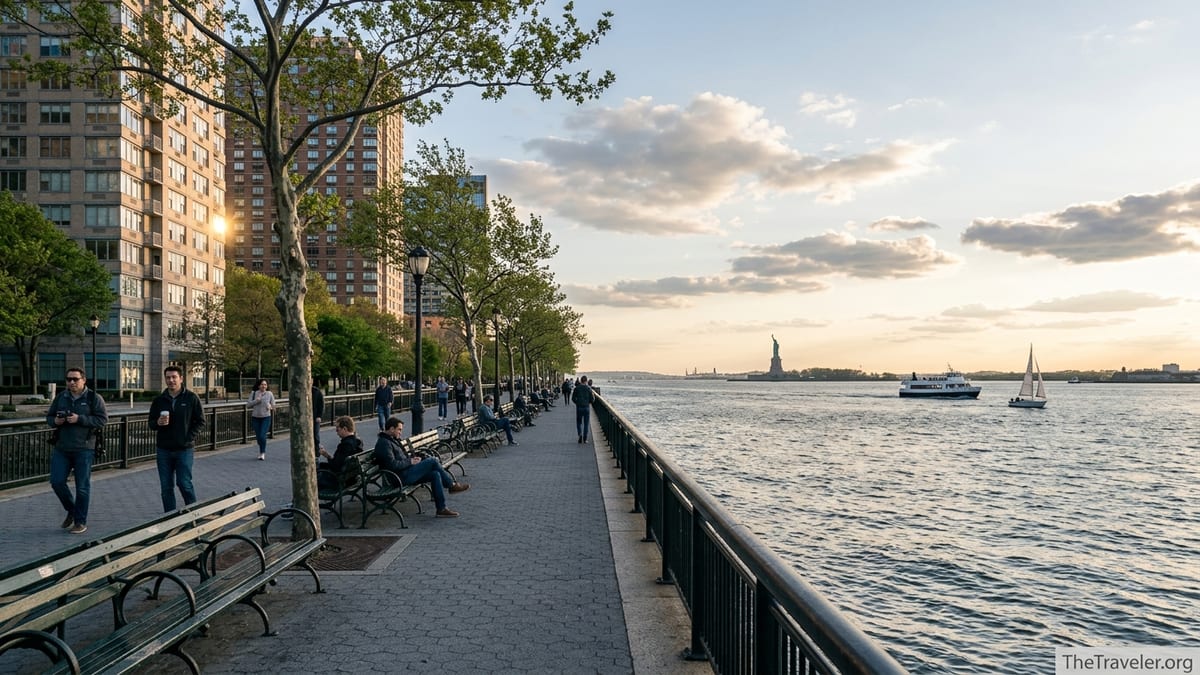
Many visitors do not realize that the experience of this waterfront does not stop at the formal boundary of The Battery. If you continue west and then north along the water, you slip onto the Battery Park City Esplanade, a mile-long promenade that runs from the historic park all the way up toward Stuyvesant High School. This is where the transformation from “busy tourist zone” to “unexpected sanctuary” is most dramatic.
The first clue is the change in pace. Near Castle Clinton you might find performers, food carts selling hot dogs that can easily hit 5 or 6 dollars each, and ticket sellers calling out for harbor cruises. Within a ten-minute walk along the Esplanade, the soundtrack shifts to the soft thud of running shoes, the hum of bicycles on the lower path, and the low lap of water against the seawall. Office workers sit on city-issue benches with paper cups from nearby coffee shops, while children zigzag between planters that frame views of the river.
Architecturally, this stretch of reclaimed land, built from World Trade Center excavation material in the 1970s, was designed to open Manhattan to the water rather than turn its back on it. A landscaped upper walkway is reserved for pedestrians, bordered by gardens and public art. On a sunny afternoon I watched a gardener trimming lavender while joggers passed under a row of London plane trees. On the lower level, closer to the water, cyclists and rollerbladers shared a wider path, giving the whole esplanade the feel of a riverfront promenade in Amsterdam or Vancouver rather than the dense financial core of New York.
What surprised me most was how much empty space there still is, even in peak visitor season. While the plaza outside the Staten Island Ferry terminal might feel packed and the security line for Statue City Cruises can stretch across the pavement, only a few hundred meters away you can find long, quiet segments of railing with completely unobstructed views west toward New Jersey and south toward the harbor mouth. It is the kind of place where you can stand with a coffee from a nearby deli, lean into the breeze, and feel, for a moment, that the city has paused around you.
Discovering the Small Places Within the Big View
Slowing down in Battery Park does not mean you need to plant yourself in one spot for hours. What it does mean is allowing yourself to follow curiosity instead of the shortest route between major landmarks. On my second unhurried visit, I traced a zigzag path through spaces I had previously ignored, each one offering a slightly different way of seeing the harbor.
Near the southern end of the Esplanade, I stumbled into South Cove, a sculpted inlet where a wooden boardwalk loops over the water, framed by blue harbor lights and clusters of boulders. The boardwalk dips low enough that, at high tide, waves curl just below your feet. Stand there for five minutes and the Statue of Liberty slides into view between the pilings, framed by trees and the occasional passing sailboat. It feels intimate and almost secret, even though you are only a few steps from a main pedestrian route.
Further north, at North Cove Marina, the urban harbor takes on a different face. Sleek private yachts and sailing boats are moored against a backdrop of glass office towers. On a summer evening, the open plaza nearby fills with office workers and residents lingering over drinks at waterfront restaurants, where a glass of house wine might run 14 to 18 dollars and a simple burger can approach 20. It is not a bargain spot, but if you time it for the hour before sunset, you can nurse a single drink and watch the sky burn pink over the Hudson, the statue shrinking to a distant silhouette at the harbor’s edge.
There are quieter niches, too: narrow stairways that dip to lower viewing platforms, an out-of-the-way bench half-hidden behind ornamental grasses, a gap in a hedge that suddenly opens onto a perfect sightline down the Hudson past the skewed angles of Jersey City’s skyline. On one walk I watched a man teaching his daughter to skip stones from a tiny, sheltered patch of shoreline, their laughter almost swallowed by the wind. None of these spots has a name on the map, yet they become anchors in your personal atlas of the park once you have found them slowly, on foot.
Seeing Everyday Life at the Edge of Manhattan
When you race through Battery Park on the way to a ferry, the people around you blur into a crowd: tourists with cameras, office workers on lunch breaks, street vendors calling out their prices. Walking slowly, you begin to notice the individuality of the routines that play out here against an extraordinary backdrop.
On a weekday morning, joggers trace loops that link the Esplanade with neighboring Hudson River Park, weaving between parents pushing strollers and seniors moving at a deliberate pace. A few carry small backpacks instead of smartphones in hand, using the riverfront as their daily commute route between residential towers in Battery Park City and office towers closer to the Financial District. Watching them, you realize that for thousands of people the view of the Statue of Liberty is not a once-in-a-lifetime moment. It is something they see, perhaps barely register, on the way to a 9 a.m. meeting.
By early afternoon, the demographics shift. School groups cluster near Castle Clinton before boarding ferries, their teachers reminding them that they will pass through airport-style security. On lawn areas framing the harbor, language students practice English with workbooks spread out on blankets. Food trucks park near the main entrances selling empanadas, falafel, or classic hot dogs and pretzels, with a quick lunch easily landing in the 12 to 18 dollar range if you add a drink and something sweet.
Stay long enough into the evening, and another layer of life appears. Residents walk dogs along the Esplanade, pausing to chat at regular spots as if they were village squares. Couples sit shoulder-to-shoulder on benches watching the ferries’ navigation lights flicker on. On warm nights, street musicians set up near the park’s internal walkways, their saxophone or guitar lines floating over the river’s constant hush. The view from Battery Park becomes not just a panorama of water and sky, but a living theater of how New Yorkers use that edge between land and harbor.
Practical Ways to Slow Down and Look Around
Seeing Battery Park differently does not require a dramatic change in your itinerary, just a small shift in how you structure your time. Instead of treating the park as a five-minute corridor between subway and ferry, budget at least an extra hour to wander before or after any scheduled activity. If your Statue City Cruises ticket has you lining up for screening at 10 a.m., aim to arrive by 8:45. Use the gap to walk west toward the Esplanade, find a bench with a clear view of the harbor, and watch one full ferry cycle depart and return.
Timing your visit can matter as much as the route you choose. Early mornings often bring softer light and fewer crowds, perfect for a contemplative walk from the southern end of the Esplanade up toward Rockefeller Park. Late afternoons into sunset are ideal for photographers, with the sun dropping behind New Jersey and reflecting off the glass towers lining the Hudson. Midday can be bright and busy, but even then, stepping off the main path into one of the smaller lawns or inlets can create a pocket of calm.
Comfort helps. The Esplanade’s upper walkway is paved and mostly flat, making it accessible for wheelchairs and strollers, but distances can add up quickly. Wear shoes you are happy to walk several kilometers in, bring a light layer even in summer because harbor breezes can be surprisingly cool, and carry water so that you are not forced to buy the priciest bottle at a kiosk. Toilets are available in and around The Battery and in certain Battery Park City parks; knowing that you will not have to race back to a terminal can make it easier to linger where the view is best.
Most importantly, give yourself permission to stop. Pause at a railing even if you have already taken a dozen photos. Spend a few minutes simply tracing the wakes on the water or the slow drift of clouds over Governors Island. Resist the urge to catalog every moment for a feed. The harbor has been here for centuries; in the span of a half-hour, it will show you more if you let it.
The Takeaway
The physical view from Battery Park and the Battery Park City Esplanade has not changed dramatically in recent years. The Statue of Liberty still raises her torch over the mouth of the harbor, Ellis Island still anchors a low rise of brick in the channel, and ferries still stitch between Manhattan, Staten Island and New Jersey in a choreography that repeats every day. What changed, for me, was how I chose to move through that landscape.
By slowing down, I discovered that this corner of Manhattan is more than a launch pad for boat tours. It is a layered, living waterfront where global icons coexist with small, quiet dramas: a father teaching a child to ride a bike along the Esplanade, a gardener trimming roses near a memorial, a commuter leaning over the railing to take three deep breaths before diving back into the subway. Those moments are as much a part of the “view” as any skyline shot.
For travelers, the lesson is simple but powerful. You do not have to add more attractions or spend more money to deepen your experience of New York. Sometimes the richest discovery comes from taking a familiar place, like Battery Park, and deciding to walk it ten minutes slower. Shift your focus from reaching the next line on your itinerary to noticing the light, the tides, and the people who share the space with you. The city will not move any slower, but you might.
FAQ
Q1. Is it worth visiting Battery Park if I am not taking the Statue of Liberty ferry?
Yes. The park and the Battery Park City Esplanade offer expansive harbor views, public art, lawns, and quiet waterfront paths that make a rewarding visit even without boarding a ferry.
Q2. How much time should I plan to spend walking the Battery Park City Esplanade?
If you walk steadily from The Battery to the northern end near Stuyvesant High School, it can take about 30 to 40 minutes one way. Allow at least an hour or more if you plan to stop for photos, sit on benches or detour into side parks.
Q3. When is the best time of day to enjoy the view from Battery Park?
Early morning and late afternoon into sunset are particularly beautiful. Mornings are quieter and often have softer light, while sunset can bring dramatic colors over the Hudson River and silhouetted views of the Statue of Liberty.
Q4. Are there free views of the Statue of Liberty from Battery Park?
Yes. From the southern edge of The Battery and many points along the Esplanade you can see the statue across the harbor at no cost. The view is more distant than from Liberty Island but still memorable, especially with binoculars or a good zoom lens.
Q5. Is the waterfront walk accessible for strollers and wheelchairs?
Most of the main paths in The Battery and along the Battery Park City Esplanade are paved, relatively flat, and suitable for strollers and wheelchairs. Some boardwalks, stairs and lower platforms have limited access, so it is wise to choose the upper promenade if accessibility is a priority.
Q6. Are there public restrooms and places to buy food nearby?
Yes. There are public restrooms within The Battery and additional facilities in surrounding parks and commercial complexes in Battery Park City. Food options range from street carts selling hot dogs and pretzels to sit-down restaurants and cafes, especially around the ferry terminals and near North Cove Marina.
Q7. How can I avoid ticket scams around Battery Park?
Only purchase Statue of Liberty and Ellis Island ferry tickets from the official operator, which sells them online and at authorized points like Castle Clinton. Ignore street sellers who approach you in or near the park and always verify that your ticket lists the recognized ferry company before you pay.
Q8. Can I combine a visit to Battery Park with other Lower Manhattan sights?
Yes. The park is within walking distance of the Financial District, the 9/11 Memorial & Museum, Wall Street, and neighborhoods like Tribeca and the Seaport. Many travelers spend a morning on the harbor and an afternoon exploring nearby streets and landmarks.
Q9. Is it safe to walk the Esplanade in the evening?
Battery Park City is generally considered one of the safer residential areas in Manhattan, and the Esplanade sees regular foot traffic into the evening. As always, use standard urban common sense, stay on well-lit paths, and be mindful of your belongings.
Q10. Do I need to book anything in advance to enjoy the views described here?
No reservations are required to visit The Battery or walk the Battery Park City Esplanade. However, if you plan to take the Statue of Liberty and Ellis Island ferry, booking tickets in advance is strongly recommended, especially during weekends and peak travel seasons.