


From a distance, Florence’s Fountain of Neptune looks like another postcard motif: white marble against warm stone, tourists flowing around it in every direction. It is only when you step close enough to see the tool marks in the marble and the spray catching afternoon light that the square changes from a famous backdrop into a living room of the city. Standing almost at the fountain’s edge, Florence’s public art suddenly feels less like a lesson in Renaissance glory and more like a series of conversations you have been invited to join.
Get the latest updates straight to your inbox!
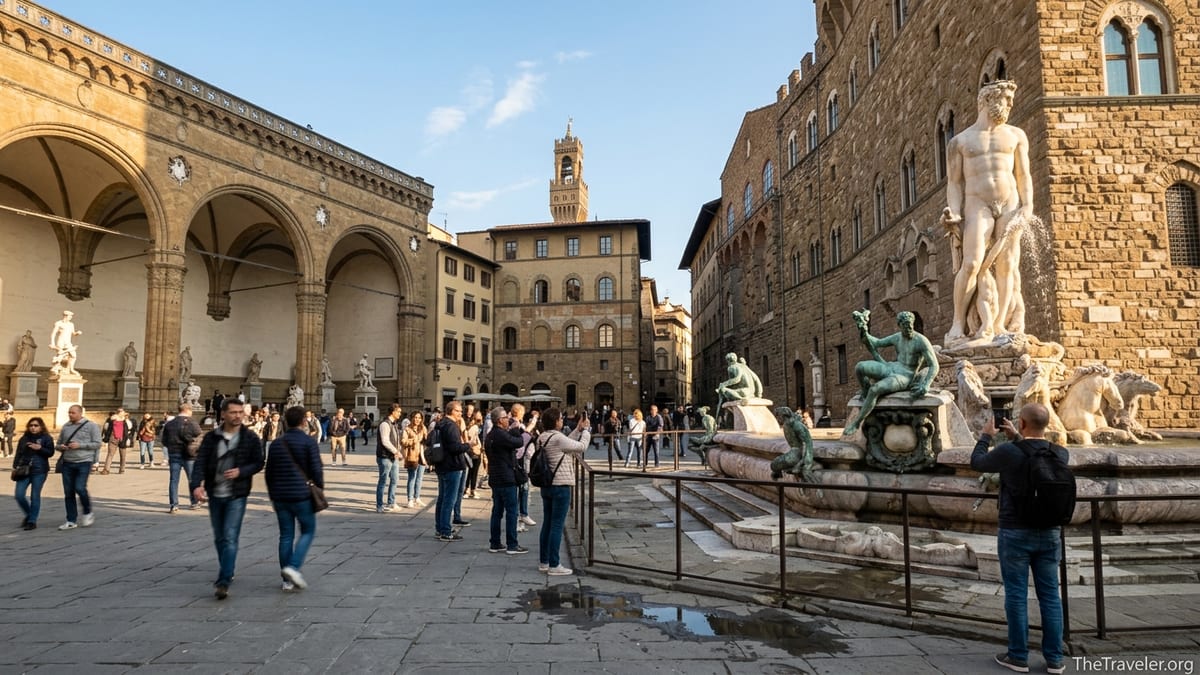
Meeting Neptune in the Heart of Florence
The Fountain of Neptune rises at the edge of Piazza della Signoria, between the fortress lines of Palazzo Vecchio and the open arches of the Loggia dei Lanzi. Created in the 16th century by Bartolomeo Ammannati for Duke Cosimo I de’ Medici, it was Florence’s first monumental public fountain, part celebration of Medici power and part declaration that this landlocked city was claiming influence over the seas. Today, it is the piece most visitors gravitate to instinctively, drawn by the gleam of marble and the cool sound of running water cutting through the heat.
From across the piazza, Neptune can feel abstract, a white statue looming above a busy basin. Up close, the sculpture becomes startlingly physical. You notice that the god’s expression is not serene, but tense, almost wary. The muscles are not idealized into smooth perfection; veins and tendons stand out, and the stone has softened in color after centuries of weather and restoration. Even the nymphs and satyrs clustered around the base bear small chips and repairs, reminders that this is not a museum piece under glass but an object exposed every day to rain, celebrations, and occasional carelessness.
Neptune’s nickname among Florentines, “Il Biancone,” loosely meaning the “big white one,” captures this mix of grandeur and familiarity. It is a work of state propaganda that locals tease, criticize, and quietly love. When you stand close enough to rest your camera against the low rail that protects the basin, you are standing in the same spot generations of residents have used as a meeting place, a shortcut, or a reference point for directions. The work’s political origins are still there, but its everyday role as part of the city’s shared memory is what you feel most strongly.
How Restoration Brought the Fountain Back to Life
Anyone who saw the Fountain of Neptune a decade ago and sees it now will notice how different the marble looks. Years of water, pollution, and even misguided cleanings had left the surface darkened and crusted. A major restoration project, completed in 2019 with significant private funding from the fashion house Salvatore Ferragamo, carefully cleaned the stone, repaired cracks, and overhauled the water system. The work took several years and involved scaffolding that wrapped the fountain like a temporary cocoon, frustrating some visitors but ultimately saving the monument.
Today, the results are visible even to casual travelers. Neptune’s body has regained a paler, more nuanced tone, with subtle variations where the marble is original and where it has been integrated with careful fills. The bronze figures at the base read sharper against the cleaned stone, and the water plays more clearly across the surfaces. In late afternoon, when the sun slides behind Palazzo Vecchio, the fountain seems to glow from within, the restored marble reflecting a cooler light than the ochre of the surrounding buildings.
For travelers, this recent restoration is not just a technical detail. It changes how you experience the work. Before, you might have seen a weather-beaten statue at the end of its life cycle. Now you are looking at a monument in mid-life, carrying scars and history but clearly cared for by the city. That sense of ongoing attention makes Florence’s idea of public art feel active rather than nostalgic. You are not simply admiring what the Renaissance left behind; you are catching a contemporary city in the act of deciding what deserves to be preserved and how.
The restoration has also prompted tighter protection. Simple railings and unobtrusive barriers keep visitors from climbing onto the marble, a response to occasional incidents of damage from people seeking the perfect selfie. While you cannot touch the sculpture, you can still approach close enough to frame the god’s profile against the Palazzo Vecchio tower, or to watch the reflections of nearby café awnings ripple across the basin. It is a careful balance between access and conservation, and experiencing that balance firsthand adds another layer to the story the fountain tells.
Reading Piazza della Signoria as an Open-Air Gallery
One of the surprises of seeing the Fountain of Neptune up close is realizing how many other major works surround it in a tight radius. Piazza della Signoria functions as Florence’s outdoor gallery, a dense arrangement of statues that would easily fill several museum rooms. To Neptune’s left, in front of Palazzo Vecchio, stands the full-size copy of Michelangelo’s David, placed where the original stood from 1504 until it was moved indoors to the Accademia Gallery in the 19th century to protect it. To Neptune’s right, just off the fountain’s edge, is Bandinelli’s muscular Hercules and Cacus, a theatrical contrast in style and attitude.
Walk a few steps under the arches of the Loggia dei Lanzi and the scene shifts again. Here you find Benvenuto Cellini’s bronze Perseus holding the severed head of Medusa, Giambologna’s swirling Rape of the Sabine Women, and a row of ancient Roman figures along the back wall. Two Medici lions guard the steps, one an ancient original and one a 16th-century copy. All of this is accessible without buying a ticket or queuing through security. You can wander in from Via dei Calzaiuoli with a gelato from a nearby shop and stand with Renaissance masterpieces only a meter or two away.
Seeing these works in the open air changes how you relate to them. In a museum, hushed voices and controlled lighting encourage reverence. In the square, noise from nearby terraces, bicycle bells, and the calls of walking-tour guides mix with your contemplation. Children dart in front of statues, couples argue gently over the best angle for a photograph, and office workers cut across the piazza using the same routes generations have walked. Rather than diminishing the art, the everyday bustle roots it in real life. You begin to understand that when these works were commissioned, they were meant to speak to a crowd, not just to specialists.
As you pivot between Neptune, David, Perseus, and the lions, Florence’s reputation as an “open-air museum” takes on concrete form. The phrase is often repeated in guidebooks, but here it simply describes reality. Each piece has a specific placement and political story, but together they turn the square into a continuous narrative about power, virtue, violence, and civic pride. Walking a slow circle around Neptune with your camera or notebook, you are effectively curating your own exhibition path.
Why Seeing Public Art Up Close Feels So Personal
Neptune becomes truly persuasive when you close the distance. At a meter or two away, you can see chisel traces on the marble, patches where restoration filled cracks, and subtle asymmetries in the modeling. These small imperfections are what make the work feel human. You begin to sense the hours of labor carved into the stone, and the choices Ammannati made as he struggled with both the material and with the expectations of his Medici patrons.
For many travelers, this physical proximity triggers an emotional response that no reproduction can match. Standing close to the fountain on a warm evening, the air damp with spray, you may become newly aware of your own body: your feet on the worn paving stones, the faint chill coming off the basin, the weight of your daypack as you lean forward for a better look. The statue is no longer an image in an art-history book; it is a towering figure occupying the same air you breathe. The moment feels less like looking at art and more like being in the presence of someone whose story you are still working out.
Public art in Florence also collapses time. The same space now filled with phone screens and tour groups once held public speeches, executions, and political ceremonies. When you stand beside Neptune at dusk, listening to the water and to fragments of conversation in Italian, English, and half a dozen other languages, you are inhabiting a site that has been continuously active for centuries. The sculpture makes that continuity visible. Every stain and repair on its surface is a compressed record of floods, festivals, and the simple abrasion of daily use.
This is one reason travelers often remember their first close encounter with Neptune or David more vividly than a morning spent in a gallery, even if the gallery houses more famous pieces. There is something disarming about meeting art without a ticket or a frame, in the same public space where you might also buy a coffee or navigate between errands. It suggests that beauty and meaning are not rarefied events, but parts of everyday infrastructure, as available as a bench or a streetlamp.
Planning Your Own Visit to Neptune and the Piazza
Most travelers reach Piazza della Signoria on foot, since central Florence is compact and largely pedestrian. From the Duomo, the walk down Via dei Calzaiuoli takes around seven minutes at an easy pace, passing clothing chains, leather shops, and small cafés. The square gradually opens ahead of you, with Palazzo Vecchio’s tower on the right and the Uffizi colonnade just visible to the left. Neptune stands slightly off-center in front of the palace, so you will likely see the fountain’s outline as you enter.
The piazza itself is open at all hours, and the fountain is visible day and night. Early morning, before most tour groups appear, is the calmest time to approach the basin. You may share the square with a few locals on their way to work and other travelers lining up early tickets for the Uffizi. In high season, by late morning and through the afternoon, the area becomes dense with walking tours. Guides often cluster near Neptune and the David copy, so if you prefer fewer voices around you, try stepping back or circling to the opposite side of the basin.
There is no admission fee to see the fountain or any of the sculptures in the piazza, which makes this one of the most accessible art experiences in Florence. Nearby expenses are optional but easy to anticipate. A coffee or soft drink at a table on the square can be several times more expensive than at a bar a few streets away, largely because you are paying for the view. Many travelers choose a compromise: pick up a takeaway espresso or gelato from a shop one or two blocks off the piazza, then return to sit on the low steps of the Loggia dei Lanzi, where you can look directly across at Neptune without committing to a restaurant bill.
If you plan to combine your visit with the Uffizi Gallery or a tour of Palazzo Vecchio, consider reserving tickets in advance, especially in spring and summer. However, keep the time in the piazza itself flexible. Some visitors find that a quick stop stretches into an hour unexpectedly, as they loop between the fountain, the Loggia, and the palace façade, trying different vantage points and observing how the light shifts across the statues. Building that unscheduled time into your day leaves space for the spontaneous connection that public art often relies on.
Experiencing the Square Responsibly and Respectfully
Part of what makes Neptune and the surrounding statues feel so immediate is also what makes them vulnerable. Decades of climbing, touching, and careless behavior led to damage that restorers are still addressing. Florence has responded with low barriers, clear signage, and, at busy times, a visible police or municipal presence on the square. Travelers can help sustain the works they have come so far to see by observing a few simple habits, many of which are already required by local rules.
The most important is to avoid sitting or climbing on any part of the fountain or base. Even behavior that seems harmless, such as perching on the marble edge for a quick photograph, contributes to wear and can lead to slips and falls. Instead, use the generous public space of the piazza itself. There are shallow steps at the Loggia dei Lanzi and the pedestal of Cosimo I’s equestrian statue where sitting is generally accepted, and patches of open pavement where you can step back to frame the fountain against the palace without blocking foot traffic.
Food and drink require similar care. While it is common to carry a gelato or a bottle of water through the square, avoid leaning over the basin or holding items above the sculpture. Spills attract pigeons and can stain stone over time. Rubbish bins are placed at several corners of the piazza, and using them promptly helps keep the space pleasant for everyone. Local authorities periodically fine visitors for littering or for eating directly on monuments, and enforcement has grown stricter as the city works to protect its heritage.
Photography is welcome, but self-awareness matters. Tripods and drones are not allowed without permits, and aggressively staging a shot can block views or create tension with others. The most rewarding images often come from patient observation rather than elaborate setups: watching for a break in the crowd, waiting until a patch of late sunlight hits Neptune’s shoulder, or catching the reflection of Palazzo Vecchio in a small pool of water near the base. By approaching the square as a shared living room rather than a private studio, you help maintain the very atmosphere that makes the art feel alive.
The Takeaway
Seeing the Fountain of Neptune up close transforms Piazza della Signoria from a checklist sight into an encounter with how Florence understands itself. The city has chosen to keep masterpieces like Neptune, David’s copy, Perseus, and the Medici lions in the open air, exposed to the weather and to the movements of daily life. Restoration campaigns, protective measures, and the constant flow of locals and visitors all shape what you see when you step next to the basin and look up.
For travelers, this closeness is an invitation. You are not only looking at Renaissance art; you are stepping into a civic tradition where beauty, power, and public space have been negotiated in stone for centuries. The fountain’s scars, its cleaned marble, the sound of water and of voices from café terraces all belong to the same story. By taking the time to approach Neptune, to walk slowly around the square, and to treat the space with care, you move from spectator to participant in that ongoing narrative.
Long after you leave Florence, it may not be the postcard view you remember most vividly, but the small, physical details: the cool dampness near the fountain on a hot day, the shadow of Neptune’s profile stretching toward the Loggia, the sudden realization that these works have stood in the open through wars, floods, and the constant reinvention of the city. In that moment, Florence’s public art stops feeling like history on display and starts feeling like something quietly, insistently alive.
FAQ
Q1. Where exactly is the Fountain of Neptune in Florence?
The Fountain of Neptune stands in Piazza della Signoria, directly beside Palazzo Vecchio and a short walk from the Uffizi Gallery and the Duomo.
Q2. Does it cost anything to see the Fountain of Neptune up close?
No. The fountain and all the sculptures in Piazza della Signoria are in public space, so you can see them at any time without an admission fee.
Q3. How close can visitors get to the Fountain of Neptune?
You can walk right up to a low protective barrier that surrounds the basin. This lets you see details in the marble and bronze while keeping the sculpture safe.
Q4. What is the best time of day to visit Neptune and Piazza della Signoria?
Early morning offers softer light and fewer crowds, while late afternoon and early evening provide dramatic shadows and a lively atmosphere around the square.
Q5. Is the statue of David in the piazza the original?
No. The David in front of Palazzo Vecchio is a full-size copy. Michelangelo’s original is preserved indoors at the Accademia Gallery elsewhere in Florence.
Q6. Can I sit or climb on the fountain for photos?
No. Climbing or sitting on the fountain is prohibited and can result in fines. Visitors are asked to respect barriers and photograph the work from the piazza.
Q7. Are there guided tours that include the Fountain of Neptune?
Yes. Many walking tours of Florence’s historic center include Piazza della Signoria, often stopping at Neptune, the David copy, and the Loggia dei Lanzi for explanations.
Q8. How long should I plan to spend in Piazza della Signoria?
Many travelers spend 30 to 60 minutes exploring the fountain and nearby sculptures, though art enthusiasts often stay longer to study details and changing light.
Q9. Is the area around the Fountain of Neptune accessible for travelers with limited mobility?
The piazza is mostly flat, paved with stone, and open to wheelchair users, though some surfaces are uneven. The fountain and major statues can be viewed from multiple angles at ground level.
Q10. Can I see the Fountain of Neptune at night?
Yes. Piazza della Signoria is accessible around the clock, and the fountain is illuminated after dark, offering a different and often quieter viewing experience.