


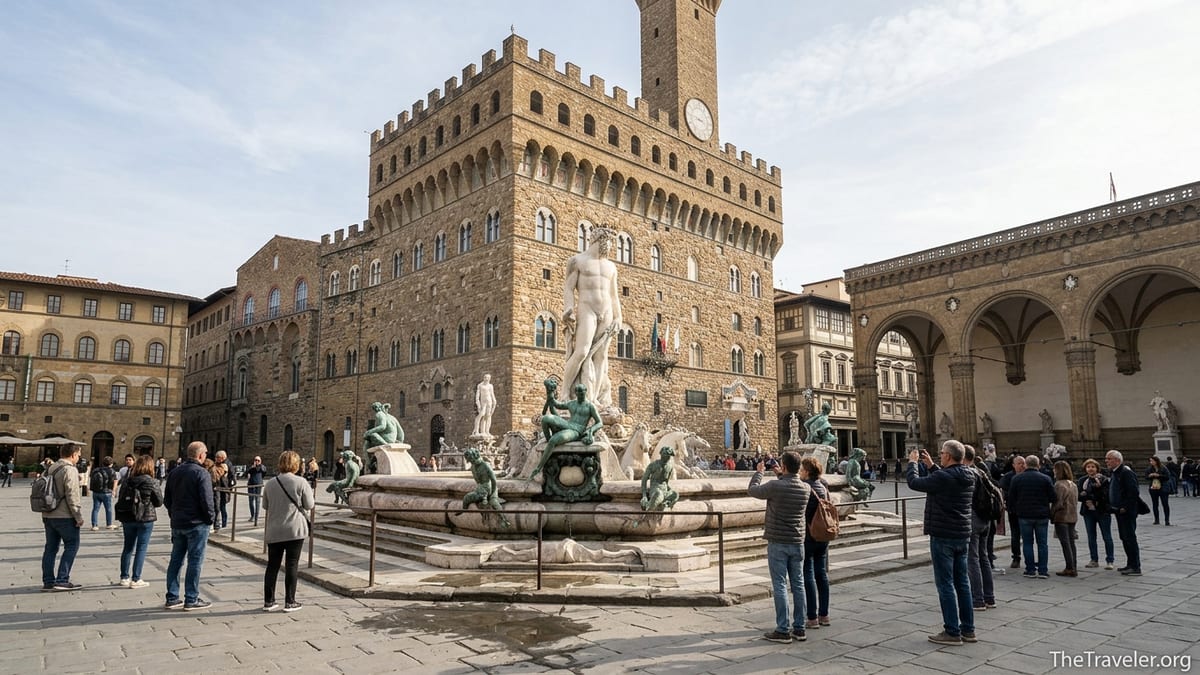
In the heart of Florence’s Piazza della Signoria, surrounded by palaces, museums, and the constant murmur of visitors, the Fountain of Neptune commands attention. Carved from pale marble and framed by bronze sea creatures, it is more than a decorative landmark. For 16th century Florence it was a bold political statement, a feat of hydraulic engineering, and the city’s first monumental public fountain. For today’s travelers, it is one of Florence’s most iconic monuments and an essential stop on any walking tour of the historic center.
Get the latest updates straight to your inbox!
What Is the Fountain of Neptune?
The Fountain of Neptune is a monumental Renaissance fountain in Piazza della Signoria, directly beside the Palazzo Vecchio, Florence’s medieval town hall. Completed in the late 16th century by sculptor Bartolomeo Ammannati with help from other artists, it was designed to celebrate a new aqueduct that finally brought abundant fresh water into the political heart of the city. The central figure is Neptune, the Roman god of the sea, standing in a chariot drawn by four marble horses that seem to surge out of the basin.
For visitors emerging from the nearby Uffizi Gallery or crossing the square on their way to the Arno River, the fountain often provides their first close encounter with large-scale Florentine sculpture in the open air. Locals call it “Il Biancone,” the big white one, a reference to the pale marble and the imposing height of the central figure. At around five meters tall without the base, Neptune towers over the surrounding tourists and the horses at his feet, making the fountain one of the most dramatic focal points of the piazza.
Unlike many fountains that serve mainly as decoration, this one was conceived as a working piece of infrastructure. Its original purpose was to distribute clean water to the people living and working around the square. Even today, when you step into Piazza della Signoria early in the morning before the crowds arrive, the sound of splashing water from the fountain mixes with the bells of Palazzo Vecchio’s tower and the clink of coffee cups from nearby bars.
Modern travelers encounter the fountain as part of a dense cluster of artworks. A few meters away stands a copy of Michelangelo’s David, the statues of the open-air Loggia dei Lanzi, and equestrian monuments to the Medici grand dukes. In this setting, Neptune feels less like a standalone attraction and more like a key character in Florence’s outdoor sculpture museum, which visitors can experience without paying a ticket.
A Medici Power Symbol in Stone and Water
The Fountain of Neptune was commissioned in 1559 by Cosimo I de’ Medici, the first Grand Duke of Tuscany. He wanted a monument that would publicly mark his achievement of bringing a reliable water supply into the city center and, at the same time, broadcast his political ambitions. By choosing Neptune, god of the sea, Cosimo tied his image to Florence’s growing maritime interests, especially through the port of Livorno. The face of Neptune closely resembles portraits of Cosimo himself, a deliberate choice that allowed viewers to associate the ruler with divine authority over water and trade.
For a traveler standing in front of the fountain today, it is easy to miss this political messaging without a guide. Many walking tours that start around 20 to 30 euros per person make a point of stopping here to explain how Renaissance rulers used public art as propaganda. Guides will often encourage visitors to compare Neptune’s profile to the bronze equestrian statue of Cosimo I just across the square, highlighting the similar features and the way both works present him as a strong, stable leader.
The location of the fountain reinforces its political role. Piazza della Signoria has served as Florence’s civic center since the Middle Ages, the place where major announcements were made and public ceremonies held. By placing Neptune directly in front of the seat of government, Cosimo visually connected his dynasty with the republic’s old institutions while demonstrating that real power now flowed through the Medici. For a modern visitor reading a city map, this is obvious: almost every route that crosses the historic center converges on this square, ensuring that Neptune’s image remains unavoidable.
Even the materials used in the fountain carried symbolic weight. The central figure and horses are carved from white marble, while the surrounding figures of river gods, satyrs, and nymphs are bronze. The sharp contrast between the shining white stone and the darker metal would have been especially striking in the 16th century, when the fountain’s waterworks were new and regularly maintained. For today’s traveler, recognizing these details adds depth to what might otherwise be just another photo stop.
Design, Details, and How to Read the Sculpture
At first glance, many visitors see only the towering Neptune and the horses below, but the fountain repays a closer look. Around the edges of the octagonal basin, bronze river gods recline with relaxed but powerful poses, while playful satyrs and sea creatures emerge from the water. Some of these bronzes were created by Giambologna, a leading sculptor of the time whose works you can also admire in the Loggia dei Lanzi nearby. If you walk slowly around the basin, you will notice that no side feels identical, giving the fountain a sense of movement as the figures interact from different angles.
Photography enthusiasts often position themselves near the corner closest to the Uffizi Gallery to capture Neptune, the horses, and the stone facade of Palazzo Vecchio in a single frame. Using a standard smartphone in wide-angle mode, you can fit most of the composition into one shot, although early morning or late afternoon light generally provides the best results. In midday sun, the white marble can appear overexposed, so some travelers find it useful to step back toward the middle of the square and use nearby statues in the foreground as a way to balance brightness.
Some of the most distinctive elements are the four marble horses pulling Neptune’s chariot. They appear to surge forward with flared nostrils and windswept manes, an effect that art historians link to the technical difficulty of carving such dynamic forms out of large, veined blocks of stone. Travelers who are used to seeing static equestrian statues are often surprised by the energy of these creatures, especially when viewed from the side facing the Palazzo Vecchio, where their profiles are sharp against the background of the building.
Water remains essential to the sculpture’s impact. After years of damage and irregular operation, a major restoration completed in 2019 revived many of the original water effects. At night, when the fountain is lit and the water is running, the bronze figures glisten and reflections ripple across the surface of the basin, creating a different atmosphere from the daytime scene. Visitors who stay in central Florence hotels or apartments can easily take an evening stroll through the square to see this more intimate side of the monument, often with fewer tour groups and more local residents passing by.
From Controversy to Classic: Changing Public Opinions
While the Fountain of Neptune is beloved today, its reception in the 16th century was mixed. Many Florentines compared it unfavorably to Michelangelo’s masterpieces and felt the proportions of Neptune’s body were awkward. Jokes circulated in the city, and the nickname “Il Biancone” originally had a slightly mocking tone. For travelers who are familiar with how Parisians once disliked the Eiffel Tower, this history offers a familiar reminder that icons are not always born as such. Over time, repeated public exposure and changing tastes transformed the fountain into a familiar part of the city’s identity.
The fountain also suffered from very practical forms of disrespect. For centuries, residents used the basin to wash clothes and even clean their ink pots, leading to the installation of a stone plaque on the nearby wall of Palazzo Vecchio in the 18th century forbidding such behavior. Today, that plaque still adds a touch of human realism to the story, and guides often point it out during tours as an example of how people of the past interacted with monuments more as everyday utilities than as museum pieces.
In more recent decades, the fountain has faced vandalism and wear from environmental pollution and heavy tourist traffic. One notorious incident in the 2000s saw a visitor climbing onto the statue and breaking part of Neptune’s foot. These episodes, widely reported in Italian newspapers, have informed the strict rules you will see enforced today: barriers around the basin, security cameras, and regular patrols. For travelers, this means photo opportunities but no chance to sit on the edge of the fountain or touch the sculptures, a contrast to older photographs where people gathered much closer.
The change in public attitude can be felt in the way the city now invests in the fountain’s care. Large-scale restorations, supported by public funds and private sponsors, have introduced new pumping systems, waterproofing, and cleaning methods. Travelers visiting after 2019 encounter a monument with brighter marble, more reliable water flow, and better nighttime lighting than at any point in recent memory. What was once criticized as an awkward experiment in public sculpture now stands proudly among the most photographed fountains in Italy.
Visiting the Fountain Today: What Travelers Need to Know
For modern visitors, one of the most appealing aspects of the Fountain of Neptune is that it is completely free to see. Piazza della Signoria is pedestrianized, and the fountain occupies a central position that you will naturally pass if you walk between the Duomo area and the Arno River. Many travelers encounter it as part of a self-guided stroll that also takes in the Uffizi Gallery, the Ponte Vecchio, and nearby shopping streets. Because the square is open at all hours, you can visit as early or as late as you like, making it easy to fit into even a short stay in Florence.
To truly appreciate the fountain without heavy crowds, timing can make a big difference. Arriving between 7:30 and 9:00 in the morning, especially outside peak summer months, often means sharing the square mostly with locals heading to work and a few early-rising photographers. Late evenings after 10:30 can also be atmospheric, with illuminated statues and cooler temperatures. Midday, particularly from May through September, tends to be the busiest, with large group tours that may briefly cluster around the fountain for explanations before moving on.
Practical services around the piazza are convenient for travelers. Several cafes directly on the square and in the side streets serve espresso and pastries in the morning and light meals and aperitivi later in the day. Prices at the terrace cafes overlooking the fountain are generally higher than in side streets, so budget-conscious visitors often grab a cappuccino at a bar a block away and then return to the square to enjoy the view. Public restrooms are available inside nearby museums such as the Palazzo Vecchio or the Uffizi for paying visitors, while independent facilities in the area usually charge a small fee.
The fountain is part of most standard city tours, from large-group walking tours to small-group art history walks focusing on the Medici. Joining a guided tour can help travelers understand references they might otherwise miss, such as the link between Neptune and Cosimo I or the way the fountain fits into a network of Medici-sponsored works across Florence. Families traveling with children often find that guides use the sea monsters and horses as a way to keep younger travelers engaged, turning the visit into a kind of open-air storybook about gods and dukes.
How the Fountain Shapes Florence’s Urban Experience
The Fountain of Neptune is more than a standalone artwork. It plays an active role in how people experience Piazza della Signoria as a living public space. Street musicians often perform at a respectful distance, and their music carries across the water’s surface. Couples pause for photos with the fountain framing Palazzo Vecchio in the background, while sketch artists set up on the edges of the square to capture the monument in pencil or watercolor. During cultural events and city celebrations, the square can fill with crowds, but Neptune remains a fixed point around which the city’s daily life continues to revolve.
For travelers, the fountain often becomes an informal meeting point. Tour guides raise small flags or umbrellas nearby to gather their groups, and friends split up to explore the surrounding streets with a plan to “meet back at Neptune” an hour later. Its visibility from many angles in the square makes it a reliable landmark, similar to the clock tower of Palazzo Vecchio or the copy of David nearby. As a result, even visitors who arrive in Florence with little prior knowledge quickly learn to orient themselves around the fountain.
The monument also anchors an important visual axis that links Florence’s civic and artistic identities. From certain angles, you can look past Neptune toward the Uffizi’s columned courtyard and, beyond that, to the Arno River. From others, the fountain leads the eye to the Loggia dei Lanzi, with its marble and bronze figures under open arches. This visual network is not accidental. Renaissance planners understood that placing the fountain here would create layered views in which art, architecture, and urban space interact. For the modern traveler with a camera, these sightlines translate into some of the city’s most recognizable images.
Seasonal changes also affect how the fountain feels. In high summer, the powerful Tuscan sun makes the white marble almost glow, and the square is alive with visitors from early morning until late at night. In cooler months, the light tends to be softer, and the sound of the water carries more clearly across the relatively quieter piazza. Travelers visiting in late autumn or winter sometimes find they have long stretches of time to contemplate the monument nearly undisturbed, offering a different, more reflective encounter than in peak season.
Comparing Florence’s Neptune with Other Neptune Fountains
Travelers who explore more of Italy or Europe may notice that Neptune appears in fountains from Bologna and Rome to Madrid and beyond. These works share a common theme of depicting the god as a symbol of maritime power, but Florence’s fountain stands out for a few reasons. It was one of the earliest large-scale Renaissance Neptune fountains in a civic center and was closely tied to a specific political program promoting Medici control of trade and water resources.
The Neptune fountain in nearby Bologna, for example, is celebrated for its elegant bronze figure by Giambologna and the boldness of its design. In Rome’s Piazza Navona, another Neptune fountain features dramatic sea creatures and baroque dynamism. Yet both of these stand in spaces that have long histories as commercial markets and social gathering places, while Florence’s Neptune occupies the political core of the city, in front of its historic seat of government. For visitors interested in how urban design reflects power, this difference in context is significant.
Within Florence itself, Neptune also connects to other Medici water projects. Day trippers who cross the river to visit the Boboli Gardens behind the Pitti Palace will find another Neptune fountain there, smaller in scale but similarly tied to themes of control over nature and water. Seeing both in a single visit offers a deeper understanding of how the Medici used fountains across public squares and private gardens to tell a consistent story about their rule.
For many modern travelers, these comparisons develop naturally. Someone might see Bologna’s Neptune on a rail trip between Venice and Florence, then arrive in Piazza della Signoria and recognize the shared iconography. This experience of encountering the same mythological figure in different cities reinforces the idea that the Fountain of Neptune in Florence is part of a broader European tradition, even as it retains its own local character and history.
The Takeaway
The Fountain of Neptune is iconic not only because it is visually striking, but because it concentrates so many layers of Florence’s story in a single place. It marks a turning point in the city’s infrastructure when clean water finally flowed into the civic center. It encodes the ambitions of a powerful dynasty that wanted to be seen as masters of land and sea. It reflects changing attitudes toward public art, from early ridicule and casual everyday use to modern conservation and global admiration.
For travelers, the fountain offers more than a quick snapshot. Spend a few extra minutes circling the basin, noticing the expressions on the bronze figures, the tension in the marble horses, and the way Neptune’s gaze stretches beyond the square. Visit at different times of day if your schedule allows, and consider pairing your stop here with a guided walk focused on the Medici or on Renaissance sculpture. In doing so, you will find that this white marble giant, once a controversial newcomer, still plays a vital role in how Florence presents itself to the world.
FAQ
Q1. Where exactly is the Fountain of Neptune in Florence?
The Fountain of Neptune stands in Piazza della Signoria, next to the Palazzo Vecchio, in the historic center of Florence. It is a short walk from the Uffizi Gallery and the Arno River.
Q2. Why is the Fountain of Neptune considered iconic?
It is iconic because it combines grand Renaissance sculpture, important hydraulic engineering, and political symbolism. As Florence’s first monumental public fountain in its civic heart, it has become one of the city’s most recognizable images.
Q3. Who created the Fountain of Neptune?
The fountain was designed and executed primarily by Bartolomeo Ammannati, with contributions from other artists including Giambologna, a leading sculptor of the late Renaissance.
Q4. When was the Fountain of Neptune built?
Work on the fountain began in the early 1560s, following a commission in 1559, and continued through the 1560s and early 1570s, during the rule of Cosimo I de’ Medici.
Q5. Is there an entrance fee to see the Fountain of Neptune?
No. The fountain stands in a public square that is open at all hours, so there is no entrance fee to see it. Visitors can walk around the monument freely, although barriers prevent climbing or sitting on the structure.
Q6. What is the best time of day to visit the fountain?
Early morning and late evening are often the most pleasant times. In the morning, you can enjoy softer light and fewer crowds, while in the evening the fountain is beautifully lit and the square is more atmospheric.
Q7. Can I drink the water from the Fountain of Neptune?
No. The water in the main fountain basin is not intended for drinking. However, there are modern public drinking fountains with potable water in and around the historic center that travelers can safely use.
Q8. Why does Neptune’s face look like Cosimo I de’ Medici?
The sculptor intentionally gave Neptune features similar to Cosimo I. This visual connection symbolized the ruler’s control over water and maritime power, reinforcing Medici authority through public art.
Q9. Has the fountain been restored recently?
Yes. A major restoration completed in 2019 cleaned the marble and bronze surfaces, improved the water system, and enhanced lighting. Visitors today see a monument much closer to its original appearance than earlier generations did.
Q10. Are there other notable Neptune fountains I can compare it with?
Yes. Other well-known Neptune fountains include those in Bologna and Rome’s Piazza Navona, as well as in cities like Madrid. Comparing them highlights how different places used the same mythological figure to express their own identities and ambitions.