


I had seen Lake Louise a hundred times before I ever stood on its shore. It was on postcards at airport kiosks, screensavers in office cubicles, and glossy tourism posters in train stations. I could have sketched the scene from memory: turquoise water, spruce-framed shoreline, the grand hotel sitting neatly at one end. It all felt almost too familiar. But the first time I followed the trail to the back of the lake and raised my eyes fully to Victoria Glacier hanging above that famous water, the scene I thought I knew so well changed entirely. The tidy postcard dissolved into something raw, vast and unexpectedly intimate.
Get the latest updates straight to your inbox!
From Postcard Pretty to a Living Glacier
The classic view of Lake Louise that most visitors know is taken from the paved shoreline in front of Fairmont Chateau Lake Louise. On a clear July afternoon, you stand shoulder to shoulder with people from all over the world, cameras lifted, trying to frame the palette of unreal blue water and dark, jagged peaks. The glacier is there in the background, a pale smudge between Mount Victoria and Mount Lefroy, but at this distance it can look almost decorative, like a painted backdrop in a theater set.
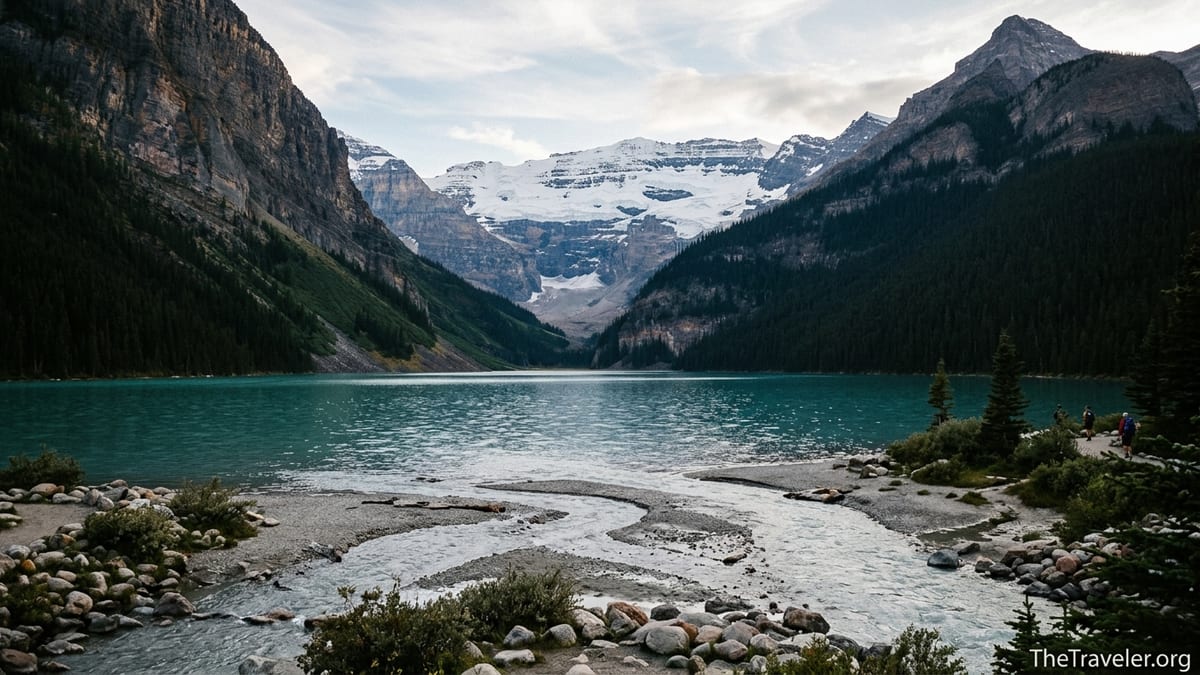
Walking away from the hotel, however, the lake begins to lengthen and deepen. The Lakeshore Trail, a mostly flat 2-kilometre path along the north side of the water, slowly shifts your perspective. The grand hotel shrinks behind you. The fan of rock and silt at the far end of the lake grows wider, and the white mass above the valley begins to separate into texture and depth. What was once just a stripe of snow starts to look like a serious body of ice.
By the time you reach the gravel flats at the back of the lake, the postcard has been replaced by a much more complex scene: braided streams carrying glacial meltwater into the lake, piles of rock that mark where ice used to reach, and a looming wall of peaks with Victoria Glacier tucked into a high cirque. It is still beautiful, but no longer in the tidy, framed way you might have expected from the brochures at the Calgary airport. Instead it feels slightly unsettling, like you have walked behind the façade and discovered all the workings of the landscape.
For many travelers, that is as far as they go. Yet the moment you leave the flats and start up the Plain of Six Glaciers trail toward the glacier itself, you begin to understand how much more there is to this place than a famous color of water.
Climbing Toward the Ice: The Plain of Six Glaciers Trail
The Plain of Six Glaciers trail is the route that transforms Victoria Glacier from a distant accessory into the main character. The hike begins at the far end of Lake Louise and gradually climbs along the valley floor before swinging up onto old glacial moraines. Most guidebooks list it at roughly 13 to 14 kilometres return with about 400 metres of elevation gain, a half-day outing for reasonably fit hikers with sturdy shoes and a couple of litres of water in their packs.
In practical terms, this means you can leave Calgary after an early breakfast, catch a mid-morning Parks Canada shuttle from the Lake Louise Park and Ride up to the lake, stroll the shoreline, and still have time to hike to the Plain of Six Glaciers viewpoint before late afternoon. The first hour is deceptive. You follow a wide trail through forest pockets and avalanche fans, passing families with strollers and couples in city sneakers. It feels almost like an extended lakeside promenade.
Gradually the path narrows and the crowds thin. The soundscape shifts from the low hum of conversation to the sharper crack of rocks underfoot and the occasional rumble echoing off the valley walls. Somewhere above and out of sight, seracs are fracturing and ice is shifting under its own weight. On hot August days, you might hear the pop and hiss of meltwater as it finds new channels beneath the glacier. Every corner in the trail brings the ice closer and makes it feel more alive.
By the time you reach the famous Plain of Six Glaciers Tea House, sitting improbably at around 2,100 metres in a pocket of larch and spruce, you are already in what feels like high mountain country. The restaurant’s wooden deck is a real-world example of how close you can comfortably come to serious ice. Hikers lean against the railings with mugs of black tea and thick slices of chocolate cake, staring straight toward Victoria Glacier’s broken front wall. On a chilly September day, wrapping your hands around a hot drink here, you can watch clouds drag across the glacier’s upper reaches and see the snowline inching lower week by week.
Seeing the Glacier Up Close Changes How You See the Lake
From the main viewpoint beyond the tea house, where the trail climbs onto a ridge of loose stone and ends just shy of the glacier’s debris-covered toe, the familiar tourist image of Lake Louise feels very far away. Instead of turquoise water and tidy shoreline paths, your immediate world is grey rock, blue ice, and deep crevasses that reveal the glacier’s unsettling thickness. The lake that looked so large from the hotel terrace now appears as a tiny oval of color far below, like a dropped fragment of sky.
This reversal of scale is what shifted the scene for me. Looking down, you can trace the path of meltwater from the dirty, crevassed ice you are standing near, through the pale, sediment-heavy streams on the valley floor, into the flat fan of silt at the back of the lake, and finally out into the open blue water. The turquoise that fills so many travel brochures stops being a romantic mystery and becomes something tangible: a product of glacial flour suspended in the water, catching the light.
You also see, in a way that is harder to grasp from the hotel promenade, how temporary this whole composition is. Almost every photo of Victoria Glacier from the 20th century shows the ice extending farther down the valley walls than it does today. When you stand at the modern viewpoint and look at the bare, scraped rock above the glacier, it is easy to imagine the ice once reaching far lower. The moraine you are standing on was built grain by grain as the glacier advanced and retreated. That knowledge subtly alters the picture postcard below; the beauty of Lake Louise starts to feel like a moment caught mid-change, rather than a timeless scene.
It was only when I walked back down, rejoining day-trippers in flip flops near the lake’s outflow, that I realized how different the scene looked to me now. The hotel, the canoes, the polished lakeshore path were all still there. But behind them I now saw the invisible workings of the glacier, the long story of ice that continues to shape the place whether visitors notice it or not.
Planning Your Own Encounter With Victoria Glacier
Experiencing Victoria Glacier this way takes more planning than simply walking from the parking lot to the shore, especially in recent years as visitor numbers to Banff National Park have risen. For most travelers arriving between mid-May and early October, the most reliable approach is to reserve a Parks Canada shuttle from the Lake Louise Park and Ride to the lakeshore. Reservations for the 2026 season opened in mid-April and popular dates sold out quickly, with some morning departures disappearing within the first half-hour of booking.
Once you have a seat secured, the logistics are straightforward. You drive to the Park and Ride near the Lake Louise Ski Resort, park for the day, and board a timed shuttle that drops you right at the lakeshore. Your ticket typically covers the Lake Connector shuttle as well, which allows you to move between Lake Louise and Moraine Lake on the same day without additional bookings. This is helpful if you plan to spend the morning on the Plain of Six Glaciers trail and the evening watching the sun set over the Valley of the Ten Peaks at Moraine Lake.
If you prefer to stay directly at Lake Louise, accommodations range from dorm beds at the Lake Louise Alpine Centre hostel to high-season rooms at Fairmont Chateau Lake Louise that can run to several hundred Canadian dollars per night. Staying on-site allows you to start earlier than the main wave of shuttle arrivals. On a late July morning, being on the trail by 7 am means cooler temperatures, more wildlife sightings and, most importantly for many hikers, a quieter experience on the first half of the Plain of Six Glaciers route.
For independent travelers, the bare minimum kit for this hike includes sturdy footwear, a waterproof shell, layers warm enough for wind at higher elevations, 1.5 to 2 litres of water, and high-calorie snacks or a packed lunch. Weather in the Rockies shifts quickly. It is common for visitors who left Calgary in a T-shirt to arrive at the glacier viewpoint in a stiff breeze cold enough for gloves, particularly in June or September. That temperature shock has a way of reminding you just how much cold is stored in the ice above.
The Human Scale: Tea Houses, Canoes and Stories on the Shore
One of the reasons Victoria Glacier can feel so powerful is the way human-scale details sit directly beside it. At lake level, the clearest example is the cluster of rentable red canoes at the Chateau Lake Louise boathouse. In recent seasons, non-hotel guests have paid on the order of 170 Canadian dollars per hour for the chance to paddle on the water, with hotel guests receiving a substantial discount. Shared between three adults in a canoe, that boat ride becomes a splurge but not an impossibility for many travelers.
Sitting low in one of those canoes, looking back toward Mount Victoria, you feel the lake cupping the glacier’s reflection. Every paddle stroke pulls you a little closer to the silt-laden streams where meltwater flows in. You can actually see the color shift as you approach the back of the lake. It is a luxurious experience in some ways, yet it also puts you in intimate contact with the same forces carving the valley above.
Higher up the valley, the Plain of Six Glaciers Tea House offers a very different but equally human touchpoint. The staff haul supplies up the trail, and the building has no road access. On a busy August afternoon, you may stand in line behind hikers from Singapore, Germany and Alberta farmers on their first mountain holiday, all waiting for homemade soup or a slice of apple crumble. Conversations float between tables about bear sightings, the trail conditions, and the startling cracks they heard coming from the glacier an hour earlier.
Back at the hotel in the evening, the crowds drift out to the shoreline for one last look at the lake as the sun drops behind the peaks. It is easy then to fall back into the familiar pattern: one more photo of the turquoise water, one more attempt to capture the silhouette of the glacier above. Yet if you have spent the day walking in its shadow, Victoria Glacier is no longer an anonymous backdrop in that frame. It has a texture, a sound, and very likely a story for you now.
Responsible Travel in a Changing Glacial Landscape
Spending time so close to a glacier also raises questions that go well beyond photography. Guides in the Lake Louise area often mention how quickly the ice has receded in recent decades. You do not need exact numbers to see this. On clear days, the dark bands of bare rock above Victoria Glacier resemble bathtub rings, marking former ice levels from years when the glacier filled more of the cirque. The Plain of Six Glaciers itself is named for an ensemble of ice bodies, several of which are now fractured or drastically reduced.
As a visitor, the most straightforward way to respond is to travel with a lighter footprint. In practical terms at Lake Louise, that might mean relying on the Parks Canada shuttles or Roam public transit rather than driving your own vehicle, especially given parking restrictions and paid parking at the lakeshore. It might mean choosing lodgings that participate in energy-saving programs, or simply making small decisions such as refilling a reusable water bottle at your hotel instead of buying multiple plastic bottles at the café.
On the trail, responsible behavior becomes even more concrete. Staying on marked paths protects the fragile vegetation growing on the old moraines around Victoria Glacier. Keeping a respectful distance from wildlife, storing food properly and hiking in groups where recommended are not just abstract rules. They are the difference between a valley where bears and hikers can coexist and one where repeated human carelessness leads to closures or relocated animals.
Perhaps the most lasting act of responsibility is less tangible: paying attention. Watching the waterfall tumble off the glacier’s edge on a hot afternoon, seeing the dust plume of a small icefall, or noticing how the melt streams deepen over the course of the day connects you to a living system rather than a static attraction. Many visitors leave Lake Louise with plans to reduce their own emissions at home or to support conservation groups, not because a sign told them to, but because standing under Victoria Glacier made the idea of a warming world feel very present.
The Takeaway
For years, I thought I understood Lake Louise from pictures alone. The first time I looked up at Victoria Glacier from the Plain of Six Glaciers trail, that assumption vanished. What had been a familiar image became a place with scale, sound and movement. The lake below stopped being a turquoise icon and became the visible expression of a much larger engine of ice and rock working quietly above it.
You do not have to be a mountaineer or a glaciologist to feel this shift. You only need enough time to move beyond the hotel terrace, curiosity about what lies at the back of the lake, and the willingness to follow a dusty path until the glacier fills your field of view. With a bit of planning, the modern shuttle system and well-marked trails make that possible for many visitors, from families with school-aged children to solo travelers chasing a few days of mountain air.
In a world where travel images often blur together on phones and social feeds, standing under Victoria Glacier is a reminder that some places still have the power to surprise us in person. Seeing it above Lake Louise does more than complete the postcard. It changes the scene entirely, turning a beautiful picture into a lived, unforgettable encounter with ice and time.
FAQ
Q1. How difficult is the Plain of Six Glaciers hike from Lake Louise?
The Plain of Six Glaciers is generally rated moderate, about 13 to 14 kilometres return with roughly 400 metres of elevation gain, on a well-defined but sometimes rocky trail.
Q2. Do I need a shuttle reservation to see Victoria Glacier and Lake Louise?
In peak season you should plan on it. Parks Canada requires advance reservations for most shuttle seats from the Lake Louise Park and Ride to the lake to manage heavy visitor demand.
Q3. When is the best time of year to see Victoria Glacier above Lake Louise?
Late June through September usually offers snow-free trails and accessible viewpoints, though conditions vary year to year and early autumn can bring sudden snowfalls.
Q4. Can I visit both Lake Louise and Moraine Lake in one day?
Yes, many visitors use a single Parks Canada shuttle booking that includes the Lake Connector, allowing them to see Lake Louise and Moraine Lake on the same day.
Q5. How much time should I budget to hike to the Plain of Six Glaciers viewpoint?
Most hikers take between 4 and 6 hours for the round trip, including breaks, photo stops, and time at the tea house or main viewpoint near the glacier.
Q6. Is specialized gear required to get close to Victoria Glacier?
No technical gear is needed for the standard hiking trail, but sturdy footwear, warm layers, rain protection and sufficient food and water are strongly recommended.
Q7. How much does it cost to canoe on Lake Louise beneath Victoria Glacier?
Recent seasons have seen non-hotel guests paying roughly 170 Canadian dollars per hour per canoe, with lower rates available for guests of the lakeside hotel.
Q8. Can I see Victoria Glacier without doing a long hike?
Yes. The glacier is visible from the main lakeshore near the hotel and along the flat Lakeshore Trail, though hiking partway up the valley provides a much closer view.
Q9. Are there facilities or food options on the Plain of Six Glaciers trail?
There is a rustic tea house operating seasonally partway up the trail that serves drinks and simple meals, but you should still carry your own snacks and water.
Q10. What safety considerations should I keep in mind near Victoria Glacier?
Check current trail reports, be prepared for changing weather, stay on marked paths, keep a safe distance from wildlife and carry bear spray if recommended by park staff.