


Framed perfectly at the far end of turquoise Lake Louise, Victoria Glacier has become one of the most instantly recognizable icefields in the Canadian Rockies. Its serrated ice and snow, clinging high between Mount Victoria and Mount Lefroy, appear in everything from tourism posters and hotel brochures to Instagram feeds and winter ski adverts. Yet its global fame is not just about good looks. Victoria Glacier sits at the intersection of rail history, luxury tourism, alpine adventure and climate storytelling, turning a relatively modest glacier by world standards into a genuine Canadian icon.
Get the latest updates straight to your inbox!
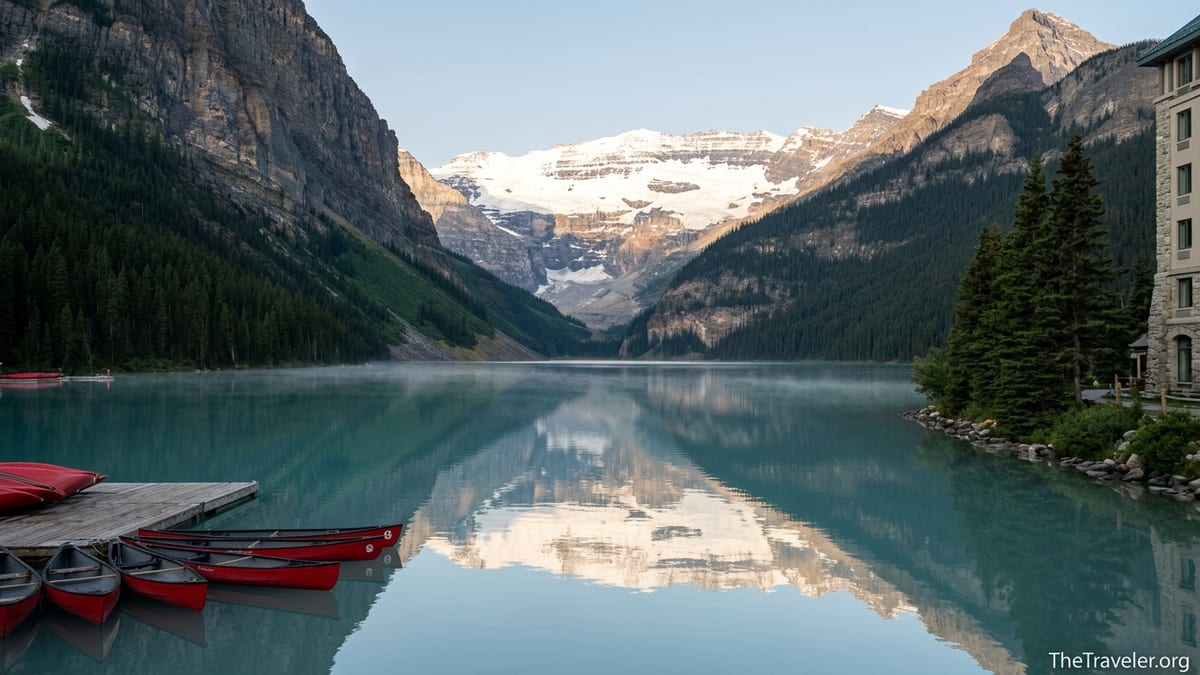
A Glacier Positioned Like a Movie Set
Part of Victoria Glacier’s recognizability comes down to sheer, almost theatrical geography. Standing on the paved lakeshore in front of the Fairmont Chateau Lake Louise, visitors see an uninterrupted sightline across the length of Lake Louise to a white wall of ice and snow cradled between peaks. Parks Canada geologists note that meltwater from Victoria Glacier feeds the lake, creating the opaque, turquoise color that appears in nearly every photograph of Lake Louise. The composition is so clean and symmetrical that even casual visitors with a smartphone can capture a postcard-quality image without effort.
Unlike many major glaciers in the Rockies that require long approaches by car and trail, Victoria Glacier is visible from a hotel lobby, a lakeside bench, or the wooden dock where guests rent canoes in summer. Guests at the Chateau routinely pay a premium for “lakeview” rooms, not just for the water itself but for the glacier backdrop. In winter, an outdoor ice rink and temporary ice castle are carved directly on the frozen surface of Lake Louise, with Victoria Glacier looming behind. The result is a natural stage set that works in every season and at almost every hour of the day.
This accessibility shapes traveler behavior. Families who might never attempt a strenuous mountain hike still leave with clear, close photographs of the glacier, taken after a gentle stroll on the flat shoreline trail or from the terrace of the Lakeview Lounge. For many visitors on tight itineraries between Banff and Jasper, this may be the only glacier they see in person, which further locks Victoria Glacier into their memory of the Canadian Rockies as a whole.
From Railway Secret to International Poster Child
Modern fame for Victoria Glacier began in the late 19th century, when the Canadian Pacific Railway pushed its line through the Rockies and aggressively marketed the mountains to wealthy travelers from Europe and eastern North America. In the 1890s, the company first built a simple chalet near the shore of Lake Louise, specifically to showcase the emerald water and the dramatic glacier at its head. Archival material from the railway and hotel makes it clear that the glacier was central to the sales pitch: advertisements highlighted “the emerald lake and the Victoria Glacier above” as the signature view.
Over time, that chalet grew into what is now the Fairmont Chateau Lake Louise, one of Canada’s grand railway hotels. The property repeatedly expanded in the early and mid 20th century, including a Glacier Wing addition in the 1980s, again signaling how closely the hotel’s identity was tied to the ice-filled panorama outside. Historic black and white photographs in the hotel’s public areas show guests in long dresses and suits lining up on the terrace to be photographed with the glacier behind them, much as visitors with down jackets and smartphones do today.
This continuity matters. When international travel magazines rank the most scenic hotel views in the world, the Chateau’s lakeside facade and its sightline to Victoria Glacier often feature prominently. Recent destination guides produced by the hotel still describe “spectacular views of Lake Louise and Victoria Glacier” as a central reason to stay, and tourism operators in Banff and Lake Louise routinely use the glacier’s silhouette as a visual shorthand in brochures and trade-show backdrops. Over more than a century, repetition in marketing has transformed a single view into a global visual brand.
An Everyday Glacier for First-Time Visitors
For many travelers, Victoria Glacier is not just famous, it is often their first meaningful encounter with glaciation. Visitors arriving on day tours from Banff or Calgary may have heard that the Canadian Rockies are heavily glaciated, yet they rarely distinguish between individual icefields. At Lake Louise, that changes quickly: guides on bus tours and small-group hikes routinely point across the water, name Victoria Glacier specifically, and explain that its meltwater creates the lake’s unusual color.
The practical effect is that visitors leave with a clear mental link between the name and the scene. When they later scroll through their photos or share them online, they label images with “Victoria Glacier at Lake Louise” rather than a generic “glacier in Canada.” Travel blogs and social media posts reinforce this by offering straightforward photo tips such as arriving at the lakeshore early in the morning to catch calm reflections of the glacier, or renting a canoe in late afternoon when side lighting accentuates the glacier’s crevasses.
On the ground, the infrastructure around Lake Louise further anchors the glacier in visitors’ experience. Interpretive panels near the lakeshore walkway mention the role of glaciers, while hotel concierges routinely recommend the Plain of Six Glaciers trail as “the hike that takes you toward the Victoria Glacier.” Local tour operators advertise half-day guided hikes specifically promising closer views of Victoria Glacier and its icefall. These repeated references ensure that the glacier’s name enters traveler vocabulary as naturally as “Banff” or “Lake Louise” itself.
The Hiking Trails That Made the Glacier Intimate
If the lakeshore creates the iconic long-distance view, the trail network behind Lake Louise is what makes Victoria Glacier feel intimate and three dimensional. The Plain of Six Glaciers trail, which begins at the lake’s eastern shore, follows the valley back toward the glacier across approximately 13 to 14 kilometers round trip, depending on the final viewpoint. Modern trail descriptions describe fine views of Mount Victoria, the Victoria Glacier and the debris-filled valley below as hikers approach the headwall, along with the sound of ice and rockfall on warm days.
Partway along this route sits the Plain of Six Glaciers Teahouse, a simple wooden building without road access that serves sandwiches, soups and tea in summer. For many hikers, the chance to drink a pot of tea on the terrace while facing Victoria Glacier is the emotional highlight of their visit. AllTrails and local guide sites consistently rank the route among the top day hikes from Lake Louise, which keeps a steady stream of hikers posting fresh images of the glacier from progressively closer vantage points as they walk up the valley.
Beyond the standard teahouse turnaround, a rougher path continues toward higher viewpoints looking directly onto the upper reaches of Victoria Glacier and the route to Abbot Pass. Photographers who follow this extension often comment that the glacier appears far more massive and complex up close than it does from the lake. The combination of a family-friendly lakeshore path, a moderate classic hike and more adventurous extensions gives Victoria Glacier multiple “faces,” all of them widely shared in guidebooks and online reviews.
Alpine Adventure and the Myth of the Death Trap
Victoria Glacier is also woven into the lore of early mountaineering in the Canadian Rockies. In the early 20th century, Swiss and Austrian guides working for the Canadian Pacific Railway used the glacier as part of the approach route to Abbot Pass, the high saddle between Mount Victoria and Mount Lefroy. From there, climbers tackled both peaks, as well as nearby objectives, turning the glacier into an alpine highway of sorts for the golden age of Rockies mountaineering.
Historical accounts of the construction of the Abbot Pass Hut in the 1920s describe materials being hauled across Victoria Glacier and winched up steep slopes, with the passage across the glacier known ominously as “The Death Trap” due to its exposure to avalanches and crevasses. Over time, stories of rope teams threading through seracs and carrying lumber on their backs entered guide narratives and coffee-table books about the Rockies, giving Victoria Glacier a slightly fearsome, romantic reputation among climbers.
While modern visitors are not encouraged to venture onto the glacier itself without technical skills and equipment, the aura of adventure lingers. Guided mountaineering companies still use historical photographs of climbers standing above Victoria Glacier in their promotional material, and interpretive talks in the Lake Louise area often reference the daring early ascents that crossed the ice. For hikers looking up valley from the Plain of Six Glaciers trail, knowing that these icefalls once formed part of a key alpine route adds a psychological depth to what they see.
Climate Storytelling in Real Time
Over the last several decades, Victoria Glacier has taken on a new kind of visibility as a tangible example of climate change in the Canadian Rockies. Scientific work on Rocky Mountain glaciers shows a consistent pattern of retreat since the mid 19th century, and historical photographs from Lake Louise make that retreat painfully obvious. In early 1900s images displayed in the Chateau Lake Louise and Parks Canada exhibits, ice extends much farther down the valley and appears thicker along the headwall. Contemporary photographs from the same vantage points, taken by tourists and researchers alike, reveal bare rock and moraine where ice once lay.
Because millions of people stand in front of the glacier each year, guides have an unusually direct opportunity to talk about that change. Walks along the lakeshore often include explanations of how a warming climate affects not just the glacier’s mass, but the duration of the lake’s ice cover and the timing of peak meltwater flow into the Bow River system. For visitors who might find technical climate graphs abstract, simply comparing an archival postcard in the hotel lobby to the live view outside can be a powerful lesson.
Travelers also encounter climate messaging in practical ways. Local guide companies may adjust the recommended hiking season for the Plain of Six Glaciers trail when unstable shoulder-season snow complicates access near the glacier. Winter brochures for Lake Louise now balance images of a snow-filled valley with notes about safety around changing ice conditions on the lake. In this way, Victoria Glacier serves both as a photogenic landmark and as a living classroom where people can see environmental change unfolding over human timescales.
Luxury, Wellness and the Glacier View
In recent years, Victoria Glacier has been reinterpreted not only as a symbol of wild nature, but also as a backdrop for wellness and high-end experiences. The Fairmont Chateau Lake Louise, which long sold its lake- and glacier-facing rooms as premium categories, has increasingly integrated the glacier view into spa, dining and retreat offerings. Afternoon tea in the hotel’s lakeview venues is marketed as much for the sightlines to Victoria Glacier as for the cakes and finger sandwiches, with prices reflecting the exclusivity of the setting.
A new generation of wellness facilities at the Chateau continues this trend by incorporating broad picture windows oriented directly toward the glacier. Editorial coverage of a recently opened thermal spa concept at the lake emphasizes how the building has been “carved” into the landscape to frame uninterrupted views of Lake Louise and its glacier. Guests frequently share candid photos from heated outdoor pools and relaxation lounges where Victoria Glacier dominates the horizon, presenting the experience as a blend of alpine wildness and curated comfort.
These developments illustrate how an already-famous landscape can be repackaged for contemporary tastes. A century ago, visitors in tailored wool suits posed stiffly on the terrace; today, yoga retreats and corporate leadership workshops use the glacier backdrop as a setting for mindfulness sessions or brainstorming breaks. In every case, Victoria Glacier functions as both scenery and silent participant in the experience.
The Takeaway
Victoria Glacier became one of the most recognizable glaciers in the Canadian Rockies because so many different forces converge on a single view. Geography placed a striking hanging glacier at the end of a perfectly framed turquoise lake. Railway and hotel visionaries turned that view into a global postcard, ensuring it appeared in travel brochures, rail posters and coffee-table books for more than a century. Trail builders and alpine guides made the glacier accessible from multiple angles, helping everyday visitors feel close to an environment that might otherwise seem remote.
In the 21st century, climate science and wellness travel layered new meanings onto the same scene. Today, a traveler might wake up in a lakeview room, photograph the glacier at sunrise from the shore, hike toward it along the Plain of Six Glaciers, hear about its retreat from a guide, and end the day watching twilight settle over the ice from a spa pool or lounge chair. Few other glaciers in the Rockies are woven so tightly into everyday itineraries. For visitors planning a Canadian Rockies trip, understanding Victoria Glacier’s role in the story of Lake Louise offers not just a beautiful view, but a lens on how natural wonders become symbols, classrooms and companions in our travels.
FAQ
Q1. Where exactly is Victoria Glacier located?
Victoria Glacier sits at the head of Lake Louise in Banff National Park, Alberta, high between Mount Victoria and Mount Lefroy, forming the dramatic backdrop seen from the lakeshore and the Fairmont Chateau Lake Louise.
Q2. Can I walk on Victoria Glacier without a guide?
No. While you can see Victoria Glacier clearly from the lakeshore and from hiking trails like the Plain of Six Glaciers, actually traveling on the glacier involves crevasses, avalanche terrain and other hazards, and should only be attempted with appropriate training and equipment, typically under the supervision of certified mountain guides on specialized mountaineering trips.
Q3. What is the best easy way to see Victoria Glacier?
The easiest way is simply to follow the flat shoreline path along Lake Louise from the parking area or hotel. Within a few minutes you get classic, unobstructed views of the glacier, and continuing to the far end of the lake gives a slightly closer, more dramatic perspective without significant elevation gain.
Q4. How difficult is the Plain of Six Glaciers hike for closer views?
The Plain of Six Glaciers trail is generally rated moderate. It is a well-trodden mountain path of roughly 13 to 14 kilometers round trip with steady but not technical elevation gain. Most reasonably fit hikers who are comfortable with uneven terrain and alpine weather can complete it in half a day, allowing time for a break at the teahouse and glacier viewpoints.
Q5. Is Victoria Glacier shrinking because of climate change?
Historical photographs and scientific studies show that Victoria Glacier, like most glaciers in the Canadian Rockies, has retreated since the late 19th century. While year-to-year snow conditions vary, the longer-term trend is a reduction in ice extent and thickness, which visitors can see by comparing older images on display in the Lake Louise area with what they view from the shore today.
Q6. When is the best season to photograph Victoria Glacier?
Summer and early autumn are ideal for photographing the glacier reflected in open water, especially in the calm early morning or late evening light. Winter also offers striking images, with the glacier rising above a frozen, snow-covered lake and seasonal ice sculptures on the surface, though reflections are absent when the lake is frozen.
Q7. Do I need to stay at the Fairmont Chateau Lake Louise to see the glacier?
No. The lakeshore, public pathways and main viewpoints are all accessible without staying at the hotel, and day visitors regularly drive or take shuttle buses to Lake Louise to enjoy the glacier view. Overnight guests at the Chateau simply have the advantage of sunrise and late-evening access right outside their door.
Q8. Are there other hikes with views of Victoria Glacier besides Plain of Six Glaciers?
Yes. Trails such as the Highline connector between the Lake Agnes and Plain of Six Glaciers areas, and higher objectives like the Big Beehive, offer more elevated angles on Lake Louise with Victoria Glacier beyond. These routes tend to be longer and steeper than the lakeshore walk but reward hikers with more expansive panoramas of the entire valley.
Q9. Is Victoria Glacier suitable for families with young children to experience?
Families with young children often enjoy the glacier from the flat shoreline path, the hotel terrace or rental canoes in summer, without attempting more demanding hikes. Older children and teenagers with hiking experience may appreciate the Plain of Six Glaciers trail, provided the family is prepared for mountain weather, carries snacks and water, and allows ample time for breaks and the return journey.
Q10. Why is the water of Lake Louise so turquoise under Victoria Glacier?
The distinctive turquoise color comes from fine rock flour produced as Victoria Glacier grinds over bedrock. Meltwater carries this suspended sediment into Lake Louise, where it scatters sunlight in a way that gives the water its opaque, milky-green to blue hue that appears so vividly in photographs of the glacier and lake together.