


Victoria Glacier is the icy crown that makes Lake Louise one of the most recognizable mountain scenes on Earth. Yet many visitors never see more than the classic postcard view from the hotel shoreline. With a bit of planning, you can get much closer to the glacier, discover quieter vantage points, and bring home photographs that go beyond the standard snapshot. This guide explains how to see Victoria Glacier at its best, which hikes offer the most rewarding views, and how to navigate logistics like shuttles, parking and crowds.
Get the latest updates straight to your inbox!
Understanding Victoria Glacier and the Lake Louise Setting
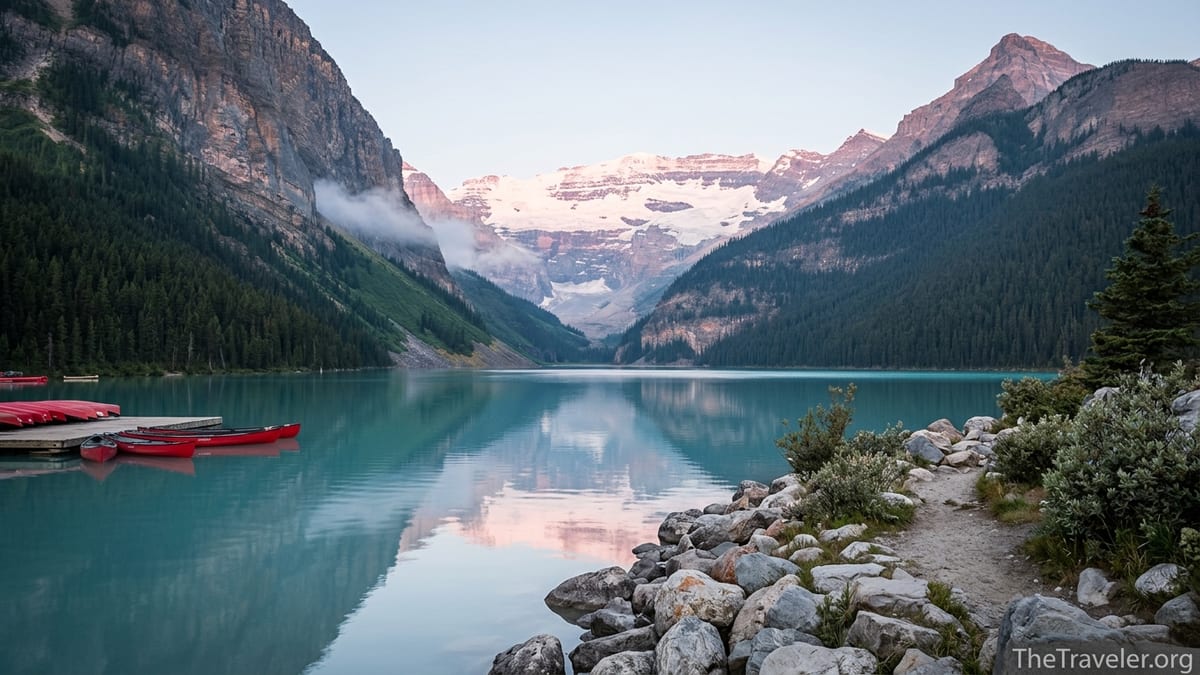
Victoria Glacier clings to the north face of Mount Victoria at the western end of Lake Louise in Banff National Park, Alberta. From the lakeshore, it appears as a broad tongue of ice spilling between Mount Victoria and Mount Lefroy, framed by steep cliffs and hanging snowfields. The glacier is part of the vast Wapta Icefield system and feeds the turquoise waters that give Lake Louise its famous color. Even if you never step onto a trail, simply standing at the water’s edge and tracing the glacier’s crevasses with your eyes is a powerful experience.
Like most glaciers in the Canadian Rockies, Victoria Glacier has been retreating over the past century. You can see the evidence in the polished rock slabs and moraines at the far end of the lake, and in historic photos displayed inside the Fairmont Chateau Lake Louise showing how much farther the ice once reached. This context makes viewpoints that bring you closer to the glacier feel especially meaningful. You are not just admiring a pretty backdrop but seeing a living, changing landscape shaped by ice, snow, and time.
Because Victoria Glacier dominates the western skyline of Lake Louise, almost every major hike from the lakeshore offers at least one memorable angle on it. Short walks like the Lakeshore Trail and Fairview Lookout give casual visitors easy access to views, while full-day outings like the Plain of Six Glaciers take you nearly to the glacier’s snout. Knowing what each route offers in terms of difficulty, distance and perspective will help you match the experience to your time, fitness and camera gear.
Season matters too. In early summer, the glacier is draped in fresh snow and avalanche debris, while the lake may still be partly frozen. By late July and August, the ice is more defined and the lake glows its brightest turquoise. In autumn, larch trees turn gold on nearby slopes and fresh dustings of snow highlight the glacier’s layers. Most visitors planning to hike close to Victoria Glacier target a window from late June through late September, when trails are generally clear of snow and shuttles and services operate reliably.
Essential Logistics: Getting to Lake Louise and Victoria Glacier Views
Lake Louise sits just off the Trans-Canada Highway, about a 40-minute drive from the town of Banff and roughly two hours from Calgary. In peak summer, private vehicle access to the main Lake Louise lakeshore parking lot is tightly managed, with paid parking and frequent full signs early in the morning. Many travelers now plan around the Parks Canada shuttle system that runs from a park-and-ride lot near the Lake Louise Ski Resort to both Lake Louise and nearby Moraine Lake in summer. A shuttle seat typically costs a modest per-person fee and must be reserved in advance, especially for July and August dates.
For a day focused on Victoria Glacier, the simplest plan is to book a morning shuttle to Lake Louise and start your hikes directly from the lakeshore. Almost all classic routes, from the flat Lakeshore Trail to the Plain of Six Glaciers and the Lake Agnes and Big Beehive loop, begin within a short walk of the drop-off area in front of the Fairmont Chateau Lake Louise. If you are staying overnight at the chateau or at one of the small lodges in the Lake Louise village, you can often walk or take a hotel shuttle to the lakeshore and skip the park-and-ride entirely.
Tour companies based in Banff, Canmore and Calgary also offer day trips that bundle transportation, time at Lake Louise, and sometimes a guided hike. This can be worthwhile if you prefer not to drive mountain highways or handle shuttle bookings yourself. However, guided options are usually much more expensive than reserving your own shuttle seats and hiking independently. If you are on a budget, using the public shuttle system and packing your own picnic is usually the best value.
Weather in the Lake Louise and Victoria Glacier area can change quickly, even in mid-summer. A sunny forecast from Calgary does not guarantee clear views at the lake. Clouds often collect at the head of the valley, shrouding the glacier while the rest of the sky remains blue. Build flexibility into your schedule: if you wake up to heavy cloud or rain, consider swapping days with more flexible activities like exploring Banff town, and hit the glacier hikes when the forecast improves. Starting early in the morning not only helps with crowds but also increases your chance of calm water and soft light for photography.
Iconic Lakeshore Viewpoints and Easy Walks
The easiest and most famous view of Victoria Glacier is from the main Lake Louise shoreline, a few steps from the Fairmont Chateau. From this spot, you get the classic composition: the lake stretching out in front of you, the hotel at your back, and the glacier framed perfectly at the far end of the water. At sunrise on a calm day, the scene can be remarkably still, with the glacier, cliffs and sky reflecting almost perfectly on the lake’s surface. Photographers often arrive 30 to 60 minutes before sunrise in July and August to claim a spot along the stone wall by the water.
For visitors who want an easy stroll with gradually shifting views of Victoria Glacier, the Lakeshore Trail runs along the northern edge of Lake Louise for roughly 4 kilometers round trip. The path is wide, mostly flat, and suitable for most fitness levels and for families with sturdy strollers. As you walk toward the far end of the lake, the glacier appears to grow larger and more dramatic, and you begin to appreciate the U-shaped valley it carved. Near the western end, you can scramble a few meters onto lakeside rocks for slightly elevated angles where the turquoise water leads your eye directly to the glacier.
Another rewarding but short outing is the Fairview Lookout trail, which climbs through forest above the southeast side of the lake to a wooden viewing platform. The hike is relatively steep but only around a kilometer each way, with about 100 meters of elevation gain. From the platform, you look down onto the Fairmont Chateau, Lake Louise and the full amphitheater of peaks, with Victoria Glacier forming the centerpiece at the head of the valley. This is an excellent option if you have just an hour between shuttle times or want a warm-up before a longer hike.
If you prefer to stay near the hotel, even walking a couple of minutes along the lakeshore to the canoe dock can change your sense of scale. From that vantage, red rental canoes sliding across the water create a strong foreground contrast with the white glacier in the distance. It is a good place to test different focal lengths on your camera: wide angles to capture the full valley, or mid-range zooms around 70 to 100 millimeters to isolate the glacier and its surrounding cliffs.
Plain of Six Glaciers: Getting Up Close to Victoria Glacier
For hikers who want to feel the presence of Victoria Glacier rather than just admire it from afar, the Plain of Six Glaciers trail is the premier route. This moderate hike is typically described as around 14 kilometers round trip from the Lake Louise shoreline to the upper viewpoint, with roughly 500 to 600 meters of elevation gain depending on your exact turnaround point. The path follows the Lakeshore Trail before rising into the hanging valley behind the lake, tracing old moraine ridges and skirting avalanche slopes carved by generations of ice.
After about 6 kilometers, you reach the historic Plain of Six Glaciers Teahouse, a rustic cabin serving simple meals, baked goods and hot drinks during the main hiking season. Many visitors choose this as their goal, enjoying a slice of cake or a pot of tea on the deck with views toward the glaciers. If you continue another 1 to 1.5 kilometers beyond the teahouse, the trail becomes rougher and more alpine, ending at a high viewpoint that faces directly toward Victoria Glacier and its neighbors. Here you can often hear the distant crack and rumble of falling ice and see seracs and crevasses in surprising detail.
This upper section provides some of the most dramatic and intimate views of Victoria Glacier available to regular hikers. You stand on a broad scree slope looking into a cirque of ice, rock and snow, with Mount Victoria towering above. On clear days, hikers sometimes spend an hour or more here, scanning the glacier with binoculars or a telephoto lens. Rock windbreaks built by previous visitors offer a bit of shelter if the weather turns breezy. In late summer, afternoon thunderstorms are common, so starting the hike before mid-morning is wise to avoid being high in the valley when lightning risk increases.
In practical terms, the Plain of Six Glaciers is a full half-day outing for most people, taking around 4 to 6 hours depending on pace and stops. Good trail shoes or hiking boots, a warm layer and rain shell, and at least 1.5 to 2 liters of water per person are recommended. There are no reliable water sources once you leave the lakeshore, and there is no cell service for much of the route. Bears occasionally travel along the valley, so carrying bear spray and hiking in small groups is standard practice. On summer weekends, the trail can be busy, which has the side benefit of added safety and a sense of shared adventure.
Higher Vantage Points: Lake Agnes, Big Beehive and Fairview Mountain
While the Plain of Six Glaciers brings you closer to Victoria Glacier horizontally, several other classic hikes above Lake Louise give you higher, more panoramic viewpoints where the glacier becomes part of a wider mountain tableau. The Lake Agnes trail climbs from the lakeshore through dense forest to an alpine lake and historic teahouse around 3.5 kilometers one-way, with a steady elevation gain of about 400 meters. From the tea house area, the glacier is mostly hidden, but you are well positioned to continue toward loftier lookouts.
The Big Beehive route, which begins from Lake Agnes, is a favorite for photographers who want to look straight down on Lake Louise with Victoria Glacier at the head of the valley. From Lake Agnes, the trail climbs via switchbacks to a broad, rounded summit with several wooden benches and rock outcrops. The full hike from the lakeshore to Big Beehive and back is often quoted at roughly 10 kilometers round trip with over 600 meters of elevation gain, so it is more demanding than the Lakeshore or Fairview Lookout but manageable for fit hikers. On a clear day, the bird’s-eye view of the lake’s turquoise water, tiny red canoes, and distant glacier is unforgettable.
Another advanced option is Fairview Mountain, which rises directly above the south shore of Lake Louise. The standard route is steep and rocky, typically around 7 to 8 kilometers round trip with more than 1,000 meters of vertical gain. Hikers are rewarded with a summit panorama that includes Lake Louise, the Bow Valley, and a full sweep of peaks, including Victoria Glacier nestled in its high cirque. This is a serious mountain hike that often holds snow into early summer and is best suited to experienced hikers equipped with proper footwear, layers and an understanding of alpine weather.
These higher viewpoints suit photographers who are comfortable carrying a bit more gear. A light tripod, a zoom lens covering roughly 24 to 200 millimeters, and a polarizing filter can help manage reflections and bring out texture in the glacier. Be conservative with your timing: even in midsummer, it is wise to be off exposed high ridges by late afternoon, especially if clouds start to build to the west. Starting early, pacing yourself, and taking advantage of benches and rock ledges for short breaks will keep the day enjoyable rather than exhausting.
Best Photo Spots and Practical Photography Tips
Victoria Glacier offers striking compositions for everyone from smartphone users to serious photographers. Around the immediate lakeshore, three easy-access photo spots stand out. First is the stone wall directly in front of the Fairmont Chateau, where the classic straight-on view aligns the lake and glacier. Second is the rocky area near the canoe dock, ideal for framing red canoes with the glacier in the background. Third is the far western end of the Lakeshore Trail, where driftwood and boulders create natural foreground elements leading toward the ice. Visiting all three only requires a comfortable walk and can easily be done within two or three hours.
Higher up, the upper viewpoint on the Plain of Six Glaciers trail and the Big Beehive lookout offer more dramatic angles. From the glacier viewpoint, using a mid-range to telephoto lens lets you capture deep cracks in the ice, small avalanches, and the contrast between ancient snow and freshly fallen debris. From Big Beehive, wide-angle lenses around 16 to 24 millimeters on a full-frame camera emphasize the drop toward Lake Louise and show how the glacier anchors the valley. Even with a phone, the panorama mode at Big Beehive can create sweeping images that include the lake, hotel and glacier together.
Light is crucial around Lake Louise, where steep valley walls throw early and late shadows across the water. In summer, sunrise often provides the calmest water and warmest tones on the peaks, though the glacier itself may remain partly in shade for a while. Midday light can be harsh but is sometimes the only time the glacier is fully illuminated, which can be useful for detail shots from the Plain of Six Glaciers. Late afternoon and early evening give softer, more directional light on the cliffs, though reflections can be broken by afternoon winds. Planning one sunrise session and one mid- or late-day hike will give you a good variety of conditions.
To keep gear safe and usable in this environment, pack it in a weather-resistant daypack with a simple internal organization: camera body with one attached lens, a spare battery in a small pouch, and a microfiber cloth for spray or drizzle. Rapid weather changes mean you may need to tuck your camera away between shots as rain showers pass. If you are traveling with a tripod, be mindful of where you set it up on busy viewpoints; keeping to one side and limiting your time in prime spots helps everyone enjoy the view. Most importantly, remember to put the camera away for a few moments and experience the glacier and mountains with your own eyes.
Safety, Seasons and Responsible Glacier Viewing
While the trails around Lake Louise and Victoria Glacier are well-established, the environment remains wild and unforgiving if you are unprepared. Even in July and August, temperatures can drop quickly with passing storms, and hail or wet snow is not unheard of at higher elevations. Carry a compact waterproof jacket, an insulating layer like a fleece, and thin gloves in your daypack, even if the day starts sunny and warm. Good footwear with solid traction is essential on the rockier sections of the Plain of Six Glaciers and the steeper climbs toward Big Beehive and Fairview Mountain.
Wildlife is another key consideration. The valley around Lake Louise is habitat for black bears and occasionally grizzly bears. Local guidance emphasizes hiking in small groups, making noise periodically on quieter sections of trail, and carrying bear spray where you can access it quickly rather than buried in your pack. Many visitors join friends they meet at the lakeshore to form impromptu groups before setting out on longer hikes. All food waste and packaging should be packed out, and snacks are best eaten away from brushy trail edges where animals might be foraging.
Trail conditions and access can change from year to year, especially as managers respond to erosion, high visitation and environmental concerns. Seasonal closures for avalanche risk, grizzly feeding areas or trail maintenance are not uncommon, particularly in shoulder seasons like May and October. Before you travel, check the latest Banff National Park bulletins and visitor information for up-to-date trail status, shuttle schedules and any restrictions on parking or access. Staff at the Lake Louise visitor center can also provide current advice on when Victoria Glacier viewpoints are snow-free and which hikes best suit your fitness and time.
Finally, remember that Victoria Glacier is a dynamic, receding feature. Staying on marked trails and respecting barriers is not only safer but also helps limit additional stress on delicate alpine vegetation and unstable moraines. Rockfall, hidden ice under thin debris, and sudden changes in stream levels can all pose hazards near the glacier’s toe. Viewing it from designated lookouts and established paths still offers outstanding experiences and photographs while helping to preserve the area for future visitors and the wildlife that lives there.
The Takeaway
Seeing Victoria Glacier is one of the highlights of any trip to the Canadian Rockies, and you do not have to be a mountaineer to experience it in a meaningful way. From the simple pleasure of watching sunrise paint the ice from the Lake Louise shoreline to the awe of standing almost beneath the glacier on the Plain of Six Glaciers trail, the valley offers options for every fitness level and interest. With thoughtful planning around shuttles, weather and trail choices, you can fit multiple viewpoints into a single day and come away with both lasting memories and standout photographs.
Whether you choose a relaxed stroll to Fairview Lookout, a moderate hike to the teahouse and glacier viewpoint, or a full day linking Lake Agnes and Big Beehive, you will see different faces of the same remarkable landscape. The turquoise lake, dark conifer forests, pale cliffs and luminous ice combine into a scene that feels both iconic and deeply personal when you are standing there in person. Pack well, start early, and give yourself time simply to sit and watch light move across the glacier. In a region full of famous views, Victoria Glacier still has the power to surprise those who take the time to look closely.
FAQ
Q1. What is the easiest way to see Victoria Glacier if I am not a hiker?
The easiest option is to ride the summer shuttle to Lake Louise, walk a few steps to the lakeshore in front of the Fairmont Chateau, and enjoy the classic head-on view of Victoria Glacier without leaving the paved path.
Q2. When is the best time of year to visit Victoria Glacier viewpoints?
Most travelers aim for late June through late September, when trails like Plain of Six Glaciers and Lake Agnes are usually snow-free and shuttle services operate consistently, offering the widest choice of viewpoints.
Q3. How long does the Plain of Six Glaciers hike take for an average visitor?
For most reasonably fit hikers, the round trip from the Lake Louise shoreline to the upper glacier viewpoint and back takes about 4 to 6 hours, including rest stops and time to admire the views.
Q4. Do I need special equipment to hike near Victoria Glacier?
You do not need technical climbing gear, but you should have sturdy hiking shoes or boots, a waterproof jacket, warm layers, sun protection, water, snacks, and ideally bear spray for longer routes like Plain of Six Glaciers and Big Beehive.
Q5. Can I visit Lake Louise and Moraine Lake on the same day to see different glacier views?
Yes, many visitors book a Parks Canada shuttle that connects the park-and-ride with both Lake Louise and Moraine Lake in one day, but you should reserve your shuttle times in advance and allow enough hours at each lake.
Q6. Is it possible to see Victoria Glacier at sunrise without staying at the Fairmont Chateau?
It is possible but requires careful planning. You would need very early access via shuttle or private transport from nearby accommodations, and in peak season that can mean booking specific early departures or staying in the Lake Louise village.
Q7. Are there good viewpoints of Victoria Glacier suitable for families with young children?
Yes, the flat Lakeshore Trail along the north side of Lake Louise and the area right by the hotel both offer excellent glacier views with minimal elevation gain, making them ideal for families with strollers or young kids.
Q8. What should photographers prioritize if they have only one day at Lake Louise?
Photographers often combine a sunrise session at the main shoreline with a mid-morning hike to either Fairview Lookout or the Plain of Six Glaciers, giving them both the classic reflection shot and closer views of Victoria Glacier.
Q9. Are there any safety concerns specific to the Victoria Glacier area?
The main concerns are quickly changing mountain weather, occasional snow or ice on higher trails, and the presence of bears. Staying on marked trails, carrying proper clothing and bear spray, and checking current conditions helps manage these risks.
Q10. Can I walk on Victoria Glacier itself without a guide?
No, walking on the glacier is not recommended without specialized training and equipment, and there are no standard public trails onto the ice. Most visitors experience Victoria Glacier safely from established viewpoints and hiking routes around Lake Louise.