


Sendai rarely appears on first‑time Japan itineraries dominated by Tokyo, Kyoto and Osaka, yet it is the natural gateway to the Tohoku region and one of the easiest medium‑sized Japanese cities for independent travel. With fast bullet trains from Tokyo, compact sightseeing areas and strong regional food traditions, Sendai works both as a relaxed city base and a springboard to coastal scenery, hot springs and historic temples.
Get the latest updates straight to your inbox!
Why Sendai Belongs on a First‑Time Japan Itinerary
Sendai is the largest city in Japan’s Tohoku region and the capital of Miyagi Prefecture, roughly 300 kilometers north of Tokyo on the Pacific coast. The city center clusters around JR Sendai Station, which sits on the Tohoku Shinkansen line. Bullet trains cover the Tokyo to Sendai run in about 90 minutes on the fastest Hayabusa services, so many travelers find it no more demanding than crossing Tokyo itself by commuter train.
For first‑time visitors, Sendai offers a softer landing than Tokyo. The downtown grid is compact and walkable, English signage is improving around major stations and attractions, and the core sights line up along a simple transport spine of subway lines, a loop sightseeing bus and short local train rides. You can comfortably explore central Sendai on foot, topping up with the Loople sightseeing bus or the two‑line subway system when hills or weather make walking less appealing.
Two or three full days in the city is enough to see the main Date Masamune‑related sights, sample local food and stroll the tree‑lined avenues that earned Sendai its “City of Trees” nickname. With Matsushima Bay, Yamadera and hot‑spring towns such as Akiu Onsen within an hour or so, a four‑day stay lets you combine urban exploring with classic Tohoku landscapes. Travel is straightforward for foreigners: IC cards work on most local transport, many restaurants display plastic food models or bilingual menus, and tourism offices around Sendai Station offer free maps in English and other languages.
Compared with Kyoto or Osaka, Sendai feels less crowded and more local. There are fewer blockbuster temples, but more chances to step into everyday markets, back‑street izakaya pubs and neighborhood parks used by residents rather than tour buses. For travelers who want to see a different side of Japan without sacrificing convenience, Sendai is a strong alternative or add‑on to a classic Tokyo–Kyoto route.
Essential Sights: Castles, Shrines, Markets and Green Streets
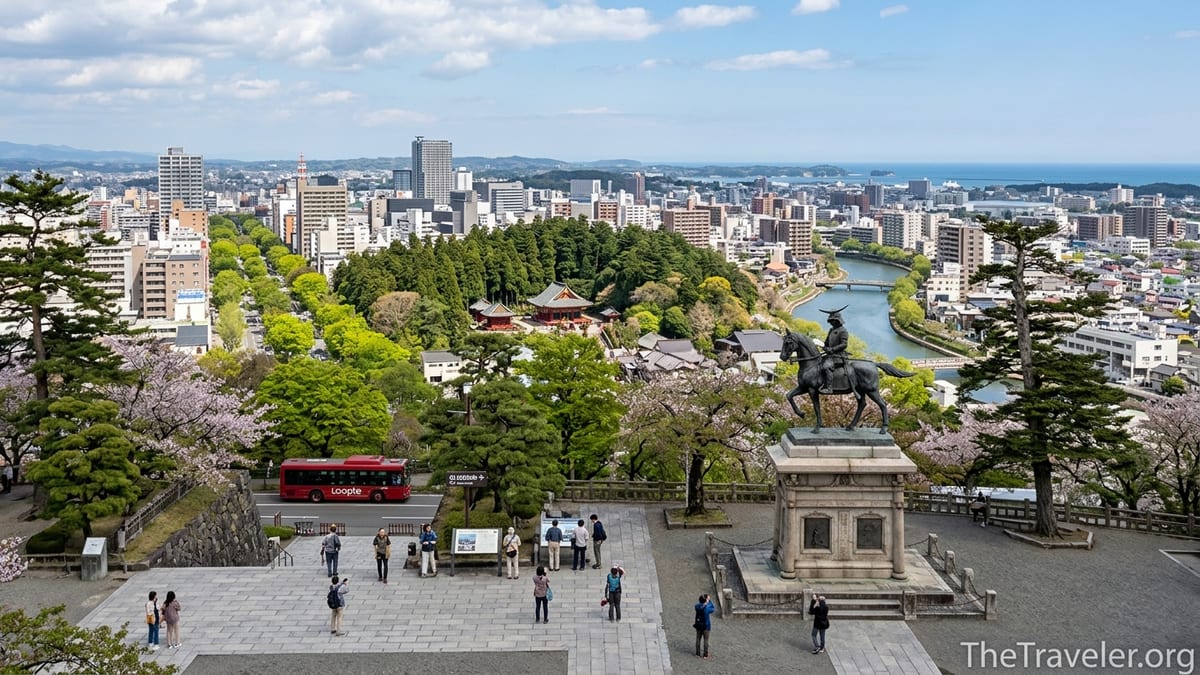
Most first‑time visitors start with the hilltop remains of Sendai Castle, often called Aoba Castle. Little of the original fortress survives beyond stone walls and reconstructed gates, but the site delivers one of the city’s best viewpoints, looking across the modern skyline and out toward the mountains. A statue of feudal lord Date Masamune on horseback dominates the plaza, and small information panels introduce his role in shaping the city.
From the castle area, wooded paths lead toward the Aoba Castle ruins and viewpoints over the Hirose River valley. On a clear day you can see how pockets of forest cut into the city, a reminder that Sendai was planned as a castle town with green belts. Visiting the castle ruins works well in combination with the nearby Sendai City Museum or a walk down to Jozenji‑dori Avenue, so it fits naturally into a single half‑day without complicated transfers.
South of the castle hill lies Zuihoden, the ornate mausoleum complex of Date Masamune, set among tall cedar trees. The buildings are richly decorated with colorful lacquer and carvings, offering an atmospheric contrast to Kyoto’s temples. The site includes small exhibition rooms about Masamune and subsequent lords, but it is compact enough that even travelers with limited interest in feudal history can appreciate the setting in under an hour. The approach road climbs steadily, so many visitors pair it with the Loople bus to reduce uphill walking.
Back at street level, Osaki Hachimangu Shrine sits in a leafy neighborhood northwest of the center, notable for its black lacquered main hall and gold detailing, reconstructed based on early Edo‑period designs. In downtown Sendai, the broad, tree‑lined Jozenji‑dori Avenue runs west from the shopping areas, framed by zelkova trees that glow green in early summer and amber in autumn. Nearby, the covered Ichibancho shopping arcades stretch for several blocks with fashion stores, coffee chains, arcades and small izakaya tucked into side passages. Between them, the compact Sendai Morning Market near the station gives a glimpse of daily life, with stalls selling seasonal vegetables, local fish, pickles and ready‑to‑eat croquettes.
Understanding Date Masamune Without a History Lecture
Sendai’s most visible historical figure is Date Masamune, the one‑eyed warlord whose equestrian statue appears on countless postcards. In the early 17th century he established Sendai as his castle town, laying out streets, supporting temples and encouraging trade that leveraged the region’s rivers and coastal access. His reputation as a bold, outward‑looking leader still shapes how Sendai markets itself, from sake labels to festival imagery.
For modern visitors, Masamune matters less for the details of his battles and more for the physical city he left behind. The choice of elevated castle grounds above the Hirose River, the pattern of samurai districts and merchant quarters, and the patronage of temples such as Zuiganji in nearby Matsushima all trace back to his rule. Walking between Aoba Castle, Zuihoden and Osaki Hachimangu in a single day connects these strands in a tangible way, especially if you pause at information boards that show old maps alongside today’s streets.
The city presents this history in digestible doses rather than long museum texts. At Zuihoden, bilingual panels explain why the mausoleum’s bright colors differ from the subdued wooden halls many travelers know from Kyoto. At the Sendai City Museum near the former castle site, compact exhibits gather armor, documents and trade goods associated with the Date clan, which helps put the scattered monuments into context. If you are short on time, a simple combination of the castle viewpoint and Zuihoden already gives a sense of why Sendai looks and feels different from other Japanese cities.
Food in Sendai: Gyutan, Zunda and Coastal Seafood
Food is one of Sendai’s easiest pleasures. The city is nationally famous for gyutan, grilled slices of beef tongue that became a local specialty after the Second World War. Today you will see gyutan restaurants inside JR Sendai Station and along central streets, often advertising set meals with grilled tongue, barley rice and oxtail soup. Typical prices for a standard set in 2026 are around 2,000 to 3,000 yen depending on portion size and brand, with chains such as Rikyu offering branches convenient for travelers catching trains.
Another signature flavor is zunda, a sweet paste made from mashed edamame beans. It appears on mochi rice cakes, in parfaits and increasingly in soft‑serve ice cream. Cafes around Sendai Station and in shopping arcades sell zunda shakes or sundaes for a few hundred yen, providing an easy introduction even for visitors unsure about bean‑based desserts. Because zunda is mildly sweet and slightly nutty, it appeals to travelers who find some Japanese wagashi confections too sugary.
Sendai also benefits from its coastal location. Fresh oysters and other seafood from nearby Matsushima Bay and Ishinomaki reach city restaurants quickly, especially during the cooler months when shellfish are in season. Modest standing sushi bars in and around the station offer individual nigiri from about 150 yen a piece, while mid‑range seafood izakaya in the downtown area plate up sashimi assortments and grilled fish sets in the 1,500 to 3,000 yen range at dinner. For budget travelers, supermarket prepared foods in the basement of department stores near Sendai Station can provide good value bento boxes and sushi trays in the 600 to 1,000 yen bracket before closing discounts.
Miyagi Prefecture is also a respected sake region. Bars and specialty shops carry labels from breweries in Urakasumi, Ichinokura and other local producers. Some izakaya offer tasting flights so you can compare dry coastal styles with richer inland brews without committing to a full bottle. Expect a glass of local sake in a casual bar to start around 600 to 800 yen. Many places have at least one English menu page or will label sake from “dry” to “sweet,” and staff are generally welcoming if you explain you are a beginner.
Getting Around: Loople Bus, Subway, IC Cards and Walking
Central Sendai is compact enough that confident walkers can cover much of it on foot. From JR Sendai Station to the heart of the Ichibancho shopping arcades is about 10 to 15 minutes at a relaxed pace, and Jozenji‑dori Avenue lies another 5 minutes beyond. However, key sights such as the castle ruins, Zuihoden and Osaki Hachimangu sit on hills or in outlying districts, which is where local transport becomes useful.
The Loople Sendai sightseeing bus is designed for visitors. It follows a one‑way loop linking Sendai Station with major sights including the castle area, Zuihoden, the museum district and Osaki Hachimangu. As of late 2026, the standard adult fare is 300 yen per ride, or 700 yen for a one‑day pass that pays off after three trips and allows hop‑on, hop‑off flexibility. The buses are smaller than regular city buses and can fill up during holiday periods, so aim for earlier departures on weekends and during the August Tanabata Festival.
Under the streets, two Sendai Subway lines form a simple cross, meeting at Sendai Station. The north‑south Namboku Line runs between Izumi‑chuo and Tomizawa, while the east‑west Tozai Line runs between Yagiyama Zoological Park and Arai. The network totals around 29 stations, and typical one‑way fares for short hops between central stations are in the 200 to 260 yen range. Trains are frequent during the day and clearly signed with English station names, making them straightforward to use even on a first visit.
Most visitors rely on IC cards to move around without buying individual paper tickets. Nationwide cards such as Suica and PASMO normally work on Sendai’s subways, JR local lines, Loople buses and many shops and vending machines, subject to any temporary issuance pauses. If you do not already have a card from Tokyo, ticket machines in Sendai Station and subway stations sell local IC cards and accept cash. Top‑ups can be made with cash or, at some machines, credit card. Walking remains the best way to experience Jozenji‑dori, the Ichibancho arcades and the area around Kotodai‑Koen, but combining short subway rides with the Loople bus keeps hills and long distances manageable.
Where to Stay: Station Convenience vs Downtown Atmosphere
Accommodation in Sendai clusters around two main areas: the blocks surrounding JR Sendai Station and the downtown shopping and nightlife districts near Hirose‑dori and Kotodai‑Koen stations. Both zones suit first‑time visitors, but the experience differs slightly.
Hotels near Sendai Station favor convenience. You will find business hotels, mid‑range chains and a few higher‑end properties directly connected to or within a few minutes’ walk of the station concourses. This makes arrivals and departures with luggage easy, especially if you are catching early‑morning Shinkansen services or using the Sendai Airport Access Line. Many of these properties include simple breakfast buffets, laundry corners and small but well‑designed rooms aimed at domestic business travelers. For foreign visitors, the main advantage is seamless access to all rail and bus services.
In contrast, staying closer to the Ichibancho arcades or the streets near Kotodai‑Koen and Jozenji‑dori places you within a short walk of most evening dining and nightlife options. Small boutique hotels and budget properties above shops put you closer to local izakaya, bars and cafes, so you can wander under the covered arcades or along the tree‑lined avenue after dark without worrying about the last subway home. The trade‑off is a slightly longer walk or short subway ride to reach JR Sendai Station when traveling out of town.
For trip planning, many visitors choose station‑area hotels for one‑ or two‑night stays focused on day trips and rail convenience, and downtown properties for longer stays where evening atmosphere matters more. Because Sendai is less saturated with overseas group tours than Kyoto, room rates outside festival periods are often more forgiving, freeing up budget for extra meals, side trips or a splurge on a hot‑spring ryokan in nearby Akiu or Sakunami.
Practical Itineraries: Two, Three and Four Days in Sendai
A focused two‑day stay works well for travelers folding Sendai into a larger Japan itinerary. On day one, base yourself around central Sendai: start at the Sendai Morning Market near the station for a simple breakfast such as onigiri rice balls and croquettes, then stroll through the Ichibancho arcades toward Jozenji‑dori Avenue. After coffee along the tree‑lined boulevard, use the Loople bus from the city hall or Sendai Station area to reach the Sendai Castle ruins for city views and the Date Masamune statue. Continue by Loople to Zuihoden and the nearby museum cluster before looping back downtown for dinner on gyutan or local seafood.
On a three‑day plan, dedicate your second full day to Matsushima Bay. From JR Sendai Station, frequent local trains on the JR Senseki Line reach Matsushima‑Kaigan Station in roughly 40 minutes. From there it is a short walk to the waterfront, where cruise operators run 40‑minute sightseeing boats through the bay’s pine‑covered islets, with standard adult tickets around 1,500 yen. After a cruise, visit Zuiganji Temple, an important Zen temple rebuilt under Date Masamune with a long, atmospheric approach lined with caves once used as meditation cells. Depending on your pace, you can either return to Sendai for dinner or linger in Matsushima for grilled oysters and seasonal seafood before taking an evening train back.
A four‑day itinerary allows for a second side trip. One common pattern is to keep days one and three in Sendai city, visit Matsushima on day two, and choose between Yamadera or a hot‑spring town on day four. Yamadera, officially Risshakuji Temple, lies about an hour from Sendai on the JR Senzan Line, followed by a climb of more than 1,000 stone steps to halls and viewpoints clinging to the mountainside. In dry conditions the ascent is manageable for reasonably fit travelers wearing proper footwear, but in winter or after heavy rain some visitors may prefer to stay in the lower precincts.
Hot‑spring fans might instead head to Akiu Onsen or Sakunami Onsen, both accessible by bus or JR local lines plus short transfers. Akiu lies southwest of the city and combines large ryokan hotels with riverside walks and a waterfall area, while Sakunami to the northwest feels more tucked into forested valleys. Some ryokan welcome day visitors for bathing, usually requiring a modest entrance fee and, in busier seasons, advance reservations. Because these resorts involve extra travel time and schedules can change, it is worth checking current bus or train timetables at Sendai Station’s tourist information counter the day before you go.
Matsushima, Day Trips and When to Reserve Ahead
Matsushima Bay ranks as one of Japan’s classic scenic views, and its location about 25 kilometers from Sendai makes it the city’s signature excursion. For a short sightseeing visit, many travelers ride a morning JR Senseki Line train from Sendai to Matsushima‑Kaigan, take a mid‑morning bay cruise, visit Zuiganji and the small museum streets near the waterfront, then return to Sendai mid‑afternoon. This pattern suits itineraries where Sendai is just one stop among many and keeps accommodation changes to a minimum.
A full‑day Matsushima excursion opens up more options. You can combine the standard bay cruise with a walk across bridges to some of the small islands open to the public, such as Fukuura Island, and linger in local shops selling grilled oysters, kamaboko fish cakes and seaweed products. With more time, it becomes easier to adjust plans for changing weather or tide conditions. Bay cruises usually run in light rain, but visibility is better on clear days, so some visitors pencil Matsushima into a flexible slot in their itinerary and decide the exact day closer to the time.
Yamadera, Akiu Onsen and Sakunami Onsen are all realistic day trips from a Sendai base in 2027. Yamadera trains can be crowded during autumn foliage and around major holidays, but individual tickets rarely sell out far in advance. For hot‑spring resorts, overnight stays at popular ryokan may require advance reservations, especially on weekends or during leaf‑peeping season. Day‑use bathing plans, where non‑staying guests can soak for a few hours, sometimes have limited capacity or fixed time windows, so it is wise to ask your hotel or the tourist office to phone ahead on your behalf.
Other options for travelers with more time include coastal towns recovering from the 2011 tsunami, where museums and memorials document the disaster and reconstruction. These visits demand more planning, both emotionally and logistically, and are best approached with up‑to‑date local advice on transport and opening hours. For a first‑time trip focused on variety without stress, combining Sendai city, Matsushima, and either Yamadera or a hot‑spring town usually strikes a good balance.
Getting There: Shinkansen from Tokyo and Access from the Airport
From Tokyo, the Tohoku Shinkansen is the most efficient way to reach Sendai. In 2026 fare tables, the base fare between Tokyo and Sendai is around 6,270 yen, with the fastest Hayabusa services charging a total one‑way price of roughly 11,600 yen for a reserved ordinary‑class seat in regular season. Journey time is about 90 minutes, and trains run frequently throughout the day. Slightly slower Yamabiko services cost a little less in express surcharge and make more intermediate stops, but most visitors prioritize schedule over small savings.
Whether to use a rail pass or buy individual tickets depends on your broader itinerary. If you plan multiple long‑distance Tohoku or Hokkaido trips within a short period, regional passes sold by JR East can offer good value, but their prices and conditions change frequently, so always check the latest details before committing. For travelers only riding between Tokyo and Sendai and perhaps making a shorter side trip, individual Shinkansen tickets are often more economical and flexible. Seat reservations are compulsory on Hayabusa services, while some Yamabiko trains have non‑reserved cars; booking a reserved seat is recommended during holiday seasons and on Friday and Sunday afternoons.
Sendai Airport lies about 17 to 25 minutes from JR Sendai Station by the Sendai Airport Access Line, depending on whether you take rapid or local trains. As of early 2026, the one‑way adult fare is around 660 to 680 yen with a paper ticket, with IC card fares a few yen cheaper. Trains run directly into the station complex with step‑free connections, so most visitors find the airport transfer straightforward even with luggage. Taxis are available but far more expensive for solo travelers, so the train remains the default choice unless you are arriving very late or carrying bulky equipment.
Because timetables and fares can change by 2027, especially after national fare revisions, it is smart to confirm your planned trains closer to departure using a current timetable service or by checking at JR ticket counters. Booking Shinkansen seats a day or two ahead normally suffices outside major holidays such as Golden Week, Obon and New Year, and many foreign visitors successfully buy same‑day tickets at Tokyo Station for Sendai even in winter travel periods.
Seasons, Budgets, Etiquette and How Sendai Compares
Seasonal changes shape the Sendai experience. In early April, cherry blossoms open around parks and rivers in the city and at nearby sites such as Mikamine Park and the grounds of castles in the wider region. Summer brings the Sendai Tanabata Festival in early August, when colorful streamers decorate the shopping arcades and hotels near downtown and the station book out well in advance. Autumn, from late October into November at higher elevations, often brings clear skies and foliage in city parks and surrounding mountains. Winters can be cold and occasionally snowy, especially inland toward Yamadera, so packing warm layers and footwear with good grip is important if you plan outdoor walks.
For daily budgets, independent travelers can plan around 10,000 to 15,000 yen per person per day in Sendai for mid‑range comfort, excluding long‑distance rail. This allows for a business‑hotel room share, local transport, attraction fees such as Zuihoden and cruises, and two to three meals including occasional sit‑down dinners. Budget travelers using hostel beds, supermarket food and walking more can live on less, while those adding ryokan stays with meals in Akiu or Sakunami should budget higher nightly amounts. Credit cards are widely accepted in hotels, department stores and larger restaurants, but carrying several thousand yen in cash helps with small eateries, local buses and temple donations.
Standard Japanese etiquette applies. Speaking softly on public transport, standing on the correct side of escalators as marked, removing shoes when indicated and handling money with both hands go a long way. In hot‑spring baths, wash thoroughly before entering shared tubs and keep towels out of the water. English levels vary, but staff in tourist‑facing businesses are accustomed to overseas visitors, and simple phrases combined with pointing at menus usually suffice. Sendai’s sidewalks and public buildings generally offer good step‑free routes and elevators, though some older shrines, castle viewpoints and Yamadera’s upper paths involve unavoidable stairs.
Compared with Kyoto, Sendai has far fewer headline temples but also far fewer crowds and tour buses. You will not find the same concentration of UNESCO sites or traditional machiya townhouses, yet you may spend more time actually enjoying quiet temple gardens, tree‑lined streets and neighborhood markets instead of queuing for photo spots. For travelers with only a week in Japan, Tokyo plus Kyoto and perhaps one other classic destination still makes sense. However, for trips of ten days or longer, or for second‑time visitors eager to see a different side of the country, shifting a few nights from Kansai to Sendai and Tohoku opens up new landscapes, food traditions and conversations with locals who encounter fewer foreign tourists.
Ultimately, Sendai rewards travelers who value atmosphere and variety over checklists. It will not replace Kyoto’s temple circuits or Tokyo’s neon sprawl, but as a base for exploring Tohoku’s coasts, mountains and hot springs with modern city comforts at hand, it provides a practical and engaging alternative that fits naturally into Japan itineraries for 2027 and beyond.