


Look at a map of Tuscany and Siena sits like a medieval jewel on a ridge of terracotta roofs, cypress-dotted hills rolling away in every direction. For many travelers planning Italy, it appears as a tempting side note after Florence, Rome, and Venice. The question is not whether Siena is beautiful. It is whether it deserves a dedicated place on your travel bucket list and precious days within a tight itinerary. The answer depends on what you value most in a trip to Italy: art, atmosphere, food, festivals, or simply slowing down in a smaller city that still feels intensely local.
Get the latest updates straight to your inbox!
Siena at a Glance: What Kind of Traveler Will Love It
Siena is a compact hilltop city in central Tuscany, about 70 to 80 minutes by regional train or bus from Florence, depending on the route and connection. Regional trains typically require a change at Empoli and take around 1.5 to 2 hours, while direct buses from Florence’s main station arrive right by Siena’s historic center in roughly 75 minutes. That ease of access makes it realistic both as a day trip and as a base for several nights in Tuscany.
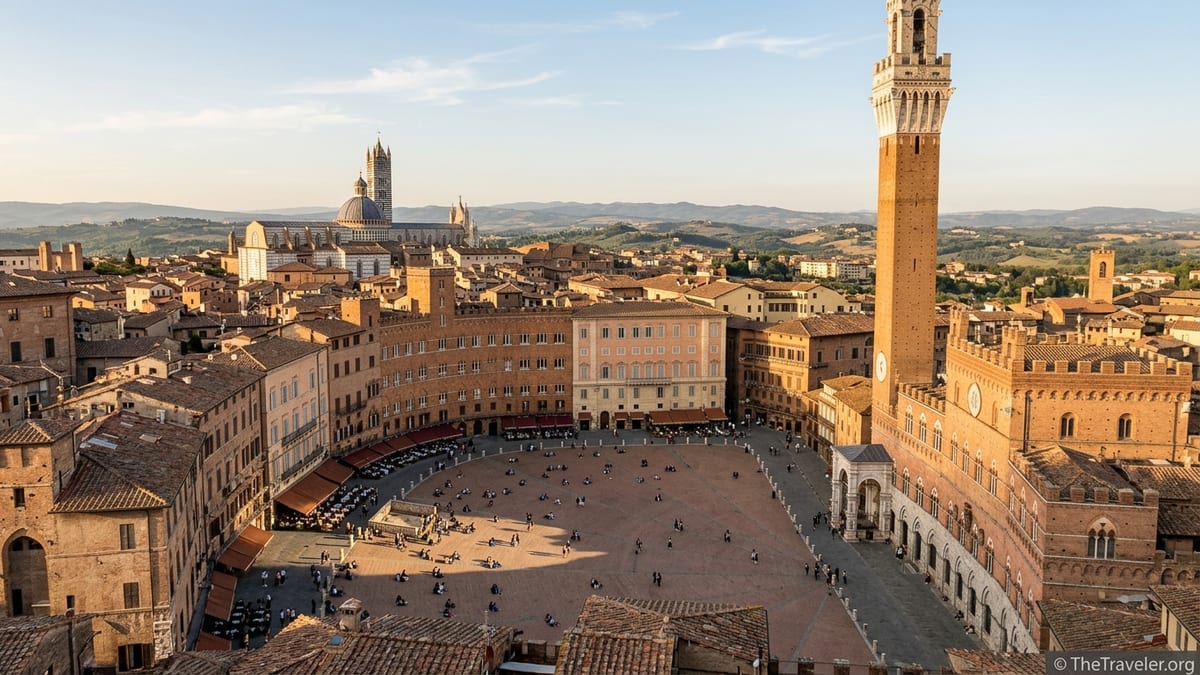
Unlike sprawling Rome or fashion-forward Milan, Siena feels intimate and consistently medieval in character. Its UNESCO-listed historic center is a tight maze of brick lanes leading toward two focal points: Piazza del Campo, one of Europe’s great public squares, and the Duomo, an extravagant Gothic cathedral of black and white marble. You can cross the old town on foot in 20 to 30 minutes, but the steep alleys and steps make it feel like a small city built vertically rather than horizontally.
Travelers who tend to fall in love with Siena are those who enjoy lingering in atmospheric places as much as ticking off big-name museums. If your idea of a perfect Italian afternoon is ordering an espresso at a café on Piazza del Campo, watching local kids chase pigeons while office workers weave past on bicycles, Siena will likely rank high on your list. Food-focused travelers, especially fans of rustic Tuscan cooking, also find plenty to love here, from pici pasta in tomato and garlic sauce to hearty ribollita soup and wines from nearby Chianti and Montalcino.
On the other hand, if you are pursuing a dense checklist of museums, palaces, and nightlife in limited time, Siena may feel quieter than you expect. It has excellent art and history, but on a more concentrated scale than Florence or Venice. That is exactly why many visitors choose it: a place where evenings may end with a glass of local red in a small enoteca rather than a packed bar crawl.
Essential Highlights: What You Can Actually See and Do
Piazza del Campo is usually the first stop. The shell-shaped square slopes gently down toward the Palazzo Pubblico and its tall Torre del Mangia. Travelers often grab a spot at a café like Nannini or one of the simple trattorie ringing the square and order a cappuccino in the morning or an Aperol spritz toward sunset. Expect to pay a slight premium for the view compared with side streets, but many visitors consider it worth it to linger on one of Italy’s most theatrical public stages.
Just a few minutes uphill, the Duomo di Siena offers a very different kind of drama. This Gothic cathedral is famous for its bold striped exterior and intricate marble inlaid floors that are uncovered in full for limited weeks each year, usually late summer or early fall. Combination tickets for the cathedral complex, which may include the Duomo, Piccolomini Library, museum, and panoramic viewpoint, generally cost under 25 euros for adults, with seasonal variations and discounts for children and students. That puts it roughly on par with major church complexes like Florence’s Duomo, but in a more compact site that you can explore in a morning.
Climbing the Torre del Mangia on Piazza del Campo is another standout experience if you can handle narrow staircases. The ascent rewards you with a sweeping view over Siena’s terracotta rooftops and the broad Tuscan countryside. Combine it with a visit to the Palazzo Pubblico’s civic museum to see Lorenzetti’s famous fresco cycle, which contrasts good and bad government in vivid narrative scenes. Even travelers with only a passing interest in art often find these frescoes surprisingly modern and accessible, a window into how medieval Sienese imagined their own city life.
Beyond the headline sights, Siena is especially rewarding for unstructured wandering. Follow Via di Città or Via Banchi di Sopra, the main commercial streets, and then duck into side alleys where laundry hangs over the lanes and small alimentari shops still sell local pecorino cheese, cured meats, and simple sandwiches. Many travelers pick up picnic supplies here and walk 10 to 15 minutes out to viewpoints near the Medici Fortress park, where city walls drop away to views of vineyards and olive groves.
Atmosphere, Food, and Local Life: How Siena Feels on the Ground
What tends to set Siena apart from many other Italian cities is how strongly local identity still shapes daily life. The city is divided into 17 contrade, or neighborhood districts, each with its own flag, colors, and community center. Even outside peak festival season you will see banners hanging above streets and locals wearing scarves in their contrada colors. Travelers who enjoy understanding the social fabric of a destination often find that learning even a little about these neighborhoods, perhaps by visiting a small contrada museum on an open day, adds a layer of meaning to every walk through town.
The culinary scene leans traditional, with a focus on Tuscan classics at a mix of family-run trattorie and slightly more polished osterie. A typical dinner at a mid-range spot just off Piazza del Campo might feature crostini with chicken liver pâté, a plate of hand-rolled pici al ragù, and a glass or two of Chianti Classico, coming to roughly 25 to 35 euros per person without dessert. Move farther from the main square and you can find simpler neighborhood places where a generous bowl of pasta and a house wine might cost closer to 15 to 20 euros.
Sweet-toothed travelers should not leave without trying at least one of Siena’s signature desserts. Ricciarelli are soft almond cookies dusted in sugar, while panforte is a dense, spiced fruit-and-nut cake often sold in wedges at bakeries and specialty food shops. Many visitors buy a small box of each near the Campo or along Via di Città to take home as edible souvenirs that travel well and evoke Siena at the first bite.
Evenings in Siena tend to be relaxed. In the warmer months, students from the local university mingle with residents on the Campo or along the main streets, and it is common to see groups of friends sharing a bottle of wine on the brick pavement as the sky turns pink over the Palazzo Pubblico. You will find a handful of wine bars and late-night cafés around the center, but do not expect the high-energy club scene of larger cities. For many travelers, that mellow rhythm is exactly what makes Siena memorable.
Timing Your Visit: Palio, Crowds, and Shoulder Seasons
No discussion of Siena is complete without the Palio, the intense bareback horse race held in Piazza del Campo in honor of the Virgin Mary. Historically, the Palio runs twice a year, on or around 2 July and 16 August, with dates confirmed and managed by the city government. The days leading up to each race are filled with practice runs, neighborhood dinners, and religious processions. For locals, it is a profound cultural and spiritual event rather than a tourist show, and it transforms Siena’s atmosphere completely.
Experiencing the Palio in person is extraordinary but not for everyone. The square fills with thousands of spectators standing in the central infield under the summer sun, while others have paid for reserved spots on balconies or temporary stands built along the track. Accommodation prices typically spike for the race dates, and many hotels and guesthouses impose multi-night minimum stays. Travelers who are sensitive to crowds or heat often prefer to visit Siena in late May, early June, September, or October, when the weather is pleasant and the city is lively but more manageable.
Outside Palio season, Siena still hosts plenty of events that can add local color without overwhelming the city. In early March many cycling fans visit for the Strade Bianche road race, which starts and finishes in Siena and sends riders over the region’s famous white gravel roads. In December, Christmas markets and light installations often appear around Piazza del Campo and Piazza del Duomo, creating a festive backdrop for winter trips. If your schedule is flexible, checking what is on in Siena during your travel dates can help you decide whether to plan a quiet cultural visit or time your stay with a particular event.
Weather-wise, Siena follows classic central Italian patterns. Summers can be hot, with daytime highs frequently above 30 degrees Celsius in July and August, and the steep streets can feel taxing in the midday sun. Spring and autumn bring milder temperatures, with many days in the high teens to low twenties Celsius, making them ideal for walking and combining Siena with day trips into the surrounding countryside. Winter is cooler and quieter, with shorter opening hours at some attractions, but also fewer day trippers and a more local feel in the evenings.
Costs, Logistics, and How Long to Stay
In terms of daily costs, Siena usually sits slightly below Florence and Venice but above many small Tuscan towns. A central three-star hotel or well-reviewed guesthouse within a 10-minute walk of Piazza del Campo often starts around 120 to 160 euros per night for a double room in spring and autumn, rising in peak summer and during Palio dates. Four-star properties and boutique hotels with views or historic interiors frequently start closer to 200 to 250 euros per night in high season. Budget-conscious travelers can reduce costs by staying just outside the historic walls or choosing agriturismi in the nearby countryside and reaching Siena by car or bus.
Train tickets from Florence to Siena on regional services are often in the range of 10 to 15 euros one way in second class, with the exact fare depending on the specific train and how far in advance you book. Because these are regional services, they do not usually sell out in the way high-speed trains can, and many travelers buy tickets a day or even a few hours before departure. Direct buses from Florence to Siena’s center are another practical option, often priced similarly or slightly less than the train and with the advantage of arriving closer to the Campo without the uphill walk from Siena’s modern train station.
Within Sicily-sized Italy, Siena’s compact size means you will likely walk everywhere once you arrive, though be prepared for steep gradients and staircases. The city also levies a nightly tourist tax, as many Italian destinations do, which is collected by accommodations and varies according to category and season. For a typical three- or four-star hotel, you might expect a few euros per person per night up to a set maximum number of nights. It is a small line item compared with accommodation and dining, but worth factoring into your budget so it does not come as a surprise at check-out.
As for how long to stay, many travelers first meet Siena on a day trip from Florence, arriving mid-morning and leaving after dinner. In that time you can comfortably visit the Duomo complex, climb either the Cathedral viewpoint or Torre del Mangia, stroll the main streets, and linger on the Campo. However, staying one or two nights reveals a different side of the city. Early mornings when delivery vans are the only traffic on the brick lanes, or late nights when the Campo empties and contrada flags rustle in the breeze, are when Siena feels least like a postcard and most like a lived-in Tuscan city.
Day Trip vs Base: When Siena Belongs at the Center of Your Itinerary
Whether Siena should simply be a day trip or a base for exploring Tuscany is one of the most practical decisions for your itinerary. If you have fewer than seven full days in Italy and are splitting time between several major cities, a day trip from Florence is often the most efficient choice. You avoid changing hotels and can still experience Siena’s core sights and atmosphere in a single long day, returning to Florence for its broader dining and nightlife options.
However, Siena starts to shine as a base once you have more time to spend in central Italy. From Siena, you can reach many classic Tuscan destinations on half-day or day trips: the wine towns of Montalcino and Montepulciano, the hot springs around Bagno Vignoni, and hilltop villages such as San Gimignano and Pienza. Organized small-group tours often depart from Siena in the morning and include tastings at wineries in Chianti or Brunello country, lunch at a farmhouse, and a couple of scenic stops, typically costing in the ballpark of 90 to 150 euros per person depending on group size and inclusions.
Travelers who prefer public transport can still use Siena as a hub, but should be prepared for slower journeys and occasional transfers. Buses run to many nearby towns, and regional trains connect to Florence, Pisa, and Grosseto. Renting a car for a day or two expands your options dramatically, allowing you to follow the white gravel “strade bianche” roads past vineyards and cypress alleys and to stop at smaller villages that barely appear in guidebooks. Many visitors compromise by keeping Siena as their no-car base and hiring a driver or joining a tour for countryside days to avoid the challenges of driving and parking in historic zones.
If your dream Italy trip includes waking up to church bells instead of traffic noise, shopping in small alimentari for picnic ingredients, and returning each evening to the same familiar streets, making Siena your base for three to five nights can feel deeply satisfying. Those who thrive on variety and nightlife, on the other hand, may prefer to keep Florence or Rome as their main base and enjoy Siena as one well-chosen chapter in a broader journey.
The Takeaway
So should you add Siena to your Italy travel bucket list? For most travelers with a week or more in the country, the answer is yes, with the caveat that how you include it should match your travel style. Siena offers a remarkably intact medieval center, top-tier art and architecture in a compact package, and a strong sense of local identity through its contrade and long-running Palio traditions. It is large enough to feel like a real city, yet small enough that you can quickly get your bearings and start to recognize favorite corners and cafés.
If your trip is your first and very short, you may prioritize Rome, Florence, and Venice and still feel you have only skimmed the surface of Italy. In that case, Siena as a day trip from Florence can be the perfect compromise: a taste of Tuscan hill town life without the logistics of another hotel change. Travelers returning to Italy, or those who value atmosphere and slower rhythms as much as big-name attractions, may want to grant Siena two or three nights to experience it beyond the afternoon crowds.
Ultimately, adding Siena to your bucket list is less about collecting another UNESCO site and more about embracing a particular flavor of Italian life: one where evenings are spent on a brick-paved square, church bells frame the day, and neighborhood loyalties still matter deeply. Whether you stand in the shadow of the Duomo’s striped façade, watch the sun set from Torre del Mangia, or wander quiet backstreets during blue hour, Siena has a way of lodging itself in memory, subtle but enduring.
FAQ
Q1. Is Siena worth visiting if I am already going to Florence?
Siena offers a very different atmosphere from Florence, with a smaller, more medieval center and a strong neighborhood culture around the contrade. If you have at least one spare day, many travelers find that a visit to Siena deepens their understanding of Tuscany and gives them a quieter, more intimate counterpoint to Florence’s big-city energy.
Q2. How many days should I spend in Siena?
One full day is enough to see the main sights such as Piazza del Campo, the Duomo complex, and Torre del Mangia. Staying one or two nights, however, lets you enjoy early mornings and late evenings when day trippers are gone and the city feels more local, which many visitors consider the most rewarding part of being in Siena.
Q3. Is Siena a good day trip from Florence by public transport?
Yes, Siena works very well as a day trip. Regional trains and buses connect the two cities in roughly 1.5 to 2 hours, with buses often dropping you closer to the historic center. Many travelers leave Florence in the morning, spend the day exploring, have dinner on or near Piazza del Campo, and return to Florence at night.
Q4. Is Siena expensive compared with other Italian cities?
Siena is generally a bit less expensive than Florence and Venice but not a budget destination. Mid-range hotels near the center, restaurant meals, and attraction tickets are all in line with what you would expect in a popular Tuscan city. Costs can rise significantly for Palio dates and peak summer, so booking early and avoiding the busiest periods helps manage expenses.
Q5. Should I visit Siena during the Palio?
Visiting during the Palio can be an unforgettable cultural experience, with processions, neighborhood dinners, and the dramatic horse race itself. However, it also means intense crowds, higher prices, and more limited availability for accommodation. Travelers who dislike crowds or extreme summer heat may prefer to come in late spring or early autumn instead.
Q6. Is Siena suitable for travelers with limited mobility?
Siena’s steep hills, uneven cobblestones, and many staircases can be challenging for travelers with mobility issues. Some routes into the center from parking areas and the station use escalators, but moving around within the historic core may still be difficult. Choosing accommodation as close as possible to Piazza del Campo and planning shorter walking segments can help.
Q7. Is Siena safe for solo travelers and families?
Siena is widely considered safe, with a calm atmosphere and a strong sense of community. Usual city precautions still apply, such as watching your belongings in crowded areas and on public transport, but incidents of violent crime affecting tourists are rare. Families and solo travelers often comment on feeling comfortable walking around the center into the evening.
Q8. Can I use Siena as a base for exploring the Tuscan countryside?
Yes, Siena can make an excellent base. From the city you can reach wine regions like Chianti and Val d’Orcia, as well as hill towns such as San Gimignano and Montalcino, by bus, organized tour, or rental car. Many visitors choose Siena precisely because it combines easy access to the countryside with the conveniences of a small city.
Q9. Do I need to book tickets in advance for Siena’s main attractions?
Booking ahead is highly recommended in peak season, especially for the Duomo complex and Torre del Mangia, where visitor numbers can be controlled during busy times. In shoulder seasons and on weekdays, you may still find same-day availability, but advance reservations give you better control over your schedule and help avoid queues.
Q10. When is the best time of year to add Siena to my Italy itinerary?
Late spring and early autumn are often ideal, with mild temperatures and fewer crowds than midsummer. March and November can be quieter and more atmospheric, though some attractions may have shorter opening hours. If your priority is experiencing the Palio or other specific events, you may plan around those dates and accept busier conditions in exchange for the unique atmosphere.