


If you have only one or two spare days in Tuscany, the choice between Siena and San Gimignano can feel surprisingly high stakes. Both are spectacular medieval hill towns, both are easy from Florence, and both promise stone lanes, church bells and sweeping vineyard views. Yet they offer very different experiences on the ground. This guide compares them side by side so you can decide which destination gives you more for your style of trip.
Get the latest updates straight to your inbox!
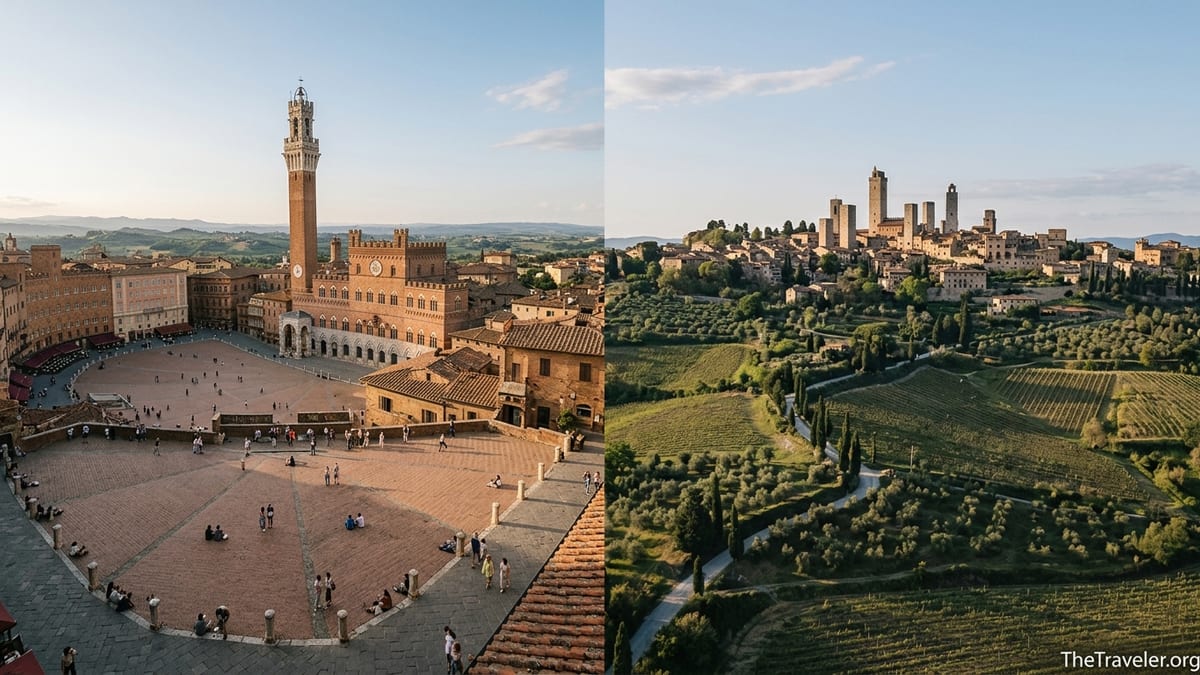
Overall vibe: big medieval city vs hilltop village of towers
Siena is a small city with about 50,000 residents and a compact but substantial historic center. Walk into Piazza del Campo, the shell shaped main square, and you instantly feel you are in one of Italy’s great civic spaces. Cafes wrap around the curve of the square, students from the university cut across on their way to class, and in the late afternoon locals sit on the bricks chatting while children chase pigeons. It feels lived in as well as beautiful.
San Gimignano, by contrast, is much smaller and feels closer to a fortified village. Its famous skyline of medieval towers, once symbols of family power, now gives the town an almost storybook profile as you approach by road. Inside the walls, the main streets are narrower and more steeply sloped than Siena’s. During the day San Gimignano is heavily oriented to visitors, with gelato shops, wine bars and artisan stores dominating the center.
If you are drawn to a place that feels like a real city scaled down to medieval proportions, Siena usually wins. If you want something that feels like an archetypal Tuscan hill town surrounded by vineyards and cypress ridges, San Gimignano may speak more to you, especially in the quieter mornings and evenings.
Getting there and around: which is easier from Florence?
From Florence, Siena is one of the easiest major day trips in Tuscany. Direct buses run roughly every 30 to 60 minutes from near Santa Maria Novella station and reach Siena in about 1 hour 15 minutes, depending on the type of service and traffic. Typical one way fares are in the region of 6 to 10 euros. The bus drops you near the historic center, so you can be in Piazza del Campo within 10 to 15 minutes of stepping off.
Trains between Florence and Siena are slower and less convenient for most visitors, because many services require a change at Empoli and Siena’s station sits downhill from the old town. After arriving by rail you either walk uphill for around 20 to 30 minutes using escalators part of the way, or catch a local bus or taxi to the center. For this specific route, many local hoteliers recommend the bus over the train for both time and simplicity.
Reaching San Gimignano is more involved. There is no train station in town. The usual public transport route is Florence to Poggibonsi by regional train or bus, then a local bus from Poggibonsi to San Gimignano. Total travel time is normally around 1.5 to 2 hours each way. In practice, many visitors either join an organized minibus tour that combines San Gimignano with a winery stop, or rent a car for the day in Florence to explore the countryside at their own pace.
Once you arrive, both Siena and San Gimignano are fully walkable. Cars are restricted from the historic centers, so you will spend your time on foot. Siena’s slopes are more gradual; San Gimignano’s lanes can be steeper but the distances are shorter. If mobility is a concern, Siena offers more taxi options within town, while in San Gimignano you will rely mainly on your own feet once you are inside the walls.
What you actually see: landmarks and experiences
In Siena, the classic first stop is Piazza del Campo, where the famous Palio horse races are held twice each summer. Even outside Palio dates, sitting on the warm bricks with a coffee or early evening spritz is a memorable experience. A few minutes away, Siena’s black and white striped cathedral is one of Italy’s most striking churches, its facade carved with saints and animals and its interior paved with intricate inlaid marble panels that are uncovered in full during specific periods each year.
Many visitors buy a combined ticket for the cathedral complex that covers the Duomo, the Piccolomini Library with its vivid Renaissance frescoes, the crypt and baptistery, and the Panorama dal Facciatone viewpoint. Prices vary by season and option, but a typical package often falls in the 15 to 20 euro range for adults, with cheaper child and family options. Climbing to the panoramic terrace is a highlight, giving you a rooftop view over the terracotta rooftops and surrounding countryside.
San Gimignano’s star attractions are more vertical. Most travelers head straight for Torre Grossa, the tallest surviving tower, which you can climb as part of the civic museum ticket. Expect to pay roughly 10 euros for entry that includes the tower and the small art collection in the Palazzo Comunale. Higher tier passes that also include the Duomo and other sites are usually somewhere around 15 euros with multi day validity. The staircase inside Torre Grossa is steep but manageable if you are reasonably fit, and from the top you see vineyards, olive groves and the full ring of towers around town.
The Collegiata, San Gimignano’s Romanesque church, is another must see, its interior almost completely covered in fresco cycles depicting Old and New Testament stories. It is smaller and more intimate than Siena’s Duomo, but the painted walls are surprisingly vivid. Many visitors combine these cultural stops with a slow stroll along Via San Giovanni and Via San Matteo, sampling gelato and browsing ceramics and leather shops.
Scenery and sense of place: where are the better views?
San Gimignano generally wins on classic Tuscan landscape views. From Torre Grossa or the viewpoints near the edges of town, you look out across rolling hills patterned with vineyards, farmhouses and lines of cypress trees. Even without climbing a tower, short walks to the south and west gates of the town give you broad panoramas suitable for photos and sunset watching.
Siena’s views are more urban. From the Facciatone terrace at the cathedral complex you see a sea of terracotta roofs pierced by bell towers, with the Tuscan countryside forming a more distant backdrop. Certain stretches of the medieval walls and the high streets near San Domenico also offer glimpses across green valleys. It is atmospheric, but less head on scenic than San Gimignano unless you actively seek out specific vantage points.
However, Siena’s internal spaces often feel more powerful. The sheer width of Piazza del Campo, sloping gently down toward the Palazzo Pubblico, creates a sense of drama that few Italian squares match. The way light shifts across the brick surface during the day, and the way the square fills in the evening with locals and visitors, is a key part of Siena’s charm. San Gimignano’s main squares, Piazza della Cisterna and Piazza del Duomo, are smaller but framed by stone towers that feel almost theatrical in the late afternoon light.
Crowds, costs and overnight stays
Both Siena and San Gimignano are very popular, but they attract different patterns of visitors. San Gimignano is one of the most common stops on half day coach tours from Florence and the Chianti area. This means that from around 10:30 in the morning until mid afternoon, especially in May through September, the main streets can feel packed with groups. After about 4 or 5 pm, once buses depart, the town quiets down and becomes far more atmospheric, particularly if you are staying the night.
Siena receives plenty of day trippers too, but because it is larger the crowds spread out more. Piazza del Campo and the immediate streets around the Duomo are busy in peak season, yet you only need to walk a few minutes into the contrade neighborhoods to find quieter lanes, local grocery stores and wine bars. On summer evenings, much of the pedestrian traffic consists of locals out for a stroll, giving the city a more balanced feel than some smaller hill towns.
In terms of costs, neither town is what you would call a budget backwater, but you can still manage on a moderate budget with a bit of planning. In San Gimignano, parking at the main P1 Giubileo lot outside the south gate is typically priced by the hour, with a capped daily rate; recent published tariffs have listed a first two hours at a few euros each and full day parking in the high single digits. In Siena, many visitors arriving by car opt for large peripheral lots such as those near the train station, then use escalators or a short bus ride to reach the center, which keeps historic streets mostly traffic free.
Hotels and guesthouses in both towns cover a wide range, from simple rooms above trattorie to boutique properties in restored palazzi. As a rough guide, in high season a central three star hotel in Siena might run from approximately 130 to 200 euros per night for a double room, with rates in San Gimignano often slightly higher relative to room size, reflecting the smaller supply inside the walls. Booking several months ahead for late spring and autumn is wise in both destinations.
Food, wine and local character
Siena has a strong food culture shaped by its contrade, the traditional neighborhood districts that organize social life and the Palio race. Look for small trattorie on side streets rather than the busiest corners of Piazza del Campo. Many menus feature hearty Sienese dishes such as pici pasta with cacio e pepe or wild boar ragù, ribollita vegetable and bread soup, and cantucci almond biscuits served with Vin Santo dessert wine. A typical lunch of a pasta course, shared salad and a glass of house Chianti in a side street trattoria might come to 18 to 25 euros per person.
San Gimignano leans heavily into its wine and gelato identity. The town is the center of the Vernaccia di San Gimignano wine region, known for a crisp white wine that pairs well with grilled vegetables, pecorino cheese and seafood. Many enotecas in town offer tastings with small plates; it is easy to spend an hour trying two or three glasses of Vernaccia with cured meats and bruschette for roughly 15 to 25 euros, depending on location and extras. The town also has several famous gelaterie on Piazza della Cisterna and along the main streets, with long queues on hot afternoons.
If you value contact with local life, Siena offers deeper layers. Outside the very center you will find neighborhood bars where people stop for an evening aperitivo standing at the counter, bakeries selling traditional ricciarelli cookies, and weekly markets. In San Gimignano, everyday life is more dispersed outside the walls, so most of what you see inside the historic core is oriented to visitors. Staying overnight can balance this somewhat, as you begin to cross paths with restaurant owners, shopkeepers and other residents after day trippers leave.
Which suits different types of trips?
For a first trip to Tuscany with limited time, Siena usually gives you more variety in a single day. You get a world class square, a major cathedral complex, atmospheric streets, and a tangible sense of how a medieval city functioned. It is also simpler to reach using public transport from Florence, so you spend more time in town and less time in transit.
San Gimignano shines for travelers whose priority is that archetypal postcard view of Tuscany’s rolling hills and ancient towers. If you love photography, wine tasting and lingering in smaller spaces rather than visiting several large monuments, you may feel you get more out of San Gimignano. It is particularly rewarding if you can stay a night or two and experience the quieter early mornings when shop shutters are just opening and local vans are delivering bread and produce.
If you have two days to spare, a good compromise is to base yourself in Siena and take a half or full day excursion to San Gimignano and the surrounding countryside. Several tour operators run small group minibus trips that pick you up in Siena or Florence, combine San Gimignano with a Chianti winery lunch, and handle the bus connections for you. This way you experience both the big city energy of Siena and the dramatic skyline and vineyards of San Gimignano without worrying about rural bus timetables.
Families with younger children often find Siena easier, thanks to more parks and open squares, plus the novelty of escalators up from the station if you arrive by train. Couples on a romantic break sometimes prefer San Gimignano, especially if they can book a farmhouse or agriturismo just outside town with a pool and views of the towers. In shoulder seasons like April and October, both destinations are at their best, with cooler temperatures and fewer crowds than the peak of July and August.
The Takeaway
If you must choose only one, Siena typically offers more depth and range in a single visit. Its combination of architectural highlights, lively squares, straightforward transport and strong local identity makes it the more complete destination for most first time visitors to Tuscany. You can fill a long day or two full days there without feeling you have exhausted what the city has to offer.
San Gimignano delivers a different kind of richness. It concentrates the essence of a Tuscan hill town into a small, visually striking package, with soaring towers, close up countryside views and a strong focus on wine and leisurely wandering. It may not have Siena’s breadth of monuments or local neighborhoods on display, but for travelers who value scenery, photography and a slower, more intimate scale, it can be the more memorable choice.
Ultimately, the question is not which place is objectively better, but which one matches the story you want to tell about your time in Tuscany. If that story centers on a great medieval city and its grand square and cathedral, choose Siena. If it centers on stone towers above vineyards and late afternoons sipping Vernaccia as swallows wheel over the walls, San Gimignano might be where you get more of what you came for.
FAQ
Q1. Is Siena or San Gimignano better for a first day trip from Florence?
Siena is usually better for a first day trip because it is faster and simpler to reach by direct bus and offers a wider range of sights and experiences in one compact city.
Q2. Can I visit both Siena and San Gimignano in one day?
It is technically possible with a car or a very tightly timed tour, but you will spend much of the day in transit. Most travelers get more enjoyment by dedicating a full day to Siena or combining San Gimignano with nearby countryside and wineries instead.
Q3. Which town has better views of the Tuscan countryside?
San Gimignano generally has better countryside views, especially from Torre Grossa and from the paths near the town walls where you look directly over vineyards and rolling hills.
Q4. Is parking easier in Siena or San Gimignano?
Parking is straightforward in both, but in different ways. San Gimignano has clearly signed pay lots just outside the walls with posted daily rates, while Siena offers several larger car parks near the station and city gateways, plus escalators and buses that help you reach the center.
Q5. Where will I find better food, Siena or San Gimignano?
Both have good food, but Siena has a deeper everyday restaurant scene with more neighborhood trattorie used by locals. San Gimignano excels for wine tasting and scenic, visitor oriented spots, especially for Vernaccia and gelato.
Q6. Is either town suitable for travelers with limited mobility?
Both towns have slopes and stone pavements, but Siena’s gradients are generally more gradual and there are more taxis and buses within the city. San Gimignano is smaller but steeper, and once you are inside the walls you will mostly rely on walking.
Q7. Which destination is better if I am traveling with children?
Siena tends to work better for families because of its larger squares, more varied food options and easier logistics. Children often enjoy running around Piazza del Campo, climbing viewpoints and riding the escalators that connect lower areas to the historic center.
Q8. Is San Gimignano worth staying overnight, or is a day trip enough?
Staying overnight in San Gimignano can be very rewarding. After tour buses leave, the streets become quieter and more atmospheric, and you can enjoy sunset views and dinner without daytime crowds. A single night is often enough to feel the difference.
Q9. How expensive are museum and monument tickets in each town?
In Siena, combined tickets for the cathedral complex typically cost in the mid teens to around twenty euros for adults, depending on what is included. In San Gimignano, a ticket that covers the civic museum and tower is usually around ten euros, with broader passes that include more sites in the mid teens.
Q10. If I love photography, which should I choose?
If your focus is landscape and skyline shots, San Gimignano offers more classic Tuscan scenes and dramatic tower views. For street photography and architectural details in a larger urban setting, Siena provides richer opportunities, especially in and around Piazza del Campo and the cathedral district.