


Wedged between Nice and Monaco on one of the most beautiful bays in the Mediterranean, Villefranche-sur-Mer is the kind of place that often appears in glossy Riviera photos but gets skipped in tightly packed itineraries. Many travelers see it only from a cruise tender or through a train window on the way to somewhere else. If you are planning a Côte d’Azur trip for 2026 or beyond, the real question is simple: is Villefranche-sur-Mer worth carving out precious hours, or even a full day, from your time on the French Riviera?
Get the latest updates straight to your inbox!
Why Villefranche-sur-Mer Keeps Appearing in Riviera Daydreams
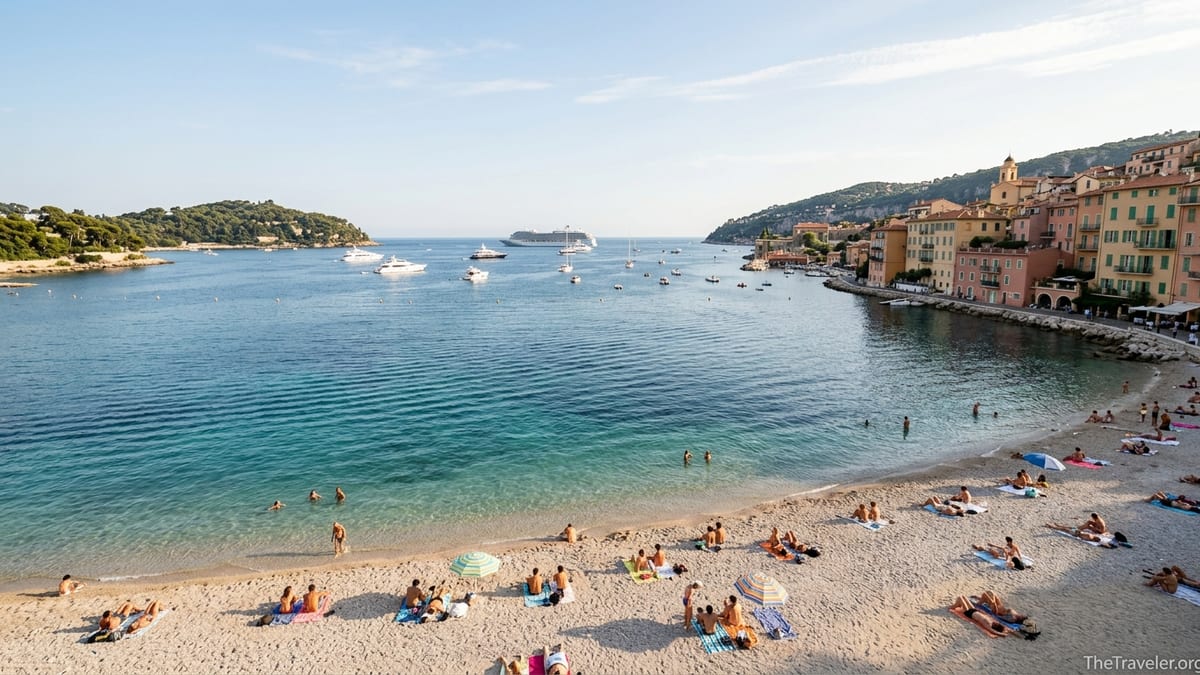
Villefranche-sur-Mer is a compact seaside town facing one of the deepest natural harbors in the Mediterranean. Its colourful facades stacked up the hillside, the curve of Plage des Marinières, and the backdrop of the Saint-Jean-Cap-Ferrat peninsula give it a postcard look that many visitors expect from nearby Nice but only truly find here. The old town is smaller than Nice’s Vieux Nice, but that is part of its charm. You can walk from the train station to the waterfront in about five minutes and feel like you have stepped into a film set.
The town sits roughly a 10-minute train ride from Nice-Ville station, with local TER trains running several times per hour throughout the day in the current schedules. A one-way ticket is usually just a few euros, which makes Villefranche an easy, low‑effort side trip even on a short Côte d’Azur stay. Many travelers staying in Nice use a sunny morning to ride over, swim, have a long lunch next to the water, then be back in Nice before dinner.
Villefranche is also a regular tender port for cruise ships, so you may find yourself here whether you planned it or not. On busy summer days, large ships anchor in the bay and passengers are shuttled by tender boats to the small port. If your itinerary lists “Nice (Villefranche),” this is the village you will be stepping onto. Understanding what the town offers helps you decide whether to stay put and enjoy it or immediately head off to Monaco, Nice or Eze.
What sets Villefranche apart from other Riviera towns is the combination of a proper sandy‑entry beach, a lived‑in old town, and relative calm compared with Nice or Cannes. You can swim, wander centuries‑old streets, tour a 16th‑century citadel and still be sitting at a waterfront café with a glass of rosé by mid‑afternoon. If you like the idea of the French Riviera but not the crowds and traffic of its bigger cities, this balance alone can justify adding Villefranche to your route.
A Real Beach in Easy Reach: What to Expect on the Waterfront
One of Villefranche-sur-Mer’s biggest draws is Plage des Marinières, the long public beach that curves for around 800 meters along the innermost part of the bay. Unlike Nice’s famously large pebbles, here the entry into the water is a mix of sand and fine gravel in many sections, which makes it more comfortable for bare feet and more forgiving for families with children. Locals from Nice and even Monaco ride the train here on hot weekends specifically for the gentler swimming and more sheltered water.
In summer, you will typically see rows of towels laid out close together near the waterline, stand‑up paddleboards skimming the surface of the bay, and small boats anchored further out. A few private beach concessions operate on part of Plage des Marinières during the main season, renting loungers and umbrellas and serving food directly to your chair. Prices change year to year but it is reasonable to expect around 25 to 40 euros per person for a full‑day lounger and umbrella in high season, with salads and mains at beach restaurants often ranging from the mid‑teens to mid‑20s in euros.
Back from the shore, a simple promenade runs alongside the railway line. You will find casual beach bars, ice‑cream stands and small restaurants, some of which stay open from late morning through dinner. This is the kind of place where you can order a plate of socca or a Niçoise salad and watch the regional trains glide past every 15 minutes while cruise tenders cross the bay below. If you keep expectations modest and focus on the view rather than ambitious gastronomy, lunch on the beach here can be a highlight of a relaxed day.
On the opposite side of the small peninsula lies the port of La Darse, historically important as a military and commercial harbor. Today it feels more like a quietly busy marina, with yachts, fishing boats and a small beach used mainly by locals. This area is less polished than Marinières, but worth wandering to if you enjoy watching everyday Riviera life and seeing the more working side of the coast.
Atmosphere in the Old Town: Slower, Steeper, More Intimate
Step up from the waterfront into Villefranche’s old town and the pace changes again. Narrow streets, some of them staircases more than streets, cut through tall ochre and terracotta buildings with green shutters. Laundry often hangs across alleyways and there is a sense that people actually live here year round, which can feel rarer in parts of the Côte d’Azur that are dominated by second homes and luxury boutiques.
The Rue Obscure is one of the town’s quirks: a covered medieval lane that runs under a row of houses. Walking through, you are reminded that Villefranche was once a fortified port controlling access along this stretch of coastline. Emerging back into the light, you can climb up toward the baroque Saint-Michel Church or continue wandering until you reach viewpoints that look across the bay to Cap Ferrat and back toward Nice.
Cafés and restaurants are scattered through the lanes and along the seafront. Prices are generally slightly lower than in Monaco and broadly comparable to central Nice. For example, it is common in 2025 and 2026 to see coffee for 3 to 4 euros on the harborfront, glasses of local rosé from around 5 to 7 euros, and main courses between 20 and 30 euros at mid‑range bistros. Simple pizzerias and crêperies provide cheaper options, especially if you head one or two streets back from the waterfront.
Even in peak season, Villefranche usually feels less frenetic than Nice’s old town. There are souvenir shops and gelato stands, of course, but you are more likely to be squeezed by the topography than by crowds. If you prefer your Riviera villages with real staircases and occasional legwork rather than flat promenades lined with designer labels, that physical scale may be exactly what you are looking for.
How Villefranche Fits Between Nice, Monaco and Eze
Because Villefranche-sur-Mer sits directly on the main coastal rail line, it slots naturally into most itineraries that include Nice and Monaco. From Nice-Ville station, frequent TER trains take about 8 to 10 minutes to reach Villefranche, and continuing on to Monaco usually adds only another 15 minutes or so. This makes it entirely realistic to combine Villefranche with either Nice or Monaco in a single day, or to use it as a relaxed base between the two.
One common pattern is to spend several nights in Nice for its restaurants, nightlife and museums, then dedicate a single full day to a loop of Monaco, Eze and Villefranche. For example, you might catch a morning train from Nice to Monaco, explore the old town and harbor, then return partway by train or bus and stop in Eze Village up on the cliff. After an afternoon wandering the Jardin Exotique and its panoramic views, you could head down to Villefranche in the late afternoon for a swim and dinner before returning to Nice late in the evening.
Another option is to check out of a Nice hotel, take the short train ride to Villefranche and stay here for one or two nights instead of continuing directly to another major city. A growing number of small guesthouses and apartments in the upper town offer sea views at prices that can be competitive with mid‑range hotels in central Nice, particularly outside July and August. Waking up to church bells and the sight of the bay below, then walking down to the beach for a morning swim, can be a distinctly different experience from staying along Nice’s busy Promenade des Anglais.
If you are traveling in high season and feel overwhelmed by crowds, it is practical to use Villefranche as a pressure valve. You can still reach Nice, Antibes or Menton by train in under an hour but retreat in the evening to a quieter base. For people planning a week on the Riviera, allocating two or three nights here and the rest in a bigger hub like Nice often creates a satisfying contrast between urban energy and small‑town coastal life.
Who Will Love Villefranche-sur-Mer (and Who Might Not)
Villefranche-sur-Mer tends to delight certain types of travelers. If you want swimmable water, pretty streets and easy logistics but are not particularly interested in shopping or nightlife, it is close to ideal. Couples on short romantic breaks often appreciate its smaller scale and the sense of enclosure created by the hills and the bay. Families like the sheltered beach, the relatively gentle entry into the sea at Marinières compared with Nice, and the fact that you can push a stroller along the waterfront promenade without contending with a major road.
It is also a good fit for cruise passengers who prefer to stay local rather than rushing to Monaco or Cannes on a short port call. You can walk from the tender dock to the old town in minutes, visit the Citadelle Saint-Elme with its free art museums, have a long lunch and a swim, and still be back at the tender pier with time to spare. For first‑time visitors to France, this can be a low‑stress way to experience a real Riviera town without dealing with big‑city transport or language demands.
On the other hand, if your main priorities are museum‑hopping, nightlife and dining at several high‑profile restaurants, you will probably be happier basing yourself in Nice or Cannes and treating Villefranche as a half‑day excursion. There are some excellent places to eat here, but the variety is inevitably limited by the town’s size. After a couple of nights, serious food‑focused travelers often find themselves riding the last evening train back from Nice or ordering taxis to explore elsewhere.
Accessibility is another consideration. Villefranche is built on a slope and many streets involve steps. While the waterfront promenade and the area immediately around the train station are mostly flat, getting into the higher part of the old town can be challenging if you have limited mobility. If steep streets are a deal‑breaker, you may still enjoy a few relaxed hours on the lower streets and the beach, but it might not be worth dedicating multiple days here.
Practicalities: Getting There, Costs and Seasonal Considerations
Reaching Villefranche-sur-Mer is straightforward. Most visitors arrive by TER train from Nice, Monaco or other towns along the coast. In recent timetables between Nice and Menton, there are often three or more trains per hour in the daytime, with the journey from Nice-Ville to Villefranche typically taking less than 10 minutes. Tickets are inexpensive and can be bought at machines or via the official apps. Because the ride is short, there is little advantage in reserving far ahead for this specific hop; what matters more is checking for any planned engineering works during your travel dates.
If you are driving, be aware that parking in Villefranche can be tight, especially in July and August or on days when cruise ships anchor in the bay. There are several small car parks around the old town and along the waterfront, but they fill quickly. Many visitors choose to park in Nice or another town and rely on the train instead. This also removes the stress of navigating narrow hillside roads and one‑way systems under time pressure.
Costs on the ground are typical for the central French Riviera. A simple beach picnic with supermarket bread, cheese, fruit and a bottle of water might come to under 10 euros per person, while a sit‑down lunch at a mid‑range harborfront restaurant will likely run 25 to 40 euros per person including a main course, shared starter and a glass of wine. Accommodation ranges from budget guest rooms and basic apartments inland from the old town to boutique hotels with sea views that can reach several hundred euros per night in peak season. Booking early is wise if you want bay views in late June through early September.
Season matters. From late June to early September, expect hot, dry weather, very warm sea temperatures and the highest crowds and prices. Shoulder months such as May, early June, late September and early October often offer a sweet spot of pleasant temperatures, swimmable water for many people and lighter crowds. In winter, some restaurants close or shorten hours and the town feels more like a quiet local community than a resort. For a deep‑winter Riviera break focused on museums and nightlife, Nice or Marseille may be better bases, but even then, a sunny day trip to Villefranche can be rewarding for the views alone.
Experiences You Can Only Have in Villefranche-sur-Mer
While you can find pretty ports, beaches and colored old towns elsewhere on the Riviera, a few experiences in Villefranche feel distinctive enough to sway an itinerary decision. Swimming in the glassy water of the Rade de Villefranche with cruise ships anchored silently offshore is one. The bay is naturally deep, which historically made it a strategic naval harbor and today allows large vessels to anchor quite close to shore. From the beach, you see a blend of everyday swimmers, paddleboarders and serious yachts sharing the same sheet of blue.
Another is wandering the grounds of the Citadelle Saint-Elme, the stone fortress that overlooks the harbor. Inside its walls you will find several small museums and exhibition spaces, many of them free or inexpensive to enter, with a mix of local history, art and sculpture. Even if you are not a museum person, the views from the ramparts and the contrast between raw stone and bright sea are compelling.
If your travel dates line up in February, Villefranche hosts the Combat Naval Fleuri, a flower‑decorated boat parade that forms part of the wider Nice Carnival period. Small boats dressed with blooms and streamers parade through the bay, watched from the quayside and shore. It is a local event rather than a mass‑tourism spectacle and offers a very different feel from the big parades in Nice itself.
Finally, simple everyday routines can be surprisingly memorable here. Buying a baguette from a small boulangerie up in the old town, carrying it down to the waterfront, and eating breakfast on a bench while early swimmers slip into the bay can feel like the essence of a slow Riviera morning. Add a detour to a viewpoint above the station where the whole curve of the beach and the Cap Ferrat peninsula open out, and you have a sequence of moments that are hard to replicate in busier, more urban parts of the coast.
The Takeaway
Deciding whether to add Villefranche-sur-Mer to your Côte d’Azur itinerary comes down to your priorities. If you are rushing through the French Riviera with only one full day and want headline sights such as the Promenade des Anglais, the Rock of Monaco and the perched village of Eze, you might reasonably treat Villefranche as something to admire from the train window. There is only so much you can fit into 24 hours.
However, if you have even a second full day in the region, Villefranche becomes very hard to justify skipping. Its combination of easy access, swimmable beach, atmospheric old town and practical dining options means you can relax into the Riviera rather than just ticking it off. Many travelers who allow themselves an afternoon here end up wishing they had stayed the night. For those who value real sea time, slower evenings and the feeling of being in a village rather than a city, Villefranche-sur-Mer is more than a pretty picture on the map. It is a quiet anchor point that can give your Côte d’Azur trip the balance it needs.
FAQ
Q1. Is Villefranche-sur-Mer worth visiting if I am staying in Nice?
Yes. The train ride from Nice is very short and inexpensive, and in a few hours you can swim at Plage des Marinières, wander the old town and enjoy a waterfront meal before heading back.
Q2. How much time should I plan for Villefranche-sur-Mer?
Many travelers are satisfied with a half day, especially when combining it with Nice or Monaco, but one full day or an overnight stay allows time for the beach, citadel and unhurried meals.
Q3. Is the beach in Villefranche sandy?
Plage des Marinières has a mix of sand, fine gravel and pebbles. The entry into the water is generally softer than Nice’s large pebbles, which makes it more comfortable for bare feet.
Q4. Is Villefranche-sur-Mer suitable for families with children?
Yes. The sheltered bay, relatively gentle beach entry and compact size make it family friendly. Just keep in mind that the old town is hilly, so strollers work best along the waterfront.
Q5. Can I visit Villefranche-sur-Mer on a cruise stop without booking a tour?
Definitely. The tender drops you close to the old town and you can explore on your own, swim, visit the citadel and eat by the water without needing an organized excursion.
Q6. Is Villefranche-sur-Mer expensive?
Prices are typical for the central French Riviera. Eating on the waterfront and renting sun loungers is not cheap, but self‑catering picnics and cafés a street or two back help keep costs down.
Q7. When is the best time of year to visit Villefranche-sur-Mer?
Late spring and early autumn often strike the best balance of good weather, swimmable water and lighter crowds. July and August are busier and hotter, with higher prices.
Q8. Is Villefranche-sur-Mer a good base for exploring the Côte d’Azur?
It can be, especially if you prefer a quieter atmosphere. Regular trains link Villefranche with Nice, Monaco and other towns, though nightlife and cultural options are broader if you stay in a larger city.
Q9. Is Villefranche-sur-Mer easy to get around on foot?
The waterfront and lower streets are very walkable, but the old town is steep with many steps. Comfortable shoes are essential and travelers with limited mobility may want to stay near the lower level.
Q10. Should I choose Villefranche-sur-Mer or Eze if I only have time for one?
Eze offers dramatic cliff‑top views and a perched village feel, while Villefranche provides a real beach and direct sea access. If you want to swim, choose Villefranche. If you prefer panoramic views and hiking, choose Eze.