


The French Riviera is full of pretty harbours and golden coves, but when you narrow your search to Villefranche-sur-Mer or Antibes, you are really choosing between two very different kinds of Mediterranean escape. Both sit on the same coastal train line between Cannes and the Italian border, both offer sea views and gelato at sunset, yet the feel on the ground could not be more distinct. One is a compact, pastel fishing village wrapped around a deep bay; the other a lively small town with sandy beaches, a famous cape and enough restaurants to fill a week. This guide breaks down the differences so you can decide which one gives you more of what matters for your trip.
Get the latest updates straight to your inbox!
Getting There and Getting Around
Both Villefranche-sur-Mer and Antibes are linked by the same coastal TER trains that run roughly every 15 to 30 minutes in each direction between Cannes, Antibes, Nice, Villefranche-sur-Mer and Monaco. In practice this means you can land at Nice, take a train from Nice-Ville station and be in Villefranche-sur-Mer in about 6 minutes or in Antibes in about 20 to 25 minutes, depending on the stopping pattern. Tickets on the Nice to Antibes stretch are usually just a few euros each way in 2nd class, and the Nice to Villefranche hop is even cheaper, which keeps day-tripping costs down for most visitors.
From Villefranche-sur-Mer station, it is a short downhill walk to the waterfront and old town, though streets are fairly steep and paved with cobblestones. If you are rolling heavy luggage or pushing a stroller, expect a 10 to 15 minute walk with some stairs. In Antibes, the station sits slightly inland; you reach the Old Town and nearest beaches with a mostly flat 10 to 15 minute walk along city streets. For travellers who plan to explore widely by train, Antibes often feels like a more central node, with direct services not only to Nice and Monaco but also west toward Cannes and Marseille.
If you are renting a car, parking realities may also influence your choice. Villefranche-sur-Mer has limited street parking near the harbour and a couple of paid car parks; spaces can be tight in July and August, especially on cruise days. Antibes offers several large underground car parks around the Old Town and port area, plus more on-street options in surrounding neighbourhoods. In both places, many visitors opt to park once and explore on foot or by local bus, but Antibes gives drivers slightly more flexibility and choice.
For getting around without a car, both towns rely heavily on the same regional train line. From either base, popular day trips such as Nice, Cannes, Monaco, Menton and even Ventimiglia in Italy are realistic. However, Villefranche-sur-Mer positions you a little closer to Monaco and the eastern villages, while Antibes is more convenient for exploring Cannes and the western stretch of coast. If your Riviera plans are packed with Monaco nightlife or an early-morning visit to Èze, Villefranche saves you some train time; if you are focused on Cannes or St-Raphaël, Antibes is the stronger base.
Vibe and Atmosphere: Village Charm vs Small City Energy
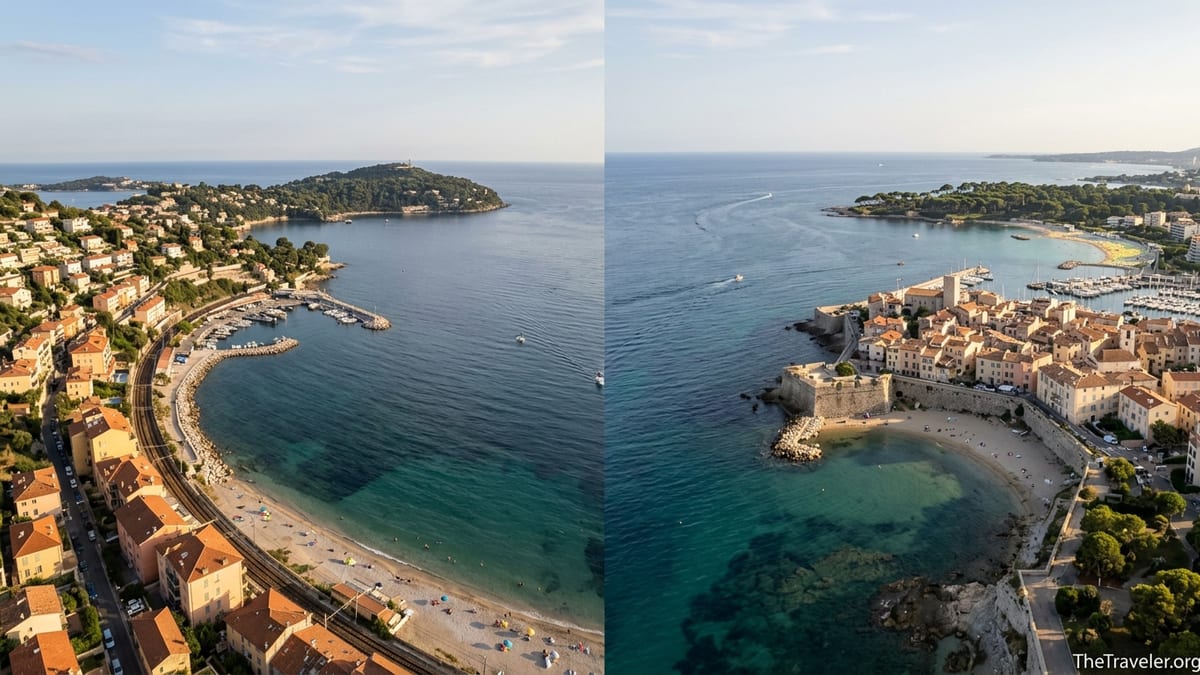
Step off the train into Villefranche-sur-Mer and the first impression is almost cinematic: a curve of terracotta and ochre facades tumbling towards an intensely blue bay, fishing boats rocking in front of pastel houses, and the peninsula of Saint-Jean-Cap-Ferrat closing the horizon. The feel is that of a small, self-contained village. The Old Town is a compact maze of narrow lanes, stone staircases and vaulted passageways like the Rue Obscure, with a handful of wine bars, a few boutiques and a small scattering of restaurants focused around the waterfront.
Antibes, by contrast, feels like a lived-in small town as much as a resort. Inside the 16th-century ramparts you find a grid of streets full of patisseries, local food shops, the covered Provençal market and a wider range of bars and restaurants. Outside the walls, the town spreads out into residential neighbourhoods, the yacht-filled Port Vauban and the more contemporary beach resort of Juan-les-Pins on the far side of Cap d’Antibes. The atmosphere in high season is energetic but less intensely touristic than in Nice; you will share the streets with commuters grabbing a morning coffee, families shopping for dinner ingredients and schoolchildren, not just holidaymakers.
In terms of evening ambience, Villefranche-sur-Mer has a softer, more romantic tone. A typical night might be an early swim at Plage des Marinières, an aperitif at a harbour-side terrace watching cruise tenders shuttle guests back to their ships and dinner on a small square with church bells in the background. Bars close relatively early, and the village tends to fall quiet not long after midnight. Antibes offers more variety: wine bars spilling into the lane near the Marché Provençal, casual spots around Place Nationale, waterfront cocktails overlooking the port and, if you cross over to Juan-les-Pins, full-on beach club nightlife in July and August with DJs and late closings.
If you picture your Riviera base as a peaceful hideaway where you can hear seagulls from your balcony and navigate the whole place in ten minutes on foot, Villefranche delivers that. If you are happier in a place with multiple café choices, a dedicated shopping street and the option of genuine nightlife without taking a train, Antibes is likely to feel more satisfying.
Beaches and Swimming: Pebbles, Sand and Scenic Coves
Beaches are where the difference between these two destinations becomes very concrete. Villefranche-sur-Mer’s main beach, Plage des Marinières, is a long curve of sand-and-pebble directly below the railway tracks. The bay here is one of the deepest natural harbours in the Mediterranean, which means the water drops off quickly but remains calm and protected from strong waves. Even in midsummer, many visitors comment on how intensely turquoise and clear the water is. You will find a mixture of public space where you can lay out your own towel and a couple of simple beachside snack bars or seasonal loungers, but there are far fewer structured beach clubs than in Nice or Cannes.
At the town end of Villefranche’s bay, the smaller Plage de la Darse offers a more local feel near the historic harbour and boatyards. It is rocky rather than sandy, with ladders diving straight into deep water, and attracts confident swimmers and snorkellers in search of fish and underwater rocks. Neither of these beaches is ideal for toddlers who want to dig in soft sand, but older children who enjoy swimming rather than paddling often love the calm, deep bay. Bring water shoes if you are sensitive to pebbles.
Antibes offers far more choice, particularly for sand seekers. Immediately beside the Old Town, Plage de la Gravette is a small crescent of sand enclosed by breakwaters. The water here is shallow, relatively calm and popular with families who like the combination of a sandy beach and quick access to ice cream and toilets inside the walls. A short walk away you reach Plage du Ponteil, another sandy option with views across the bay towards the snow-capped Alps in spring and early summer.
As you move toward Cap d’Antibes, Plage de la Salis stretches out with soft sand and a relaxed, residential vibe. Further along the cape, around Plage de la Garoupe, the coastline becomes more rugged and exclusive, mixing public strips of sand with upscale beach clubs linked to luxury hotels. On the opposite side of the headland, Juan-les-Pins offers a string of sandy urban beaches backed by bars and restaurants, some with loungers and waiter service for a fee. For travellers who want multiple sandy options and perhaps a day in a full-service beach club, Antibes has a clear edge. For those who prioritise dramatic scenery and calm, luminous water over sand, Villefranche’s bay remains hard to beat.
Where You Get More for Your Money
On accommodation and day-to-day spending, both Villefranche-sur-Mer and Antibes sit firmly in French Riviera price territory, but there are nuances. Villefranche has a relatively small inventory of hotels and rentals, many of them perched on the hill above the bay with exceptional views. In peak season, sea-view rooms in simple three-star properties or well-located apartments can command premium prices, reflecting the limited supply and strong demand from repeat visitors. You may pay notably more per night here than in a similar category hotel in downtown Nice, particularly in July and August, though travelling in May, early June or late September often brings better value.
Antibes, by virtue of its size, offers a broader range of options. You can find modest two-star hotels just outside the ramparts, mid-range three and four-star properties near the beaches and high-end suites on Cap d’Antibes or along the Juan-les-Pins waterfront. Because there are simply more beds available, prices at the mid-range level can be slightly more competitive, especially if you book well in advance or are willing to stay a ten to fifteen minute walk from the Old Town. Travellers on a moderate budget often report that they can afford a slightly larger room or a better hotel category in Antibes than in the most coveted streets of Villefranche.
Restaurant prices across both towns are broadly similar to Nice: a casual lunch of a salad or socca with a soft drink might run to around 15 to 20 euros per person, while a three-course dinner with wine at a mid-range bistro could cost roughly 40 to 60 euros per person, depending on menu and location. In Villefranche, you will find a row of waterfront restaurants lining the quays, some catering primarily to visitors from cruise tenders. In Antibes, the spectrum is wider, from simple pizzerias and traditional brasseries near Place Nationale to more contemporary addresses scattered through the backstreets.
For self-catering or simply keeping snack costs down, Antibes clearly wins. It has several full-size supermarkets, numerous bakeries and the daily Marché Provençal, where you can buy cheese, cured meats, fruit and olives to assemble an inexpensive picnic. Villefranche has a small supermarket and a handful of local shops and bakeries but lacks the same depth of choice. If keeping food costs under control is a priority, basing yourself in Antibes or at least planning regular grocery runs there can make a noticeable difference over a week-long stay.
Culture, Sights and Day-Trip Potential
If cultural sightseeing is important to you, Antibes generally offers more to fill your itinerary without leaving town. Inside the old ramparts you will find the Picasso Museum housed in the Château Grimaldi, with works linked to the artist’s time living and working in Antibes in the 1940s. Nearby, the Archaeology Museum explores the area’s Greek and Roman past, while galleries, small museums and artist studios are scattered through the lanes. Fans of boats and maritime history can wander the docks of Port Vauban, home to both traditional fishing boats and some of the Mediterranean’s largest superyachts.
Villefranche-sur-Mer’s old centre is smaller, but it does hide a few notable sights: the Baroque Église Saint-Michel with its distinctive facade, the Chapelle Saint-Pierre decorated by Jean Cocteau and the atmospheric Rue Obscure, a vaulted passage running beneath houses parallel to the waterfront. Above the town, the 16th-century Citadelle Saint-Elme looks out across the bay, with small museums focused on local history and art and occasional outdoor concerts in summer. Many visitors, however, find that the main “sight” in Villefranche is simply the view itself and the leisurely act of watching the water change colour through the day.
For day trips, both bases are well placed but skew in different directions. From Villefranche-sur-Mer, it is quick and easy to reach Nice, Monaco, Beaulieu-sur-Mer and the walking paths of Saint-Jean-Cap-Ferrat, often in under 20 minutes by bus or train. You can walk from Villefranche to some of the Cap Ferrat trails in under an hour, turning a beach day into a scenic coastal hike. From Antibes, journeys to Cannes, Juan-les-Pins, Biot and even Saint-Raphaël are shorter and more convenient, while Nice and Monaco remain accessible with a direct train, albeit in a longer ride.
In practice, many travellers split a week on the Riviera between two bases to experience both moods: several nights in Villefranche-sur-Mer for quiet sea views and walks around Cap Ferrat, followed by several nights in Antibes or Juan-les-Pins for sandy beaches, markets and a bit more evening buzz. If you prefer to stay in one place and day-trip from there, think carefully about which cluster of destinations appeals more; that will often make your choice for you.
Who Each Town Suits Best
While any type of traveller can enjoy both Villefranche-sur-Mer and Antibes, certain profiles tend to be happier in one over the other. Villefranche is especially appealing to couples on a romantic break, solo travellers who like a quiet, walkable base and anyone who values a strong sense of place over a long list of attractions. It works well if you picture yourself reading on a balcony with a sea view, dipping in and out of the village for coffee or an evening stroll and taking occasional train trips to Nice or Monaco without needing nightlife at your doorstep.
Antibes is often a better fit for families with children, particularly younger kids who want sandcastles and shallow water. Beaches like Plage de la Gravette and Plage du Ponteil provide exactly that, with playgrounds and ice cream close by. The town’s larger size also means more practical amenities: pharmacies, multiple supermarkets, a hospital nearby and activities like boat excursions and bike rentals. Teenagers may also appreciate the easy connection to Juan-les-Pins for late-night ice cream or music.
Travellers who enjoy food and local markets tend to find more to work with in Antibes. The covered Marché Provençal is the sort of place where you can buy ingredients for dinner from producers you meet face to face, while nearby streets host wine caves, cheese shops and bakeries. Back in Villefranche, shopping is mostly limited to a few souvenir and clothing shops and basic groceries; serious food shopping is more likely to involve a train ride into Nice.
If you are sensitive to crowds and cruise-ship surges, it is worth factoring that in. Villefranche’s deep bay makes it a regular anchorage for cruise ships, and on some days in high season, tenders can bring several hundred passengers ashore, which briefly swells the small streets. Even so, the village often feels less relentlessly busy than Nice. Antibes, with its more diffuse layout, spreads visitors out between Old Town, beaches and Cap d’Antibes, so while it stays lively for most of the year, it rarely feels overwhelmed in any single spot except perhaps the beach in peak July afternoons.
The Takeaway
Choosing between Villefranche-sur-Mer and Antibes is less about which town is objectively “better” and more about what you want your Riviera days to look and feel like. If your ideal scene is waking to the sound of water in a pastel fishing village, wandering steep lanes that lead straight to a luminous bay and ending the evening with a quiet glass of rosé watching boats at anchor, Villefranche-sur-Mer is likely to give you more of what you are seeking. Its setting is arguably one of the most beautiful on the coast, and its small scale encourages you to fully slow down.
If, on the other hand, you picture a week of sandy beaches, morning markets, children playing in shallow water, gallery visits and the option to stretch your legs along a dramatic headland walk before cocktails in a busy square, Antibes may be the better choice. It offers more variety in dining, shopping and beaches, a wider accommodation range and slightly easier logistics for day-tripping across the coast without sacrificing charm.
For travellers with enough time, combining both is the ultimate answer: start in Villefranche-sur-Mer for two or three nights of bay views and eastward day trips, then move to Antibes for sandy beaches and westward excursions. If your itinerary only allows for one base, think about your priorities in terms of pace, beach type and amenities. With those pieces clear, the decision between Villefranche-sur-Mer and Antibes usually becomes obvious, and either choice will still place you on one of Europe’s most celebrated stretches of shoreline.
FAQ
Q1. Which is better for a first-time French Riviera trip, Villefranche-sur-Mer or Antibes?
For a first visit, Antibes usually works better because it combines sandy beaches, a lively Old Town, markets and good train links in one package.
Q2. Is Villefranche-sur-Mer cheaper than Antibes?
Not usually. Villefranche has fewer places to stay, so sea-view rooms can be expensive in summer, while Antibes’ wider range often means more mid-range options.
Q3. Which town has better beaches?
Antibes wins for sand and variety, with several sandy beaches and nearby Juan-les-Pins. Villefranche wins for scenery and calm, clear water in a deep bay.
Q4. Is it easy to visit both towns without a car?
Yes. Regional trains run frequently along the coast, and the journey between Villefranche-sur-Mer and Antibes via Nice usually takes about 30 to 40 minutes in total.
Q5. Which base is better if I want to explore Monaco and the eastern Riviera?
Villefranche-sur-Mer is slightly better placed for Monaco, Èze and Menton, with shorter train and bus rides compared with starting from Antibes.
Q6. Which base is better if I want to explore Cannes and the western Riviera?
Antibes is closer to Cannes, Juan-les-Pins and the western resorts, so day trips in that direction are generally quicker and more convenient.
Q7. Is Villefranche-sur-Mer suitable for families with small children?
It can be, but the pebbly beach and steep lanes are not ideal for toddlers. Families often find Antibes’ sandy, shallow beaches more practical.
Q8. Does Antibes feel very touristy?
Antibes is popular, but it also functions as a real town, so you will see plenty of locals. It feels less purely touristic than some nearby resorts.
Q9. Can I stay in one town and still enjoy the other’s beaches?
Yes. Many people base in Antibes and take a day trip to swim in Villefranche’s bay, or stay in Villefranche and spend a beach day on the sands of Antibes.
Q10. If I only have three nights, which should I choose?
Choose Villefranche-sur-Mer if you want a quiet, romantic village feel; choose Antibes if you prefer more restaurant choice, sandy beaches and a livelier atmosphere.