


Siem Reap–Angkor International Airport (SAI), which replaced the old in-town airport in late 2023, is now the main gateway to the temples of Angkor. Located about 50 kilometers east of Siem Reap town, it is modern, spacious and still relatively new, which means procedures are generally smooth but also evolving. This guide walks you step by step through what to expect after landing in 2026: immigration and visas, baggage claim, SIM cards and ATMs, airport shuttle and taxis, and how much time to allow before you meet a guide or connect to onward transport.
Get the latest updates straight to your inbox!
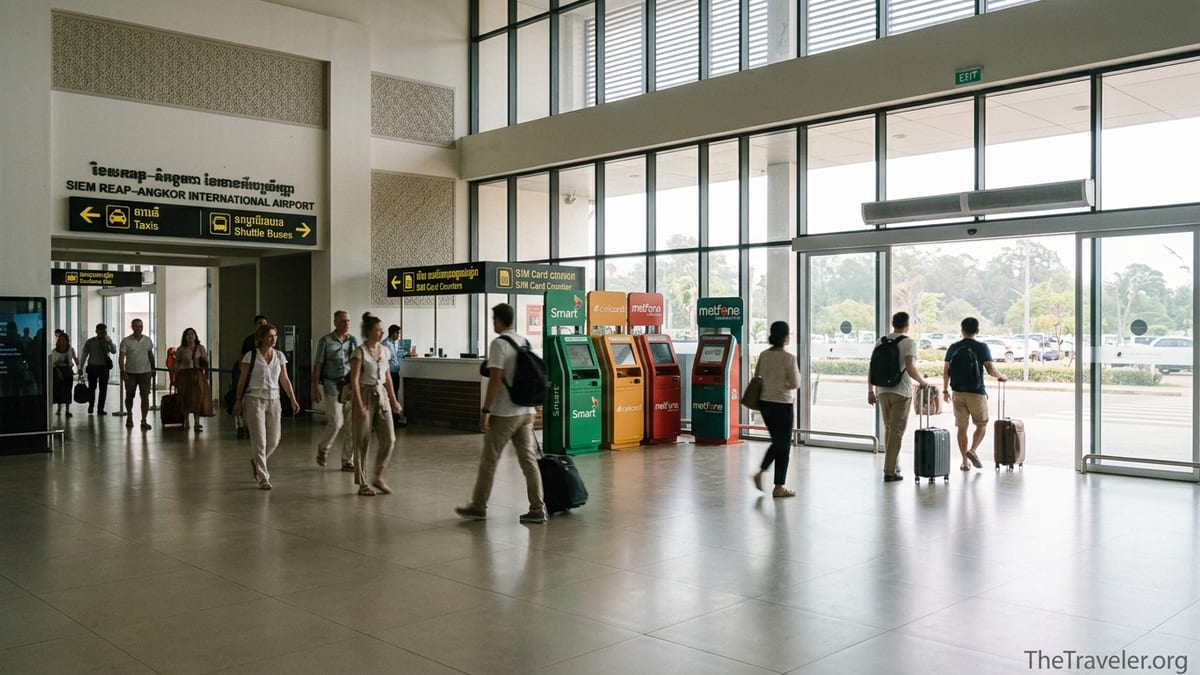
First Steps After Landing: Layout & What to Expect
On arrival at Siem Reap–Angkor International Airport your aircraft will typically park at an airbridge, and you will walk directly into the terminal. The arrivals level is straightforward: a short walk from the gate brings you to the immigration hall, followed by a compact baggage claim area, customs screening, and then the public arrivals hall with money exchange, SIM card counters, and transport desks. Compared with older Southeast Asian airports, walking distances are moderate and signage in English is clear.
SAI currently handles a mix of regional flights from hubs such as Bangkok, Singapore, Kuala Lumpur, and Ho Chi Minh City, plus services from Phnom Penh and other regional cities. This means arrival waves tend to cluster around these banked flight times. If you land just after several international flights, queues at immigration can lengthen; if you arrive on a quieter midday or late evening flight, you may be through in well under 30 minutes. The airport is fully air conditioned, but seating in the immigration hall can be limited during busy banks, so be prepared to stand for part of the process.
For most travelers the key thing to keep in mind is the distance from the new airport to town. Even with light traffic the drive to central Siem Reap is typically 45 to 60 minutes, and at peak holiday times it can be longer. If you are planning an afternoon Angkor tour on your arrival day or booking a night bus onwards to Phnom Penh, make sure you factor this surface travel time into your plans, on top of immigration and baggage formalities.
As you move through the terminal, you will find that almost all frontline staff, from immigration officers to transport desk agents, have at least basic English. Signs and electronic boards use Khmer and English. While announcements are sometimes hard to hear, flight and baggage belt information is displayed on screens, and staff in uniform are used to guiding first-time visitors who look uncertain about which way to go.
Immigration, Visas and the New E-Arrival Card
Immigration is your first real checkpoint. Cambodia continues to offer different entry options depending on nationality: visa-free access for certain ASEAN passports, visa-on-arrival for many nationalities, and advance eVisa for others. The majority of long-haul visitors from Europe, North America and Australia either obtain an eVisa before departure or purchase a tourist visa on arrival. Official fees can change, but a single-entry tourist visa is typically around 30 to 40 US dollars, payable in cash. Because card facilities at the visa-on-arrival desk can be unreliable, it is prudent to carry at least 50 US dollars in clean, undamaged banknotes for each traveler who needs a visa.
In addition to the visa, Cambodia has been rolling out a digital e-Arrival Card that combines immigration, health and customs declarations. In practice, by mid-2026 many passengers arriving at Siem Reap–Angkor report that airlines still distribute paper arrival forms on some routes, while others rely completely on the e-Arrival system. The safest approach is to complete the official e-Arrival form within seven days before your flight, then still accept any paper form handed to you on the plane and fill it out if instructed. A number of travelers in 2024 and 2025 described scenarios where immigration officers paid no attention to the e-Arrival QR code and instead collected only the paper card, so be flexible and follow staff directions.
The immigration hall is clearly divided into lines for “Visa on Arrival,” “eVisa,” and “ASEAN / Visa Exempt” passengers. If you already hold an eVisa, proceed directly to the appropriate counters with your printed approval letter and passport; officers will verify the details and place a visa sticker in your passport. If you are using visa-on-arrival, you first stop at the visa desk to submit your passport, a completed form, and a passport photo if requested. You will then wait a short time while the visa is processed before moving to the main passport control line. Processing times vary: a solo traveler with an eVisa arriving at a quiet time might clear in 15 to 20 minutes, whereas a family of four seeking visas on arrival right after a full regional flight could easily spend 45 minutes or more in the combined visa and passport queues.
Dress modestly and keep your documentation handy. Immigration officers occasionally ask for proof of onward travel or the name and address of your first hotel in Siem Reap, so it helps to have your reservation details accessible on your phone or printed out. Very occasionally, travelers report being asked how much cash they are carrying; stating a reasonable amount, for example a few hundred US dollars plus cards, usually satisfies any concern. Remaining polite and patient goes a long way, especially in busy periods when officers are processing large tour groups bound for Angkor.
Baggage Claim, Customs and Time Buffer Planning
Once your passport is stamped, you descend or walk directly into the baggage claim area. The hall is compact, with a small number of carousels and large overhead screens showing flight numbers. Because SAI is new and still relatively uncongested, bags from a typical regional flight often begin appearing within 10 to 20 minutes of the first passengers reaching the carousel. However, if you had to wait a long time for visa-on-arrival, your luggage may already be circulating when you enter the hall. It is worth checking the carousel screens as soon as you arrive, because occasional late changes can move bags between belts.
Luggage trolleys are generally available free of charge near the carousels. Porters are not a major feature here compared with larger Asian hubs, though an airport staff member may offer informal assistance if you look overloaded. If you are traveling with large camera tripods or bulky outdoor gear for temple photography, make sure these items are clearly tagged, as odd-sized luggage can emerge from a separate side door. Oversized baggage is usually placed near the customs exit, where staff will point it out if they see you searching.
Customs checks are typically light for arriving tourists. After you collect your bags, you will pass through a short customs corridor where officers may direct you to place luggage through an x‑ray machine. Many travelers simply walk through without being stopped, especially if they appear to be ordinary holidaymakers with standard suitcases and backpacks. That said, Cambodia has regulations around bringing in drones and professional filming equipment, so if you are carrying such items it is best to declare them if asked. Officers are more likely to focus on commercial quantities of electronics or tobacco rather than personal cameras and laptops.
When planning onward arrangements, give yourself a realistic time buffer. A cautious rule of thumb is to allow at least 90 minutes from scheduled landing to walking out into the public arrivals hall if you need a visa on arrival, and around 60 minutes if you hold an eVisa and are traveling carry‑on only. During peak travel periods such as major regional holidays, add an extra 30 minutes. For example, if you are landing at 10:30 and have arranged a private driver to meet you, asking them to be at the airport for 11:45 or 12:00 will usually avoid unnecessary waiting while still giving you margin for delays.
Money, ATMs and Getting a Local SIM Card
After customs you emerge into the public arrivals area, where you will find currency exchange booths, several bank ATMs, and a row of mobile phone counters. Cambodia operates on a dual-currency system in which both US dollars and Cambodian riel are used widely. In Siem Reap, hotels, tour operators and airport transport desks usually quote in US dollars, while smaller shops and markets may give change in riel. With this in mind, most visitors choose to withdraw or bring US dollars, then accept riel as small change for local purchases.
ATMs from major Cambodian banks are placed just beyond the customs exit. They typically dispense US dollars, sometimes with the option to receive riel. Daily withdrawal limits and fees depend on your home bank, but it is not unusual for machines to allow withdrawals of the equivalent of 300 to 500 US dollars per transaction, with a local ATM fee that is modest by international standards. Because occasional power or network interruptions are possible, especially during storms, it is wise to carry at least some backup cash from home rather than relying on the first ATM you see.
For connectivity, the simplest option is to purchase a local SIM card or eSIM from the official kiosks in the arrivals hall. Cambodia’s three main mobile operators used by travelers are Smart Axiata, Cellcard and Metfone. All three usually maintain counters at SAI, with opening hours aligned to international flight arrivals. Travelers in 2025 and 2026 commonly report finding Metfone open very early in the morning and late into the night, with Smart and Cellcard operating from early morning to late evening. The staff handle tourist SIM activations all day, and you will need to present your passport for registration as required by Cambodian law.
Prices at the airport are typically a little higher than in town but still reasonable by global standards. As a ballpark example, you might see tourist packages in the range of 5 to 10 US dollars for around 15 to 30 GB of data valid for 7 to 30 days. One recent traveler arriving to Siem Reap for a ten‑day temple trip described buying a Smart tourist SIM with about 25 GB of data for a little under 10 US dollars at the airport desk, which comfortably covered mapping, ride‑hailing apps, and social media for the entire stay. If you are a heavier user or remote worker, you might instead choose a 30‑day package with 40 GB or more, which may cost only a few dollars extra.
Airport Shuttle, Taxis and Other Transport Options
Because Siem Reap–Angkor International Airport sits roughly 50 kilometers from town, choosing the right transport option can significantly affect both your arrival budget and your comfort. The most economical official option is the airport shuttle bus, sometimes branded in connection with the local post office. Tickets are sold at a shuttle desk in the arrivals hall or from a small counter outside. Recent travelers report a one‑way adult fare of around 8 US dollars, with children sometimes charged less or riding free depending on age. The shuttle normally runs multiple times per day, with its schedule adjusted to airline timetables, although late‑night services can be limited.
The shuttle route typically offers several central drop‑off points in Siem Reap, such as near the main post office north of Pub Street, a duty‑free complex close to National Road 6, and a supermarket along the same road. For example, a backpacker arriving on a midday low‑cost flight might buy an 8 US dollar ticket at the airport, ride the shuttle for about an hour into town, and then walk or take a short tuk‑tuk ride for a couple of dollars to their guesthouse near the Old Market. If your hotel is not within easy walking distance of one of the shuttle stops and you are carrying heavy luggage, remember to factor in the extra tuk‑tuk cost and effort.
For most short‑stay visitors, the simplest solution is an official taxi booked at the transport counter just outside the arrivals exit. These counters display fixed prices for different zones in Siem Reap, usually in the range of 25 to 35 US dollars for a private car to central areas as of 2025 and 2026, depending on vehicle size and time of day. One couple arriving from Bangkok in the late afternoon, for instance, recently reported paying 25 US dollars at the desk for an air‑conditioned sedan that took them directly to their boutique hotel near the river in about 55 minutes. You pay at the counter, receive a receipt, and are then escorted to your driver in the taxi rank, which avoids the need to negotiate fares outside.
Ride‑hailing services and informal taxis also operate in Siem Reap, though coverage out at the new airport can be patchy and some app drivers are reluctant to make the long run without a guaranteed return trip. A few visitors have shared experiences of trying to book a ride-hail car on arrival, only to find that prices were similar to or higher than the official taxi desk rate, or that no drivers accepted the request. For peace of mind, especially after a long international flight, the fixed‑fare official taxi or a pre‑booked hotel transfer is the most reliable choice. Budget travelers with flexible schedules can still opt for the shuttle bus to save money, but should check the latest timetable in advance if landing late in the evening.
Meeting Guides, Group Tours and Allowing Enough Time
Because Angkor tours are often tightly scheduled, many visitors pre‑arrange a guide or driver to meet them on arrival day. To avoid stress, communicate clearly about the new airport location and realistic timing. Some older guidebooks and blogs still mention the closed in‑town airport, which was only a 15‑minute drive from Pub Street. Make sure any local contact understands that you are arriving at Siem Reap–Angkor International Airport roughly an hour away. Include your flight number, scheduled landing time and whether you expect to need visa‑on‑arrival, and agree on a meeting point such as outside the main exit doors or at a specific café in the arrivals concourse.
For planning purposes, consider these rough timings for a typical international arrival with checked baggage. If you have an eVisa, arrive on time, and the airport is not busy, you might be through immigration and baggage in 45 to 60 minutes. Adding a 50‑minute drive into town, you would likely reach a central hotel about 1 hour and 45 minutes after landing. If you need visa‑on‑arrival and arrive behind another full flight, the airport process could stretch to 75 to 90 minutes or a bit more, meaning a total of 2 to 2.5 hours from touchdown to hotel door.
Concrete examples help frame expectations. A family of four landing from Singapore at 09:30 with an eVisa and two checked suitcases might exit the airport by around 10:15, purchase a SIM card and ATM cash in 15 minutes, then board an official taxi at 10:30 and reach a riverside resort by 11:20. By contrast, a solo traveler from Bangkok arriving at 18:00 without a visa, behind a full regional flight, might not clear immigration until 18:50, collect bags and walk out by 19:10, and reach a downtown guesthouse with a pre‑booked taxi closer to 20:10. Building your schedule around the slower of these scenarios reduces the risk of missing early dinner reservations or sunset temple plans.
If you have a tight onward connection, such as a night bus from Siem Reap to Phnom Penh or a domestic flight the same evening, incorporate generous padding. Local tour operators often recommend a minimum of three hours between scheduled landing and any onward departure from town, particularly during the high season from November to February. While many travelers will not need that full buffer, using it as a planning baseline will keep you on the safe side if weather, air traffic or immigration queues cause unexpected delays.
Practical Tips for a Smooth Arrival
A few small preparations can make your arrival at Siem Reap–Angkor notably smoother. First, keep a pen and your hotel details handy in your cabin bag so you can complete any paper forms given on the plane. Having the hotel name, address and phone number ready speeds up both immigration cards and any questions at the transport desk. Second, carry some US dollars in smaller denominations, such as 1, 5 and 10 dollar bills, which are useful for paying visa fees, buying a SIM card, or covering the shuttle or taxi fare without needing immediate change.
For connectivity, decide in advance whether you prefer a physical SIM or an eSIM. If your phone supports eSIM, several international providers sell Cambodia data packages that can be activated before you land, allowing you to use maps and messaging as soon as the aircraft doors open. Alternatively, you can purchase a local eSIM directly from Smart, Cellcard or Metfone at their airport counters, where staff can scan a QR code to provision your plan. This option suits travelers who want local pricing but also the convenience of not handling a tiny plastic SIM after a long flight.
When it comes to transport, avoid negotiating directly with individual drivers clustered outside the terminal on your first visit, especially late at night when you may be tired. The official transport desk inside offers transparent pricing and a record of your booking, which reduces the scope for misunderstandings. If you are staying at a higher‑end hotel, check whether they provide a complimentary airport transfer; several resorts on the outskirts of town have begun to bundle pick‑ups into room rates to compensate for the longer drive from the new airport.
Finally, remember that Angkor is a major heritage site and Siem Reap is accustomed to welcoming first‑time visitors. Even if you feel disoriented, staff are used to explaining where to find the shuttle bus, which counter sells SIM cards, or how to locate your guide. Taking a brief moment in the arrivals hall to organize cash, connectivity and a confirmed ride into town will pay off in a calmer start to your temple journey.
FAQ
Q1. How long does it usually take to get from landing at Siem Reap–Angkor Airport to my hotel in town?
For most travelers it takes around 1.5 to 2.5 hours from scheduled landing to reaching a central hotel, depending on whether you need visa-on-arrival, how busy immigration is, and your chosen transport. A smooth eVisa arrival with a taxi can be as quick as 90 minutes door to door.
Q2. Should I apply for an eVisa in advance or get a visa on arrival?
If your nationality is eligible for the Cambodian eVisa, applying in advance generally shortens your time in the immigration hall and reduces uncertainty. Visa-on-arrival is still workable for many passports, but queues can be longer and you must carry sufficient US dollars in cash for the fee.
Q3. Is the e-Arrival Card mandatory for Siem Reap–Angkor Airport?
Cambodia has been phasing in an e-Arrival Card, and Siem Reap is part of that rollout. In practice, some flights still use paper forms. The safest approach is to complete the official e-Arrival within seven days before travel and also fill out any paper card the airline provides if immigration staff request it.
Q4. Can I easily get cash at the airport, or should I bring US dollars from home?
You can withdraw money from ATMs in the arrivals hall, and they usually dispense US dollars. However, occasional outages or card issues do occur, so it is wise to arrive with at least enough US cash to cover your visa fee, initial transport, and a day or two of expenses.
Q5. Which mobile operator is best for a SIM card in Siem Reap?
Most visitors choose between Smart, Cellcard and Metfone. Smart and Cellcard often get good feedback for speed in town, while Metfone is strong in many rural areas. For a short stay focused on Siem Reap and Angkor, any of the three will usually be adequate, and airport tourist packages are competitively priced.
Q6. Are SIM cards at the airport much more expensive than in town?
Airport prices are somewhat higher than those in city shops, but the difference is modest in absolute terms. You may pay a few extra dollars for the convenience of setting everything up immediately after landing, which many travelers find worthwhile after a long journey.
Q7. What is the cheapest way to get from the airport to Siem Reap city?
The official shuttle bus is generally the cheapest formal option, with fares around the cost of a simple restaurant meal and multiple central drop-off points. If you are traveling solo or on a tight budget and your arrival time matches the shuttle schedule, this can be a good choice.
Q8. Are taxis from the airport safe and regulated?
Yes, taxis booked through the official transport counter in the arrivals area are regulated, use fixed posted fares, and are considered safe. You pay at the desk, receive a receipt, and are then matched with a driver, which avoids fare disputes and helps ensure a standard level of service.
Q9. Can I use ride-hailing apps like Grab from the new airport?
Ride-hailing apps operate in Siem Reap, but coverage at the new airport is less dense than in town and drivers may be reluctant to accept the long trip. Some travelers succeed in booking a car, while others find no drivers available or see prices similar to the official taxi desk. For reliability, most new arrivals choose the shuttle or an official taxi.
Q10. How much time should I allow before booking an Angkor tour on my arrival day?
To avoid rushing, plan your first temple visit for at least three hours after your scheduled landing time, and more if you arrive in the afternoon or during peak season. This window allows for immigration, baggage claim, buying a SIM, the drive into town, hotel check-in and a short rest before meeting your guide.