


More news on this day
The United Kingdom has raised its travel warning for Venezuela to the highest level, advising people not to travel to the South American country at all as security, political and consular risks intensify following the 2026 crisis.
Get the latest news straight to your inbox!
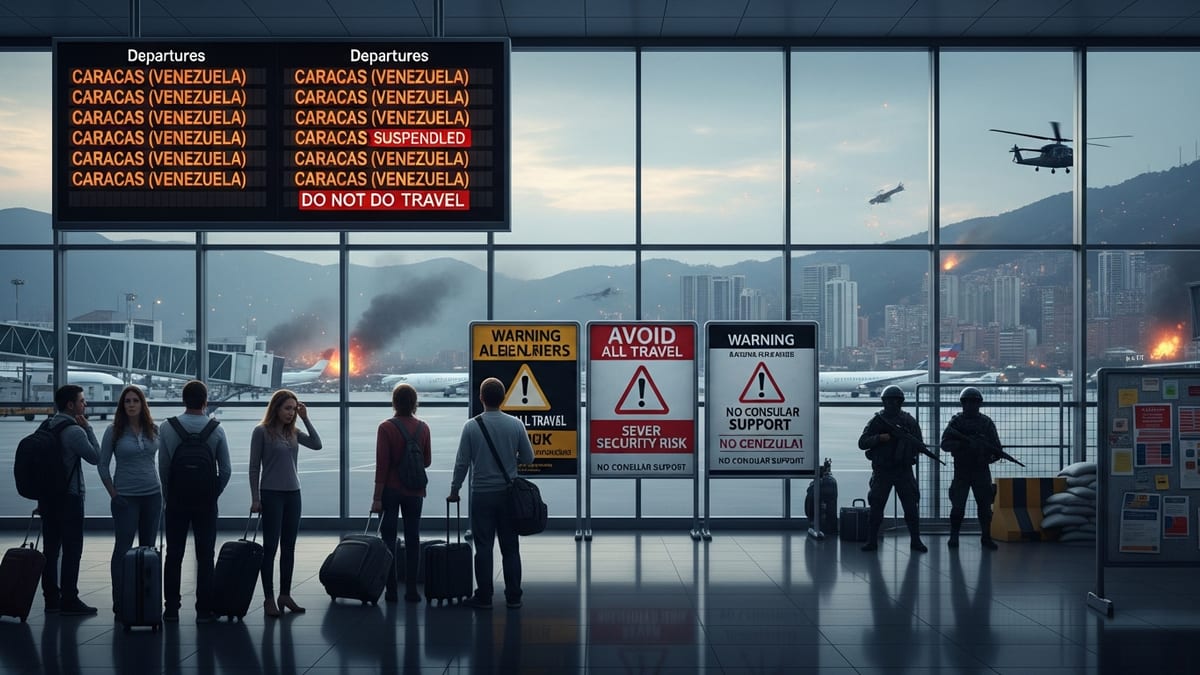
What the new UK warning actually says
Updated Foreign, Commonwealth and Development Office (FCDO) guidance shows Venezuela now categorised as a destination where travel is not advised anywhere in the country. Earlier versions of the travel advice differentiated between regions, with some areas rated as “all but essential travel,” but the latest update applies a blanket “do not travel” stance.
The FCDO’s Venezuela travel advice page, revised in mid October 2026, highlights the very limited ability of the UK government to provide in-person consular help inside Venezuela. Public information stresses the need for travellers already there to maintain a personal emergency plan that does not rely on evacuation or direct assistance from the UK.
The shift brings Venezuela into the group of destinations that UK guidance treats as posing an unacceptably high risk to visitors. The decision follows a period of heightened instability, including armed activity, sporadic violence in major cities and significant disruption to basic services.
While the advice is not a legal ban, it has wide practical consequences. Many mainstream travel insurers will not cover trips that go ahead against an explicit FCDO “do not travel” warning, and some airlines and tour operators use the rating as a benchmark for suspending services.
Why Venezuela is considered high risk
Published material from the FCDO points to a combination of violent crime, political tension, border insecurity and weak health infrastructure as key drivers of the upgraded warning. The safety and security section of the government’s advice notes that criminal groups are active in urban centres and along transport routes, with incidents of armed robbery, kidnapping and carjacking reported.
Travel advisories issued by other governments trace a deterioration in the overall risk picture since early 2026, when armed clashes, targeted strikes and militia activity were reported in and around Caracas and several border states. Open sources describe irregular armed groups operating checkpoints and roadblocks on some key routes, increasing the chance that foreign travellers could be caught in confrontations or opportunistic crime.
Concerns also extend to the functioning of essential services. International assessments over recent years have cited shortages of medicines, limited hospital capacity and frequent power and water outages, all of which can sharply reduce the standard of care available to visitors who fall ill or are injured.
On the political side, Venezuela remains in a prolonged period of contestation, with questions over governance, control of territory and relations with neighbouring countries. Public briefings by foreign ministries emphasise that rapid changes on the ground are possible, including sudden curfews, closures of airspace or borders and restrictions on movement that can leave travellers stranded.
Impact on flights, borders and consular support
Commercial flight options between the UK and Venezuela were already very limited before the latest warning. British travellers generally reach Caracas or other Venezuelan cities via connections through European, Caribbean or Latin American hubs. Since the escalation of risk in 2026, some international carriers have reduced frequencies or adjusted schedules in response to demand and security assessments.
Open-source reports indicate that airports in Venezuela remain operational, but movement to and from terminals can be unpredictable because of checkpoints, fuel shortages and occasional roadblocks. Road journeys at night are widely described as high risk, and several governments explicitly advise avoiding after-dark travel to and from airports wherever possible.
The land borders present further complications. Publicly available guidance highlights increased danger in areas close to Colombia, Brazil and Guyana, where armed groups, smuggling routes and contested territory create volatile conditions. Border crossings can close without warning, leaving foreign nationals with few safe exit options if commercial flights are disrupted.
Consular assistance is another central concern. The UK has warned that its capacity to help citizens on the ground in Venezuela is severely constrained, particularly outside the capital. Other foreign ministries deliver a similar message, noting that evacuation operations or direct support during an emergency could be very difficult to organise if the security situation deteriorates further.
What this means for trips already booked
For travellers who have already booked flights or holidays to Venezuela, the upgraded UK advice has important financial and practical implications. Travel insurance policies sold in the UK commonly exclude cover for trips taken against explicit FCDO warnings, especially to destinations listed as “do not travel.” That can affect claims related to medical care, theft and cancellation.
Industry practice varies, but package tour operators based in the UK and European Union often treat a highest-level government warning as grounds to cancel or significantly alter itineraries without charging customers standard amendment fees. Independent travellers may have to negotiate directly with airlines and accommodation providers regarding refunds or credits, relying on fare rules and local terms rather than consumer package regulations.
Travelers who are already in Venezuela are being urged, through public advisories, to evaluate whether it is safe to leave using available commercial options. Foreign ministries stress the importance of having a contingency plan that may include alternative routes out of the country, access to funds outside local banks and arrangements for staying in contact with family and friends if communications are disrupted.
Those who decide to remain face the challenge of operating in an environment where security conditions and administrative rules can change at short notice. Guidance from multiple governments encourages foreign nationals to monitor reputable local and international media, keep travel documents secure and avoid large gatherings or demonstrations that could be targeted by security forces or armed groups.
Practical guidance for anyone still considering travel
Despite the strong warning, some individuals may still weigh travel to Venezuela for work, family or humanitarian reasons. Public travel advisories emphasise that anyone contemplating such a trip should consider whether their purpose meets a very high threshold of necessity, and should fully understand that they may be travelling without the safety net of normal consular and insurance protections.
Pre-travel preparation is critical. Official advice for high-risk environments typically includes registering contact details with the relevant embassy or consular service where this is offered, arranging comprehensive insurance that explicitly accepts cover in spite of government warnings, and planning redundant routes in and out of the country in case primary options become unavailable.
Health precautions require particular attention. Government and international health sources describe Venezuela’s healthcare system as under severe strain, with chronic shortages of medicines and equipment. Travellers are encouraged to seek specialist medical guidance before departure, travel with any essential medication in sufficient quantities and be prepared for limited access to advanced treatment facilities outside a small number of major urban hospitals.
For most leisure travellers, though, the message from the latest UK position is clear. With Venezuela now designated as a place where travel is not advised anywhere in the country, prospective visitors looking for beaches, nature or cultural experiences are being strongly steered to consider alternative South American or Caribbean destinations where security conditions and support structures are more favourable.