


Consistently ranked among the world’s best airports, Singapore Changi is far more than a transport hub. Between the lush indoor rainforest at Jewel, efficient immigration, excellent dining and easy links into the city, it is an airport where many travelers happily plan long layovers. This guide brings together the latest practical information and on-the-ground tips to help you navigate Changi with confidence, whether you are flying in, out, or simply passing through.
Get the latest updates straight to your inbox!
Understanding Changi’s Layout and Terminals
Singapore Changi Airport currently operates four main passenger terminals: T1, T2, T3 and T4, arranged around the central Jewel complex that links Terminals 1, 2 and 3. Terminal 1 opens directly into Jewel’s departure hall, while Terminals 2 and 3 connect to Jewel via air conditioned pedestrian link bridges from their departure levels. Terminal 4 is separate on the other side of the runway and is connected by shuttle bus. This layout matters because your route to attractions, check in counters and immigration depends on which terminal your airline uses.
Most full service international carriers, such as Singapore Airlines, Lufthansa and United, operate out of Terminals 2 and 3, while a mix of regional and low cost airlines use Terminals 1 and 4. Budget carriers like AirAsia and VietJet are commonly assigned to T4, which has its own security and immigration and does not physically plug into Jewel. If your boarding pass shows T4 but you want to see the Rain Vortex at Jewel, you will need to factor in shuttle time back and forth.
Airside, Terminals 1, 2 and 3 are linked by the free Skytrain, which runs frequently and allows you to move between gates and lounges without clearing immigration. This is particularly useful on tight connections where your inbound and outbound flights use different terminals. For example, a passenger arriving on a Singapore Airlines flight into T3 and departing on a Qantas flight from T1 can remain in transit and ride the Skytrain in under 10 minutes, instead of rechecking in landside.
Terminal 4, by contrast, is not connected airside to the other terminals. If you are transiting between T4 and another terminal on separate tickets, you generally have to clear immigration, collect any checked bags if they are not through checked, and then take the shuttle bus that links T1 and T4. For this reason, travelers booking separate low cost connections often allow at least three hours when one flight uses T4.
Arrivals, Immigration and Getting Into the City
Changi’s reputation for fast, efficient immigration is well deserved, but actual processing times can fluctuate depending on the time of day and how many long haul flights arrive at once. Many passport holders from Europe, the United States, Australia and much of Asia are eligible to use automated lanes with biometric scans, which significantly speeds up the process. Even at busier periods, it is common for arriving passengers with no checked baggage to be curbside within 30 to 45 minutes of landing.
Once you exit customs, you will find airport taxi queues, ride hailing pick up areas and public transport signs clearly marked. Metered taxis are plentiful and regulated, with typical daytime fares to central areas like Orchard Road or Marina Bay usually in the range of 22 to 35 Singapore dollars depending on traffic, route and surcharges. Late night rides or trips during peak hours may cost more due to higher surcharges and demand. For many families or small groups with luggage, taxis remain the simplest option.
Travelers on a budget or those comfortable with public transit can take the MRT, Singapore’s metro. The airport is served by Changi Airport station, which connects via the East West Line to the rest of the network. Trains usually start running early in the morning and finish around midnight. A typical adult fare into the city using a stored value card is often under 3 Singapore dollars, although the journey involves a simple transfer at Tanah Merah. This makes the MRT particularly attractive for solo travelers or backpackers arriving in off peak hours.
Private transfers, hotel limousines and ride hailing services like Grab are also widely used. A prebooked car can be convenient for late night arrivals, those traveling with young children or visitors who prefer a point to point solution with a fixed quoted price. At major hotel chains in Marina Bay, you will often see bell staff waiting for arriving guests who have booked limousine pickups, an option worth considering if you have multiple large suitcases or mobility needs.
Exploring Jewel and the HSBC Rain Vortex
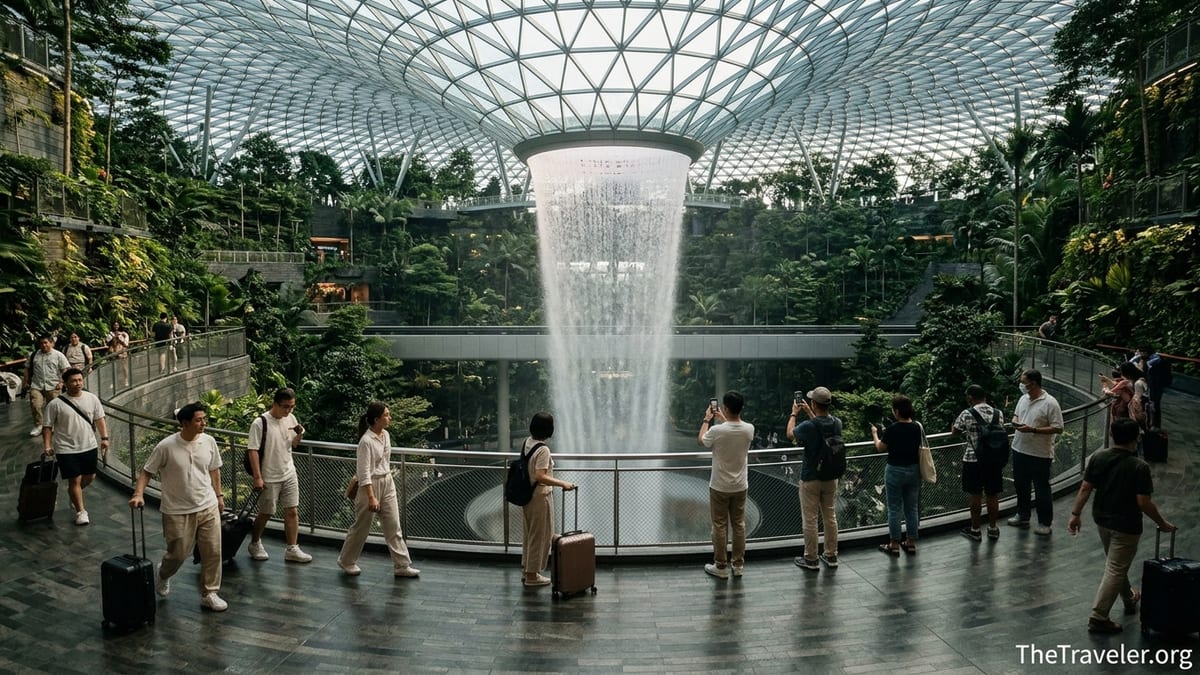
Jewel Changi Airport is the star attraction for many first time visitors. The dome shaped complex, with its glass and steel roof and multi level Shiseido Forest Valley garden, is anchored by the 40 meter HSBC Rain Vortex, widely described as the world’s tallest indoor waterfall. The cascade drops from an oculus in the roof down seven stories into the basement, surrounded by terraced greenery, walking paths and restaurants with direct waterfall views.
Jewel operates daily, generally from morning until around 10 pm for its ticketed attractions, with the public areas of the mall open for longer hours. The Rain Vortex itself typically runs during the day as a continuous waterfall and then transforms into a Light and Music showcase in the evening, with scheduled shows. Current information published by the airport indicates that light and music performances usually take place around 8 pm and 9 pm on weekdays, with an additional 10 pm show on Fridays, weekends and public holidays. Travelers with evening layovers often time their visit around these slots to see the waterfall illuminated with projected patterns and colored lights.
Admission to the Rain Vortex and the surrounding Forest Valley is free, and there is no ticket or reservation required simply to walk into Jewel, stroll the garden paths or photograph the waterfall from different levels. Many passengers with a few hours before departure grab a coffee from an international chain cafe on Level 2 and watch the light show from the balcony seating. Others walk up through the forested ramps to Level 5 to look straight down into the vortex before heading back to their gates.
If you have a longer layover or an overnight stop, you can explore Jewel’s ticketed experiences at Canopy Park on the top level. Current official price lists show that entry to Canopy Park itself is typically from about 8 Singapore dollars, with additional charges for specific attractions such as the Sky Nets, Hedge Maze, Mirror Maze and the glass floored Canopy Bridge. For example, a ticket for the bouncing Sky Nets is commonly priced in the mid-20 dollar range per adult, while combination bundles that include multiple attractions are marketed to families who want to spend several hours inside Jewel.
Transit, Layovers and Where to Sleep
One of Changi’s major strengths is how manageable it makes long layovers. Transit passengers who remain airside in Terminals 1, 2 and 3 can take advantage of numerous quiet seating zones, charging points, snooze chairs and small nap areas. Some travelers choose to simply recline on padded benches near their gate, especially on late night flights where the terminal lighting is dimmed and ambient announcements are less frequent.
For more privacy or for layovers stretching beyond five or six hours, transit hotels and pay by use lounges are a popular choice. Dedicated Ambassador Transit Hotels in Terminals 2 and 3 offer blocks of a few hours that can be reserved for a flat rate, with updated pricing materials indicating rates in the ballpark of 45 Singapore dollars and up for a six hour block in a basic room. These rooms are located airside, so you do not need to clear immigration or retrieve checked luggage, which is convenient for travelers on tight overnight connections.
On the landside of Jewel, YOTELAIR offers compact, cabin like rooms that can be booked either overnight or in several hour chunks during the day. This works well for travelers who deliberately schedule a day time stop in Singapore and want to explore the city center, then return to the airport for a shower and nap before their next flight. For those seeking a more traditional full service hotel, the Crowne Plaza at Terminal 3 is connected directly to the terminal and offers standard hotel amenities, including a pool and fitness center, popular with airline crews and frequent flyers.
If you prefer not to pay for a hotel, you can still freshen up at one of the many shower facilities in airline lounges or pay per use lounges across the terminals. Independent lounges often sell access for a set number of hours, including use of showers, Wi Fi, food and drinks. Travelers on economy tickets without elite status frequently book these lounges in advance, especially on overnight itineraries where a hot shower and proper meal significantly improve the journey.
Food, Shopping and Practical Services
Singapore Changi is known among travelers for its wide range of dining options, from local hawker style dishes to international fast food brands and upscale restaurants. In the public areas of Jewel alone, you will find Singaporean favorites like chicken rice and laksa alongside Japanese ramen chains, Korean barbecue, Western burger outlets and dessert cafes. Inside the transit areas of each terminal, food courts typically offer mixed rice, noodles, dim sum, Indian curries and vegetarian options at price points that are competitive with city malls.
Travelers looking to keep costs in check can expect to pay around 7 to 15 Singapore dollars for a simple rice or noodle dish in a food court, while coffee from international chains usually ranges from about 5 to 8 dollars for a latte or iced drink depending on size. At the other end of the spectrum, sit down restaurants at Jewel with direct Rain Vortex views charge more for the setting, particularly at dinner, though many visitors consider a meal with the waterfall backdrop a memorable splurge for a special trip.
Shopping is another major draw. All terminals feature extensive duty free areas selling cosmetics, skincare, fragrances, liquor and electronics from global brands. Premium fashion labels line the central retail streets of Terminals 1 through 3, while Jewel adds flagship outlets for international sportswear, beauty and lifestyle brands as well as specialist stores for Singapore souvenirs and local snacks. It is common for travelers with a few hours to pick up locally loved pineapple tarts, kaya spreads or souvenir boxes of kopi sachets to bring home as gifts.
Essential services are well distributed throughout Changi. Currency exchange counters and ATMs are available in both arrival and departure halls, though experienced travelers often compare rates or withdraw cash from ATMs instead of exchanging large amounts at counters. Free Wi Fi is available, typically accessible via a simple registration with your phone number or by scanning your passport at dedicated kiosks. Pharmacies, medical clinics, baby care rooms, prayer rooms and luggage storage counters are also present in each terminal and at Jewel, making it straightforward to handle practical needs during a layover.
Getting Around Safely and Smoothly
Even though Changi is large, it is an easy airport to navigate, especially if you pay attention to signage and leave sensible buffers between activities and boarding times. Flight information display screens are visible everywhere and provide updated gate assignments and boarding times. At Changi, security screening usually takes place at the gate rather than at a centralized point before duty free, which means you should aim to be at your gate a little earlier than you might at some other airports to allow time for screening queues.
If you plan to visit Jewel during a layover and your onward flight departs from Terminals 1, 2 or 3, keep in mind that you will need to clear immigration to access Jewel and then pass through departure immigration and security again to re enter the transit area. Frequent travelers often recommend allowing at least three hours between flights if you want to comfortably visit Jewel, have a meal, and account for queues, especially during school holidays or major festive periods when the mall is busier.
Another safety consideration involves your luggage. If your bags are checked through to your final destination, you can move more freely around the airport and Jewel without worrying about large suitcases. If you arrive on a separate ticket and have to reclaim luggage, baggage storage counters in each terminal and at Jewel offer short term paid storage for anything from a few hours to a full day. Travelers stopping in Singapore for half a day often use this service before heading into the city to visit places like Gardens by the Bay or Marina Bay Sands.
Changi is widely regarded as a safe environment, but standard travel sense still applies. Keep valuables on your person, avoid leaving laptops or bags unattended while you shop, and check that your boarding pass, passport and any necessary visas or transit approvals are in order before you leave the secure area. Local police and airport security staff are visible throughout the terminals and can provide assistance, and information counters staffed by customer service agents are easy to spot if you become disoriented.
The Takeaway
Singapore Changi Airport has evolved into a destination in its own right, combining efficient operations with attractions that many travelers would happily visit even without a flight. Understanding the layout of the terminals, how Jewel connects to them, and the difference between airside and landside areas will help you make the most of your time, whether you have a tight connection or a long, leisurely layover.
Plan your movements with your flight times in mind: if you want to see the evening Light and Music show at the HSBC Rain Vortex, build in enough buffer to clear immigration and return through security without stress. Consider whether a transit hotel, lounge or nap pod will meaningfully improve your journey, especially on overnight itineraries, and take advantage of the airport’s well priced local food and extensive shopping only after you have confirmed your gate and boarding time.
With realistic expectations, a bit of planning and awareness of your terminal and timing, Changi can transform the most mundane part of air travel into an enjoyable experience. From a quick coffee overlooking the indoor waterfall to a full day exploring Canopy Park and then heading into Singapore’s city center, the airport is designed to make connecting through Southeast Asia as pleasant and memorable as possible.
FAQ
Q1. Do I need to clear immigration to visit Jewel Changi Airport during a layover?
In most cases yes. Jewel is in the public area connected to Terminals 1, 2 and 3, so you must clear immigration to reach it and then go through departure immigration and security again to re enter the transit area. The main exception is when you simply ride the Skytrain between Terminals 2 and 3 and glimpse Jewel from the train without entering the mall.
Q2. How much time should I allow if I want to see the Rain Vortex before my flight?
If your flight departs from Terminals 1, 2 or 3 and you plan to properly visit Jewel, many travelers allow at least three hours between flights. This window gives you time to clear immigration, walk to Jewel, watch the waterfall or Light and Music show, have a quick meal and then return through immigration and gate security without rushing.
Q3. Is the HSBC Rain Vortex running 24 hours a day?
The waterfall typically operates throughout the day and into the evening during Jewel’s regular opening hours, but the full Light and Music shows are scheduled for specific times in the evening, usually around 8 pm and 9 pm on weekdays with an additional later show on weekends and public holidays. Very late at night and in the early morning, the waterfall and much of Jewel may not be operating, so it is wise to check current timings close to your travel date.
Q4. What is the cheapest way to get from Changi Airport into central Singapore?
The MRT metro is usually the cheapest option. From Changi Airport station you connect to the East West Line, with fares to central areas often under 3 Singapore dollars using a stored value card. The journey time is longer than a taxi and requires at least one transfer, but it is economical and easy to navigate with luggage.
Q5. Can I sleep in the airport for free during an overnight layover?
Yes, many travelers sleep on benches or in designated rest zones, particularly in Terminals 2 and 3 where there are reclining chairs and quieter corners. However, lights and announcements continue overnight and privacy is limited. If you want a proper bed and shower, transit hotels and pay per use lounges offer more comfort at a cost.
Q6. Are there showers available if I do not have lounge access?
Yes. Several independent pay per use lounges across the terminals sell access that includes shower use, even if you are not flying in a premium cabin. There are also a few standalone shower facilities where you can pay a smaller fee just to freshen up. Exact pricing varies, so it is worth checking the options in your specific terminal upon arrival.
Q7. What can I do at Changi Airport if I have a five or six hour layover and do not want to leave the transit area?
Within the secure zones you can explore themed gardens, watch movies in free cinemas when available, use children’s play areas, visit duty free shops, enjoy local and international food courts, or rest in quiet zones. Many passengers also book short stays at transit hotels or lounges to nap, shower and catch up on work between long haul flights.
Q8. Is Terminal 4 connected to Jewel Changi Airport?
Terminal 4 is not physically connected to Jewel. To visit Jewel from T4 you must clear immigration, take the shuttle bus to Terminal 1 and then walk into Jewel via the public link. Because this involves additional transfers and security checks, passengers with flights into or out of T4 should allow extra time if they plan to visit Jewel during their trip.
Q9. Are food and shopping at Changi significantly more expensive than in the city?
Prices vary. Simple meals in airport food courts and some casual restaurants are often comparable to mid range city malls, while branded coffee and sit down restaurants with prime views or premium locations can be more expensive. Duty free goods may offer savings on selected items such as cosmetics or liquor compared to some home markets, but it is always wise to know typical prices before assuming everything is a bargain.
Q10. Can I store my luggage at Changi while I explore Jewel or go into the city?
Yes. Luggage storage counters in each terminal and at Jewel offer short term paid storage for a range of bag sizes. Many travelers drop off large suitcases for several hours or even most of the day so they can move around more easily, either within the airport or on a quick trip into central Singapore, before collecting their bags and checking in for their onward flight.