


Singapore Changi Airport regularly tops global rankings for passenger experience, but its size and four-terminal layout can feel overwhelming on your first visit. Whether you have a 60-minute connection or a full day to explore, understanding how Terminals 1, 2, 3 and 4 fit together makes Changi far easier to navigate. This guide breaks down the terminal layout, transfer options, typical walking times and real-world examples so you can move around Changi with confidence.
Get the latest updates straight to your inbox!
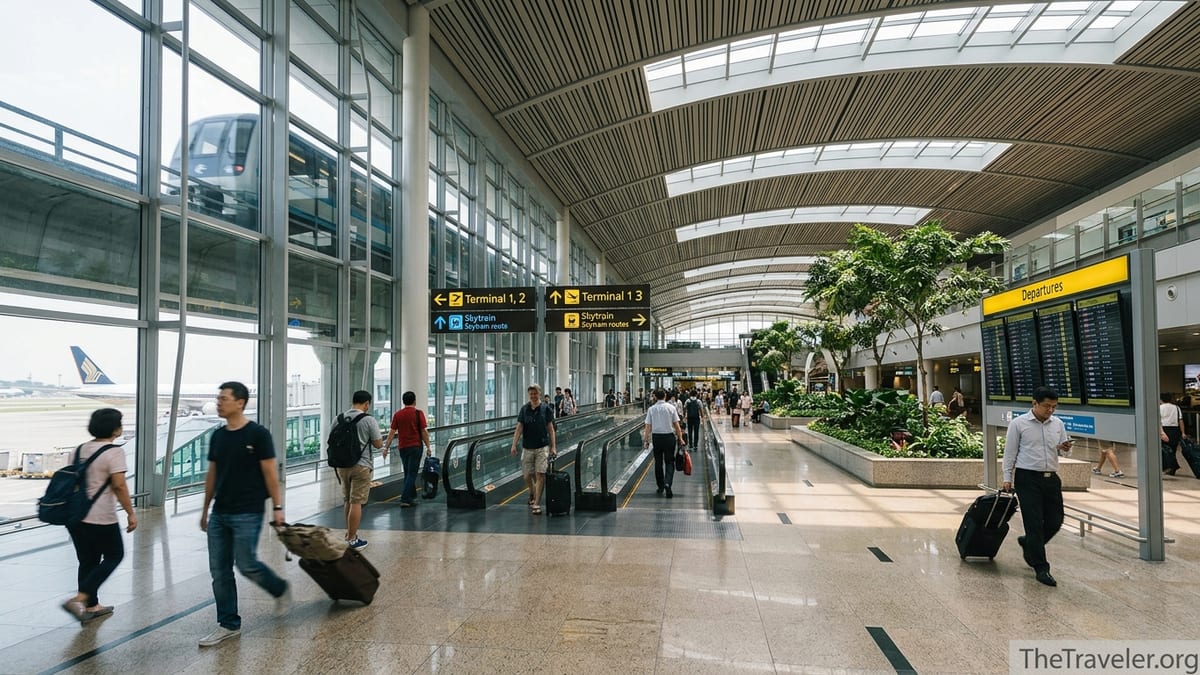
How Changi’s Terminals Fit Together
Changi Airport currently operates four passenger terminals: T1, T2, T3 and T4, with a combined capacity of around 90 million passengers a year. Terminals 1, 2 and 3 form a connected core in a broad U-shape, linked by walkways, travellators and the free Skytrain people mover in both the public and transit (airside) areas. Terminal 4 sits separately across the airport road system and is connected by shuttle bus rather than Skytrain.
In practice, this means you can walk or ride the Skytrain between T1, T2 and T3 without ever leaving security if you are in transit. For example, a traveler arriving on Singapore Airlines in T3 and departing on a codeshare in T2 can follow the purple “Transfer” and “Skytrain” signs and move between terminals in about 10 to 20 minutes, depending on gate locations. You stay within the secure zone and do not pass through immigration as long as you are on a through‑ticket and already checked through.
Terminal 4 works differently. It has no Skytrain connection and no direct pedestrian bridge from the main terminal cluster. Getting between T4 and the other terminals requires a shuttle bus and usually means exiting to the public area, so you must re-clear security at the next departure terminal. This is straightforward but takes more time, which is why airlines typically build longer official connecting times when a T4 transfer is involved.
Jewel Changi Airport, the nature‑themed retail and dining complex crowned by the Rain Vortex waterfall, sits directly in front of Terminal 1 and connects landside to T1, T2 and T3. It is not inside the transit zone, so anyone in transit must clear immigration to visit. For a U.S. traveler on a long layover, it is common to arrive on a long‑haul flight at T1, clear immigration, walk straight into Jewel for a few hours of food and shopping, then return to T1 or T3 to check in for the next flight.
Terminal by Terminal: What to Expect
Terminal 1 is Changi’s original terminal and today serves a wide mix of full‑service and low‑cost carriers. It connects directly to Jewel by bridge, making it the most convenient base if you plan to explore the complex between flights. Inside, you will find the central departure hall on Level 2, immigration counters, and piers extending out to the gates. Airlines like Qantas and Emirates typically use Terminal 1, so an Australian traveler connecting from Qantas to Emirates may never leave this terminal.
Terminal 2 has recently been modernized and now handles a combination of regional and some long‑haul services, including many Star Alliance carriers. It has direct access to the Changi Airport MRT station in the public area, which makes it a common entry point for passengers arriving from the city by train. If you land on a Scoot regional flight at T2 and are staying in downtown Singapore, you can follow the “Train to City” signs and be on the East‑West Line within about 10 minutes of clearing immigration and customs.
Terminal 3 is the main hub for Singapore Airlines long‑haul operations. It is laid out as a long spine, roughly a kilometer end to end, with multiple piers branching off. Many North America to Europe or Australia itineraries route through T3. A traveler flying New York to Singapore to Sydney on a single Singapore Airlines ticket will often arrive and depart from T3, making that connection very simple: get off the first flight, follow the “Transfer” signs, pass through the security check at the next gate and you are done.
Terminal 4 is smaller, newer and designed with significant automation. It is favored by several low‑cost and regional carriers. You check in at self‑service kiosks, drop bags at automated counters, and pass through automated immigration gates if eligible. The terminal has its own compact shopping and dining area after security. A traveler on AirAsia arriving from Kuala Lumpur into T4 and then self‑connecting to a separate Emirates ticket in T1 would need to collect bags, exit to the public arrivals hall, take the free shuttle bus to T3 or T1 and then check in again.
Skytrain, Walking and Shuttle Buses: Getting Around Quickly
The Changi Airport Skytrain is a free automated people mover that links Terminals 1, 2 and 3 in both the public and transit areas. It operates from roughly 5 am to around 2 am daily, with trains every few minutes during most of the day. Typical travel time between adjacent terminals is about four minutes. For instance, if you land in T1 and your connecting flight departs from T3, the Skytrain ride between the terminals is often faster and more comfortable than walking the whole way.
Walking is still a realistic option within the main terminal cluster. Changi’s official guidance notes that all inter‑terminal walking between T1, T2 and T3 can usually be done in under 30 minutes, with many common routes taking 10 to 15 minutes for an average traveler. This means a family arriving in T3 who wants to stretch their legs can follow the well‑marked “Terminal 1” or “Terminal 2” signs along air‑conditioned corridors and travellators rather than waiting for the Skytrain.
Terminal 4, as the outlier, is reached by shuttle bus. The free T4 shuttle typically runs between T4 and T3 in the public area, and some services also loop via T1 or the MRT station at peak times. Operational details can change, but in normal conditions buses run roughly every 10 to 20 minutes during the day. The ride itself is short, around 5 to 10 minutes, but you must allow extra time for waiting, unloading and re‑clearing security at your departure terminal.
In practical terms, a traveler landing on a budget airline at T4 at 8 am with a 12 pm full‑service departure from T3 would have plenty of time. They could collect bags by about 8:30 am, catch the shuttle to T3, check in by 9:00 am, and still have two to three hours to visit a lounge or walk across to T1 and T2 via Skytrain. The key is to build a generous time buffer if your itinerary involves T4, especially when you have separate tickets or need to recheck luggage.
Minimum Connection Times and How Much Time You Really Need
Official minimum connecting times at Changi are among the shortest in the world, with many same‑terminal, same‑airline transfers published around 50 minutes. Airlines design their schedules around these figures, and thousands of passengers make tight connections every day. If both flights are on one ticket and you remain in T3 or move between T2 and T3, airline ground staff can often assist and fast‑track you if the inbound flight arrives slightly behind schedule.
In real‑world terms, travelers usually feel comfortable with 90 minutes for a standard through‑ticket connection involving different terminals within the T1–T3 cluster. For example, someone arriving from Tokyo into T1 at 6:00 am and departing to Bangkok from T2 at 7:30 am should generally have enough time, as long as they follow the “Transfer” and “Skytrain” signs directly and do not stop to shop. You stay within the transit area, bypass immigration, and only face security screening at the departure gate.
Connections involving Terminal 4 or separate tickets require more caution. Because T4 usually means taking a shuttle and re‑clearing security, many frequent travelers aim for at least three to four hours when self‑connecting between T4 and the main terminals. For instance, if you book a low‑cost carrier into T4 arriving at 3:00 pm and a separately ticketed long‑haul from T3 at 5:30 pm, you would have only two and a half hours. That can work in ideal conditions, but it leaves little room for delays, queues at immigration or baggage issues.
If your layover is longer, Changi becomes a destination in its own right. With four to six hours between flights, you can ride the Skytrain to explore multiple terminals, try different hawker‑style food courts, or even clear immigration to visit Jewel, have a meal at one of the international restaurants overlooking the Rain Vortex and return through any of the connected check‑in halls at T1, T2 or T3. Just remember that security in Changi is at the gate, so factor in extra time to clear the checkpoint before boarding.
Using Public Transport and Taxis Between Terminals and the City
For trips into Singapore, most travelers will use either the MRT or taxis and ride‑hailing services. The Changi Airport MRT station sits between Terminals 2 and 3 in the public area. If you arrive into T2 or T3, you can be at the station in under 10 minutes by following the green “Train to City” signs. From T1, you cross through the public arrivals area and follow overhead signs to T2 or T3 via an enclosed walkway or the public‑area Skytrain, then continue to the MRT station. From T4, you first take the shuttle bus to T3 and then walk to the station.
For a concrete example, a solo traveler arriving on a late‑morning flight at T3 who is staying in the Bugis district might budget around one hour from gate to hotel lobby if using the MRT and then a short walk. After clearing immigration and customs, they would reach the MRT station, board a train on the East‑West Line and make one or two simple transfers downtown. The cost is modest compared to taxis and gives you a clear sense of the airport’s geography as you move under Terminals 2 and 3.
Taxis and ride‑hailing pickups are available at the ground transport areas of each terminal. For families with luggage or travelers arriving late at night when MRT frequency decreases, a taxi from any terminal to central areas like Orchard Road or Marina Bay usually takes 20 to 30 minutes in normal traffic. The route by road takes you past the side of Terminal 4 if you are heading toward the city from T1–T3, reinforcing how T4 sits slightly apart from the main complex.
If you are transferring between terminals on separate tickets and worried about your connection, a taxi within the airport grounds is rarely necessary. In almost all cases, the Skytrain, walking routes and free shuttle buses are sufficient. The money saved can instead go toward a shower in a pay‑per‑use lounge or a meal in one of the food courts, which many repeat visitors consider part of the Changi experience.
Practical Wayfinding Tips for Stress Free Navigation
Changi’s signage is generally excellent, but a few simple habits make navigating the terminals even easier. First, always follow the big yellow flight information signs before anything else. When you disembark, look for the large boards listing “Transfer,” “Baggage Claim,” and “Arrival Immigration.” If you have a connecting boarding pass already, choose “Transfer” and then look for the “Transfer Lounge” nearest to your departure gate. You can confirm your gate number on the displays and the terminal will be clearly marked, for example “Gate B4, Terminal 3.”
Second, pay attention to color coding and symbols rather than trying to memorize maps. Skytrain routes are marked with pictograms of the trains and arrows between terminals. Walking routes to other terminals often show approximate walking times like “To Terminal 2: 8 mins.” If you are tired after a long‑haul flight from Europe and land in T3, these visual cues help you quickly decide whether to walk or ride the Skytrain to reach a food court in T1 or a garden in T2.
Third, use the airport’s official app or terminal information counters if you feel lost. Free Wi‑Fi is widely available in all terminals, so you can pull up a live map that shows your current location and recommended routes. At peak times, staff and volunteers are often stationed near major junctions and escalators, and they are used to answering questions like “How do I get from T1 to Jewel?” or “Is this Skytrain for Terminal 2 or Terminal 3?” A short conversation can save you unnecessary walking and give you realistic expectations about timing.
Finally, remember that Changi is designed to be forgiving. If you arrive early at the wrong terminal, staff can direct you to the fastest route, whether that is a Skytrain, a shuttle or a short walk. If you arrive late and risk missing a connection on a through‑ticket, airline agents at transfer counters can sometimes rebook you or prioritize you at security. The more you know about the basic layout of T1–T3 and the separate nature of T4, the more these systems work in your favor.
The Takeaway
Understanding how Singapore Changi’s four terminals connect is the key to a smooth journey. Terminals 1, 2 and 3 form a single, walkable complex stitched together by the Skytrain and clear wayfinding, while Terminal 4 functions as a separate, shuttle‑linked satellite. Once you grasp that structure, you can make realistic decisions about connection times, whether to visit Jewel, and how best to move between flights.
For straightforward through‑ticket connections within the T1–T3 cluster, 60 to 90 minutes is usually enough, as you stay airside and rely on fast Skytrain links. When Terminal 4 or separate tickets enter the picture, aim for longer layovers and build in extra time for shuttles, immigration and security. In all cases, following the airport’s signage, checking the live flight boards and asking staff when in doubt will keep your route efficient.
Many travelers leave Changi remembering not just a stress‑free transfer but also a few hours spent wandering butterfly gardens, sampling local dishes or watching the Rain Vortex. With a basic mental map of the terminals and the confidence to switch between Skytrain, walking routes and shuttles, you can turn what might have been a confusing maze into one of the most enjoyable parts of your trip.
FAQ
Q1. How long does it take to transfer between terminals at Changi?
Most transfers between Terminals 1, 2 and 3 take about 10 to 20 minutes using the Skytrain or walking, not counting time for security at the next gate.
Q2. Is Terminal 4 connected to the Skytrain?
No. Terminal 4 is not on the Skytrain network. You use a free shuttle bus between T4 and the main terminals, then re‑clear security for your next flight.
Q3. Do I need to clear immigration for a connection at Changi?
If both flights are on one ticket and you remain in transit, you usually do not clear immigration. You follow “Transfer” signs and stay airside until your next departure.
Q4. Can I visit Jewel during a layover?
Yes, if you have enough time and are eligible to enter Singapore. You must clear arrival immigration, visit Jewel in the public area, then check in or re‑enter the transit area afterward.
Q5. How much time should I allow for a self‑transfer involving Terminal 4?
For separate tickets that require baggage reclaim and check‑in at another terminal, many travelers aim for at least three to four hours when Terminal 4 is involved.
Q6. What is the best way to get from Terminal 1 to Terminal 3?
The Skytrain is usually fastest, taking only a few minutes between terminals. You can also walk along signposted corridors and travellators if you prefer to stretch your legs.
Q7. Where is the MRT station located at Changi?
The Changi Airport MRT station is in the public area between Terminals 2 and 3. You can reach it on foot or via the public‑area Skytrain from Terminal 1 and by shuttle then walking from Terminal 4.
Q8. Are walking times clearly shown inside the airport?
Yes. Many signs indicate approximate walking times between terminals or gate zones, helping you judge whether to walk or use the Skytrain for your connection.
Q9. Do I go through security when entering the terminal or at the gate?
At Changi, the main security screening happens at the departure gate area rather than at a central checkpoint. You can move freely airside until you enter your gate’s screening queue.
Q10. What should I do if my incoming flight is late and my connection is tight?
If you are on a through‑ticket, inform airline staff as soon as possible. Follow “Transfer” signs directly, use the Skytrain where available, and staff may be able to fast‑track or rebook you if needed.