


More news on this day
Polar cruise specialist Poseidon Expeditions is leaning into a deliberate single-ship strategy built around its 114-passenger Sea Spirit, betting that focus and intimacy will stand out in an increasingly crowded expedition market.
Get the latest news straight to your inbox!
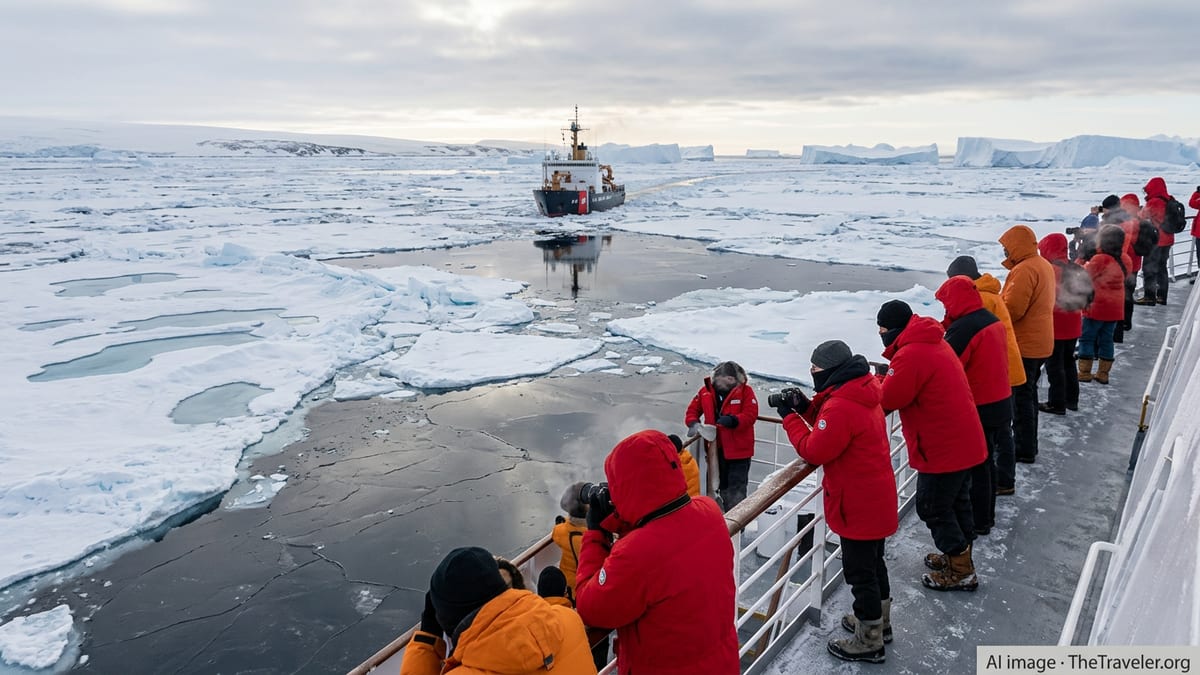
Deliberate focus on one all-suite expedition vessel
Publicly available company information shows that Poseidon Expeditions currently bases its core Arctic and Antarctic programs on a single vessel, the all-suite Sea Spirit. The ice-strengthened ship carries a maximum of about 114 guests, placing it firmly in the small-ship category at a time when many rivals are adding larger newbuilds.
Brochures and trade material describe Sea Spirit as the company’s backbone for polar operations, following the seasons between hemispheres with Antarctica itineraries in the southern summer and Arctic voyages in the northern summer. This year-round repositioning allows the ship to operate nearly continuously in high-demand expedition regions without the need to spread resources across a broader fleet.
Destination programs promoted for the 2024 to 2027 seasons indicate a familiar portfolio built around the Antarctic Peninsula, South Georgia and the Falklands, as well as Svalbard, Greenland, Iceland and Franz Josef Land. By running these routes with a single vessel, the operator appears to be concentrating on a narrow band of high-profile polar itineraries where its experience is longest and demand is most resilient.
Industry profiles emphasize that Sea Spirit underwent significant refurbishments over the past decade, adding contemporary suites and public spaces while retaining a compact footprint. This has allowed Poseidon Expeditions to keep a proven platform in service rather than embarking on a capital-intensive fleet expansion program.
Operational advantages in tightly regulated polar regions
According to specialist expedition agencies and polar cruise comparison sites, operating one ship of this size brings practical advantages in regions where landing rules are strict. In Antarctica, guidelines generally limit the number of visitors ashore at many sites to about 100 at a time. With Sea Spirit’s capacity typically managed around that level, the operator can plan for all guests to go ashore simultaneously rather than staggering landings in multiple waves.
This scale also simplifies Zodiac logistics, frequently cited as a key element of expedition cruising. The ship carries a fleet of rigid inflatable boats that ferry guests from ship to shore and on coastal explorations. With a single, relatively small complement of passengers, the time needed to embark and disembark everyone for excursions can be shorter than on larger vessels with 200 or more guests.
Industry commentary further notes that focusing on one vessel enables a consistent expedition team, from polar guides and naturalists to photography experts. Many of these specialists return season after season, building familiarity with the ship, the routes and one another. For travelers, that often translates into a cohesive onboard program with lectures, briefings and interpretations that reflect deep, route-specific knowledge.
From an operational standpoint, a single-ship model may also streamline planning around sea ice, wildlife and weather conditions, which can rapidly change in polar environments. Rather than coordinating multiple hulls with differing capabilities, the company can tailor its seasonal deployment and contingency plans to one known platform.
Market recognition supports the niche strategy
Travel industry awards and rankings in recent years point to a positive reception for this focused approach. Poseidon Expeditions has been recognized repeatedly by international award programs dedicated to cruising and adventure travel, often in categories specific to polar expedition operators.
Small-ship comparison services and polar travel specialists increasingly highlight the company as a leading option for travelers seeking an intimate expedition experience rather than a large-ship cruise. Several rankings list Poseidon Expeditions and Sea Spirit prominently among top choices for Antarctica and Arctic voyages, citing the combination of modest capacity, experienced guides and a pure focus on polar regions.
In the wider market, the company’s single-ship stance contrasts with that of competitors that operate multiple newbuilds or mixed fleets of chartered and owned vessels. While those operators often emphasize breadth of itineraries and departure dates, Poseidon Expeditions appears to be positioning itself instead around depth of expertise on a narrower set of routes and one well-understood ship.
Reports from travel advisors who specialize in expedition voyages suggest that this positioning resonates with a subset of travelers who prioritize time ashore, small group sizes and a lower-impact presence at landing sites over onboard amenities or entertainment options more typical of larger cruise ships.
Forward schedule underscores confidence in Sea Spirit
Booking information released through trade channels and public brochures shows that Poseidon Expeditions has opened sales for Sea Spirit itineraries several seasons into the future, including Arctic and Antarctic programs through at least 2026 and 2027. The long booking window suggests an expectation of sustained demand for small-ship polar travel despite broader uncertainties affecting the cruise sector.
Upcoming seasons include classic Antarctic Peninsula journeys, longer combinations that add the Falkland Islands and South Georgia, and expedition-style trips in Svalbard and Greenland. Some programs incorporate special events, such as voyages planned around astronomical phenomena, indicating that the operator is using its single vessel to create distinctive offerings rather than expanding capacity.
Travel trade reporting notes that Sea Spirit continues to receive technical enhancements, including stabilizer upgrades and other comfort-focused investments, as it remains the centerpiece of the brand. These incremental updates point to a commitment to extend the vessel’s service life as a competitive expedition platform rather than rushing to replace it with larger tonnage.
By publishing detailed itineraries several years ahead and centering them on the same ship, the company signals to agents and potential guests that it intends to preserve continuity in both product and scale. For repeat travelers, that consistency can be an incentive to return to familiar surroundings while exploring new corners of the polar regions.
Competitive landscape favors differentiated small-ship products
The broader expedition cruise market has expanded rapidly in the past decade, with multiple lines introducing new polar-class vessels and adding capacity. Industry analysis shows that this has intensified competition in headline destinations such as the Antarctic Peninsula and Svalbard, while also raising concerns about crowding at popular landing sites.
Within that context, Poseidon Expeditions’ single-ship strategy functions as a point of differentiation. Rather than matching competitors ship for ship, the company appears to be betting that a tightly defined product focused on one vessel, one passenger band and a compact route map will appeal to travelers wary of larger-scale operations.
Polar-focused retailers and advisory platforms increasingly frame the decision for travelers as one between bigger, feature-rich expedition ships and smaller, more traditional vessels like Sea Spirit. With its single-ship model, Poseidon Expeditions is firmly aligned with the latter camp, presenting itself as an option for those who view the ship primarily as a base for exploration rather than a destination in its own right.
As new capacity continues to arrive in polar cruising over the next several years, the effectiveness of this strategy will likely hinge on the company’s ability to maintain high occupancy on a single hull while preserving the small-group feel that differentiates it. For now, forward programs, ongoing vessel investment and sustained industry recognition suggest that the single-ship focus is working as intended.