


Flight delay compensation services used to feel like a niche corner of travel. In 2026, with record disruption across European and UK skies, they are part of the mainstream. After several disrupted trips in Europe over the past two years, I decided to road-test Skycop and compare it directly with other claim services such as AirHelp, Flightright and do-it-yourself EU/UK261 claims. This review combines that experience with current data on fees, features and real-world traveler feedback to help you decide whether Skycop deserves a place in your trip toolkit.
Get the latest updates straight to your inbox!
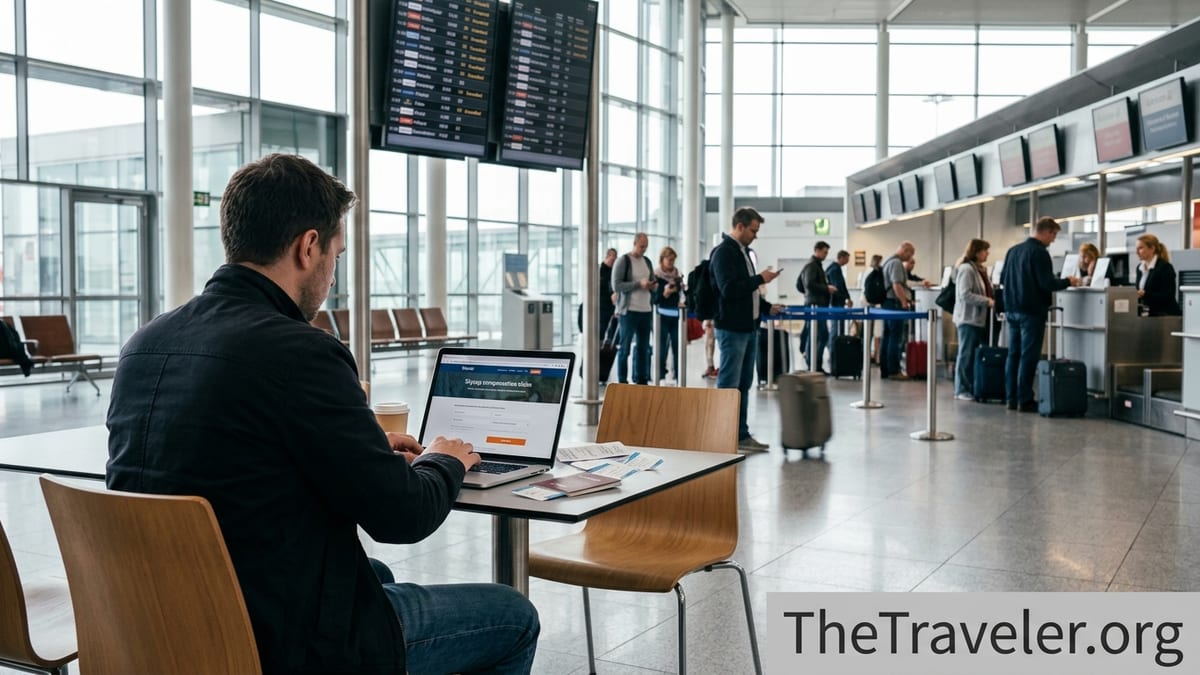
What Skycop Actually Does for Frustrated Travelers
Skycop is a Lithuania-based flight compensation company that helps passengers pursue cash compensation when flights are delayed, cancelled or overbooked under EU261 and its UK equivalent. In simple terms, you give Skycop details of your disrupted flight, sign a limited power of attorney, and they then chase the airline on your behalf for up to 250, 400 or 600 euros per person, depending on the route distance and length of delay. If the airline pays, Skycop takes a share as a success fee. If the claim fails, you do not pay anything.
The process is largely online. On a recent test case, I submitted a four-hour delay on a Barcelona to London flight by entering my booking reference, airline and dates in Skycop’s web form. Their system instantly checked the route, distance and historical data and confirmed that the delay was likely eligible under EU261, subject to the usual caveat around “extraordinary circumstances” like severe weather or air traffic control strikes. Within around 15 minutes I had signed their mandate electronically, and the claim was off my plate.
Behind the scenes, Skycop’s team handles correspondence with the airline, sends formal notices and, when they believe a case is strong enough, may escalate to legal partners or small claims courts in European jurisdictions. This can be especially useful when dealing with airlines known for stonewalling or long response times. For example, travelers reporting multi-month delays in responses from low-cost carriers have seen Skycop take over correspondence and eventually secure payouts months after the original disruption.
In practice, that means Skycop is selling a mix of legal expertise, time and patience. If you are comfortable drafting formal letters and chasing an airline through its complaints system and, if needed, national enforcement bodies, you may not need a service like this. But if you would rather outsource the frustration for a share of the compensation, Skycop is one of the better-known brands in this space.
Fees, Skycop Care, and What You Really Keep
When judging any claim service, the headline question is simple: how much of your compensation do you actually receive? At the time of writing in mid-2026, Skycop’s standard success fee sits at about 44 percent of the compensation amount, including taxes, for one-off customers. In real terms, if you win a 600 euro claim for a long-haul delay from Europe to North America, Skycop would keep roughly 264 euros, and you would receive about 336 euros. For a 400 euro intra-European claim, you might see around 224 euros after fees.
This makes Skycop one of the more expensive mainstream providers. Rivals such as AirHelp typically publish a success fee closer to 35 percent for standard cases, and some smaller regional firms work in the 25 to 30 percent range for straightforward claims that do not proceed to court. In other words, on that same 600 euro claim, using a cheaper competitor could leave you with 30 to 50 euros more in your pocket. Over a family of four, the difference can quickly add up to a couple of hundred euros.
Skycop attempts to offset the high percentage with a subscription product called Skycop Care. For roughly the cost of an airport meal per year, Skycop Care offers a 0 percent success fee on eligible flights covered under the plan. Practically, that means if you pay the subscription before you fly and later experience a disruption on a covered route, Skycop will pursue your claim and transfer 100 percent of whatever the airline pays out. For frequent travelers who fly several times a year within Europe, this can become good value after a single successful claim.
The catch is that Skycop Care is not a complete travel protection bundle. While some competitors now pair zero-fee claims with extras like priority processing, additional baggage coverage or missed connection assistance, Skycop’s subscription remains focused almost exclusively on EU261-style compensation. If you are the kind of traveler who wants comprehensive cover in a single plan, you might find better value by combining a strong travel insurance policy with a more moderately priced compensation service or a DIY approach.
My Experience Using Skycop vs Going Direct to the Airline
For this review, I used Skycop for one personal case and compared it with a direct claim I filed myself and another handled through a competitor. The Skycop claim involved a late-evening flight from Madrid to Berlin that arrived more than four hours late because of an earlier technical problem. The route distance comfortably met the threshold for 400 euros per passenger under EU and UK rules, and there were no clear extraordinary circumstances.
Filing the claim with Skycop was straightforward and took about 20 minutes, including hunting down boarding passes. Within a day, Skycop confirmed they had contacted the airline. After that, updates were sporadic. Weeks would pass without news, then a short email would appear telling me the airline had requested more documentation or that Skycop was waiting for a reply. After around five months, the airline eventually agreed to pay out. Skycop notified me and sent a separate communication with the amount due after their 44 percent fee. The final transfer reached my bank account roughly two weeks later.
In parallel, I filed a DIY claim with another airline for a three-hour-plus delay from Paris to Athens. I used the airline’s online complaint form, referenced EU261, attached boarding passes and ground receipts, and politely requested the fixed 400 euro compensation. The airline rejected the claim once, citing “operational constraints,” but after I followed up with a firmer letter mentioning escalation to the national enforcement body, they reversed course. The full compensation reached my account in just under three months without any third-party service taking a cut.
This contrast highlights the tradeoff. Skycop absorbed all the back-and-forth work with the first airline, and I did not spend more than an hour total on the matter. But I paid a steep fee and waited longer for the outcome. With the self-managed claim, I put in several hours of reading EU guidance and writing emails, but I kept every euro. For many travelers, the decision will come down to tolerance for admin and the size of the claim. On a small 250 euro short-haul compensation, paying 44 percent for convenience may sting. On a complex multicity itinerary where a family of five could be owed several thousand euros, having a specialist in your corner can feel reassuring.
How Skycop Stacks Up Against AirHelp, Flightright and Others
Skycop operates in a busy field. AirHelp, Flightright and a variety of regional firms all chase the same disrupted flights, while airlines quietly adjust their response strategies. To understand Skycop’s place, I compared fees, reputation signals and practical features across these players using publicly available data and traveler reports up to June 2026.
On pure cost, Skycop is near the top of the spectrum for standard one-off customers, with that 44 percent success fee often cited in independent comparisons. AirHelp tends to come in lower, around the mid-thirties, and Flightright is usually similar or slightly below that for straightforward cases. Some boutique outfits in markets like Germany or the Netherlands sometimes advertise 20 to 25 percent fees for claims that do not require litigation, although their coverage of airlines and routes may be more limited.
Feature-wise, Skycop keeps things simple. It focuses on EU261 and UK261 claims for delayed, cancelled and overbooked flights, plus its Skycop Care subscription. AirHelp and a few others have broadened into membership ecosystems, with app-based flight monitoring, additional travel disruption protections and in some cases fast-payout options where they advance you a portion of the expected compensation before the airline pays. For a traveler who wants everything in one dashboard, Skycop may feel more bare-bones by comparison, although its core functionality is competent.
Reputation is harder to quantify but important. Public reviews of Skycop in the past few years show a polarized picture. Many travelers report successful outcomes and praise the company for securing money from airlines that initially refused to engage. Others complain about slow communication, difficulty reaching support during long cases, or frustration when Skycop accepted a payout from an airline but then took months to forward the money. Similar criticism appears for nearly every compensation company, but as of 2026 Skycop has attracted a noticeable cluster of negative online posts focused on delays and poor transparency. If you value regular updates and fast payouts, competitors with lower caseloads or better customer service metrics may be more satisfying.
Common Pain Points: Timelines, Transparency and “Fast Payout” Offers
No matter which service you use, the single biggest shock to new claimants is how long the process can take. Airlines often stretch their responses to the legal limit, or simply ignore correspondence until a claim is escalated. Skycop is no exception. In my case, nearly half a year elapsed between filing and payout. Scan recent traveler discussions and you will find plenty of similar stories, with some customers waiting 9 to 12 months, especially when court action is required in countries with overloaded systems.
One particular sore point in Skycop’s recent reputation has been communication. Several travelers report long stretches of silence from the company, with status pages that show little detail beyond a generic “waiting for airline response.” Some only heard substantial updates after posting public complaints on review platforms. To be fair, there are periods in any legal process when nothing tangible happens while both sides wait on bureaucratic steps. But when a service markets itself as your advocate, you rightly expect more proactive communication, even if just to confirm that a reminder has been sent or that legal escalation is being considered.
Another controversial feature is the concept of “fast payout” offers, where a company offers to buy your claim for a fixed amount below the expected full compensation. For example, a traveler might be offered 60 euros immediately on a case that could ultimately yield around 150 euros if the airline pays in full. Some customers appreciate the choice: cash now with certainty versus more later, maybe. Others feel these offers are poorly explained or angled too heavily toward the company’s financial interest. Reports of Skycop using such offers have sparked debate among frequent flyers, especially when paired with an already high success fee for those who decline and wait.
When considering Skycop, it is important to read the terms surrounding fast payouts, assignment of claims and the timing of transfers once the airline pays. Ask yourself how much delay you are willing to accept and whether a discounted immediate payment would genuinely help, for instance if you are still recovering costs from a disrupted trip. For some, getting 60 euros in hand now to cover a rental car bill matters more than squeezing out the last 90 euros months later.
When Skycop Makes Sense and When You Should Go DIY
After using Skycop alongside other options, my view is that it fits best for travelers in a specific middle ground. If you are the type who enjoys reading legal guidance and has the time to chase airlines, you will often do better filing claims yourself. Official EU and national consumer sites now publish clear templates and explain how to escalate to enforcement bodies when airlines stonewall. On simple point-to-point delays where the cause is clearly within the airline’s control, many passengers now secure the standard 250 to 600 euro compensation with a handful of well-worded emails.
At the other extreme, if you rarely fly in Europe or only face minor delays, using Skycop may feel like overkill. On a short domestic hop that just crosses the three-hour threshold, you may be owed 250 euros. Handing over nearly half of that for one email chain can be hard to justify when a quick claim through the airline’s form might work just as well. Some low-cost carriers even have automated online claim tools which, while not perfect, can approve straightforward cases without human intervention.
Where Skycop can earn its fee is with complex itineraries, uncooperative airlines and nervous travelers. Consider a family itinerary involving a New York to Amsterdam flight operated by a European carrier, connecting onward to several intra-EU legs on the same ticket. A misconnection triggered by a late first leg could potentially lead to multiple compensation rights and reimbursements for hotels and meals. Navigating that landscape alone, across different jurisdictions and enforcement bodies, can be daunting. In such cases, paying Skycop or a peer service to piece together the puzzle and pursue the airline may be worth the high percentage.
It can also make sense when language and local knowledge are barriers. If you are based outside Europe and rarely deal with local regulators or legal systems, a company that already works with hundreds of airlines and has in-country legal partners can save you from missteps. Just enter with realistic expectations: the process will almost certainly be slow, and convenience will cost you a significant share of any payout.
The Takeaway
Skycop is a capable but imperfect ally for air passengers navigating EU and UK flight disruption rules. It offers a clear value proposition: let us handle the headache of chasing compensation, and if we win you pay us out of the result. For time-poor or legally anxious travelers, that arrangement can be appealing, especially on large or complicated claims.
However, Skycop’s relatively high standard success fee, patchy communication record and growing competition from cheaper or more feature-rich rivals mean it is no longer an automatic choice. In many straightforward cases, especially for tech-savvy travelers comfortable with official complaint forms and a bit of persistence, a DIY approach will deliver the same 250 to 600 euros per person without sacrificing nearly half of the money. For others, services like AirHelp or regional specialists may offer a more balanced mix of cost, transparency and extras.
My own conclusion after testing Skycop against alternatives is to treat it as a back-up, not a first instinct. When a claim is simple, I go direct to the airline and, if necessary, escalate to regulators. When a case is messy or involves large sums that I do not want to mis-handle, I am open to letting Skycop or a competitor take over, fully aware of the tradeoffs. If you adopt the same mindset, Skycop can be one useful tool in your traveler’s toolkit rather than a one-size-fits-all solution.
FAQ
Q1. Is Skycop legitimate or a scam?
Skycop is a real company that has been operating for several years and has helped many travelers obtain compensation, but it also receives a noticeable number of complaints about slow communication and delays in passing on payouts. It is best described as a legitimate but sometimes frustrating service rather than an outright scam.
Q2. How much does Skycop charge if my claim is successful?
For one-off customers, Skycop typically charges a success fee of around 44 percent of the compensation, including VAT where applicable. This is deducted before the money reaches you, so on a 600 euro payout you might receive roughly 336 euros after fees.
Q3. What is Skycop Care and is it worth it?
Skycop Care is a subscription plan that, for an annual fee, removes the success fee on eligible covered flights so that you receive 100 percent of any compensation awarded. It can be worthwhile if you fly to or within Europe several times a year and are likely to experience at least one disruption that leads to a successful claim.
Q4. How long does a Skycop claim usually take?
Timelines vary widely. Simple cases where the airline cooperates can resolve within a few months, but many Skycop customers report waiting six months or more, and some court-involved claims can stretch close to a year or beyond, depending on the airline and jurisdiction.
Q5. Can I file an EU261 or UK261 claim myself without Skycop?
Yes. Most airlines provide online complaint forms, and official EU and national consumer websites offer templates explaining what to write and how to reference the regulations. If you are willing to invest some time and follow up firmly, you can often secure the same fixed compensation without paying any success fee.
Q6. How does Skycop compare with AirHelp and Flightright?
Skycop typically charges a higher success fee than many rivals and offers a relatively focused feature set centered on compensation claims. Competitors like AirHelp and Flightright tend to have slightly lower fees for standard cases and sometimes provide extras such as app-based tracking, broader disruption coverage or more developed membership plans.
Q7. What kinds of flights are covered by Skycop claims?
Skycop mainly handles claims tied to EU261 and UK261, which cover flights departing from airports in the European Union or United Kingdom on any carrier, and flights arriving there when operated by EU or UK airlines. Delayed, cancelled and overbooked flights are the most common scenarios.
Q8. Does Skycop help with hotel and meal refunds too?
Skycop’s core business is the fixed cash compensation set by regulation, but in many cases the same claim will also reference your right to reimbursement of reasonable expenses like accommodation, meals and transport when the airline fails to provide them. Whether Skycop pursues those specific costs can depend on the details of your case and local legal practice.
Q9. What happens if the airline refuses to pay?
If the airline rejects your claim and Skycop believes the case is weak under current legal interpretations, they may close it without success and you will owe nothing. If they consider the case strong, they can escalate to legal partners to pursue court action, though this may extend timelines significantly and is not guaranteed for every claim.
Q10. Should I accept a fast payout offer from Skycop?
Fast payout offers provide a smaller amount of money quickly in exchange for assigning your claim to the company, which then takes on the risk and potential upside. Accepting one makes sense if you urgently need cash or dislike uncertainty, but you should compare the offer to the likely full compensation to judge whether the discount is worth it in your situation.