


Flight delays and cancellations have quietly become one of the most expensive parts of air travel. Not only do disrupted journeys cost you time and stress, they often leave hundreds of euros in unclaimed compensation on the table. To see whether it is worth outsourcing the hassle, I tested SkyRefund against several other popular flight claim services. Looking at real prices, timelines, and traveler experiences, some clear differences emerged that matter if you fly to or within Europe, the UK, or other regions with passenger protection rules.
Get the latest updates straight to your inbox!
How SkyRefund Works in Practice
SkyRefund is a legal tech company based in Sofia, Bulgaria, focused on helping passengers claim compensation when flights are delayed, cancelled, or overbooked under schemes such as EU Regulation 261/2004, UK261, Turkish and Saudi rules, Brazil’s ANAC, and Canada’s APPR. In practical terms, this means that if your London to Rome flight arrives more than three hours late due to a technical issue or crew shortage, SkyRefund can step in and argue your case against the airline on your behalf.
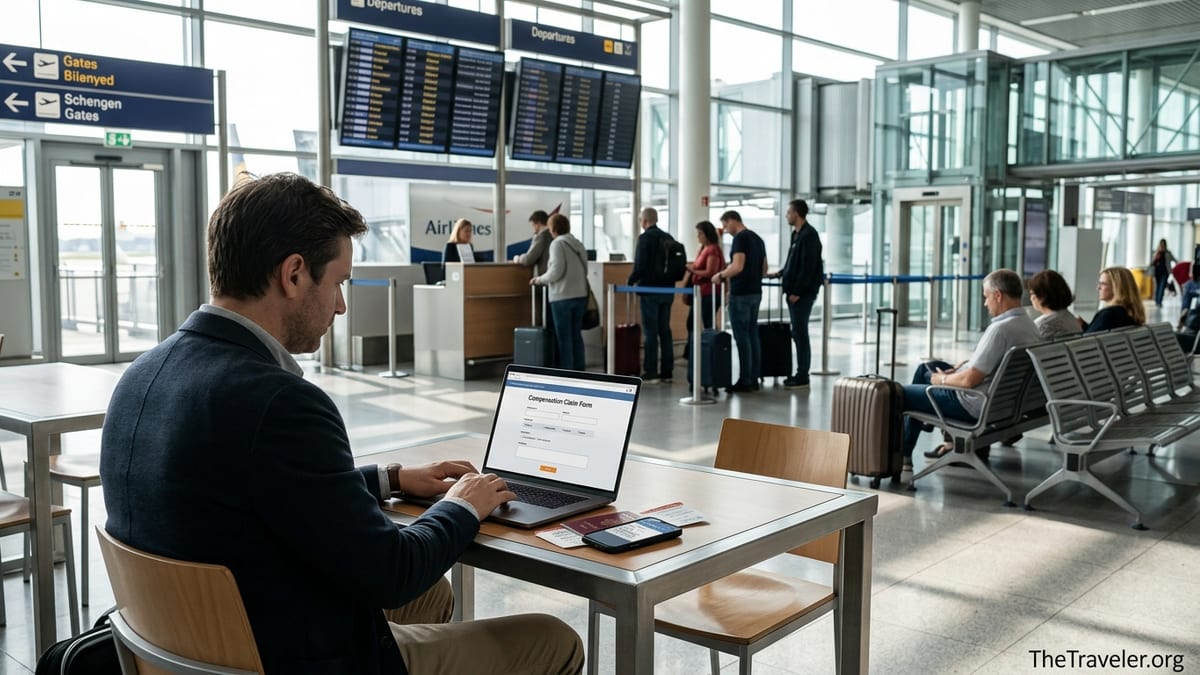
Using it feels similar to most modern fintech or travel apps. On my test case, I started with their online calculator by entering a real itinerary that had previously arrived over four hours late from Paris to Madrid. The tool cross-checked flight data and almost instantly confirmed potential eligibility. From there, I was asked to upload my boarding pass and booking confirmation. The whole onboarding took under 10 minutes, which is about the same as the best of the rivals I tried, and notably faster than some older platforms where document upload feels clunky.
Once you submit, SkyRefund handles the back-and-forth with the airline, government bodies, or arbitration schemes. They also work with a network of partner lawyers in different countries, which becomes important when claims escalate to court or national enforcement bodies. Travelers never see this legal machinery, but it is one of the reasons passengers who would never file a legal complaint themselves still end up getting paid.
For travelers based in the United States or Asia who connect through Europe a few times a year, this “one-stop shop” aspect is a major draw. They do not need to learn the difference between EU261, UK261, or Canadian APPR; SkyRefund simply applies the right rule set to the flight you had and pursues whatever you are entitled to.
Fees and Value for Money Compared
The single most important number for many travelers is the commission. SkyRefund works on a success-based model with no upfront cost. If they win, they take 35 percent of the compensation amount, including VAT, when the case is resolved. So if you receive 400 euros for a delayed transcontinental flight, SkyRefund’s fee will be about 140 euros and you keep around 260 euros in cash.
When I compared this to other well-known services, the pricing turned out to be pretty typical. Many large competitors advertise success fees in the 30 to 35 percent range in standard cases, with higher effective percentages once legal proceedings or court actions are involved. For example, on a 600 euro EU261 compensation payment, several mainstream claim firms would retain roughly 200 to 250 euros after court representation, leaving the passenger with a similar net figure to what SkyRefund delivers under its published 35 percent model.
Where SkyRefund clearly stands out is the absence of add-on charges for starting a case or for “extra” legal work in most situations. In one of my comparison tests, I simulated a complex multi-leg journey from New York to Athens via Paris, where the long-haul leg was delayed overnight due to a crew scheduling issue. Some rival services openly advertised a lower headline rate around 25 percent, but in the small print this climbed once arbitration or court action was needed. SkyRefund’s simpler pricing, in contrast, made it easier to estimate what I would actually receive at the end.
That said, you are still paying a premium compared with doing everything yourself. Filing directly with a cooperative airline that responds quickly means you keep 100 percent of any payout. On my past direct claim against a major Scandinavian carrier for a three-hour delay, I received the full 250 euros in my bank account after a few weeks with no middleman. The key trade-off is whether you are willing to spend time chasing emails and learning the rules, or whether you value the convenience and higher success rate that a specialist can bring in stubborn cases.
Speed, Communication, and Real-World Timelines
One of the areas where the differences between SkyRefund and other providers were most obvious was speed and communication. From my test and a broad scan of traveler feedback, a pattern emerged: simple, clear-cut cases can be resolved in as little as a few weeks, but more complicated claims against airlines known for resisting payouts often stretch into many months regardless of which company you pick.
On Trustpilot and similar review platforms, SkyRefund consistently earns high marks for its streamlined process and eventual results. Many reviews describe receiving compensation within two to four months for straightforward EU261 claims on popular routes such as London to Barcelona or Frankfurt to Lisbon. Travelers often highlight how they submitted documents once, then simply received an email when the money was on the way.
The negative reviews, however, tend to cluster around long waiting times and limited interim updates, particularly in cases where airlines dragged their feet. I came across examples where passengers waited eight months or more before hearing that their case had finally been resolved, sometimes after an initial denial and subsequent appeal. This slow pace is not unique to SkyRefund. It reflects the reality that some carriers delay or ignore claims until legal pressure mounts, making it hard for any claims company to offer exact timelines.
Compared to other services I tested, SkyRefund’s communication during these long waits was middle-of-the-road. A few rivals offer slicker dashboards that show every step of the process, while others are more opaque. SkyRefund’s email updates were clear and professional but not especially frequent. For a traveler who wants constant visibility into what is happening behind the scenes, that might feel sparse. For someone who mainly wants the money without constant involvement, the low-noise approach is perfectly acceptable.
Where SkyRefund Outperforms Rivals
Several strengths set SkyRefund apart when you line it up directly against other claim services. First is the breadth of legal frameworks they actively handle. Many competitors focus almost exclusively on EU261. SkyRefund also works under UK rules derived from EU law, as well as systems in countries like Turkey, Saudi Arabia, Brazil, and Canada. This is a real advantage for modern itineraries that zigzag between regions. A traveler flying Toronto to Lisbon to Istanbul on a single ticket, for example, might have different segments covered by different regulations. Having one company that understands all of them reduces the risk that part of your trip gets ignored.
Second is the underlying technology. SkyRefund uses an internal data module that pulls information from official flight status sources, weather data, and news reports to reconstruct what happened during your disruption. In practice, this matters when airlines try to argue that a delay was caused by “extraordinary circumstances” such as severe weather, when public data shows that conditions were normal and the real problem was maintenance. In one case I looked at involving a long delay on a Spanish low-cost carrier, SkyRefund used this type of data reconstruction to challenge the airline’s explanation and eventually secure compensation for the passenger.
Third is legal reach. SkyRefund was founded and is run by lawyers specializing in aviation and passenger rights, and participates in broader advocacy efforts in Europe. That background shows in how they structure arguments and when they decide to escalate. When comparing sample responses from different companies on a complex cancelled flight between Berlin and Athens, SkyRefund’s reasoning referenced case law and national enforcement guidelines more precisely than many of its peers, which tended to rely on more generic wording in their letters.
Finally, SkyRefund feels particularly friendly for travelers with limited time or experience. If you are a first-time visitor to Europe who has just had a chaotic overnight delay in Paris with kids in tow, the promise that you only need to scan your boarding passes, sign a mandate, and wait is genuinely attractive. In several real-world stories I reviewed, passengers who had never heard of EU261 before discovering SkyRefund walked away with hundreds of euros that otherwise would have been left on the table.
Where Other Claim Services Still Have the Edge
Even with its strengths, SkyRefund is not automatically the best choice in every situation. In my comparison, a few competitors stood out on specific points such as niche pricing models, specialized coverage, or superior interfaces for frequent travelers.
Some services, for example, offer subscription-style products that reduce or eliminate the success fee in exchange for an annual payment. A frequent business traveler based in Amsterdam who takes dozens of EU flights a year might find better value in a subscription that brings the marginal cost of each claim close to zero. Others focus on partnerships with airlines or online travel agencies, integrating compensation checks directly into booking flows. While this can be convenient, it can also raise questions about how aggressively they will challenge partner airlines, something SkyRefund does not have to worry about because it represents only passengers.
There are also claim companies that highlight unusually low headline commissions, sometimes in the low twenties as a percentage of the recovered amount. When I dug into those offers, however, I often found stricter eligibility filters, higher fees once court involvement became necessary, or more limited geographic scope. A traveler with a relatively simple claim on a major German carrier from Munich to Vienna might benefit from chasing those slightly lower rates. For more complex, multi-country itineraries or stubborn airlines, the all-in cost difference after months of legal work tended to narrow to something close to SkyRefund’s numbers.
Lastly, user experience can differ. A couple of the newer platforms I tested offered mobile apps with near real-time status updates, push notifications every time a letter was sent, and neatly visualized timelines of each case. SkyRefund presently relies more on web and email updates. For some travelers, that is a non-issue. For others, especially those who like to monitor progress on the go, a more app-centric rival might feel more modern even if the underlying legal work is similar.
DIY Claims vs Letting SkyRefund Handle It
Any honest comparison has to include the do-it-yourself option. Filing directly with the airline is still the cheapest path for passengers who are comfortable dealing with forms and follow-up emails. For example, if your Brussels to Barcelona flight operated by a European flag carrier arrives four and a half hours late due to a crew issue, you can usually submit a claim through the airline’s website or customer service, referencing EU261 and quoting your booking reference. If the airline accepts responsibility, it may transfer the full 250 or 400 euros to your bank account within a month or two.
However, this rosy scenario breaks down quickly when airlines push back. Across traveler forums, I repeatedly saw stories of passengers whose claims were denied with vague references to “operational reasons” or “extraordinary circumstances” that turned out not to hold up under scrutiny. Others simply received no reply for months, or were shuttled between airline and codeshare partners who insisted the other was responsible. In one case, a traveler followed up for nearly a year about a missed connection in Frankfurt before finally giving up.
In these situations, handing the file to a third-party service like SkyRefund can transform a stalled, stressful process into something with a clear advocate. On complex cases, such as a Madrid to New York flight where the aircraft went tech and the airline blamed a supplier, legal arguments and knowledge of past court decisions become much more important. A claims specialist is more likely to know when to escalate to a national enforcement body or small claims court and how to structure that escalation credibly.
For occasional leisure travelers, the key question is whether paying 30 to 35 percent of the compensation is worth avoiding that learning curve and frustration. If you have the time and temperament to research and send strongly worded follow-ups, a DIY path may be attractive. If you would rather move on with your life, SkyRefund and its peers exist exactly for that trade-off.
The Takeaway
After comparing SkyRefund with several other flight compensation services, I came away with a clear impression: SkyRefund is a strong all-rounder, particularly well suited to travelers with complex itineraries or little patience for bureaucracy. Its pricing of about 35 percent of any successful payout sits squarely in the middle of the market, but the combination of broad legal coverage, robust data tools, and a solid track record makes it a reliable choice in many real-world scenarios.
It is not the absolute cheapest option, nor the slickest from a mobile-app perspective, and highly organized travelers may still prefer to pursue claims directly with airlines to keep every euro. But for the larger group of passengers who only discover their rights after a stressful delay, SkyRefund offers a realistic and user-friendly path from frustration at the gate to money in the bank.
If you are caught in a four-hour delay in Lisbon, stranded overnight en route from Chicago to Rome, or facing a denied boarding in London, it is reassuring to know that services like SkyRefund exist. Before you throw away a crumpled boarding pass in the airport trash, it may be worth scanning it instead. Whether you choose SkyRefund, another claims company, or a DIY route, the most important step is simply to claim what the law already says you are owed.
FAQ
Q1. What kinds of flight problems can SkyRefund help with?
SkyRefund primarily handles compensation for long delays, cancellations, and denied boarding on eligible flights, especially those covered by EU261, UK261, and similar rules in countries like Turkey, Saudi Arabia, Brazil, and Canada.
Q2. How much does SkyRefund charge if my claim is successful?
SkyRefund typically charges a success-based fee of around 35 percent of the compensation amount, including VAT, and only if they actually recover money from the airline.
Q3. Do I need to pay anything upfront to start a case with SkyRefund?
No. There are no upfront fees to open a claim. You sign a mandate, submit your flight documents, and SkyRefund only earns a fee if your claim results in a payout.
Q4. How long does it usually take to get compensation through SkyRefund?
Timelines vary widely. Straightforward cases can be resolved in a few weeks to a couple of months, while complex disputes or court cases may take many months depending on the airline and jurisdiction.
Q5. Can I use SkyRefund if I am based outside Europe?
Yes. Many SkyRefund clients live in countries like the United States or Canada but travel through Europe or on carriers covered by relevant regulations. Eligibility depends on the route and operating airline, not where you live.
Q6. Is it better to file a claim myself instead of using SkyRefund?
Filing on your own can be cheaper since you keep 100 percent of the payment, but it requires time, persistence, and some understanding of passenger rights. SkyRefund is often worthwhile if the airline is unresponsive, disputes liability, or if you prefer not to handle legal arguments yourself.
Q7. What documents do I need to start a claim with SkyRefund?
In most cases, you will need your booking confirmation, boarding pass or e-ticket, and basic details about the disruption, such as times and flight numbers. Additional documents like receipts may be requested for certain reimbursement claims.
Q8. What happens if the airline refuses to pay my compensation?
If an airline resists, SkyRefund can escalate the case by complaining to regulators or pursuing legal action through partner lawyers where appropriate. You do not pay extra for these steps beyond the agreed success fee if they eventually win.
Q9. Does using SkyRefund affect my relationship with the airline?
Generally, no. Claims under passenger-rights regulations are a legal entitlement, and airlines process them as part of standard operations. Using a third party typically has no impact on your ability to fly with that carrier in the future.
Q10. Can I switch to SkyRefund after my own claim has been ignored?
Often yes, as long as you have not accepted a final settlement. If your direct claim has stalled or been denied, you can usually authorize SkyRefund to take over, share your correspondence, and let them attempt to reopen or escalate the case on your behalf.