


More news on this day
A SkyWest Airlines operated United Express flight from Sheridan, Wyoming to Denver, Colorado diverted to Western Nebraska Regional Airport amid unsettled weather across the central High Plains, adding a fresh example of how quickly conditions can disrupt regional connections into Denver International Airport.
Get the latest news straight to your inbox!
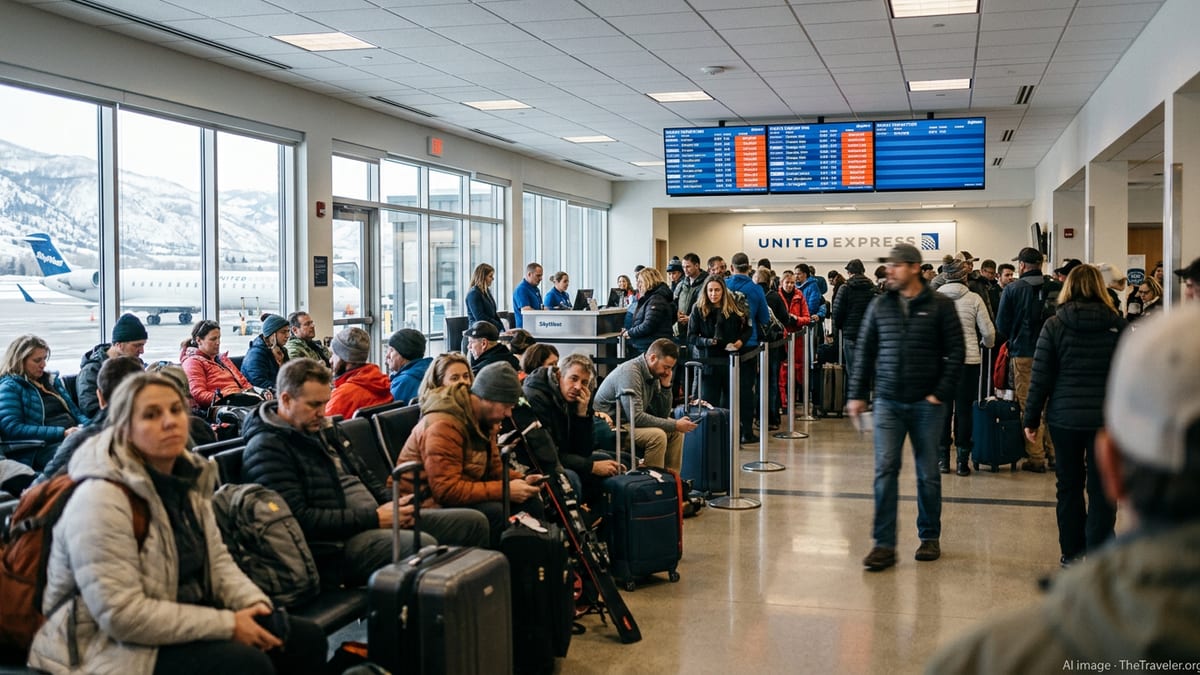
Routine Sheridan–Denver Hop Turns Into Diversion
Publicly available flight tracking data and passenger accounts posted online indicate that SkyWest flight SKW5079, operating as a United Express service with a Mitsubishi CRJ-200LR regional jet, departed Sheridan County Airport on schedule for Denver before altering course toward western Nebraska. The aircraft ultimately landed at Western Nebraska Regional Airport in Scottsbluff, a facility that has long served as an alternate for Denver-bound regional operations.
The Sheridan to Denver route is a short but strategically important link for northern Wyoming, connecting local travelers into United Airlines’ extensive hub at Denver International Airport. The sector is typically flown by 50-seat CRJ-200 aircraft under the United Express brand, providing daily access to the carrier’s domestic and international network.
While diversions on the route are not frequent, travel records and historic operations show that weather, congestion, and air traffic control initiatives around Denver can sometimes force regional jets to hold, delay, or divert to nearby airports such as Scottsbluff, Cheyenne, or other fields designated as alternates.
Reports circulating on aviation forums on June 9 suggest the diversion unfolded quickly after the flight left Wyoming airspace, with the jet setting course east toward Nebraska rather than continuing directly along its usual track into Colorado.
Stormy Pattern Around Denver Adds Pressure
The diversion occurred against a backdrop of unsettled early-summer weather along the Front Range and central Plains. Recent coverage from Colorado-based news outlets describes thunderstorms, high winds, and intermittent ground stops impacting Denver International Airport in the days leading up to the incident, resulting in rolling delays for both mainline and regional carriers.
Regional jets such as the CRJ-200 typically operate at altitudes and along routings that can leave them particularly exposed to storm cells building quickly over the mountains and adjacent plains. When convective weather or strong crosswinds take hold near Denver, traffic-management initiatives can tighten arrival flows, forcing dispatchers and flight crews to weigh fuel reserves against expected holding times.
In such conditions, diversion decisions are often driven less by distance than by safety margins and the availability of suitable alternates. Western Nebraska Regional Airport, located in Scottsbluff, sits within relatively easy reach of Denver-bound traffic and offers the runway length, approach infrastructure, and ground support required for a 50-seat regional jet to land, refuel, and await an improvement in conditions downstream.
Observers following the Sheridan service note that the timing of SKW5079’s diversion aligned with another round of unstable weather in the broader region, reinforcing the long-standing operational reality that Denver’s role as a major hub comes with heightened weather-related vulnerability.
Western Nebraska Regional’s Role As A Diversion Field
Western Nebraska Regional Airport has a history of hosting SkyWest-operated services into Denver, and state transportation documents highlight the field’s role as both a commercial gateway for Scottsbluff and a practical diversion option for regional traffic headed to Colorado. The airport’s infrastructure accommodates regional jets under a variety of weather conditions, making it an attractive alternate when Denver operations slow or storms build along the approach corridors.
Past service announcements and planning reports outline how communities in western Nebraska rely on consistent links into Denver for business and leisure travel. That same connectivity makes the airport a logical safety valve when a surge of arrivals or adverse conditions at Denver prompts dispatchers to move inbound flights out of holding stacks and onto the ground elsewhere.
When SKW5079 touched down in Scottsbluff, the flight joined a familiar pattern in which Denver-bound aircraft temporarily park at regional alternates. Passengers typically remain on the aircraft or in the terminal while ground crews coordinate refueling, updated routing, and potential re-clearance into Denver once the hub can accept additional arrivals.
Aviation enthusiasts tracking the Sheridan flight online noted that the CRJ-200LR involved in the diversion remained on the ground in Nebraska for an extended period after landing, a sign that weather or traffic constraints into Denver did not ease immediately.
Impact On Passengers And Regional Connectivity
For travelers on board, the diversion converted a relatively short hop into a more uncertain journey. However, aviation safety guidance emphasizes that choosing the nearest suitable airport when conditions deteriorate is a standard and conservative response, particularly for smaller jets operating into a large and sometimes congested hub.
Passengers connecting from Sheridan through Denver often have onward itineraries that depend on tight schedules. A diversion to Western Nebraska Regional Airport can trigger missed connections and rebooking challenges, especially when the broader network is under strain from storms or operational slowdowns. Travel advocates frequently suggest that passengers on short regional segments build extra time into itineraries during peak storm seasons in the central United States.
From a broader network perspective, the event underscores how a single regional flight experiencing disruption can have a ripple effect. Aircraft and crews diverted away from Denver may not be able to operate their next scheduled segments on time, compounding delays across multiple cities reliant on United Express and SkyWest services.
Industry analyses of recent Denver operations highlight that regional partners shoulder much of the exposure when weather or air traffic restrictions take hold. Flights similar to SKW5079 form the connective tissue between rural communities and major hubs, and any irregular operations can quickly be felt in places that may only see a handful of departures each day.
Ongoing Questions And Operational Takeaways
As of June 9, publicly available information did not indicate any mechanical issue with the CRJ-200LR involved, and the diversion has been widely interpreted as a precaution related to operational or weather considerations rather than a technical emergency. Aviation tracking platforms and user-generated reports have instead pointed to the broader pattern of unsettled conditions around Denver as the likely backdrop.
For Sheridan and other small communities tied closely to a single hub, episodes like the SKW5079 diversion highlight both the value and fragility of regional air service. While modern dispatch and forecasting tools have improved planning, fast-building storms along the Rockies and across the Plains still impose last-minute changes that no schedule can fully absorb.
Travel industry observers note that diversions into airports like Western Nebraska Regional are likely to remain an occasional feature of flying in this part of the country, particularly during late spring and early summer when frontal systems and convective activity are common. Passengers can reduce some of the stress by monitoring flight status closely, signing up for airline alerts, and allowing extra connection time when possible.
For SkyWest, United, and airport operators in Sheridan, Denver, and Scottsbluff, the SKW5079 event serves as another operational data point in refining contingency planning, fuel strategies, and communication practices when weather once again turns a routine regional hop into an unscheduled stop in western Nebraska.