


More news on this day
Spain’s main airports are now part of a fast‑expanding rollout of the European Union’s new biometric Entry/Exit System, raising fears that the record queues, missed connections and flight disruptions already seen in Belgium, Portugal, the Netherlands, France and Italy will intensify just as summer travel peaks.
Get the latest news straight to your inbox!
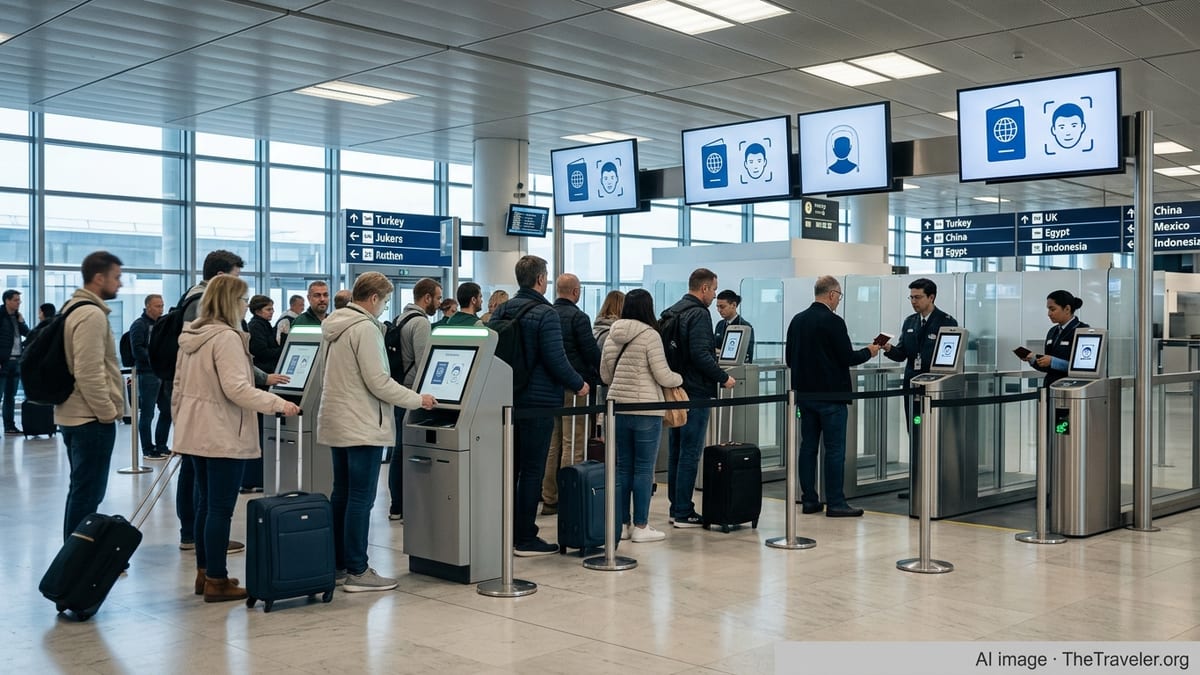
New Digital Borders, Old-Fashioned Bottlenecks
The Entry/Exit System is the EU’s flagship project to replace manual passport stamping for non-EU visitors with biometric registration, including fingerprints and facial images. The system entered into operation in October 2025 and is being phased in across all Schengen external borders, from major hubs such as Amsterdam and Barcelona to smaller regional airports.
Publicly available information explains that the first time a traveler is processed under the system is the slowest step, because new biometric data must be captured and verified at the border. Subsequent crossings should, in theory, be faster once a digital profile exists, but most long-haul visitors currently arriving in Europe are still encountering this initial registration stage.
Reports from industry bodies and travel media show that the transition is coinciding with a sharp rebound in leisure and business demand. As airports that already struggled with staffing and infrastructure constraints move to biometric checks at scale, the effect has been to transfer pressure from airline check-in and security lanes to passport control halls where space and staffing are less flexible.
European institutions describe the system as a long-term investment intended to enhance security and reduce fraud. For now, however, many of Europe’s busiest gateways are grappling with an awkward reality in which the technology designed to streamline border crossings is, at least temporarily, slowing them down.
Spain Joins Club of Hard-Hit Hubs
Spain’s inclusion among the countries actively registering travelers under the biometric scheme brings key tourism and business centers such as Barcelona and Madrid squarely into the front line of disruption. Spanish media and airport operator notices highlight that testing and early deployment at hubs including Barcelona-El Prat and Málaga-Costa del Sol have already extended processing times during peak hours.
In recent weeks, reports indicate that Spain is now seeing similar patterns to those observed in Belgium, Portugal, the Netherlands, France and Italy, where long queues and patchy kiosk performance have become a recurring feature of the Entry/Exit rollout. Travelers arriving at Barcelona and Madrid during busy morning and evening waves have described dense lines of non-EU passengers waiting to enroll biometrics before reaching a border officer.
Airport associations warn that the risk is not limited to leisure visitors. Spain’s major hubs are core connectors for business travelers shuttling between Europe, North America, Latin America and North Africa. Prolonged waits at passport control can force airlines to delay departures when large numbers of connecting customers are stuck in immigration halls, amplifying knock-on disruption across European networks.
Industry commentary notes that Spain’s importance as a gateway for both tourism and trade magnifies the potential impact of any systemic friction. With the country now fully involved in Entry/Exit deployment, the pressure to stabilize biometric processing before the main holiday season is intensifying.
Queues of Two to Three Hours in Key European Gateways
Across the continent, the most striking feature of the Entry/Exit transition has been the emergence of queues lasting between two and three hours at some of Europe’s flagship airports. Coverage from travel-focused outlets and national newspapers describes recurring congestion at border checkpoints in Paris, Frankfurt, Brussels, Amsterdam, Venice and Milan, often concentrated in weekend and evening peaks.
Airport Council International Europe, which represents the region’s airports, has published assessments warning that several large hubs are already experiencing waits of up to three and a half hours at passport control for non-EU passengers. According to these reports, even well-resourced airports with extensive self-service infrastructure are struggling when the first-time biometric registration process coincides with holiday surges and late aircraft arrivals.
Specific incidents have drawn attention to how quickly the system can tip into disruption. At Milan Linate, for example, media coverage describes a recent case in which more than 100 passengers on a flight to Manchester were unable to board because they remained stuck in Entry/Exit queues. Similar accounts from Amsterdam Schiphol, Brussels and Portuguese hubs such as Lisbon point to long, snaking lines through immigration halls, with some passengers missing connections despite being in the terminal for several hours.
The pattern is becoming familiar: relatively smooth flows during off-peak periods, followed by sharp surges that overwhelm the available kiosks and booths when several widebody flights arrive close together. As the number of travelers enrolled in the system gradually increases, these pressure points may ease, but for now the experience is highly variable and often unpredictable.
Business Travel Itineraries Under Strain
While holidaymakers are bearing the brunt of the most visible queues, the new procedures are also reshaping business travel planning across Europe. Corporate travel managers cited in specialist trade coverage are advising staff to allow significantly longer connection times at Schengen entry points, particularly when itineraries involve hubs such as Amsterdam, Paris, Brussels, Milan and Barcelona.
Some airlines have already adjusted minimum connection times and schedule buffers in response to the new reality at border control. Reports from airline and airport briefings indicate that carriers are re-evaluating tight inbound connections from long-haul markets where passengers must clear Entry/Exit checks before boarding onward flights within Europe.
Travel advisers are increasingly recommending that non-EU corporate travelers avoid itineraries that rely on short international-to-Schengen connections through the most congested hubs. Instead, they are steering clients toward longer layovers or routings through airports that appear to be coping better with Entry/Exit, even if that means less convenient departure times or higher fares.
Industry observers warn that if extended waits become a durable feature of the system, Europe’s reputation as an efficient destination for short-notice business trips could suffer. For companies that depend on frequent travel to financial and industrial centers such as Barcelona, Milan, Amsterdam and Brussels, the need to build in extra buffer time effectively raises the cost of doing business.
Summer 2026: Stress Test for Europe’s New Borders
Looking ahead to the core summer months of 2026, aviation and tourism stakeholders are treating the Entry/Exit rollout as a region-wide stress test for Europe’s border infrastructure. A statement issued by ACI Europe in late March warned that the transition phase is coinciding with one of the busiest travel seasons in recent memory, heightening the risk of severe congestion if staffing, signage and technology are not aligned.
Recent coverage in European and international media suggests that, for now, the “new normal” at some major airports may involve planning for two to three hours between scheduled arrival and clearing border control, particularly for non-EU families and groups requiring multiple biometric enrollments. In crowded terminals, even small technical glitches or misrouted passengers can quickly cascade into long visible queues.
Authorities and airport operators are continuing to refine procedures, adding extra staff at manual booths, redistributing traffic between terminals and experimenting with pre-registration tools where legally possible. However, industry voices caution that there are limits to how much can be achieved without long-term investment in additional space and equipment at border checkpoints.
For travelers heading to or through Spain, Belgium, Portugal, the Netherlands, France, Italy and other Schengen states in the coming months, the immediate implication is clear. The combination of a new biometric regime and resurgent demand means that leaving only the minimum time for border formalities is becoming a high-risk strategy, especially at heavily used gateways like Barcelona, Venice, Amsterdam, Milan and Brussels.