


More news on this day
Spain’s major airports have joined a growing list of European hubs grappling with hours-long queues and flight disruption as the European Union’s new biometric Entry/Exit System beds in, raising concern that summer 2026 could be one of the most chaotic travel seasons in years for non-EU visitors.
Get the latest news straight to your inbox!
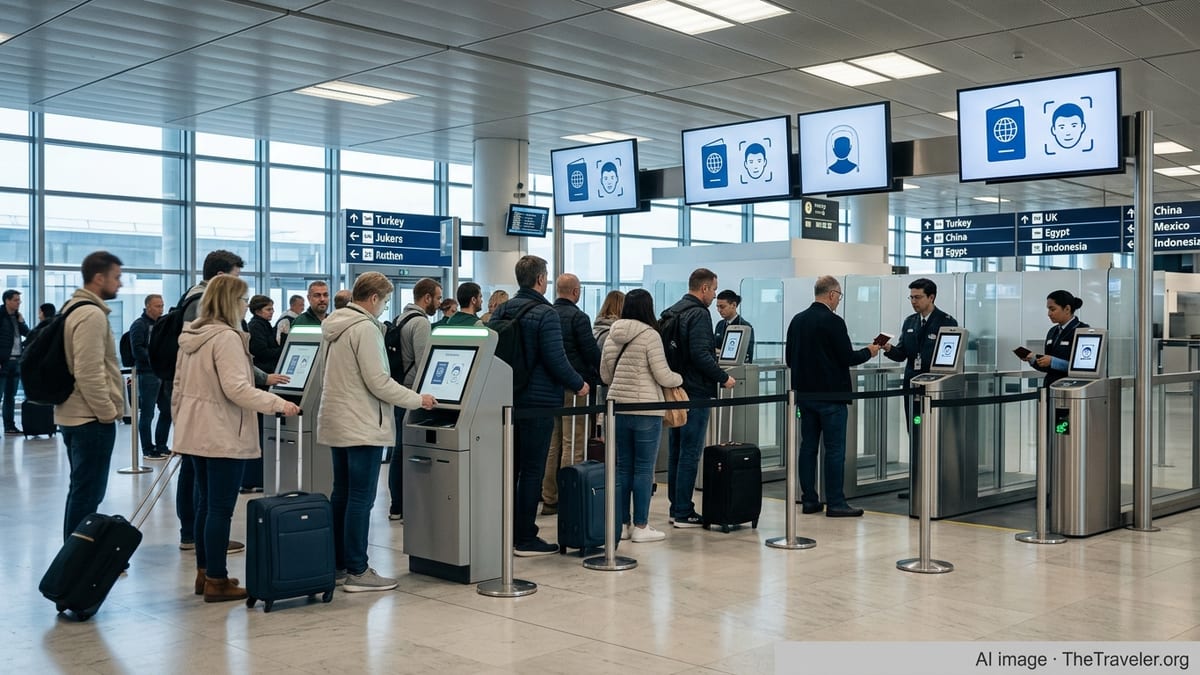
Spain Fully Steps Into Europe’s New Biometric Border Era
Spain has now aligned with Belgium, Portugal, the Netherlands, France, Italy and other Schengen states in rolling out the EU’s Entry/Exit System, a bloc-wide digital border regime that replaces traditional passport stamping with biometric registration. The system, which became operational across Schengen external borders in October 2025 and is being phased in over several months, records fingerprints, facial images and passport details for most non-EU travellers entering or leaving the zone.
Publicly available guidance from Spanish airport operator Aena explains that non-EU nationals, including many transatlantic and British visitors, must now undergo biometric capture the first time they cross an external Schengen frontier such as Barcelona, Madrid, Málaga or Valencia. That initial registration adds several steps at the border, and while each individual scan lasts only a short time, the cumulative effect during busy arrival banks is proving significant.
According to recent European media coverage and airport industry assessments, processing times at some EES-equipped border checkpoints in France, Germany, Greece, Italy, Portugal, Belgium and Spain have increased sharply since the transition period ended in April 2026. Reports indicate that, during peak traffic, control times can be up to 70 percent longer than under the previous manual stamping system, with queues for non-EU passengers now regularly stretching well beyond one hour.
While the European Council and European Commission have framed EES as a necessary upgrade that will strengthen border security and ultimately streamline repeat crossings, the near-term reality for travellers has been more turbulent, especially at gateways with intense leisure demand such as Barcelona-El Prat.
Queues of Two to Three Hours and Missed Flights at Key Hubs
Across the continent, the early months of full EES operation have been marked by long hold-ups at passport control, with multiple outlets in April and May documenting passengers waiting two to three hours at airports including Brussels, Lisbon, Paris, Milan, Rome and Spanish hubs. Aviation-focused publications and airport groups describe non-EU travellers missing flights after spending much of their connection time in border queues.
In Barcelona, Spanish and international press have highlighted growing congestion around the EES kiosks and e-gates at Terminal 1, where non-EU arrivals feed into bottlenecks before and after biometric registration. Travellers recount being funnelled through a series of machines and manual checks, with confusion over whether queues are separated for first-time enrollees, repeat visitors and EU residents. Some describe overall border processing at busy times now taking close to 40 minutes even when the system runs smoothly, with significantly longer waits when technical glitches occur.
Industry bodies representing European airports have issued several public warnings since mid-April, noting that some locations have already recorded waiting times of up to three hours for non-EU passengers at peak periods. Airlines have responded by urging customers to build in extra time: recent guidance from low-cost carriers serving Spain and neighbouring countries advises arriving at the airport as much as three hours before departure, particularly for flights to the United Kingdom and other non-Schengen destinations.
Travel reports from Belgium mirror the experience in southern Europe, with Brussels Airport singled out in late 2025 and early 2026 for queues approaching or exceeding three hours at border control. Similar accounts have since appeared from major hubs in France, Italy, Portugal and Spain, suggesting that the impact is systemic rather than limited to one or two under-resourced facilities.
Business Travel Itineraries Under Pressure
The timing of EES’s ramp-up is especially sensitive for corporate travellers who rely on tight connections and predictable transit times. Business associations and travel management companies monitoring the rollout warn that traditional 60 to 90 minute connections through major European hubs are increasingly risky when crossing the external Schengen border, particularly for itineraries involving the United States, the United Kingdom or long-haul markets in Asia and the Middle East.
Recent commentary in European business media notes that some corporate travel buyers are already lengthening minimum connection times, shifting meetings away from same-day arrival, or re-routing staff through less congested secondary airports. In Spain, that could mean diverting trips from Barcelona or Madrid to cities where EES deployment is still being fine-tuned, though capacity limitations and flight options constrain how far this strategy can go.
For sectors that depend on high-frequency, last-minute travel, such as consulting, financial services and technology, the uncertainty around border processing adds a new layer of friction. Missed connections can translate into lost billable hours, rebooking costs and downstream disruption to complex multi-city itineraries. Published accounts of passengers missing transatlantic flights out of European hubs after queuing for border checks have reinforced concerns that the new system is undermining the very efficiency gains it was meant to deliver, at least in the short term.
Some analysts suggest that, until EES becomes routine and the proportion of first-time registrations declines, companies may increasingly favour direct flights that avoid an additional Schengen border crossing, or build in overnight stays to buffer against afternoon and evening peak congestion at immigration.
Leisure Hotspots Face a High-Stakes Summer
Leisure travel is expected to bear the brunt of any sustained disruption in summer 2026. Tourism-heavy countries that were early and enthusiastic adopters of EES, including Spain, Portugal, Italy and Greece, are entering the peak season just as biometric checks move from pilot to daily reality across more terminals and border posts.
Spanish and Portuguese outlets have reported two to three hour lines at passport control during busy holiday weekends this spring, especially for non-Schengen arrivals on morning and late-evening waves of flights. In some cases, airports have reportedly scaled back use of EES at the busiest moments or opened additional staffed booths to reduce queues, highlighting the tension between operational resilience and strict adherence to the new procedures.
In Barcelona, the combination of cruise traffic, low-cost carriers and long-haul routes amplifies that pressure. Travel forums and consumer coverage from April and May describe families with young children facing lengthy waits at the border after early-morning arrivals, and older travellers struggling in densely packed, slow-moving lines around the biometric kiosks. Similar stories are emerging from coastal and island airports that serve Spain’s resort regions, including the Balearic and Canary Islands.
Tourism organisations and local business groups are monitoring the situation closely, aware that prolonged border delays risk denting visitor satisfaction at a time when many destinations are counting on a strong summer to consolidate their post-pandemic recovery. If queues harden into what some outlets have called a “new normal” of extended waits, there are concerns that repeat visitors from key markets could begin reconsidering their European travel plans.
Authorities Seek Fixes as Debate over the System Intensifies
Policy makers at EU and national level are under growing pressure to demonstrate that EES can deliver its promised benefits without turning airports and seaports into choke points. Ahead of the main summer peak, the European Council acknowledged in public communications that member states would need to ensure sufficient staffing, expanded use of self-service kiosks and clear passenger information to keep traffic moving.
In Spain, official guidance stresses that EES is designed to speed up border crossings for repeat travellers once the initial biometric data has been collected. However, reports from spring 2026 suggest that many passengers are still being channelled through full checks even on subsequent visits, limiting the system’s time-saving potential. Technical interruptions, partial suspensions and inconsistent signage between terminals and airports have further complicated the rollout.
The European Commission has also pushed back on suggestions that EES alone is responsible for every long queue, pointing to factors such as staffing levels, infrastructure constraints and seasonal surges in demand. Industry voices, by contrast, argue that these pressures were well known and that the transition should have been more carefully sequenced to avoid coinciding with major travel peaks.
As the summer peak approaches, airlines and airports continue to refine contingency plans, from bolstering ground staff at key pinch points to adjusting boarding times and encouraging earlier passenger arrival. For now, business and leisure travellers heading into or out of Spain, Belgium, Portugal, the Netherlands, France, Italy and other Schengen states are being advised, in media and travel advisories, to allow generous time for border formalities and to prepare for what could be one of the most testing high seasons in recent European travel history.