


Spain is a consolidated parliamentary democracy with strong institutions and an established rule-of-law framework. For potential relocators, the main political considerations today are not about regime volatility or systemic breakdown, but rather about the effects of fragmented party politics, territorial tensions, and periodic episodes of polarization on policy continuity and the wider operating environment. This briefing reviews Spain’s political stability profile, recent developments, and medium term risks relevant to relocation planning.
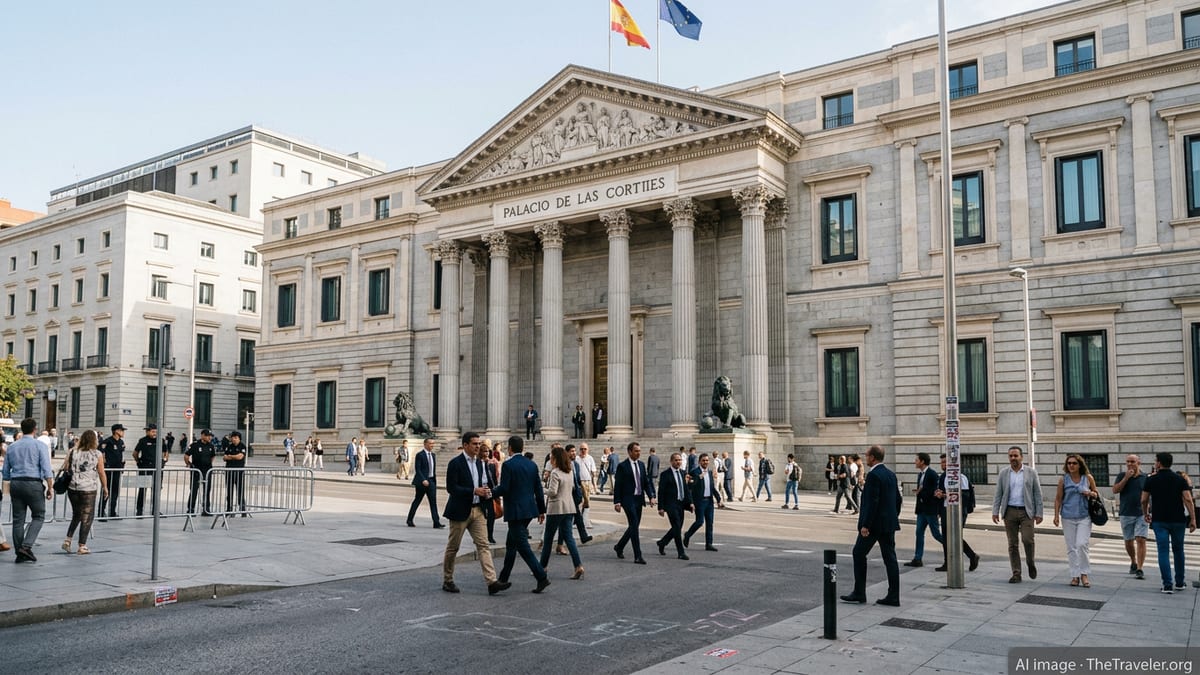
Core Features of Spain’s Political System
Spain is a parliamentary monarchy with a written constitution adopted in 1978. The head of state is the King, while executive power is exercised by a prime minister accountable to the Congress of Deputies. The system is characterized by proportional representation, multi party competition, and a strong separation between the judiciary and the political branches. Since the late 1970s there has been uninterrupted democratic governance, with alternation in power between center-left and center-right parties through competitive elections.
Political stability in Spain is underpinned by several structural factors. These include membership in the European Union and euro area, binding EU-level fiscal and regulatory frameworks, a professionalized civil service, and robust constitutional courts. Even when coalition negotiations are protracted or parliaments are fragmented, the basic constitutional order has shown resilience and there is no realistic risk of extra-constitutional regime change in the current context.
The state is decentralized into 17 autonomous communities and 2 autonomous cities, each with its own parliament and government. This territorial model absorbs many regional demands and gives subnational governments significant authority over education, healthcare, and policing. At the same time, decentralization requires continuous negotiation between Madrid and regional capitals, which can generate political friction and occasional institutional stand offs, particularly in Catalonia and, to a lesser extent, the Basque Country.
For individuals considering relocation, this framework means that day-to-day stability and continuity of public services are generally robust, even when national level politics is contentious. Government transitions occur through constitutional procedures, and security forces and public administration continue to function normally during political crises or elections.
Recent Electoral Dynamics and Government Fragmentation
The most relevant shift in Spain’s political landscape over the last decade has been the breakdown of the traditional two-party dominance of the Socialist Party (PSOE) and the Popular Party (PP). The emergence of new parties on both the left and right has resulted in fragmented parliaments and frequent coalition or minority governments. The July 23, 2023 general election confirmed this pattern, with no single party approaching the 176-seat absolute majority threshold in the 350-seat Congress of Deputies. PSOE and the new left-wing platform Sumar together fell short of a majority, as did the center-right PP and the far-right Vox.
After the 2023 vote, Spain experienced several months of coalition bargaining. A new government was eventually formed under PSOE leader Pedro Sánchez through an investiture vote in November 2023, supported by Sumar and several regional nationalist and pro-independence parties. This produced a narrow and heterogeneous majority, reliant on disciplined parliamentary voting and ongoing negotiations with smaller parties. Similar patterns have appeared in several regional parliaments, where coalition or minority governments are common and may periodically break down.
For relocation planning, the main implication of this fragmentation is heightened political uncertainty at the national legislative level. Passing major reforms can be slow and subject to last-minute concessions. Minority governments are more vulnerable to losing support on individual bills, which can trigger confidence votes or early elections. However, this institutional churn has not translated into systemic instability or abrupt reversals of core constitutional guarantees. From a risk management perspective, the most likely scenario is recurring electoral cycles and shifting coalitions rather than structural political breakdown.
Opinion polling in 2024 and 2025 has shown fluctuating support among the major parties and suggests that an early election could produce another closely balanced parliament. Some surveys show the PP and Vox with a potential combined majority, while others indicate continued fragmentation with no clear governing bloc. This fluidity adds to policy uncertainty, particularly around issues where left and right differ sharply, but the democratic framework and alternation in power remain accepted across mainstream parties.
Territorial Tensions: Catalonia and the Amnesty Law
The main domestic political stress point in Spain over the past decade has been the Catalan independence movement. The 2017 unilateral independence referendum, declared unconstitutional by Spain’s courts, triggered a severe institutional confrontation between Barcelona and Madrid. While the immediate crisis has receded, the underlying issue of Catalonia’s constitutional status remains unresolved and periodically resurfaces in national politics.
Following the 2023 general election, the support of Catalan pro-independence parties became pivotal for government formation. As part of the negotiated agreements, the Spanish parliament approved an amnesty law in 2024 to halt or reverse legal proceedings against hundreds of individuals linked to the Catalan independence process. Estimates from official and civil society actors suggest that several thousand people, including political leaders, local officials, activists, and police officers, could be affected by the amnesty. The law aims to normalize institutional relations and reduce judicialization of the conflict, but it has been highly divisive nationally.
The amnesty law sparked large street demonstrations, particularly organized by the conservative PP and far-right Vox, and contributed to a significant wave of protests in late 2023 and 2024. While the vast majority of mobilizations were peaceful and managed by security forces without major disorder, isolated clashes occurred near political party headquarters and central squares in Madrid and other cities. These episodes were notable politically but remained far from the scale of unrest seen in some other countries.
For relocators, the key assessment is that Catalan tensions can generate periods of elevated political rhetoric, legal disputes, and symbolic standoffs between institutions. However, the likelihood that this evolves into sustained physical insecurity in major urban areas is low under current conditions. Catalan regional politics may continue to influence national coalition stability, but the conflict is now largely channeled through parliamentary, legal, and electoral arenas rather than street level confrontation.
Public Order, Protest Activity, and Security Environment
Spain has a long record of managing public demonstrations, labor strikes, and regional protests within a stable legal framework. Over the past years, protest peaks have been associated with economic austerity, the Catalan question, and, more recently, opposition to the Catalan amnesty. The 2023–2024 protest wave against the amnesty included repeated demonstrations near the national parliament and in city centers, with participation sometimes in the tens of thousands.
Despite intense political rhetoric, Spain’s overall security environment remains comparatively stable for a European democracy. Law enforcement capacity is strong, and coordination between national and regional police forces is well institutionalized. Public order legislation grants authorities significant powers to regulate and, when necessary, disperse protests, a factor that both supports stability and draws criticism from civil liberties groups. Isolated vandalism, scuffles with police, or blockades of key roads and transport hubs can occur during major demonstrations or strikes, but they are typically announced in advance and resolved within hours or days.
In terms of terrorism risk, Spain experienced severe attacks in the past, including the 2004 Madrid train bombings and sporadic jihadist incidents. However, there has been no comparable large-scale attack in recent years, and the Basque separatist group ETA definitively ended armed activities more than a decade ago. Security services maintain a high level of vigilance, and current assessments by international partners generally categorize Spain as facing a moderate but managed terrorism threat, comparable to that of other large Western European states.
For those relocating, the practical implication is that political events can occasionally disrupt mobility and public transport in central urban areas, especially around parliaments or regional government buildings. Nonetheless, the risk of being directly affected by serious political violence is low, and most demonstrations occur without major incident. Employers and relocation providers typically address such episodes through standard contingency planning rather than emergency evacuation measures.
Institutional Strength, Rule of Law, and Governance Indicators
International governance benchmarks consistently rank Spain as a high-performing democracy with solid rule-of-law metrics, despite some recent concerns about politicization and institutional gridlock. In the World Bank’s Worldwide Governance Indicators, Spain scores well above the global average on rule of law, control of corruption, and government effectiveness, and moderately high on political stability. Although these indicators are not real-time and can fluctuate slightly year to year, they show a stable or only mildly declining trajectory rather than sharp deterioration.
OECD analyses of public governance and regulatory quality point to a relatively robust institutional framework, combined with challenges common to many mature democracies. Issues frequently cited include slow judicial processes, politicized appointments to key judicial bodies, and tensions over the renewal of the General Council of the Judiciary. These concerns have provoked criticism from legal associations and the European Commission, but they take place within an environment where constitutional courts and independent bodies have real authority and where government decisions remain subject to legal challenge.
Spain’s EU membership adds an additional layer of political and legal stability. EU treaties, fiscal rules, and judicial oversight via the Court of Justice of the European Union constrain the scope for abrupt policy reversals and anchor expectations around economic and regulatory governance. Access to EU recovery and structural funds also incentivizes continuity in key policy areas, since disbursements are conditioned on meeting reform milestones and maintaining compliance with agreed frameworks.
For relocators, this combination of domestic and supranational checks and balances means that contract enforcement, property rights, and basic civil liberties are generally secure and predictable. While isolated high-profile political or corruption scandals periodically surface and may dominate news cycles, they have not led to systemic institutional breakdown or expropriation risks in recent decades.
Medium Term Political Risks and Scenario Outlook
Looking ahead over a three to five year horizon, Spain’s main political risks relate to coalition fragility, polarization, and further territorial disputes, rather than to regime instability. The current government’s parliamentary base is narrow, and support from some regional parties has already proven volatile. At various points in 2024 and 2025, key allies have threatened to withdraw backing or block major bills, raising the possibility of early elections and shifts in governing coalitions.
One plausible scenario is a future government formed by the center-right PP with outside or formal support from the far-right Vox. Some polls in 2025 have suggested that such an alliance could achieve a working majority under certain electoral conditions. While this would represent a notable ideological shift relative to current policy directions, it would still occur within constitutional boundaries and subject to EU constraints. For relocation decisions, the main implications would concern changes in labor, migration, and social policy, rather than fundamental instability or security breakdown.
Another scenario is continued fragmented parliaments in which successive minority or coalition governments struggle to pass structural reforms but maintain basic macro policy continuity. In this case, political gridlock could delay infrastructure projects, regulatory updates, or reforms affecting specific sectors. For individuals, this translates into a policy environment that may be slower to adapt but remains broadly predictable, with low risk of sudden systemic shocks driven purely by domestic politics.
Low-probability but higher-impact risks include a renewed escalation of territorial conflicts or a severe constitutional standoff over judicial reforms. While current trends suggest that Catalan independence support is more fragmented than in 2017 and that major actors prefer institutional negotiation, unexpected events or leadership changes could reignite tensions. Even in such cases, Spain’s track record suggests that disputes are likely to be managed through courts, elections, and EU mediation rather than sustained street-level confrontation.
The Takeaway
From a relocation perspective, Spain presents a profile of high institutional resilience combined with elevated political complexity. The democratic system is consolidated, with no realistic risk of regime change or systemic collapse in the current horizon. EU membership, strong rule-of-law structures, and a professional public administration provide significant anchors of stability that mitigate the impact of coalition volatility and public protests.
Potential relocators should, however, be aware of ongoing political polarization, the centrality of territorial questions such as Catalonia, and the likelihood of periodic episodes of street mobilization and intense public debate. These factors can create a perception of instability in media coverage, but their direct impact on daily security, business continuity, and access to services is typically limited. Major cities continue to function normally through electoral cycles, government negotiations, and protest waves.
Overall, Spain can be assessed as a generally stable democratic destination, comparable to other large Western European states, with low levels of political violence and robust institutional checks and balances. The principal political risks for relocators are related to policy uncertainty and coalition shifts rather than personal security threats. As with any country, monitoring key political developments, especially around national elections and major reforms like the Catalan amnesty, is advisable for medium and long term relocation planning.
FAQ
Q1. Is Spain currently considered a politically stable country for relocation?
Spain is broadly considered politically stable, with a consolidated democracy and strong institutions, despite fragmented parliaments and recurring coalition negotiations.
Q2. How do protests and political demonstrations affect daily life in Spain?
Protests occur regularly, especially in major cities, but are usually announced in advance, time limited, and managed by police, causing localized disruption rather than widespread insecurity.
Q3. Does the Catalan independence issue pose a security risk for residents?
The Catalan issue generates political tension and legal disputes, but current risks are mainly political and institutional, with low likelihood of sustained physical insecurity for residents.
Q4. How likely is a sudden change of government to disrupt stability?
Changes of government occur via elections and parliamentary votes. While they can alter policy direction, they are orderly and do not usually disrupt core public services or security.
Q5. Are there terrorism or extremist threats that impact political stability?
Spain faces a managed terrorism risk similar to other Western European countries, but there have been no large-scale attacks in recent years and security services remain active.
Q6. Could early elections significantly increase political risk?
Early elections could heighten uncertainty and media tension, but are expected to occur within constitutional rules, with stable institutions and continued functioning of public administration.
Q7. How does Spain compare to other EU countries in terms of political stability?
Governance indicators generally place Spain in the group of higher performing EU democracies, with solid rule-of-law and moderate but manageable political stability risks.
Q8. Do regional governments create additional political uncertainty?
Regional governments add complexity and can produce local disputes, but they also help absorb territorial demands, and core state functions remain stable across autonomous communities.
Q9. Are foreign residents commonly targeted during political tensions?
Foreign residents are not typically targeted in political disputes or protests, which focus on domestic issues and actors; incidental disruption is more likely than direct targeting.
Q10. What is the medium term outlook for Spain’s political stability?
The outlook is for continued democratic resilience with recurring coalition challenges and debates over territorial issues, but low probability of systemic breakdown or widespread unrest.