


More news on this day
Spain’s Pajares base tunnel, now fully integrated into the new Pajares Variant high-speed rail link, is transforming how travelers and freight cross the Cantabrian Mountains between León and Asturias.
Get the latest news straight to your inbox!
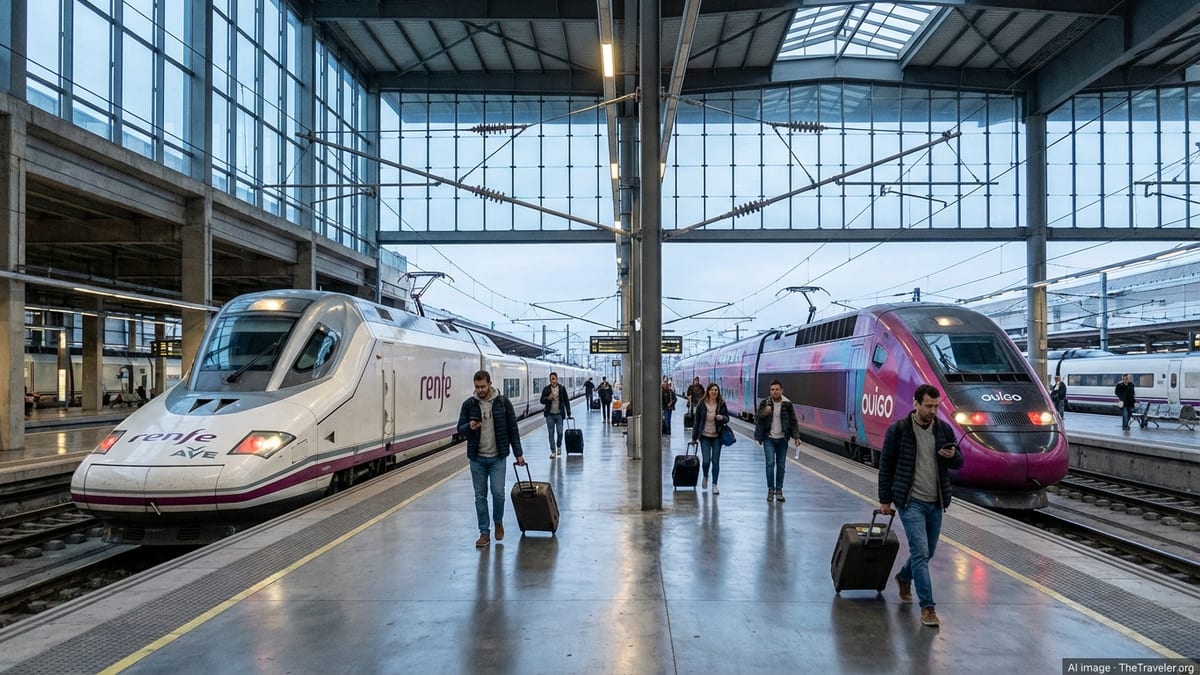
A New Fast Line Through the Cantabrian Range
The Pajares Variant is a roughly 50 kilometer rail corridor that replaces the historic Rampa de Pajares mountain line as the principal rail connection between the Meseta and Asturias. Publicly available information shows that more than 80 percent of this new route runs underground, with the Pajares base tunnel as its central element.
The alignment begins near La Robla, north of León, and runs north toward Pola de Lena in Asturias, threading beneath the main ridge of the Cantabrian range. Reports indicate that the new route shortens the rail distance between León and Asturias by around 37 kilometers compared with the 19th century alignment over the pass, while also reducing gradients and altitude. For long-distance services from Madrid to Oviedo and Gijón, the corridor has already shifted travel times and service patterns across northern Spain.
Engineering documents on the project describe the Pajares base tunnel as a twin-tube structure of about 25 kilometers, one of the longest railway tunnels in Spain. Each tube carries a single track, separated by cross-passages that act as safety links and maintenance access points. Together with a chain of approach tunnels and viaducts, the base tunnel allows trains to remain on a relatively straight, gently sloping path that is better suited to high-speed operations.
From Rampa de Pajares to Base Tunnel
For more than a century, rail traffic between Asturias and the rest of Spain relied on the Rampa de Pajares, a steep and winding mountain section marked by sharp curves, heavy gradients, and severe winter conditions. Published coverage of the old line highlights frequent disruptions from snow and landslides, as well as capacity constraints on both passenger and freight services.
The decision to build a base tunnel was aimed at overcoming these limitations by burrowing under the range rather than climbing over it. Early planning documents in Spain’s official gazette laid out a new alignment between La Robla and Pola de Lena that would avoid the most difficult sections of the pass while integrating into the wider high-speed network from Madrid and León. Over time, the Pajares Variant has come to be viewed as a strategic piece of the Atlantic Corridor, the trans-European route that connects the Iberian northwest with central Europe.
With the inauguration of the Pajares Variant in late 2023, long-distance services began shifting away from the old mountain ramp. According to recent rail timetables and specialist rail coverage, Alvia services now routinely use the base tunnel, cutting journey times and offering a more reliable year-round link. The legacy line is expected to see reduced traffic, and its long-term role is still the subject of local debate.
Project Map: Tracing the Pajares Variant
Project maps released by Spain’s infrastructure manager and reproduced in technical publications show the Pajares Variant as a sweeping north-south arc across the Cantabrian chain. Starting near La Robla, the line enters a sequence of tunnels and viaducts before reaching the twin portals of the base tunnel on the southern side of the mountains.
Inside the Pajares base tunnel, the alignment remains almost perfectly straight for much of its 25 kilometer length. Geological profiles published in academic studies depict the tunnel cutting through complex folded and faulted rock formations, including limestones and shales that required intricate support systems. Diagrams of the cross section show the two parallel tubes separated by roughly 50 meters, linked at regular intervals by emergency galleries.
On the northern side, the line emerges near Campomanes and continues through additional tunnels and structures before reaching Pola de Lena, where high-speed services connect with the conventional network toward Oviedo and Gijón. Recent educational reports and engineering presentations include updated schematics that overlay the new alignment on older maps, making clear how the Pajares Variant bypasses the sharp curves and zigzags of the historic mountain route.
Construction Challenges Beneath the Mountains
Publicly available project dossiers describe the Pajares base tunnel as one of the most demanding engineering efforts ever undertaken on Spain’s rail network. At peak activity, up to five tunnel boring machines worked simultaneously on the twin tubes, digging at depths that in some stretches approached one kilometer below the surface.
The geology of the Cantabrian Mountains presented particular challenges. Research papers on the tunnel’s geology note zones of high water inflow, variable rock quality, and intricate fault systems. These conditions required continuous monitoring and the adaptation of excavation methods, including adjustments to tunnel lining and drainage. Project summaries emphasize that controlling groundwater and stabilizing the surrounding rock mass were central to keeping excavation on schedule.
Beyond the tunnel itself, the Pajares Variant incorporates around a dozen major viaducts and multiple shorter tunnels on the approaches, creating a largely grade-separated corridor. The combination of deep tunnels and tall viaducts allows the railway to maintain consistent speeds while crossing rugged valleys and ridges on both sides of the main range.
Implications for Travelers and the Wider Network
Since the opening of the Pajares Variant, journey times between Madrid and Asturias have fallen significantly, according to recent timetable comparisons and transport ministry summaries. Direct services between the capital and Oviedo now benefit from the faster, more direct route, and passenger rail has become more competitive with road and air travel on this corridor.
The new alignment has also improved freight prospects. The Pajares base tunnel eliminates some of the steepest gradients and tightest curves that previously limited train length and load on the mountain ramp. Although the exact mix of passenger and freight services continues to evolve, logistics industry coverage suggests that the upgraded route is expected to play a larger role in moving goods between Asturias’s ports and inland logistics hubs.
At the European scale, the Pajares Variant strengthens the Atlantic Corridor by closing a major bottleneck in the north-south axis along Spain’s northwest. Combined with ongoing upgrades around León and improvements near Gijón and Avilés, the base tunnel is helping to redraw the rail map of the Cantabrian region and reshape how travelers and cargo move across one of the country’s most formidable natural barriers.