


More news on this day
Airport security lines in the US are increasingly shaped by two parallel realities: most checkpoints are staffed by federal Transportation Security Administration officers, while a smaller set of airports uses private screeners under TSA oversight through the Screening Partnership Program (SPP). For travelers, the immediate question is practical rather than political: do these different staffing models change what shows up as a “wait time,” and how reliable are the numbers people check before leaving for the airport?
Get the latest news straight to your inbox!
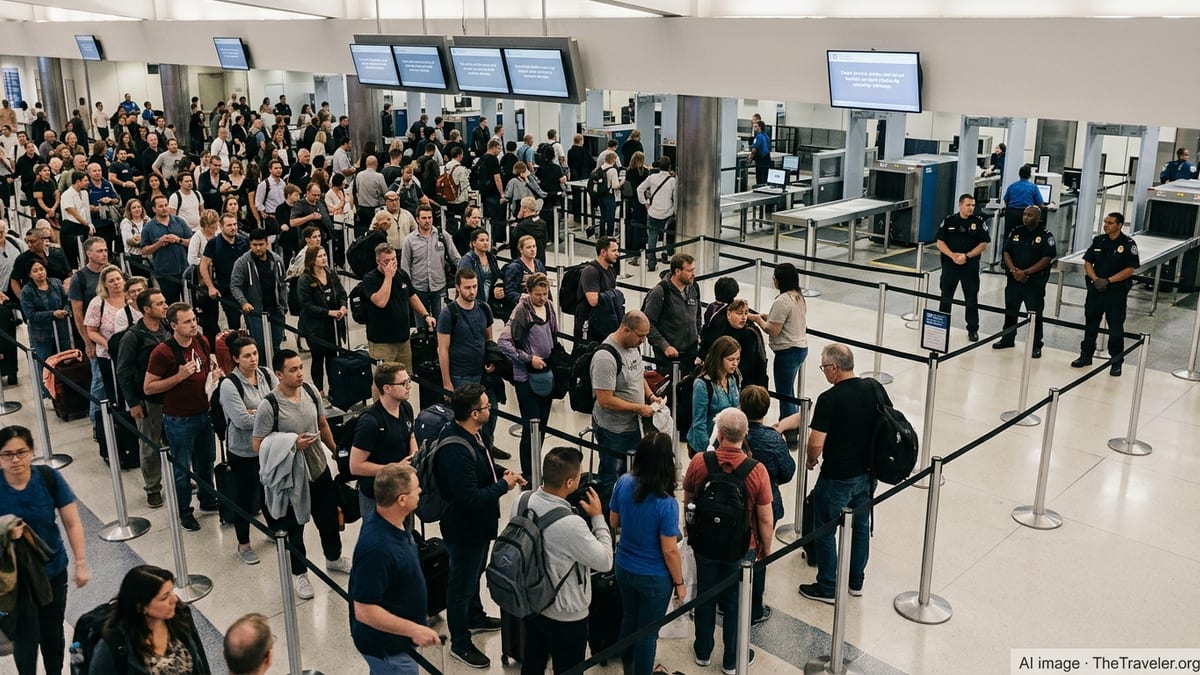
What the Screening Partnership Program is, and where it operates
SPP is a federal framework that allows qualified private vendors to carry out passenger and property screening, under TSA supervision and using TSA procedures and standards. The program has been available to commercial airports since 2004, and publicly available TSA program guidance has described 22 participating airports in its published materials.
SPP’s footprint is small relative to the national system, but it includes airports that travelers regularly associate with heavy traffic as well as smaller facilities. Published coverage in 2026 has pointed to San Francisco International as a prominent example of an airport where checkpoint screening is staffed by private contractors under TSA oversight, alongside other SPP participants such as Kansas City International, Atlantic City International, and Orlando Sanford.
One reason SPP has drawn renewed attention in 2026 is operational resilience during federal disruptions. Published coverage has highlighted that privately operated checkpoints paid through federal contracts can keep operating more normally during shutdown conditions, when the broader federal workforce can be strained and morale issues can ripple through the system.
Why “TSA wait times” can be harder to interpret than they look
Travelers have more ways than ever to check security waits, but the quality of what they see can vary. The MyTSA app remains a widely used reference point, and its public app-store description states that travelers can report checkpoint wait times and that reporting requires being at the airport.
However, published coverage during the 2026 shutdown period underscored a major limitation: TSA was not actively managing its sites at that time, meaning wait times shown in MyTSA could be inaccurate. The same reporting also noted that third-party sites can be outdated as well if they depend on the same underlying public data sources.
Another complication is that many large airports publish checkpoint-specific estimates on their own channels, sometimes with more granular, terminal-by-terminal detail than a single airport-wide number. Published reporting has described airport-managed updates as among the more reliable options during periods when federal systems are not consistently updated, while still emphasizing that conditions can change quickly within the same airport.
SPP does not change the rules, but it can change the operating dynamics
From a traveler standpoint, SPP does not mean a different set of prohibited items or different screening standards. TSA’s published guidance describes SPP as private screening conducted under federal supervision using TSA guidelines, with TSA retaining oversight of procedures.
What can differ is the labor model behind the lanes and how staffing responds to local conditions. In 2026 coverage about privatization debates, SPP has been framed as one possible way to reduce the impact of federal shutdown conditions on day-to-day checkpoint operations, because contractor compensation can continue under existing contract structures.
That said, wait times are driven by more than payroll mechanics: passenger surges, checkpoint layout, open lane count, technology uptime, and staffing experience all influence throughput. For travelers, that means SPP alone is not a guarantee of shorter lines, and TSA-run screening is not automatically a predictor of delays. The most useful signal often comes from the most current, most local update available for a specific checkpoint at a specific time.
Modernization efforts that target the choke points behind the line
Across both TSA-run and SPP checkpoints, the biggest operational story is modernization aimed at reducing time spent at identity verification and at the bins. TSA has been rolling out automation at the document-check stage, including electronic gate concepts designed to speed identity checks. In an August 2025 TSA release about a public-private partnership, the agency described CLEAR-operated eGates as a way to expedite identity verification at select airports, with initial deployments at Atlanta and anticipated rollouts at Washington National and Seattle-Tacoma.
At some airports, TSA has also promoted touchless or digital identity experiences in TSA PreCheck lanes. Local reporting in 2026 described airports adding new self-service gates and touchless identity options aimed at increasing throughput at peak times.
At the same time, TSA’s published budget materials for FY 2026 described significant spending aimed at deploying checkpoint computed tomography systems at scale. Those documents described a request that included funding to procure and deploy 197 CT systems, alongside support for testing and capability upgrades, as TSA works toward broader full operational capability across checkpoints.
A separate trend: TSA-operated screening outside the main checkpoint
Beyond the SPP versus TSA-staffed checkpoint debate, a separate development is quietly changing how some travelers experience “wait times” at all: TSA-operated screening that happens away from the primary checkpoint, funded through reimbursable agreements. TSA’s Reimbursable Screening Services Program (RSSP) is authorized as a pilot through FY 2026 and allows TSA to provide screening services outside the airport terminal’s existing primary screening area, with participating entities reimbursing TSA for the added costs.
Publicly available TSA program information lists operating RSSP locations at LAX, ATL, JFK, DFW, BOS, and MIA, with LaGuardia described as approved but not yet operational. The same materials describe specific start dates and partner models at several locations, including a May 2026 start at Dallas Fort Worth International and June 2026 starts at Boston and Miami, as well as a Boston pilot involving a secure bus service from Framingham, Massachusetts directly to BOS.
For travelers, RSSP matters because it creates a parallel pathway where the “security line” may begin somewhere other than the terminal. As these pilots expand, comparing wait-time estimates across airports and even across terminals becomes more complex, because the passenger flow is being reshaped rather than simply sped up.