


St Peter’s Square is often a first glimpse of the Vatican for many travelers, and it can feel overwhelming: security lines wrap around the colonnades, groups cluster under tour flags, and the basilica’s façade dominates the skyline. With a little preparation, though, your first time in the square can be calm, memorable, and surprisingly easy to navigate. This guide explains how St Peter’s Square works in practice today, how to time your visit, what to expect from security and crowds, and how to make the most of your time there even if you never set foot inside a museum.
Get the latest updates straight to your inbox!
Understanding St Peter’s Square Before You Arrive
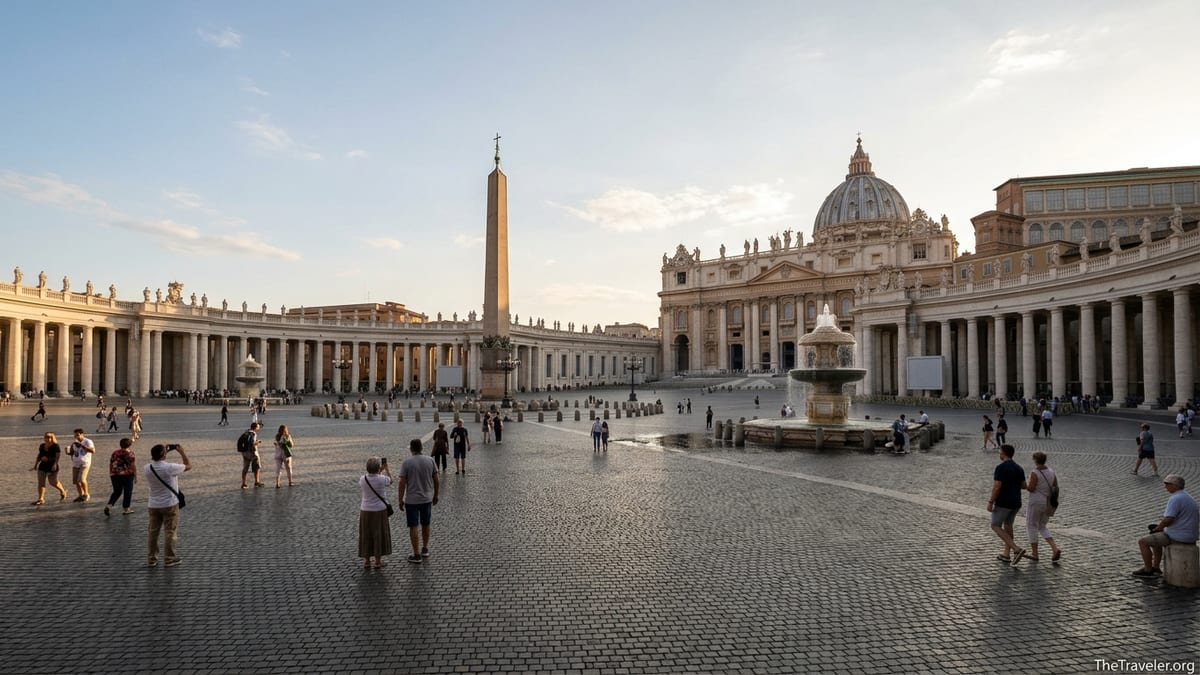
St Peter’s Square is the vast oval piazza directly in front of St Peter’s Basilica, the spiritual heart of the Vatican and one of the most recognizable religious sites in the world. Designed in the 17th century by Gian Lorenzo Bernini, it is framed by sweeping colonnades that curve around like open arms, with an ancient Egyptian obelisk at the center and two large fountains on either side. First-time visitors are often surprised at the scale: the square can hold tens of thousands of people, and during major papal events it feels like a sea of pilgrims, tour groups, and cameras.
For practical purposes, think of the square as the antechamber to everything else in the Vatican. From here you enter St Peter’s Basilica, access the dome climb, gather for papal audiences or the Sunday Angelus, and move on toward nearby streets that lead to the Vatican Museums. If you are only in Rome for a short stay, it is entirely possible to experience the atmosphere of the Vatican by spending an hour or two in the square, watching the play of light on the façade, listening to the bells from the basilica, and observing pilgrims who have traveled from every continent.
The square itself is open-air public space and generally accessible free of charge, with no tickets or reservations required. You simply walk in through the openings between the colonnades from Via della Conciliazione or the surrounding streets. However, as soon as you move toward the front half of the square, closer to the basilica steps, you will encounter a controlled area with security checkpoints. Understanding where those checks are, and when they are busiest, is the key to planning a smooth first visit.
Unlike the Vatican Museums, which sit on the other side of the city walls and have timed-ticket entries, St Peter’s Square functions more like a large public plaza that occasionally turns into a vast outdoor church. On a quiet winter afternoon you may find locals cutting through the square on their way to work, while on a spring Wednesday ahead of a papal audience you may see lines starting to form before 7 am as pilgrims queue to pass security and get a place closer to the front.
When to Visit and What It Is Really Like at Different Times
The experience of St Peter’s Square changes dramatically depending on the time of day and day of the week. Early morning, roughly from 7:30 to 9:00, is usually when independent travelers and photography enthusiasts have the best chance of finding the square relatively calm, especially outside peak months like May, June, September, and October. At that hour, you may share the space with a few guided groups and locals heading into the Vatican, but you can typically walk unobstructed around the obelisk and fountains and frame photos with fewer tour flags in the background.
Late morning to early afternoon is the busiest period most of the year. This is when buses drop off day tours that combine the Vatican Museums, Sistine Chapel, and St Peter’s Basilica, and those groups empty into the square either before or after their museum visit. In practical terms, a first-time visitor arriving at 11:00 on a sunny May day should expect dense crowds, a security queue that may loop around the right-hand fountain, and a more hurried, noisy atmosphere. If your schedule is flexible, it is often wiser to come either early or toward late afternoon, after 16:00, when the day’s organized tours begin to thin and the light softens.
Wednesdays and Sundays require special attention. On most Wednesday mornings, the Pope holds a public audience that is either in the square or in the nearby audience hall, and on those days much of the front of the square is filled with seating and barriers. Ticket holders for the audience start queuing early, often by 7:00 or earlier, and regular visits to the basilica are typically paused until the audience finishes around late morning or midday. On Sundays at noon, the Pope usually appears at a window of the Apostolic Palace to give the Angelus prayer, drawing thousands of pilgrims. Even if you do not intend to attend, you should be aware that movement through the square feels more like a festival crowd for about an hour before and after.
Evenings offer a very different, more contemplative experience. The basilica itself closes earlier, but the square remains accessible. In summer you may arrive around 20:30 to find the façade bathed in golden light, fountains illuminated, and tour buses largely gone. Couples stroll along the cobblestones, small prayer groups stand quietly facing the church, and street noise from Rome feels surprisingly distant. If you are staying nearby, returning for a brief nighttime visit can give you a second, calmer impression that complements the daytime rush.
Security, Bag Rules, and Dress Code in Practice
Although St Peter’s Square is open space, access to the part closest to the basilica is controlled with security checks similar to an airport but on a smaller scale. You walk through metal detectors, and your bags go through an X-ray scanner. On a typical busy day this may take anywhere from 15 to 45 minutes, depending on time and crowd size, but during peak events or in the hour before a papal audience it can stretch longer. Travelers who arrive shortly before closing or just before a big ceremony sometimes discover they cannot clear security in time to enter the basilica, so allow a buffer if your day is tightly planned.
Bag policies focus on size and potential risk items rather than banning all backpacks. Most visitors pass security with small daypacks, camera bags, or medium backpacks that would fit under an airplane seat, often roughly under 40 by 35 by 15 centimeters. Problems arise with rolling suitcases, hiking packs, or very full travel backpacks. For example, a traveler heading straight from Rome’s airport to the square with a 60-liter pack will likely be turned away and asked to find storage in the city, losing valuable sightseeing time. If you must visit with luggage, it is wiser to use left-luggage offices around Termini station or independent storage services near the Vatican before entering the security line.
Liquids are checked less strictly than on flights, but large bottles or opaque containers can be an issue. Many visitors report being allowed through with a 500 ml clear plastic water bottle, especially in hot weather, while others have had multiple larger bottles confiscated when security was being more cautious. A conservative approach for first-timers is to carry one small clear bottle per person, drink it while you wait in line if necessary, and refill it later from fountains elsewhere in Rome. Glass bottles and alcohol are usually not permitted, and anything resembling a tool or sharp object, including some souvenir pocket knives, will almost certainly be taken.
The formal Vatican dress code applies inside religious buildings and the museums, not to simply standing in St Peter’s Square itself. In practice this means you can cross the open piazza in shorts or sleeveless tops, but if you intend to pass security and enter the basilica or dome area you must have shoulders and knees covered for both men and women. A common real-world solution is to wear lightweight trousers or a long skirt with a T-shirt, and carry a foldable scarf or pashmina for extra coverage. Street vendors along Via della Conciliazione and near the colonnades sell these scarves for roughly 5 to 15 euros, and many travelers end up buying one at the last minute after noticing dress code signs near the security queue.
Navigating the Square: Layout, Landmarks, and Best Views
First-time visitors often enter St Peter’s Square along Via della Conciliazione, the straight boulevard that frames the basilica in the distance. As you emerge into the piazza, the colonnades curve away to your left and right, forming an almost oval enclosure. The central obelisk, brought from Egypt in antiquity, rises above the crowds and serves as a simple reference point if you get disoriented. Two fountains, one designed by Carlo Maderno and the other by Bernini, flank the obelisk and mark the main divide between the outer part of the square, which you can stroll freely, and the inner portion closer to the basilica that is often encompassed by security barriers.
For many travelers, the priority upon arrival is to take that classic photo with the basilica centered in the background. An easy place to do this is just in front of the obelisk, facing the church, where you have enough distance to capture the full façade and the statues along the top. At busier times, it is often worth walking slightly off-center to the left or right, toward the fountains, where crowds thin a little and you can frame the colonnades sweeping inward. Because the square is paved with cobblestones and can be harshly lit at midday, photographers often prefer early morning or late afternoon when shadows from the columns create depth and the stone reflects warmer tones.
Several architectural details reward a slower walk. Near the colonnades you can look up to see the statues of saints lining the rooftop, each carved with distinct attributes. On the ground level, small circular stones mark the so-called “centers of perspective,” spots from which the four rows of columns line up visually to appear as a single row. Finding one of these and watching the colonnade seemingly flatten into a wall is a quiet, almost playful experience far removed from the bustle at the obelisk. Casual visitors who arrive only long enough to join the basilica line often miss these small moments.
There are also more practical vantage points. If you step outside the security cordons and walk behind the right-hand colonnade as you face the basilica, you can sometimes find near-empty stretches of pavement where the square opens again toward the surrounding streets. From here you can photograph the curve of the columns from a low angle, showing their scale without many people in the frame. Families with strollers also appreciate these quieter edges, since children can move a little more freely while one adult holds a place in the main line closer to the front.
Experiencing Papal Events and Spiritual Moments
For many first-time visitors, being in St Peter’s Square during a papal event is a highlight of their trip. The two most common public moments are the Wednesday General Audience and the Sunday Angelus prayer at noon. For the Wednesday audience, free tickets are available through church channels, and on audience days the square is partially filled with rows of chairs and large screens. If you have a ticket and want a closer seat, arriving by 7:00 or shortly after is recommended, particularly in high season, since security queues form early and the central sections fill first.
If you do not have a ticket, you can still experience the atmosphere by standing behind the seating area or under the colonnades, where large screens and speakers broadcast the proceedings. On a typical mild spring Wednesday, you might share the square with youth groups from Spain singing hymns, families from the United States holding small flags, and pilgrim groups from Africa in matching shirts. The Pope usually moves through the square in the popemobile before or after the main address, and those along the central barriers often get the closest views. Be prepared for a more crowded, energetic environment than on a regular day, with security lines starting earlier and restrooms and nearby cafés busier than usual afterward.
The Sunday Angelus is less structured but can be just as moving. Shortly before noon, the bells ring and crowds look up toward a simple window in the Apostolic Palace, where the Pope appears to lead a short reflection and prayer. The atmosphere is a mix of tourists who happen to be there and pilgrims who have planned their whole day around those few minutes. If you are staying in Rome on a Sunday, it can be powerful simply to stand among the crowd, listen to the brief address in Italian with summaries in other languages, and feel the square respond in unison.
Beyond official events, St Peter’s Square also offers quieter spiritual moments. Early in the morning, before the day’s lines form, you may see individuals kneeling on the cobblestones facing the basilica, praying silently. Others sit on the low steps around the fountains reading or journaling. Even non-religious visitors often describe a sense of scale and significance that goes beyond architecture. Setting aside ten or fifteen minutes simply to sit at the edge of the square without rushing to the next attraction can transform the experience from a box-ticking stop into a more meaningful memory.
Practical Tips: Weather, Accessibility, and Nearby Essentials
Rome’s climate shapes your experience in St Peter’s Square more than you might expect. In peak summer months, especially July and August, the piazza can feel like a stone oven by late morning, with very little natural shade. Visitors queuing for basilica security under a midday sun often rely on small umbrellas, hats, or folding fans bought from nearby kiosks. Temperatures can easily climb above 30 degrees Celsius, and a 30-minute wait feels significantly longer without water or sun protection. In cooler months, particularly December through February, wind can whip through the open space and make it feel noticeably colder than nearby streets, so a scarf and warm layers help if you intend to linger.
Footwear matters more here than many first-timers assume. The square’s cobblestones may look charming in photos, but standing for an hour in a queue on uneven stones in thin-soled sandals can quickly become uncomfortable. Simple, closed walking shoes or cushioned sneakers are a better choice, especially if your Vatican day also includes the long gallery corridors of the museums. Travelers planning a whirlwind “Rome in a day” itinerary sometimes underestimate how much standing time their feet will endure between St Peter’s, the Colosseum, and city-center streets.
Accessibility is gradually improving. There is a dedicated ramped entrance near the colonnades for wheelchairs and visitors with limited mobility, and the square itself is on a gentle slope without steps. Once inside the controlled area, Vatican staff can direct wheelchair users toward appropriate lines for the basilica and, where allowed, the dome elevators. In practice, though, navigating through dense crowds can still be tiring, so many visitors with mobility challenges opt for early morning visits or off-season months like January or early February, when the overall number of people in the square tends to be lower.
Basic services sit just outside the square. Cafés and small restaurants on the streets leading away from the piazza offer coffee, sandwiches, and quick lunches, though prices are often higher than in less touristy neighborhoods. Souvenir shops sell everything from rosaries and holy cards to postcards and magnets, as well as practical items such as cheap ponchos on rainy days or scarves and shawls for the dress code. Public restrooms are available inside the Vatican-controlled area, but lines can be long immediately after papal events, so planning ahead helps. Many travelers step into a nearby café, order an espresso at the counter, and use the facilities there before or after their time in the square.
The Takeaway
St Peter’s Square is far more than a backdrop for photos; it is both the physical forecourt of the Catholic Church’s central basilica and a lived public space where daily routines, grand ceremonies, and quiet personal moments intersect. For first-time Vatican visitors, the sheer scale and symbolism can feel intimidating, but the essentials are straightforward. Arrive early or late in the day if you want calmer crowds, give yourself generous time to clear security if you plan to enter the basilica, and dress with simple, respectful layers that can adapt from open square to sacred interior.
By understanding how the square functions at different times, what security and bag checks look like in practice, and where to find shade, views, and basic services, you turn what could be a stressful hour into a highlight of your Rome trip. Whether you join pilgrims for a papal audience, sip a takeaway coffee while watching the fountains, or return at night to see the façade illuminated against the sky, a little preparation lets you experience St Peter’s Square not merely as a crowded checkpoint, but as one of the most distinctive public spaces in Europe.
FAQ
Q1. Do I need a ticket to enter St Peter’s Square?
The square itself is free and open to the public; you do not need a ticket to walk into the piazza or move around the colonnades. Tickets are only required for specific papal events and for other Vatican attractions like the museums.
Q2. How early should I arrive if I want to attend the Wednesday papal audience?
If you have a ticket and want a good seat, arriving by around 7:00 is sensible on busy days, especially in spring and autumn. Security lines often begin forming soon after that, and arriving later usually means sitting farther back or standing.
Q3. What is the dress code for visiting from the square into St Peter’s Basilica?
To enter the basilica from the square, shoulders and knees must be covered for both men and women. Sleeveless tops, very short shorts, and low-cut clothing can lead to being turned away at security, so plan on modest, lightweight layers.
Q4. Are backpacks allowed through security in St Peter’s Square?
Small and medium backpacks or daypacks are usually allowed, provided they are not overstuffed or suitcase-sized. Large hiking packs and rolling luggage are often refused, and visitors are told to leave them in external storage before returning.
Q5. Can I bring a water bottle into the controlled area of the square?
Security generally permits small clear plastic water bottles, especially in hot weather, but larger or opaque containers may be confiscated. Glass bottles and alcohol are typically not allowed, so it is safest to carry one small clear bottle per person.
Q6. Is St Peter’s Square accessible for wheelchair users and people with limited mobility?
Yes, the square is broadly accessible, with ramped entries near the colonnades and smooth, gently sloping surfaces. During very busy periods it can still be tiring to navigate through dense crowds, so early morning or off-season visits are more comfortable.
Q7. What is the best time of day to visit the square for photos?
Early morning shortly after sunrise or late afternoon before sunset usually offers the best light, with softer shadows and fewer crowds. Midday light tends to be harsh, and lines around the fountains can make it harder to frame wide shots.
Q8. Are there restrooms or places to buy food directly in the square?
Public restrooms are available inside the Vatican-controlled area, though lines can be long after big events. Food and drink are found just outside the square in surrounding streets, where cafés, bakeries, and small restaurants cater to visitors.
Q9. Can I visit St Peter’s Square in the evening or at night?
Yes, outside of rare security closures the square remains accessible after dark, even when the basilica interior is closed. Many visitors enjoy returning in the evening to see the illuminated façade and quieter atmosphere.
Q10. Is it worth visiting the square if I am not religious or do not plan to enter the basilica?
Absolutely. The combination of grand Baroque architecture, historical significance, and the sheer scale of the space makes St Peter’s Square rewarding even as a purely cultural or architectural visit, and it is often a highlight of a first trip to Rome.