


Few public spaces anywhere in the world inspire the kind of loyalty that St Peter’s Square does. First-time visitors to Rome often find themselves planning a return before they have even left the cobblestones of the Vatican’s great piazza. Between the drama of Bernini’s architecture, the chance to see the pope in person, and the way the square changes mood from dawn to midnight, St Peter’s Square is not just a must-see once, but a place many travelers build entire trips around revisiting.
Get the latest updates straight to your inbox!
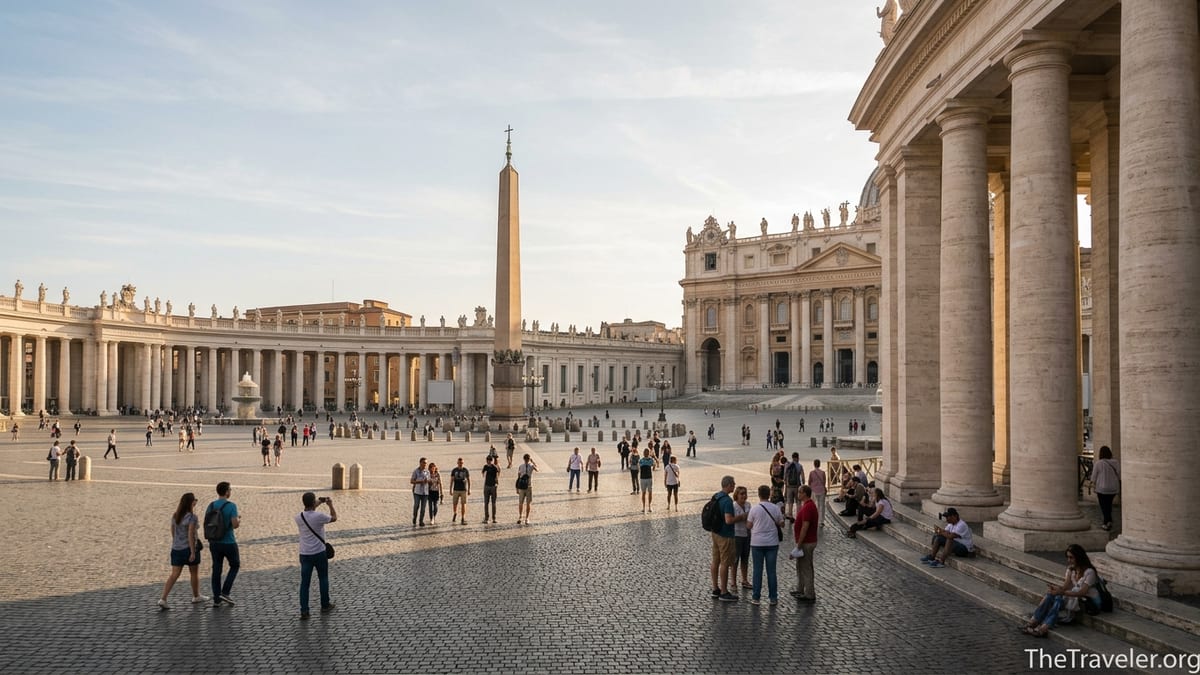
A Masterpiece of Urban Theater That Feels New Every Time
For many travelers, the main reason to come back to St Peter’s Square is simple: the space itself is unforgettable. Designed by Gian Lorenzo Bernini in the 17th century, the square’s grand ellipse stretches roughly 320 meters long and 240 meters wide, framed by sweeping colonnades. On paper, those numbers are impressive. In person, standing on one of the marble disks that mark the focal points of the ellipse while 284 Doric columns seem to merge into a single row, the effect is pure theater. Even if you have seen it in photographs, walking into that space again feels like a new performance of a familiar play.
The colonnades, four deep and crowned by 140 statues of saints, create a sense of entering a monumental outdoor room. Regular visitors learn to notice details first-time tourists often miss: the subtle height difference between the inner and outer columns, the way the paving radiates out from the central obelisk, and how the façade of St Peter’s Basilica rises like a stage set beyond the open space. Repeat travelers often time their visits to see how the light transforms the travertine and marble: soft pink at sunrise when early-morning pilgrims arrive, blinding white at midday in high summer, and golden amber in late afternoon in October.
Part of the square’s enduring appeal is that it is both vast and surprisingly humane. At peak times, it comfortably holds tens of thousands of people, yet there are intimate corners along the colonnades where you can lean against a cool column, step out of the sun, and watch the flow of visitors. Travelers who stay nearby, in neighborhoods like Prati or around the Ottaviano metro stop, often stroll through the piazza repeatedly during a trip, using it as a kind of outdoor living room where the drama of the Vatican plays out hourly.
Because the square is open and free to enter, it naturally becomes a repeat stop. Visitors might first encounter it on a guided Vatican tour, then deliberately return later alone at dusk, and again on departure day for one last look. Each visit reveals a new angle or detail, from coats-of-arms carved into the stone to a quiet side fountain where locals refill water bottles during the summer heat.
Faith, Ritual, and the Emotional Pull of Papal Events
St Peter’s Square is the beating heart of Catholic ritual, and that religious significance is a powerful reason many travelers come back year after year. On Wednesday mornings when the pope holds his general audience, the square transforms. Long before dawn, pilgrims from across the world pass through security checkpoints, cluster around the metal barriers, and stand under the colonnades clutching flags and banners. Tickets for these audiences are free, obtained in advance through church offices or online request forms, but the true cost is time and patience. Seasoned visitors who have attended before know to arrive at least two hours early to secure a good spot in the open air.
The moment the papal motorcade winds through the square is often a once-in-a-lifetime experience for first-timers. For repeat visitors, it can become a tradition. Many families return to mark milestones such as wedding anniversaries or confirmations, timing their trips to coincide with a papal audience or a special Mass on major feast days. Travelers who have previously attended Easter Sunday Mass in the square sometimes come back years later for Christmas Eve, or vice versa, eager to experience how the same space feels under different liturgical seasons and decorations.
Even on ordinary Sundays, the square fills for the Angelus prayer, when the pope appears at a window of the Apostolic Palace overlooking the piazza. No tickets are required, so many travelers staying elsewhere in Rome make a point of returning to St Peter’s specifically for this short, focused moment of shared prayer and blessing. People who might visit the Vatican Museums only once in a lifetime find themselves drawn back to this outdoor ritual on subsequent trips, especially if they are traveling with new generations of their family.
For non-Catholic visitors, the spiritual dimension is often more about atmosphere than doctrine. Repeat travelers report coming back to St Peter’s Square simply to stand among the crowd when the bells of the basilica ring, to listen to the rustle of prayers in multiple languages, or to feel the hush that falls over tens of thousands of people at once during a papal blessing. That emotional experience, hard to capture in photos, is what lingers and motivates many to return.
Living History in Stone: Obelisk, Fountains, and Colonnades
Another reason travelers keep revisiting is that St Peter’s Square is a compact encyclopedia of history in stone. At its center rises the Vatican obelisk, an ancient Egyptian monument brought to Rome in antiquity and moved to its current position in the late 16th century. Knowing that this 25-meter shaft of red granite once stood in the Roman circus where early Christians were martyred adds emotional weight to every photo taken at its base. Repeat visitors often find new meaning in circling the obelisk, tracing the Latin inscriptions, and noticing how it aligns perfectly with the basilica façade.
Flanking the obelisk are two monumental fountains, one designed by Carlo Maderno in the early 1600s and the other added by Bernini later to balance the composition. In summer, the sound of water splashing into stone basins becomes a constant backdrop, and returning travelers learn to use the fountains as informal meeting points. It is common to hear instructions like “Let’s meet by the Bernini fountain at 9” from tour guides or friends who have been here before and now treat the space like a familiar neighborhood square rather than an intimidating monument.
The colonnades themselves tell a story that rewards repeat viewing. The 284 columns are crowned by 140 statues of saints, each more than three meters tall. On a first trip, many visitors experience them simply as a sculptural forest. On subsequent visits, especially with a good guidebook or after some reading, travelers often try to identify specific figures, picking out well-known saints or those from their home countries. Some tours now build this into their itineraries, stopping to highlight particular statues at quieter times, such as late afternoon or early evening when the setting sun creates long shadows through the columns.
Because St Peter’s Square has been the backdrop to countless major events, from papal elections to canonizations and historic announcements, it also functions as a living stage set for world history. Visitors who watched a new pope introduced on television often return years later to stand in the exact place where crowds once chanted, now quiet except for the murmur of tourists. The continuity between those global moments and an ordinary Wednesday morning visit is part of what keeps drawing people back.
The Changing Atmosphere from Dawn to Night
One of the secrets that frequent visitors share is that St Peter’s Square is really several different places depending on the time of day and season. An early morning visit in June, when the light is soft and the air is still cool, feels wholly different from a crowded midday in August or a quiet winter evening. Travelers who return often intentionally plan visits at off-peak hours, sometimes building a routine into their stay: a pre-breakfast walk through the piazza, or a post-dinner stroll when the crowds have thinned.
At sunrise, especially in shoulder seasons like April or October, you might see only a scattering of locals, a few nuns hurrying across the cobblestones, and workers setting up temporary barriers for later events. Photographers returning for a second or third trip to Rome will often head straight to St Peter’s at this hour for wide shots of the empty square and long exposures of the fountains before the tour groups arrive. The security lines for the basilica, which can stretch well across the square from mid-morning, are often minimal before 8 am, another practical reason repeat travelers aim for an early start.
By midday, the mood is livelier, with school groups, cruise-ship excursions bused in from Civitavecchia, and guided tours in multiple languages swirling around the obelisk. Return visitors who remember their first overwhelmed impression often now move confidently through this bustle, using landmarks like the Swiss Guard posts or the information desks under the colonnades to orient themselves. They know where to find shade, where to refill a water bottle, and how to step just a bit to the side of the main flows of people to appreciate the architecture.
After dark, the square takes on a hushed grandeur. The façade of the basilica and the tops of the colonnades are bathed in warm light, while the pavement remains relatively dim, encouraging a slower, reflective pace. Many travelers who have already checked the basilica and museums off their list return in the evening purely for atmosphere. Couples on anniversary trips linger on the steps of the central obelisk pedestal, listening to the distant music of street performers across the Tiber. Winter visitors sometimes describe watching light rain glisten on the stones, turning the piazza into a shimmering canvas that feels a world away from the midday crowds they remember from summer trips.
Gateway to Deeper Vatican Experiences
St Peter’s Square also acts as the front door to a whole cluster of experiences that reward repeat visits. The main security checkpoints for St Peter’s Basilica open from the square, and returning travelers often come back with a more strategic plan: attending morning Mass inside the basilica, then exiting to enjoy the quieter square before most tours arrive, or climbing the dome on a second trip after leaving it for “next time” the first round.
Many guided Vatican tours begin or end in the square, but seasoned travelers soon realize that the piazza deserves its own unhurried time separate from museum visits. They may book a formal tour of the Vatican Museums and Sistine Chapel one day, then return another morning solely to wander the square, visit the basilica independently, or join a small-group early-access tour that enters the basilica as soon as it opens. Because reservations for these specialized experiences can sell out months ahead during peak season, repeat visitors often plan their itineraries around dates and times that let them experience the square under different conditions.
The square is also the starting point for exploring nearby neighborhoods that feel different at each visit. Walking from the piazza along Via della Conciliazione toward the Tiber leads to Castel Sant’Angelo, while crossing into Prati brings you to streets lined with local cafés and shops where returning visitors greet familiar baristas and pick up fresh cornetti before their daily lap around the basilica. For some travelers, revisiting St Peter’s Square is less about ticking off a sight and more about slipping back into a rhythm of Roman life that now feels personally significant.
Practical elements reinforce this. Hotels and guesthouses in the streets around the Vatican often use the square as their main selling point, promoting walking times of five or ten minutes to the basilica. Guests who enjoyed rolling out of bed and being in the piazza before most tour buses arrive commonly rebook the same hotel or at least the same area on future trips, turning St Peter’s Square into a recurring anchor in their European travels.
Accessible Icon: Free, Open, and Welcoming to All Budgets
Unlike many of Rome’s major attractions that require timed tickets or substantial entrance fees, St Peter’s Square is free and open to the public. This accessibility makes it an easy place to revisit, even on trips when budgets are tight or schedules are packed. Travelers returning to Rome for a quick weekend, for example, can always count on being able to drop by the square without advance planning, even if they do not have time for another full Vatican Museums visit.
For budget-conscious travelers, the square itself offers hours of interest at no cost. People-watching on the steps around the obelisk, sketching the colonnades, or simply sitting against a column with a takeaway espresso from a nearby bar can fill a morning without spending more than a few euros. Families who visited once with a guided tour may return on a later trip with older children, using what they learned previously to lead their own informal walk, turning the piazza into an open-air classroom where history, art, and religion intersect.
Even when attending special events, the costs remain more about time and logistics than money. Papal audiences and many outdoor liturgies in the square are free, though they require advance ticket requests and early arrival to pass security and secure a good view. Repeat visitors quickly learn the small efficiencies that make these experiences smoother: which side of the colonnade usually has shorter security lines at a given hour, where portable restrooms are typically set up during major events, and how early to arrive based on the season.
Because the square is part of Vatican City yet open from Italian territory, it also feels symbolically inclusive. Tourists walking up Via della Conciliazione from central Rome cross an invisible border into the smallest independent state in the world without formal checks, yet the experience is as simple as strolling into any other piazza. That mix of global significance and everyday ease is rare, and it is one reason travelers who may not return to all the major sites still make a point of standing in St Peter’s Square again.
The Takeaway
St Peter’s Square exerts the kind of pull usually reserved for natural wonders or beloved hometown landmarks. It is a place where architecture functions like stagecraft, where ancient stone tells stories of emperors and martyrs, and where present-day rituals gather tens of thousands of people in a shared, fleeting moment. Travelers return for the thrill of seeing the pope drive past within arm’s reach, for the quiet of dawn between the colonnades, for the way the fountains sound at night, and for the simple comfort of recognizing a landscape that once felt overwhelming and now feels oddly familiar.
On a return trip to Rome, you may find that your priorities shift. The first time, you might rush through the square on the way to the Sistine Chapel. The second or third time, you may choose instead to sit on a low step at the base of the obelisk, watching the play of light on the basilica and remembering earlier visits. In a city of infinite sights, St Peter’s Square stands out as a place that rewards this kind of long relationship. It is not just somewhere to see, but somewhere to return to, each time discovering that the space has changed, you have changed, and yet the grand embrace of Bernini’s colonnades remains reassuringly the same.
FAQ
Q1. Is St Peter’s Square always open to visitors?
The square is generally open 24 hours a day, but access can be restricted or partially closed during major events, security operations, or preparations for papal ceremonies.
Q2. Do I need a ticket to enter St Peter’s Square?
No ticket is required to enter the square itself; it is free public space. Tickets are only needed for certain events, such as papal audiences or special Masses, and even those tickets are usually free but must be reserved in advance.
Q3. What is the best time of day to visit St Peter’s Square?
Early morning is ideal for fewer crowds and softer light, while late evening offers a quieter, more contemplative atmosphere with the basilica beautifully illuminated.
Q4. Can I see the pope from St Peter’s Square?
Yes, you may see the pope during the Wednesday general audience, many Sunday Angelus prayers, and special liturgies or celebrations when he appears either in the square or at a window of the Apostolic Palace.
Q5. How long should I plan to spend in St Peter’s Square?
Many first-time visitors spend 30 to 60 minutes, but repeat travelers often allow at least an hour or two, especially if combining the square with a visit to St Peter’s Basilica.
Q6. Are there security checks to enter the square?
On ordinary days, you can walk into the square without passing through metal detectors, but you must clear security to enter St Peter’s Basilica. During big events, additional checks or barriers may be set up within the piazza.
Q7. Is there a dress code in St Peter’s Square?
There is no strict dress code just to stand in the square. However, modest clothing that covers shoulders and knees is required to enter St Peter’s Basilica, and many visitors choose to dress respectfully in the piazza as well.
Q8. Can I visit St Peter’s Square at night?
Yes, visiting at night is highly recommended. The square remains open, the colonnades and basilica façade are illuminated, and the crowds are usually much smaller than during the day.
Q9. Are guided tours of St Peter’s Square available?
Many Vatican and Rome walking tours include the square as part of a broader itinerary, and some specialized tours focus on its art, architecture, and history in more detail.
Q10. Is St Peter’s Square accessible for travelers with limited mobility?
The square is mostly flat and paved, making it accessible for wheelchairs and strollers. During major events it can become very crowded, so allowing extra time and aiming for off-peak hours can make movement easier.