


The moment the trail finally levelled out and the wind off the Bay of Naples hit my face, I realized this was nothing like the tidy mental picture I had of “going up a volcano.” Reaching the crater of Mount Vesuvius, with its raw rock, quiet fumaroles and sweeping views over Naples, felt stranger, more intimate and more unsettling than any guidebook had prepared me for.
Get the latest updates straight to your inbox!
First Glimpse of a Volcano You Already Know Too Well
You think you know Mount Vesuvius long before you see it. It is the villain in school textbooks, the black cloud over Pompeii, the name attached to grainy photos in museum displays. From Naples, the volcano’s double-peaked silhouette on the eastern skyline looks almost benign, a familiar backdrop to everyday life. The surreal part begins when you leave that postcard distance behind and start threading your way toward the actual crater.
For most travelers, the approach starts at Napoli Centrale, the city’s main train station. From here, the Circumvesuviana commuter train rattles out toward Ercolano Scavi, a local stop that costs just a few euros and takes roughly 20 to 30 minutes, depending on the departure. On board you share the carriage with commuters heading home, schoolkids glued to their phones, and a handful of backpackers gripping daypacks. It feels like the start of an ordinary suburban outing, not a visit to one of the world’s most notorious volcanoes.
Outside Ercolano Scavi station, the scene shifts. Minibuses for the Vesuvio Express line up along the curb, drivers calling out departure times in Italian and English. A combined shuttle and entrance package often runs in the region of 30 to 40 euros per person, which includes the park admission, currently a bit over 10 euros when bought directly, plus transport up to around 1,000 meters. You pay at a small ticket office or kiosk, get a paper receipt, and suddenly your everyday commute has turned into an excursion to the top of a stratovolcano.
The bus grinds up through the suburbs of Ercolano, past apartment blocks draped with laundry, then switchbacks into the protected slopes of Vesuvius National Park. Bit by bit, the city falls away. The asphalt narrows, broom and wildflowers appear at the roadside, and on clear days the Bay of Naples flickers into view between the trees. Already the volcano feels more real and less academic, but the true jolt of unreality is still ahead, waiting at the rim.
The Gran Cono Trail: A Short Hike With Long Shadows
The bus drops you at the quota 1,000 area, where the asphalt ends and the gravel begins. Here, at a line of turnstiles and a low visitor booth, tickets are scanned and visitors funnel onto Sentiero n. 5, better known as the Gran Cono trail. Official information boards warn that the path is unpaved and exposed, which is accurate: the track is basically a wide cinder ramp, climbing steadily for about 30 to 45 minutes, depending on fitness and crowding.
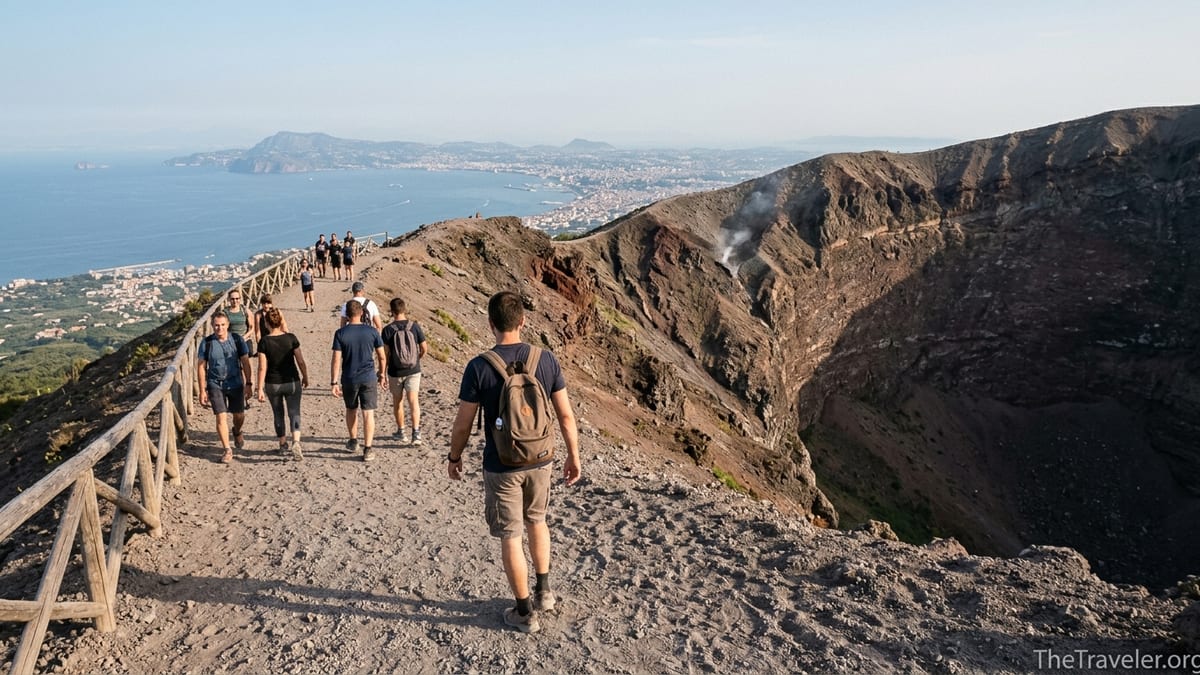
The hike itself is not technically difficult, but it is relentlessly uphill on loose volcanic grit. Sneakers with decent tread are usually enough, though you see a surprising number of people struggling in smooth-soled fashion trainers or open sandals. In summer, when temperatures on the upper slopes regularly feel well above 25 degrees Celsius under direct sun, the lack of shade can make the ascent feel harsher than the distance suggests. Many visitors break the climb into short bursts, catching their breath beside simple wooden railings while guides point out old lava flows and ash layers in the cliff faces below.
As you gain altitude, the views over the coast grow more expansive. To one side lies the dense sprawl of metropolitan Naples, with its tight grid of streets and the cruise ships docked near the historic center. To the other, the Sorrentine Peninsula stretches toward the hazy outline of Capri. Buses continue to arrive in waves, and yet the higher you climb, the more the ambient noise falls away into the wind, boots crunching on pumice and the occasional shout from a guide explaining the eruption of 79 AD.
The surreal part is how quickly the hike compresses time. One moment you are stepping around clumps of hardy plants and recent rockfalls; the next you are peering down at the same bay that Roman sailors once crossed under a darkened sky. The path’s final switchbacks feel as if they lead not just upward, but backward, into a catastrophe that still shapes every conversation about Vesuvius today.
Face to Face With the Crater
Reaching the crater’s lip is a quiet shock. There is no grand viewing platform or glossy visitor center perched at the edge. Instead, the trail simply eases off its incline and, with a few more steps, the ground opens abruptly into a vast bowl of rock, ash and silence. The active vent is off to one side, a gash in the crater floor where, on cooler days, wisps of steam rise lazily into the air.
Plenty of travelers arrive expecting a lava-filled cauldron, a cinematic image shaped by movies and video games. The reality is more unsettling precisely because it is so still. Inside the crater, shades of brown, black, red and ochre layer the walls, and the surface is fractured into ledges and gullies that look strangely fragile for something capable of reshaping an entire coastline. Standing there, you recall that the last eruption in 1944 sent ash across Naples and destroyed villages along the slopes, and that the volcano is merely dormant rather than extinct.
Along the rim, a simple rope barrier and wooden posts mark how far you are allowed to go. Authorized volcanological guides, some of whom grew up in the surrounding “red zone” towns, hover nearby, answering questions about gas measurements and seismic monitoring. They explain, often in plain and reassuring terms, that Vesuvius is under 24-hour surveillance by Italy’s national geophysical institute, with dense networks of instruments and an elaborate civil protection plan designed for the 700,000 people who live within the highest-risk area.
What makes the moment feel surreal is not fear so much as contrast. Below you, the crater floor is lifeless, streaked with sulfur and broken stone. Behind you, just a few kilometers away, is a thickly populated urban region with shopping malls, train depots and apartment towers. You are literally stood on the edge of the event that buried Pompeii and Herculaneum, while simultaneously watching planes glide in toward Naples’ modern airport. It can feel, as one visitor murmured beside me, “like standing inside a history documentary that forgot to end.”
The Human Side of an Active Volcano
Spend more than a few minutes on the rim and the human side of Vesuvius comes into sharper focus. Stalls set up along parts of the path sell volcanic rock souvenirs, bottles of local Lacryma Christi wine and magnets printed with ash clouds and red lava flows. The vendors are mostly from Ercolano and other nearby towns, families whose daily income is tied to the ebb and flow of tourism on a volcano that also defines their risk.
Guides share small, practical details that do not fit onto glossy brochures. They point out the direction of the prevailing winds that determine where ash is most likely to fall in a future eruption. They talk about the evacuation drills held in local schools and the traffic simulations that attempt to model what would happen if hundreds of thousands of residents needed to move away from the red zone in a matter of days. These conversations happen in the shadow of selfie sticks and smartphones, and the juxtaposition is quietly jarring.
Travelers arrive with different emotional expectations. Some come straight from visiting Pompeii or Herculaneum earlier that morning, still carrying the image of plaster casts of victims frozen in ash. For them, peering into the crater often triggers an unspoken comparison between the serene emptiness below and the crowded Roman streets they just walked. Others treat Vesuvius as a straightforward half-day outing from Naples or Sorrento, something to slot between pizza lunches and a gelato stop on Via Toledo. Yet even they tend to fall silent for at least a few seconds at the rim.
The surreal feeling peaks when you remember how routine this has become. On busy summer days, thousands of people make this same short hike, each occupying the same narrow strip of ground along the crater rim for a handful of minutes before the next group arrives. You realize that, for local authorities and tour operators, the volcano is both an ever-present hazard and an everyday workplace, with ticket scanners, bus timetables and shift rotations like any attraction. Few places in Europe combine such existential risk with such normalized, almost casual access.
Practical Realities: Tickets, Closures and Crowds
Nothing punctures romantic notions of adventure like an electronic turnstile, and Vesuvius is no exception. Access to the crater area is strictly regulated, with timed-entry tickets sold online and through authorized partners. In recent seasons, basic entry has hovered around the low double digits in euros, not including transport. Same-day tickets sometimes sell out during peak months from May to September, particularly in the late morning slots favored by tour groups, so buying in advance is highly recommended if your dates are fixed.
Travelers should also be prepared for last-minute changes. The Gran Cono trail has been closed in the past for safety inspections after rockfalls or heavy rain, and park authorities can suspend access with little notice during high winds, storms or volcanic unrest. When the trail reopens, announcements filter through official national park channels and local transport operators, but visitors relying on old blog posts or guidebooks occasionally arrive at the gate only to find the path temporarily off-limits. Flexibility, and a Plan B involving Pompeii, Herculaneum or the Amalfi Coast, can save a day’s outing.
On a typical clear day, however, the system is straightforward. From Naples, most independent travelers take the Circumvesuviana train to Ercolano Scavi, then a Vesuvio Express minibus to the quota 1,000 car park and ticket checkpoint. Some shuttle companies run direct buses from central Naples or from Pompeii, bundling park entrance with transport for convenience. Driving yourself is possible, but private cars must stop at a lower parking lot and passengers continue on foot or by shuttle to the trailhead. In all cases, expect to show your ticket both at the bus departure point and again at the park’s turnstiles.
Crowds are part of the experience, but you can mitigate them. Early morning slots, especially before 10 am, tend to be quieter, as do late-afternoon entries outside the height of summer. Shoulder seasons in April, May, late September and October often offer clearer views with cooler temperatures and fewer coach tours. At the crater rim, people naturally cluster at the first viewpoints, but if you walk a few minutes farther along the allowed section of the rim, you can usually find pockets of relative calm to absorb the scene.
How It Feels to Look Back Down on Naples
Paradoxically, the emotion that lingers longest from a Vesuvius crater visit is not fear but tenderness toward the landscape below. From the higher viewpoints along the rim, Naples looks both fragile and defiant, a dense, complicated city cradled between sea and volcano. The checkerboard of streets, the narrow ribbon of the port, the outline of Castel dell’Ovo on its little peninsula: all are familiar landmarks, suddenly miniaturized under your feet.
If the air is particularly clear, you can trace the arc of the Gulf from Pozzuoli around to Sorrento, spotting the isles of Ischia and Capri on the horizon. On hazy summer afternoons, the scene softens into pale blues and greys, as if viewed through smoked glass. Somewhere down there, people are sipping espresso in Piazza del Plebiscito, navigating scooters through traffic near Spaccanapoli, or wandering through the archaeological museum where artifacts from Pompeii and Herculaneum are displayed. The distance between your vantage point and their daily routines feels astonishingly short.
That proximity can be emotionally complicated. Knowing that hundreds of thousands of people live within the official “red zone” of potential pyroclastic flows and ashfall, and that evacuation plans exist not as an academic exercise but as a living civil protection document, may sit uneasily with the postcard view. Yet the very ordinariness of life below is part of what makes standing on the crater rim so affecting. People here have chosen, or inherited, lives in the shadow of Vesuvius, adapting to its presence in ways that visitors glimpse only briefly.
When you finally start the descent back down the Gran Cono trail, boots sliding a little on the cinders, you carry more than photographs. You carry a sense of how layered this landscape really is: Roman villas preserved in ash, modern commuter trains hugging the coast, vineyard terraces coaxed from volcanic soil, and above it all, the quiet, watchful crater you just left behind. The whole experience is less about ticking off a bucket-list volcano and more about realizing how a single mountain can shape the stories of an entire region.
The Takeaway
Reaching the crater of Mount Vesuvius near Naples feels surreal because it refuses to behave like an abstract symbol. It is not just “the volcano that buried Pompeii,” nor simply a scenic viewpoint high above the bay. It is a living, closely monitored geological system that you can access on a half-day excursion using ordinary public transport, climbing in sneakers past souvenir stalls to peer into an active vent.
The practical details matter. Timed-entry tickets, shuttle buses from Ercolano or Pompeii, and the very real possibility of weather-related closures mean that planning ahead is wise. Good footwear, sun protection and a flexible schedule can make the difference between a rushed, crowded dash to the rim and a quietly absorbing visit. Combining Vesuvius with a morning at Pompeii or Herculaneum is entirely feasible, but the volcano warrants its own mental space if you want to absorb what it represents.
More than anything, a visit to the crater invites you to hold conflicting truths at once. Vesuvius is dangerous, yet intimately woven into local life. It is monitored with some of the most advanced volcanic surveillance systems in the world, yet retains an element of unpredictability that humbles scientists and visitors alike. Standing there, wind tugging at your jacket as you stare into the silent bowl of rock, you understand that this is not simply a backdrop to Naples, but its uneasy, unforgettable heart.
FAQ
Q1. How hard is the hike to the crater of Mount Vesuvius?
The main Gran Cono trail is short but steady uphill on loose gravel. Most reasonably fit people manage it in 30 to 45 minutes, but the lack of shade and the altitude can make it feel tougher than the distance suggests.
Q2. How do I get to Mount Vesuvius from central Naples by public transport?
Most travelers take the Circumvesuviana train from Napoli Centrale or Porta Nolana to Ercolano Scavi, then connect with a shuttle such as Vesuvio Express that runs directly up to the park entrance near 1,000 meters.
Q3. Do I need to book tickets for Vesuvius in advance?
Timed-entry tickets often sell out for popular midday slots in peak season, so advance purchase is strongly recommended. Day-of tickets may be available in quieter periods but are not guaranteed, especially from May to September.
Q4. How much time should I allow for a visit to the crater?
From Naples, plan at least half a day. The round-trip train and bus journey, the hike up and down, and 30 to 60 minutes at the crater rim together typically require four to five hours.
Q5. Is visiting Mount Vesuvius safe given that it is an active volcano?
Vesuvius is classed as active but currently dormant and is continuously monitored by Italy’s national geophysical institute. Access to the crater can be suspended during adverse weather or signs of unrest, and detailed civil protection plans exist for the surrounding area.
Q6. What should I wear and bring for the hike?
Closed shoes with decent grip, a light jacket or windbreaker, sun protection, and water are essential. The path is dusty and exposed, so sandals, heavy backpacks, and umbrellas are best avoided.
Q7. Can I visit Vesuvius and Pompeii on the same day?
Yes, many visitors combine a morning at Pompeii with an afternoon trip to Vesuvius or vice versa. Be realistic about your pace, and factor in train connections and the timed entry window for the crater.
Q8. Are children allowed on the crater trail?
Children are generally permitted, but very young kids may struggle with the steep, loose surface and lack of shade. Park rules at times restrict access for children under a certain age, so check current guidelines before you go.
Q9. What happens if the weather is bad on the day of my visit?
High winds, heavy rain or storms can lead authorities to close the Gran Cono trail at short notice. In such cases, shuttles may still operate partway up the mountain, but access to the crater rim itself can be suspended for safety.
Q10. Are there guided tours at the crater, or can I explore on my own?
You can walk the allowed section of the rim independently, but licensed volcanological guides are often available on-site or through tour packages, adding context about the volcano’s history, geology and current monitoring.