


St Peter’s Square looks wonderfully simple on a postcard: a vast ellipse of travertine, Bernini’s colonnades, the dome of St Peter’s Basilica and, on many Wednesdays, the Pope addressing tens of thousands of pilgrims. On the ground, though, this serene space can be confusing and unforgiving for first-time visitors. Lines can stretch around the colonnades, security rules shift with the liturgical calendar, and an entire ecosystem of touts has grown up around the gates. Knowing the most common mistakes people make is the difference between a moving visit and a stressful, wasted morning.
Get the latest updates straight to your inbox!
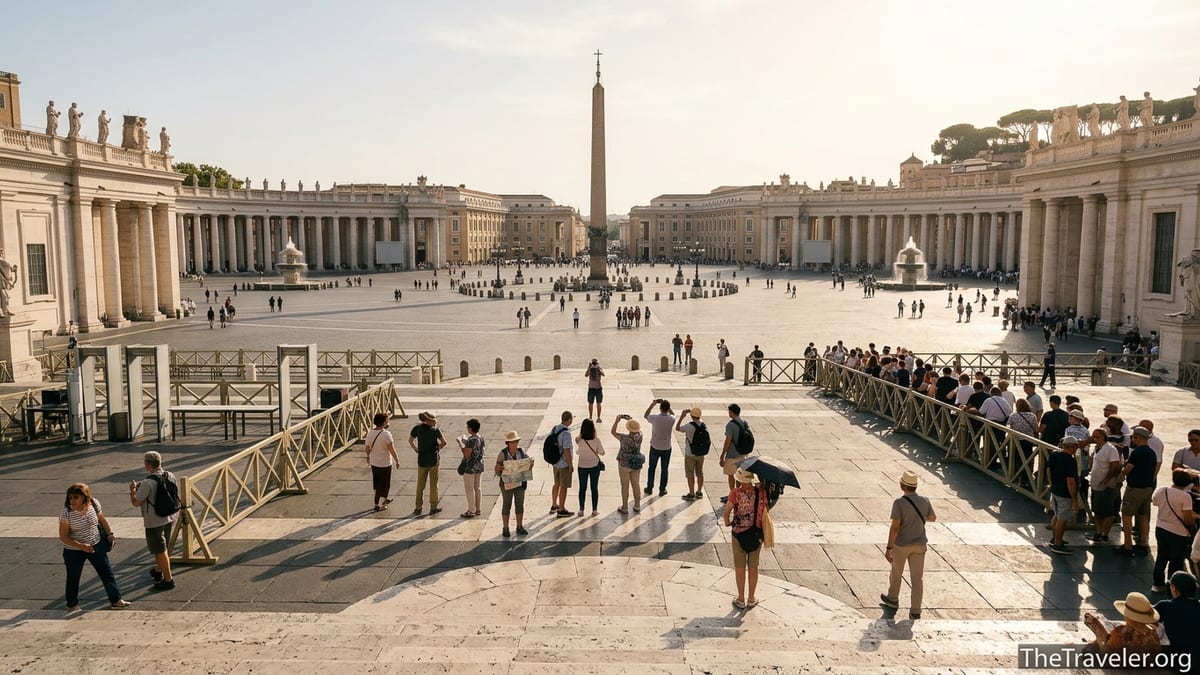
Arriving at the Wrong Time and Losing Hours in Line
By far the most common mistake in St Peter’s Square is assuming you can stroll up to the basilica whenever it suits you. Security is centralized in the square, so everyone visiting St Peter’s Basilica or climbing the dome must first pass through metal detectors and bag scanners. In high season, especially from June to August, lines can easily reach 60 to 120 minutes if you show up between late morning and early afternoon. Many visitors arrive at 11 a.m., see the queue curling all the way around the right-hand colonnade, and end up burning half a day before they even set foot inside the church.
The smarter move is to work with the current opening hours. As of June 2026, St Peter’s Basilica opens daily at 7 a.m. and remains open into the evening, with last entry allowed around 7:15 p.m. depending on security queues. Early mornings between opening time and roughly 9 a.m. are usually the quietest, with security often taking only a few minutes, even in summer. Travelers who time it this way often report walking straight up to the scanners, stepping into the basilica in near silence, and having the nave and side chapels almost to themselves while Rome is still waking up.
Another major timing trap is Wednesday morning. On most Wednesdays when the Pope holds a General Audience, St Peter’s Square is reserved for ticket holders and large parts of the square are blocked by barriers from early morning. Standard visitors are frequently surprised to discover they cannot reach the main security entrance until after the gathering ends, often around midday or early afternoon. Similarly, on certain major feasts and during Holy Week the square fills with seating and structures for papal liturgies, and usual circulation patterns change. Checking the Vatican’s liturgical calendar before your trip and avoiding mid-morning arrivals on papal event days will save you hours of frustration.
Finally, many people underestimate how long a full visit takes, especially if they combine the basilica with a climb to the dome. Realistically you should budget two to three hours for security, a calm walkthrough of the church, and the dome ascent, not counting time for lingering in the square. Starting at 4 p.m. and assuming you will “quickly pop up the dome” just before closing is one of the surest ways to miss out, since last dome entry is typically about an hour before closing and the stairways can still be busy.
Misunderstanding What Is Free, What Needs Tickets, and Where Scams Lurk
St Peter’s Square itself is an open public space and you do not need a ticket to enter it. Entry to St Peter’s Basilica is also free, which surprises many visitors used to paying for every major European church. This is where confusion sets in. Because there is no official ticket booth for basilica entry, commercial websites and street touts step into the information vacuum and sell “skip the line” or “basilica access” products that sound official, but often only wrap a free service inside marketing language and a markup.
A typical real-world scenario goes like this: A family arrives around 10:30 a.m., sees the queue in the sun and panics. At the outer edge of the square, someone with a badge and clipboard approaches them, warning that security lines will take two hours and saying they “need tickets” or an “obligatory tour” in order to enter. The family ends up paying 30 to 50 euro per person for a “fast track pass” that merely walks them to the same security checkpoint everyone else uses. In some cases the product is a legitimate guided tour, which can be worthwhile if you want commentary. In many others it is nothing more than an escort to the existing line, or a Vatican Museums tour that never even enters the basilica despite the sales pitch implying otherwise.
The distinction to remember is simple: access to the square and basilica is free, but anything involving a licensed guide, headsets, or pre-arranged schedules will cost money because you are paying for a professional service, not entry to the church. This is also true for companies that help you obtain free papal audience tickets and then accompany you into the square on Wednesday morning; you are paying them for logistics, translations, or commentary, not for the ticket itself. Scams flourish when visitors do not realize there is no such thing as an official paid basilica entry ticket or paywall at the gates.
To stay on the safe side, treat anyone at the perimeter of St Peter’s Square who insists you must buy a ticket just to enter the square or basilica with extreme skepticism. If you decide you want a tour, compare prices and descriptions on reputable platforms in advance and look carefully at what is actually included. Many “skip the line” products in Rome do legitimately bypass ticket-purchase queues for attractions that charge admission, like the Vatican Museums and Colosseum. For St Peter’s Basilica, though, there is no separate ticket line to bypass, only security, so promises of miracle access should immediately raise a red flag.
Confusing the Square With the Vatican Museums and Sistine Chapel
Another source of disappointment is failing to distinguish between St Peter’s Square, St Peter’s Basilica, and the Vatican Museums. Travelers regularly assume that once they are in the square they will somehow “see the Sistine Chapel” as part of the same visit. In reality, the Vatican Museums and Sistine Chapel have their own separate entrance on the north side of Vatican City, about a 15 to 20 minute walk from the square. They charge for entry, require timed tickets in busy periods, and have their own security checkpoints and queues.
Here is how the mistake typically unfolds. A couple with an afternoon flight plans to “swing by the Vatican” in the morning, stands in the basilica line in St Peter’s Square for an hour, walks through the church for thirty minutes, then heads toward what they think is the Sistine Chapel entrance. They are then told that the museums are not accessed from the square and that same-day tickets are sold out or available only much later. Short on time, they end up seeing neither the chapel’s frescoes nor the museum collections that they had flown across an ocean to admire.
The square itself offers powerful experiences even without museum access. You can linger beside the central obelisk that once stood in Nero’s Circus, hunt for the precise marble disk from which Bernini’s colonnades align perfectly, or simply stand in the middle of the ellipse as the bells ring the hour. However, if the Sistine Chapel is non-negotiable for you, book museum tickets before you leave home and build your day the other way around: start with the Vatican Museums, then use the separate time at St Peter’s Square and Basilica as a calmer counterpoint later in the day.
It is also worth noting that some licensed guided tours of the Vatican Museums include a special exit that leads directly toward St Peter’s Basilica, which can save you walking time and re-queuing at security if it is in use that day. This shortcut does not work in reverse, though. Starting in the square will never bring you to the museum galleries or Sistine Chapel on its own, no matter what imaginative promises you hear at the gates.
Getting Dress Code and Security Rules Wrong
Visitors are often surprised by how seriously dress and security are taken at St Peter’s. The square itself is an open piazza and, in practice, Vatican security focuses dress code checks on people entering religious buildings or attending papal events, rather than on everyone who happens to cross the border line painted in the paving stones. Where many travelers stumble is at the threshold between the square and the basilica, where Vatican staff inspect clothing at the security checkpoint and turn people away if they do not meet the modesty guidelines.
In general, shoulders and knees should be covered for anyone entering the basilica, regardless of gender. That means tank tops, strapless dresses, very short shorts, and ripped jeans can all cause issues. One common real-world scene unfolds when a visitor queuing under the colonnade on a hot day reaches the metal detectors only to be pulled aside because their shorts are too far above the knee or their top is too revealing. With a long line behind them and no place nearby to buy suitable clothing inside the security zone, they face a dilemma: abort the visit or leave the queue, purchase or retrieve more modest clothing, and start over.
Preparation avoids this entirely. Many savvy travelers carry a lightweight scarf or large cotton shawl in their day bag, using it as a sunshade in the square and as shoulder or leg coverage in the basilica. Others pack foldable knee-length shorts or a simple summer dress that meets the guidelines and change into them before joining the line. Children are expected to follow the same standards, though enforcement can be slightly more flexible. Footwear is rarely a problem as long as it is not beach flip-flops, but hats should be removed inside the church.
Security also extends to bags and objects. Airport-style scanners screen backpacks and purses, and staff may ask you to remove belts or metal items, which slows the line when people are not ready. Large suitcases, bulky luggage, and items like glass bottles or oversized tripods are likely to be denied. There is a cloakroom service associated with St Peter’s, but relying on it at peak times can add extra walking and waiting. The safest approach is to arrive with only what you can comfortably carry for several hours: a small daypack or tote, water bottle, and essentials. Travelers who show up with wheeled carry-ons straight from the airport often find themselves turned away or stuck figuring out last-minute storage elsewhere in the city.
Underestimating Crowds and Comfort in the Square
St Peter’s Square can look like an elegant stone theater in photos, but on the ground it behaves like what it is: a vast, mostly unshaded plaza that bakes in the Roman sun. In summer, pavement temperatures climb quickly and the reflected heat can be intense. Many visitors arrive without hats, sunscreen, or water, then find themselves standing in an exposed line that moves slowly along the right-hand colonnade. There are some shaded stretches beneath the columns, but you cannot rely on them being available when you arrive, especially if security queues have spilled out into the open area.
The lack of planning shows in small, avoidable crises. Families with young children discover that the only toilet facilities are either inside the basilica complex after security or in a limited number of services tucked under the colonnade, which may also have lines. Travelers with mobility challenges sometimes underestimate the amount of standing required if they join long queues without scouting alternative entry points or wheelchair access ramps. In busy seasons, even moving from the obelisk to the edge of the square can take time simply because of the density of people waiting for audiences, tours, or photo opportunities.
Comfort planning pays dividends. Arriving early or later in the afternoon to avoid the most punishing midday heat can transform your experience. A refillable water bottle, a wide-brimmed hat, and sunglasses are simple items that make lingering in the square far more pleasant. If you are traveling with someone who has reduced mobility, take a moment before committing to the main queue to locate ramps and ask security staff about the most accessible route to the basilica entrance. Several tour operators offer specialized visits designed for wheelchair users and those who cannot manage the dome stairs, and these can be worth considering if standing for long stretches is an issue.
Even in cooler months, underestimating crowds can limit your enjoyment. On days of special liturgies or during the 2025 Jubilee celebrations, for example, St Peter’s Square has hosted tens of thousands of pilgrims at once, with entire sectors reserved for ticketed groups. Arriving without understanding what is happening can leave you fenced off in a corner, separated from the central action or unable to move freely. A quick schedule check and a willingness to adjust your time in the square around major events will help you experience it as an inspiring gathering place rather than a congested bottleneck.
Mismanaging Papal Audiences and Angelus Events
Many travelers dream of seeing the Pope in person, but misunderstand how papal events in St Peter’s Square actually work. The Wednesday General Audience is a public gathering that usually requires free tickets for seated sections closest to the pope, though large crowds also fill the standing areas further back in the square. Visitors often make two opposite mistakes: either they assume they must pay for tickets and are duped into expensive “access packages,” or they arrive without any ticket at all expecting a clear view and then find themselves far from the central action behind multiple rings of seating.
In practice, tickets to papal audiences are free and distributed in advance by the Prefecture of the Papal Household and various church institutions, such as seminaries and religious colleges in Rome. Some visitors email months ahead, receive a confirmation, and collect physical tickets from an office near the Bronze Door by the right-hand colonnade. Others join organized pilgrim groups that handle the paperwork on their behalf. A growing number of commercial tour companies also help travelers obtain these free tickets and then bundle them with guiding services or transfers. Again, you are paying for their time and logistics, not for the papal ticket itself.
Another frequent miscalculation is timing on audience or Angelus days. For a Wednesday audience, security opens hours before the event. Those who show up at 8 a.m. or earlier often manage to secure seats closer to the front, especially in less busy months. Many others underestimate demand, arriving at 9:30 or later for a 9 a.m. audience and finding the best areas already filled, screens flickering far in the distance. Similarly, on Sundays when the Pope appears at the window above the square for the Angelus at noon, people tend to drift in at the last minute, not realizing that security filters and minor checks can slow entry into the most central areas.
Small practical choices help. If attending a papal event is a priority, build your day around it rather than trying to squeeze it in between other attractions. Wear clothing that meets the dress code, bring water and a snack, and be prepared to stand in the sun. Decide beforehand whether you absolutely need a seat or if you are content simply to be somewhere in the square, listening to the address and blessing through loudspeakers. If you are content with the latter, you may be able to skip tickets altogether and still take part from the outer sections when capacity allows, which is common on non-holiday Wednesdays.
Ignoring the Dome, the Details, and the Wider Neighborhood
Another subtle mistake is treating St Peter’s Square only as a gateway to the basilica interior, rushing through without looking closely at the space itself or its surroundings. Some visitors emerge from the church, take a quick photo of the facade, and leave without ever standing at the center of the ellipse or noticing the play of perspective created by Bernini’s colonnades. Yet the square rewards those who linger. Stand on one of the marked spots near the obelisk and look at the colonnade: from that precise vantage point, the rows of columns visually merge into a single line, a deliberate optical effect that is easy to miss in a hurry.
Many people also skip the dome out of fear of the stairs or confusion about how the tickets work. Climbing to the top is a paid experience with two basic options: taking an elevator partway up and then climbing the remaining steps, or walking the entire route on foot. Either way, you will tackle hundreds of steps and some narrow, sloping corridors near the top, which can be challenging if you are claustrophobic or have mobility issues. However, for those who can manage it, the reward is one of the most iconic panoramas of Rome, with the Tiber, Castel Sant’Angelo, and the city’s domes spread out below. Planning early morning or late afternoon ascents yields softer light and cooler air compared with midday climbs in high summer.
Beyond the square’s perimeter, the immediate neighborhood around the Via della Conciliazione often serves merely as a corridor for tour buses and souvenir shops. Visitors who follow the crowds straight back toward the Tiber miss quieter corners just a few blocks away, from local bakeries on side streets to small devotional shops that serve Romans more than tourists. Spending a little time exploring the streets that branch off the main avenue can enrich your sense of the Vatican as a living place rather than a self-contained monument.
Above all, the biggest missed opportunity is failing to allow emotional as well as visual space. Even if you are not religious, St Peter’s Square has been the stage for moments that shaped global history. Taking ten minutes to sit on one of the steps, listen to the fountains, and watch pilgrims from dozens of countries stream through the colonnades can be as memorable as any photograph. Rushing in and out just to “check it off the list” is arguably the most modern mistake of all.
The Takeaway
Most of the problems visitors encounter at St Peter’s Square are not caused by obscure rules but by rushed planning and misunderstandings. People arrive at the wrong time, confuse free basilica access with ticketed attractions, underestimate security and dress code enforcement, or let themselves be steered by touts who thrive on confusion. Others simply fail to respect the square’s scale, sun, and crowds, leading to uncomfortable waits and frazzled tempers.
With a small amount of preparation, though, your experience can be very different. Check the current basilica hours and papal event schedule before choosing your day. Decide in advance whether you want to attend a papal audience, climb the dome, or visit the Vatican Museums and book what actually requires tickets accordingly. Dress for both modesty and the weather, pack light but smart, and give yourself enough time to move slowly through both the square and the church. If you do, St Peter’s Square is far more likely to feel like the grand, welcoming forecourt to a spiritual heart of Rome rather than a logistical obstacle course.
FAQ
Q1. Do I need a ticket to enter St Peter’s Square or St Peter’s Basilica?
Tickets are not required to enter St Peter’s Square or to visit the interior of St Peter’s Basilica. Access is free, although everyone must pass through security screening in the square. You only pay for optional services such as guided tours or the dome climb.
Q2. What are the current opening hours for St Peter’s Basilica?
As of mid 2026, St Peter’s Basilica generally opens at 7 a.m. and remains open into the evening, with last entry allowed shortly after 7 p.m. Exact hours can vary on major feast days or during special events, so it is wise to verify the schedule shortly before your visit.
Q3. How early should I arrive to avoid long lines in St Peter’s Square?
In busy months, arriving between opening time and around 9 a.m. usually means shorter security queues, often 15 minutes or less. Late mornings and early afternoons, especially between 11 a.m. and 2 p.m., see the longest waits and the most intense sun in the square.
Q4. What is the dress code for visiting St Peter’s Basilica?
The standard expectation is modest clothing with shoulders and knees covered for all visitors. Sleeveless tops, very short shorts, and low-cut garments can lead to you being refused entry at security. Lightweight scarves, shawls, or longer shorts that reach the knee are practical ways to meet the dress code in warm weather.
Q5. Can I see the Sistine Chapel from St Peter’s Square?
No. The Sistine Chapel is part of the Vatican Museums, which have a separate entrance on the other side of Vatican City. You cannot access the chapel directly from St Peter’s Square or the basilica without going through the museums and their ticketed, timed-entry system.
Q6. Are papal audience tickets really free, and how do I get them?
Yes, tickets for the Wednesday General Audience are free. They are distributed in advance by the Vatican and several church institutions in Rome. You can request them by contacting the Prefecture of the Papal Household or through religious colleges and pilgrim offices, or you can use tour companies that include the free tickets as part of a paid guided experience.
Q7. Is it worth paying for a “skip the line” service at St Peter’s Square?
There is no official paid fast-track entry lane for the standard security check into St Peter’s Basilica. Some tours legitimately include early entry, guided commentary, or more convenient meeting points, which can be worthwhile. However, be cautious of anyone claiming you must pay simply to enter the square or church, or promising to bypass security entirely, as those offers are often misleading.
Q8. How long does it take to climb the dome, and is it difficult?
Most visitors spend 45 to 90 minutes on the dome experience, depending on crowds and how long they linger at the top. The climb involves hundreds of steps and some narrow, sloping corridors, especially near the summit. It can be challenging for those with mobility issues, heart problems, or claustrophobia, so assess your comfort level before buying tickets.
Q9. What can I bring through security into St Peter’s Square and Basilica?
You can usually bring small bags, daypacks, cameras, and water bottles, which go through metal detectors and X-ray machines similar to airport security. Large suitcases, bulky luggage, glass containers, and potentially dangerous items are not allowed. To minimize delays and problems, arrive with only essential items that you can comfortably carry for several hours.
Q10. Is St Peter’s Square accessible for wheelchair users and people with limited mobility?
St Peter’s Square is largely flat, and there are ramps that provide wheelchair access toward the basilica entrance. However, security queues can still involve some waiting, and the dome climb is not suitable for wheelchairs due to the stairs. If mobility is a concern, consider planning extra time, asking security staff for the most accessible routes, or booking specialized tours designed for visitors with mobility challenges.