


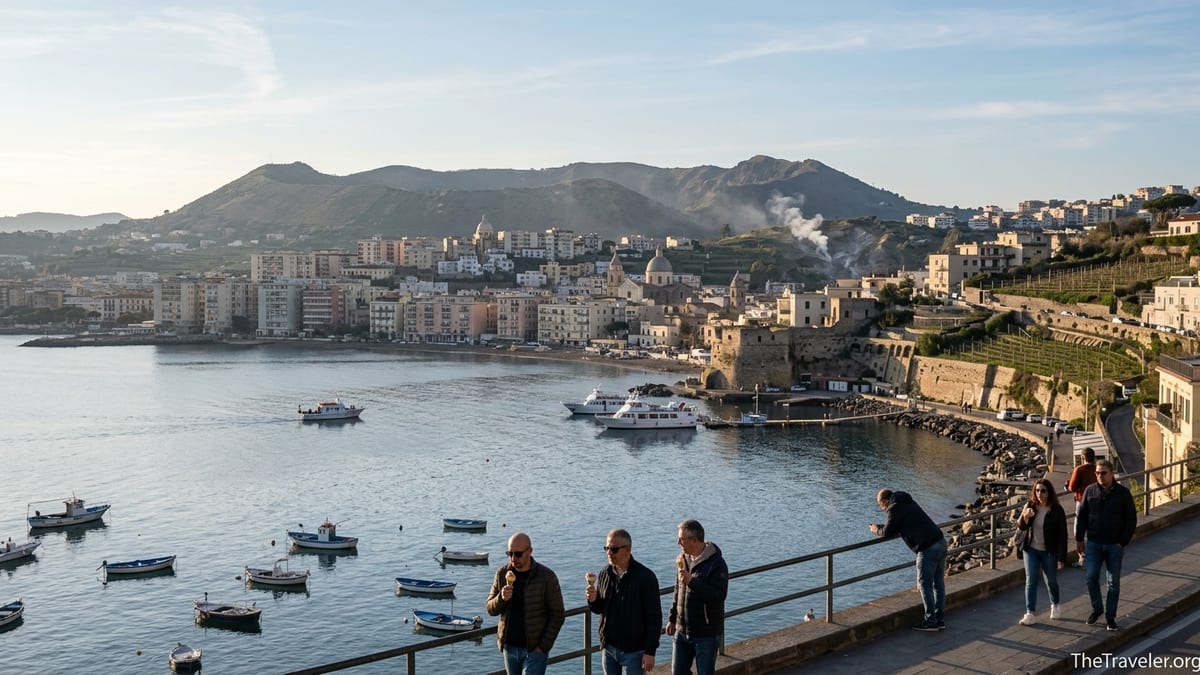
To stand on the seafront in Pozzuoli on a calm evening is to feel very far from catastrophe. Fishing boats bob in the harbour, families stroll for gelato, and teenagers lean against the railings scrolling on their phones. Yet beneath this easygoing Campanian scene lies one of the most closely watched volcanic systems on the planet: the Phlegraean Fields, or Campi Flegrei. Far from being a niche concern for geologists, this restless caldera west of Naples shapes how hundreds of thousands of people live, plan and imagine their future. It is also reshaping how visitors experience one of Italy’s most intriguing cultural landscapes.
Get the latest updates straight to your inbox!
A Restless Supervolcanic Heart Next to Naples
The Phlegraean Fields are not a single cone like Vesuvius but a broad, low-lying caldera that stretches from the western edge of Naples across Pozzuoli, Bacoli and the Tyrrhenian coastline. The landscape looks deceptively gentle: suburban apartment blocks, 1960s housing estates, seaside promenades and low hills dotted with vineyards and citrus groves. Yet this 12–kilometre wide depression was carved by colossal eruptions in prehistory, and today it hosts at least two dozen craters, fumarole fields and bubbling hydrothermal pools hidden between modern roads and railway lines.
Italy’s Civil Protection Department currently classifies the Phlegraean Fields at a yellow alert level, meaning “attention” rather than imminent eruption, but also a clear acknowledgement that the volcanic system is out of its long-term equilibrium. This heightened status, in place since 2012 and periodically reconfirmed, is based on several measurable trends: increased seismic swarms, sustained ground uplift and evolving gas emissions from vents such as the Solfatara crater.
For travellers, this scientific context matters. The area is not a closed danger zone; ferries run from Pozzuoli to Procida and Ischia, trains connect the district to central Naples in under half an hour, and tour guides still lead small groups past hissing fumaroles. But it is a landscape where you might see a civil protection information booth on the same piazza as a Neapolitan pastry shop, and where public loudspeakers or smartphone alerts occasionally punctuate daily life when a notable earthquake hits.
This coexistence of routine and risk is exactly why the Phlegraean Fields still matter so much today. They are a living test case for how densely populated regions worldwide will navigate the overlap between geophysical instability, heritage conservation and everyday urban life.
Bradyseism: When the Ground Itself Breathes
To understand why Campi Flegrei remains front-page news in Italy, you need to understand bradyseism, the slow rise and fall of the ground that has marked the area for centuries. The word describes a kind of “slow earthquake” in which the caldera floor can rise by more than a metre over a decade, then subside again, as fluids and gases move deep underground. This is not theoretical: in the historic marketplace of Pozzuoli, the Macellum, shell marks on ancient marble columns show how the floor has dipped below sea level and then re-emerged multiple times since Roman times.
Since 2005, the Campania Region and the Vesuvius Observatory have documented a new phase of uplift centred under the old Rione Terra district of Pozzuoli, with the ground there rising roughly a metre in less than twenty years. Residents experience this indirectly through frequent small earthquakes, cracked plaster in stairwells and temporary closures of some churches or schools while structural checks are carried out. In May 2024, a magnitude 4.4 event, the strongest in the modern monitoring era, rattled windows across the bay and briefly pushed Campi Flegrei back into international headlines.
For visitors, bradyseism adds a subtle, unsettling layer to the travel experience. You might notice fresh asphalt patches where the road surface has warped, building façades propped with metal braces, or yellow-and-black civil protection posters explaining evacuation routes in hotel lobbies and metro stations. Local restaurateurs in Pozzuoli will casually tell you which recent swarm knocked bottles from their shelves, as if recounting a winter storm. The ground is literally moving under everyone’s feet, and people adapt.
Scientifically, this ongoing uplift is a crucial reason Campi Flegrei matters beyond Italy. Research teams use dense networks of GPS instruments, sea-floor sensors and gas analyzers here to refine models of how magma and hydrothermal fluids pressurise a caldera. Studies published in recent years have even used machine learning to detect previously missed micro-earthquakes, revealing a ring-shaped fault structure beneath Pozzuoli. These advances help volcanologists worldwide interpret unrest signals at calderas in places as far apart as New Zealand, Japan and the Andes.
Culture, Myth and the Gate to the Underworld
Long before anyone could measure uplift in millimetres per year, people sensed that the Phlegraean Fields were different. The ancient Greeks founded the colony of Cumae here in the 8th century BC, choosing this geologically active coastline as their first foothold in mainland western Europe. For them, the sulphurous vapours rising from the crater of Solfatara and the dark, still waters of Lake Avernus were tangible portals to a supernatural realm.
Roman writers picked up the theme and amplified it. Virgil’s Aeneid places the entrance to the underworld on the wooded shores of Lake Avernus, and myths tell how Hercules dammed nearby Lake Lucrinus. Roman engineers, less concerned with myth than with comfort, channelled the region’s hot springs into luxurious bath complexes at Baiae, turning Campi Flegrei into a playground for emperors and senators. The ruins of those seaside villas now lie partly submerged off Bacoli, where local dive operators offer guided underwater archaeology trips among collapsed columns and mosaic fragments.
This layering of mythology, imperial leisure and modern suburbia is what makes a simple bus ride through Pozzuoli and Bacoli so striking. A commuter could pass, in the space of a few stops, from a nondescript concrete housing block to the entrance of the Flavian Amphitheatre, Italy’s third largest Roman arena, and then on to steaming fumaroles at the Astroni crater, now a nature reserve. In Baiae, a modern marina and seafood restaurants overlook a shoreline that has moved dramatically due to bradyseism, swallowing and then revealing the foundations of temples and bathhouses.
For contemporary Italy, this heritage has economic as well as symbolic weight. A weekend visitor from Rome might book a room in a Pozzuoli boutique hotel that markets itself on panoramic views across the caldera, dine in a restaurant that serves local Falanghina and Piedirosso wines grown on volcanic soils, and finish the evening in a Roman-era cistern such as the ethereal Piscina Mirabilis, now a sight featured regularly in travel magazines. Volcanic risk management must now grapple not only with protecting residents, but also with safeguarding this layered cultural capital.
Monitoring, Evacuation Plans and Everyday Life
The Phlegraean Fields have become one of the best-instrumented calderas in the world. The Vesuvius Observatory in Naples maintains 24-hour monitoring of seismic activity, ground deformation, gas emissions and temperature changes, feeding data in real time to Italy’s Civil Protection Department. When sequences of tremors intensify, scientists and civil protection officials hold urgent video conferences to assess whether the unrest marks a continuation of the long-running pattern or a qualitative shift requiring new measures.
From a traveller’s perspective, this monitoring is largely invisible but occasionally palpable. On some days, a noticeable tremor might trigger push notifications from Italian news outlets, and you could see live interviews with volcanologists on café televisions. In schools and public offices, periodic evacuation drills rehearse how people would leave in the unlikely event of a major crisis, and those same routes are printed on laminated maps that hotel staff can show you if you ask.
A defining feature of Campi Flegrei’s significance is its national evacuation planning. The official red zone, where people would be evacuated before an explosive eruption, includes densely populated districts of Pozzuoli and western Naples. Authorities have mapped which regions of Italy would temporarily host evacuees, from Puglia to Tuscany, and they periodically test communication systems, including IT-alert messages sent directly to mobile phones. In 2024 and 2025, families in neighbourhoods like Monterusciello took part in civil protection exercises that involved boarding buses and travelling along designated outbound routes, a dry run for a scenario everyone hopes will never materialize.
All of this turns Campi Flegrei into a laboratory for what disaster preparedness looks like in a modern democracy. Officials must balance frank communication about risk with reassurance that an eruption is not considered imminent. Shopkeepers need to keep their businesses viable despite occasional news cycles that portray the area as a ticking time bomb. Visitors, for their part, are learning to fold basic risk awareness into their itineraries, much as travellers to Japan or California might check earthquake guidance without cancelling a trip.
A Unique Tourism Experience on the Edge of Risk
Rather than deterring tourism, the Phlegraean Fields’ volatile reputation is gradually reshaping the kind of traveller who comes. This is not the polished, high-volume circuit of the Amalfi Coast, but a more curious, slow-travel audience that wants to understand how people live with an active caldera. They might stay in a modest guesthouse in Pozzuoli’s old town, eat grilled octopus on the lungomare while watching ferries glide toward Ischia, and then spend the next morning visiting both Roman remains and steaming vents.
Tour operators and local guides increasingly weave science into their storytelling. A walk through the Solfatara area is not only a tour of hot mud pools and hissing fumaroles but also a primer on gas monitoring stations and why certain sectors remain fenced off following increased activity. At archaeological parks such as Cumae or Baiae, bilingual panels explain how bradyseism has submerged and re-exposed ancient structures. Even wine tastings at small estates above Bacoli often include an explanation of how volcanic ash enriches the soil.
The emotional tenor of a trip here can be surprisingly reflective. Recent photojournalism and travel reportage have highlighted the contrast between grandmothers playing cards in sunlit courtyards, teenagers taking selfies with smoking vents in the background, and civil defence buses idling in squares during drills. A visitor strolling through a residential piazza might see children practising evacuation routes with their teachers in the morning, then watch those same children ride bicycles through the same streets in the golden evening light.
This blend of the ordinary and the existential is precisely what gives Campi Flegrei such narrative power. For travel writers, it has become a place to explore big questions about living with uncertainty: how much risk is acceptable, what it means to “belong” in a landscape that could change quickly, and how a community tells its own story when outside media periodically frame it as an impending disaster zone.
Why Campi Flegrei Matters Far Beyond Campania
From a geological standpoint, the Phlegraean Fields are a reference point for understanding caldera unrest worldwide. Because the area has been monitored intensively for decades, scientists can correlate patterns of uplift, seismic swarms and gas changes with on-the-ground impacts such as cracked buildings or road damage. This makes the caldera a natural laboratory for testing models that may one day inform decisions in places like Yellowstone in the United States or Aso in Japan.
Recent research here has emphasised that not all signs of unrest point clearly toward an eruption and that some signals, like widespread shallow earthquake swarms, may be driven mainly by pressurised hydrothermal systems rather than rising magma. For policymakers in other volcanic regions, the Campi Flegrei experience underscores how complex the decision to order a mass evacuation can be, particularly when millions of people live within potential impact zones.
Societally, Campi Flegrei has become a case study in risk communication. Surveys conducted over the past two decades show that residents’ perception of danger shifts in response to both scientific bulletins and media coverage. After notable events such as the 1980s bradyseismic crisis, when tens of thousands of people were temporarily evacuated from Pozzuoli, or the strong 2024 earthquake, anxiety tends to spike and then taper as months pass without major consequences. Authorities now invest heavily in community outreach, from open days at the Vesuvius Observatory to information stands at local festivals where civil protection staff explain, in straightforward language, what different alert levels mean.
For travellers, all of this leaves a tangible impression. Visiting Campi Flegrei becomes less about ticking off sights and more about witnessing how a modern European region is negotiating its future in the shadow of a restless caldera. Conversations in cafés might turn, unprompted, to questions of insurance, house values, or whether younger generations will stay if seismic swarms intensify. In this way, a trip here provides a ground-level view of issues that will increasingly define life in many hazard-prone regions worldwide.
The Takeaway
The Phlegraean Fields still matter, and not only because every tremor here prompts another round of speculation about Italy’s “supervolcano.” They matter because this caldera, sprawling quietly west of Naples, concentrates some of the central challenges of the 21st century: living with natural hazards in dense urban regions, protecting cultural heritage as the ground shifts beneath it, and finding a balance between alarm and denial.
For Italy, Campi Flegrei is both a responsibility and an asset. It demands constant scientific vigilance, careful evacuation planning and honest dialogue with residents who must weigh emotional connection to place against long-term risk. At the same time, it offers a magnetic landscape where myth, history and volcanology intersect in daily life, drawing visitors who are willing to look beyond postcard Italy and engage with a more complex story.
For travellers, the lesson is not to avoid the Phlegraean Fields, but to approach them with curiosity and respect: to read the civil protection leaflets in your hotel as carefully as the wine list at dinner, to walk the Roman ruins with an awareness that the shoreline might not always be where it is today, and to listen when locals share their own experiences of living on shifting ground. In doing so, you become part of the ongoing narrative of a place that, perhaps more than almost any other in Italy, reminds us that the Earth beneath our feet is alive.
FAQ
Q1. Is it safe to visit the Phlegraean Fields right now?
Italian authorities currently consider tourism acceptable in the Phlegraean Fields, provided visitors follow local guidance. The alert level is raised, but there is no order to leave and everyday life continues. Travellers should stay informed through official civil protection channels and follow any instructions given by local authorities or accommodation providers.
Q2. How likely is a major eruption at Campi Flegrei in the near future?
Scientists emphasise that while the caldera is in a phase of unrest, a major eruption in the near term is not considered likely based on current data. What is more probable is the continuation of uplift and small to moderate earthquakes. Forecasting exact timelines for eruptions is not possible, so authorities focus on monitoring and preparedness rather than prediction.
Q3. What should I do if an earthquake occurs while I am in Pozzuoli or nearby?
If you feel a tremor, follow standard earthquake safety advice: move away from windows and items that could fall, take cover under a sturdy table if indoors, and avoid stairs and lifts until shaking stops. Afterwards, listen for announcements from civil protection and check whether trains, ferries or local roads have been temporarily suspended for inspections.
Q4. Are attractions like Solfatara and Baiae always open?
Access to specific sites can change depending on safety assessments. Some areas of Solfatara, for example, have been periodically closed or restricted after past incidents and in response to increased fumarole activity. Archaeological areas such as Baiae and Cumae can also close temporarily after strong quakes for structural checks. It is wise to confirm opening conditions locally shortly before you plan a visit.
Q5. How does bradyseism affect daily life for residents?
Bradyseism brings frequent minor earthquakes, gradual deformation of streets and buildings, and occasional temporary evacuations or reinforcements of structures. Residents may deal with recurring repairs, civil protection drills and uncertainty about long-term housing stability. At the same time, schools, markets, cafés and public transport generally operate as normal, and many people choose to stay because of family ties and work.
Q6. Do I need special insurance to travel to the Phlegraean Fields?
Most standard travel insurance policies that cover Italy include the Campania region, but coverage for natural disasters and trip disruption can vary. Before travelling, check whether your policy includes interruptions due to earthquakes or civil protection orders. If not, consider upgrading to a plan that explicitly covers natural hazard-related cancellations or delays.
Q7. How can I stay informed about volcanic activity while I am there?
In Italy, national and regional civil protection agencies, together with the Vesuvius Observatory, issue regular updates through official channels and local media. While you are in the area, pay attention to notices posted in hotels, train stations and municipal offices, and ask your hosts how alerts are communicated. Italian TV news and radio also provide quick coverage when notable tremors occur.
Q8. Are there guided tours that explain the geology in an accessible way?
Yes. In Pozzuoli, Bacoli and nearby towns, local guides and small tour companies offer walks that combine visits to fumaroles, craters and Roman remains with straightforward explanations of the caldera’s behaviour. Some tours are led in collaboration with science communicators or staff from local observatories, and many can be booked through visitor centres or directly with licensed guides in town.
Q9. How does Campi Flegrei compare with Vesuvius for visitors?
Vesuvius offers a classic cone-shaped summit walk and sweeping views over the Bay of Naples, while Campi Flegrei is more diffuse and lived-in, with craters, ruins and residential districts mingling together. The experience in Campi Flegrei feels less like a day trip to a single volcano and more like immersion in a complex landscape where everyday urban life, archaeology and ongoing geological unrest intersect.
Q10. What can responsible travellers do to support local communities here?
Responsible visitors can choose locally owned accommodation and restaurants, hire licensed local guides, and respect any access restrictions around fumaroles or unstable ruins. Taking civil protection advice seriously, rather than treating it as a curiosity, also supports community efforts to normalise preparedness. Finally, sharing balanced impressions of the area when you return home can help counter sensationalist narratives that focus only on disaster scenarios.