


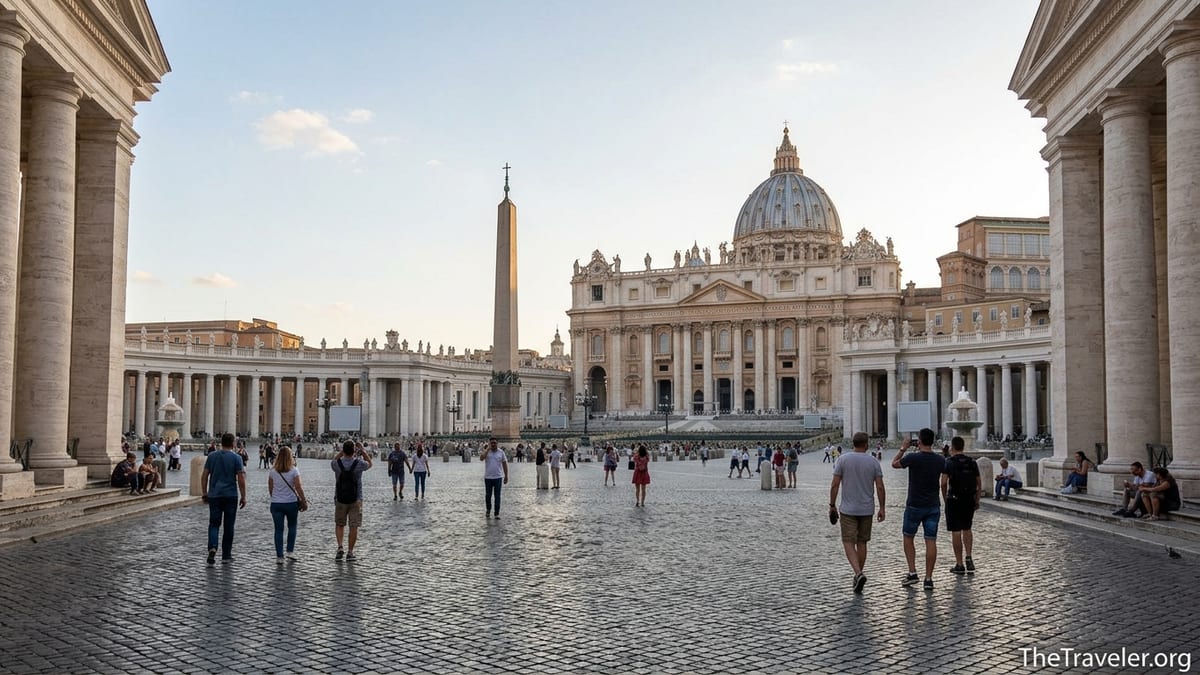
The first time I walked into St Peter’s Square, I expected the usual postcard moment: basilica dome, Egyptian obelisk, a few tour groups, maybe a nun on a bicycle. Instead, I found myself in a space so vast and carefully choreographed that my sense of Vatican City shifted in a single glance. The world’s smallest independent state suddenly felt anything but small. It was in that ellipse of cobblestones, ringed by Bernini’s famous colonnades, that I finally understood the true scale of the Vatican.
Get the latest updates straight to your inbox!
When “The World’s Smallest Country” Stops Feeling Small
On paper, Vatican City is easy to dismiss. At roughly 0.44 square kilometers, it is smaller than many urban parks and often described as a curiosity of international law rather than a place with physical presence. You read that the whole country is tucked inside Rome’s western bank and assume it will feel like an annex, a historic cul-de-sac tacked onto the city.
Then you step through security from Via della Conciliazione and the space suddenly opens. St Peter’s Square stretches about 320 meters long and roughly 240 meters wide at its broadest point, a stone ellipse that can hold tens of thousands of people. The cobblestones, the colonnades, and the façade of the basilica all pull your eye outward and upward. In an instant, the abstract statistic about the Vatican’s size becomes irrelevant. What matters is that you are standing in one of the most expansive urban rooms in Europe.
That contrast is what surprises so many first-time visitors. They walk in expecting a miniature state and find instead an architectural statement designed for crowds the size of small cities. It explains how this tiny place can host major events like Easter Mass, papal funerals, or a World Youth Day vigil, when the square becomes a human sea of flags and candlelight. The country might be small on a map, but this plaza is built for global gatherings.
Even on an ordinary weekday morning, when the only drama is the shuffle of tour groups and the occasional tolling of bells, St Peter’s Square feels large enough to reset your sense of proportion. The moment you register just how far you would have to walk from one colonnade to the other, the cliché of the Vatican as a pocket-sized nation stops making sense.
Bernini’s Embrace: Reading the Colonnades With Your Feet
From afar, the colonnades framing St Peter’s Square can look almost delicate, a froth of stone columns curving politely around the ellipse. Step closer and you discover their true scale. Each of the Doric columns is around 13 to 16 meters high, and there are 284 of them in four deep rows, forming a monumental portico that can swallow entire tour groups under its shadow. On top, 140 larger-than-life statues of saints look down, each one taller than most visitors.
Gian Lorenzo Bernini, the 17th century architect behind the design, intended the colonnades to be more than decoration. He famously described them as outstretched arms: the church extending an embrace to Catholics, doubters, and the curious alike. You feel that symbolism physically when you cross the square. The further you walk into the center, the more you sense the curve closing in around you, not in a claustrophobic way but as if the space were guiding you toward the obelisk and basilica.
One of the most striking real-world tricks is hidden in the paving near the fountains. Look for a small white marble disk set into the cobblestones between the colonnades and the obelisk. Stand on it and look across the square: the four rows of columns on that side suddenly align so perfectly that they appear as a single line. Guides love to point this out, and it is worth trying yourself. In one step, you move from a blur of stone to a razor-straight arcade, an optical illusion Bernini built to show off his mastery of perspective.
For many travelers, this simple act of standing on a marked spot becomes a quiet revelation. You realize the square is not just big; it is precisely calibrated. The distance from the obelisk to the fountains, the spacing of the columns, even the slight inward tilt of the trapezoidal forecourt directly in front of the basilica all serve a purpose. The Vatican’s scale is not accidental. It is measured in Roman palms and liturgical processions as much as in modern square meters.
The Obelisk and the Dome: Vertical Scale in a Tiny State
The strongest lesson in vertical scale sits at the very center of St Peter’s Square. The Egyptian obelisk, carved from red granite and moved to its present location in the late 16th century, stands about 25 meters tall. With its base and cross, it reaches close to 40 meters into the air. On the ground, it is already imposing enough that most visitors pause for a photograph without quite registering the numbers.
Now draw your gaze beyond it to the façade of St Peter’s Basilica and the famous dome. The façade alone is a multi-story wall of travertine that dwarfs the obelisk. The dome, designed in large part by Michelangelo, rises to over 130 meters at its peak. When you first see the obelisk framed against the dome from the center of the square, the effect is like watching a small skyscraper lined up against a much taller one. The eye jumps back and forth, recalibrating.
This vertical dialogue matters because it underscores how the Vatican uses height to amplify space. The country may not sprawl horizontally, but its key monuments reach for the sky. Visitors who take the elevator and then the narrow stairs up into the dome often report that the experience shifts their mental map of the Vatican completely. You emerge onto the viewing terrace and suddenly see the square as an enormous stone compass below, the colonnades wrapping almost 360 degrees around the obelisk, with Rome’s apartment blocks spreading out beyond the walls.
From up there, everyday details give the numbers meaning. On a typical morning, you might count the lines of pilgrims fanning out from the security checkpoint, see clusters of umbrellas marking tour groups, and watch the slow movement of people tracing the curve of the colonnade. The crowds look small from such height, yet they fill an architectural frame that can accommodate more than you might expect of a state often compared in size to a golf course.
Crowds, Ceremonies, and the Human Scale of the Square
To understand how St Peter’s Square operates at full scale, it helps to visit on two different days. One might be a quiet Tuesday afternoon in November, when security waits are brief and the square feels generous, full of space between scattered visitors. The other should be a Wednesday morning or a Sunday at noon, when a papal audience or Angelus is scheduled and the space becomes an open-air congregation.
On an audience day, barriers appear almost magically, channelling the square into sectors. Metal detectors multiply. Loudspeakers test their echoes against the stone. Around mid-morning, coaches from across Italy and beyond spill out pilgrims and tourists who merge into the already forming crowd. The vast ellipse begins to feel smaller as bodies fill in the gaps. Yet even with tens of thousands of people in attendance, there is still room to breathe beneath Bernini’s colonnades.
For travelers, these shifts in density are a practical lesson in how scale is experienced. The same square that feels almost meditative under a winter drizzle can feel compact and intimate when flags, banners, and singing groups claim every corner. It explains why some visitors describe the Vatican as overwhelming, while others insist it is surprisingly manageable. Both are right, depending on when you show up and how far into the crowd you wade.
These crowd patterns also influence how long you will spend there. On a low-season weekday, you might linger on the steps of the basilica, studying the statues of Christ and the apostles above the façade, before strolling across the square to sit by a fountain. On a spring Sunday during a jubilee year or major event, you may find yourself slowly inching forward shoulder to shoulder for an hour or more, the obelisk and papal window serving as your only landmarks in a sea of people.
From Square to State: How Your Feet Trace Vatican City’s Outline
What many visitors do not realize until they are in St Peter’s Square is how closely the plaza’s footprint aligns with the borders of the state itself. Look toward the far ends of the colonnades, where they almost touch the street. Just beyond them, discreet yellow and white boundary markers and a low stretch of stone indicate the line between Italy and the Vatican. Stand in the center of the square and you are only a short walk from leaving the country in any direction.
This proximity becomes clear when you plan a full Vatican day. A typical itinerary might combine the Vatican Museums and Sistine Chapel in the morning and St Peter’s Basilica and square in the afternoon. The museums entrance, on Viale Vaticano along the northern edge of the state, can be a 15 to 20 minute walk from the square at a relaxed pace. Many travelers are surprised that it takes that long in a country whose entire boundary could, in theory, be circled in under an hour by a determined walker.
Timed-entry tickets for the Vatican Museums, now common and strongly recommended in busy months, make this geography even more tangible. An 8:30 a.m. entry slot means joining a well-organized but sometimes lengthy security line outside the walls. Standard online tickets for adults are often in the range of 20 euros plus a reservation fee, with “fast track” options from private companies costing more. Once you are inside, the galleries and the Sistine Chapel can easily absorb three hours or more, and the exit leads you back toward the heart of Vatican City, within walking distance of St Peter’s Square.
By late afternoon, when you emerge from the museums and cross back into the square, you have physically traced much of the outline of the world’s smallest nation. The realization hits that you have moved from one side of a country to the other in a few thousand steps, yet those steps have taken you past priceless collections, papal palaces, gardens you cannot see, and the administrative core of an institution that shapes lives far beyond its walls.
Practical Ways to Experience the Square’s Scale
The most insightful encounters with St Peter’s Square often come from slowing down rather than sprinting between sights. Arriving early, before 8 a.m., allows you to see the square breathe awake. Street sweepers finish their circuits, Swiss Guards change posts, and the first groups of visitors drift in under a softer light. In these quieter moments, standing near one of the two fountains and listening to the water, you can appreciate the sheer distance between the colonnades without the distraction of crowds.
Midday offers a different lesson. The Roman sun, especially between May and September, can be unforgiving on the open cobblestones. Travelers quickly discover why seasoned guides recommend carrying water and a hat. The open nature of the square, so beautiful in photographs, means there is limited shade away from the colonnades. Lines for the basilica’s security checks can snake across the plaza, turning the space into a heat trap in high summer. Booking a timed entry product that uses a separate, shorter security queue, or visiting later in the afternoon when the sun begins to dip, can make the experience far more comfortable.
One of the simplest yet most rewarding walks is to start at the far end of Via della Conciliazione and slowly approach the square. As you move closer, the dome seems to grow and shift against the sky. Once you pass through the security machines and step fully into the oval, pause and turn around. The view back toward Rome makes it clear how the Vatican both belongs to the city and stands apart from it, framed by the great stone arms of the colonnade.
If you have the time and energy, pair your exploration of the square with the dome climb. Tickets for the dome, which you can book in advance for specific time slots, usually offer a choice between taking an elevator part of the way or climbing entirely on foot. The elevator option still requires negotiating narrow, sloping staircases near the top. The reward is a view that puts everything you have just walked through into perspective: the square, the colonnades, the Vatican gardens, and the densely packed rooftops of Rome beyond.
The Takeaway
Standing in St Peter’s Square alters how you understand Vatican City because it confronts you with a paradox. On one side, the numbers are small: less than half a square kilometer of territory, only a few main public sites, a state that can disappear into a thumbnail on your phone’s map. On the other, the physical reality of the square is undeniably grand. It is a space built to receive the world, to accommodate history’s surges of pilgrims and onlookers, and to project a sense of continuity and authority that reaches far beyond its walls.
For travelers, absorbing that difference changes the way you move through the rest of your visit. You are more likely to linger under the colonnades, to notice the slope of the paving stones, to respect the time it takes to cross from the museums to the basilica or to navigate security lines that look deceptively short against such a large backdrop. The Vatican stops being a checklist of separate attractions and becomes, instead, a tightly woven urban landscape whose scale you have felt with your own body.
Long after you leave Rome, it is often that first moment in the square that stays with you: the sudden opening of space, the ring of stone columns, the obelisk aligning with the dome. It is the instant when the smallest country in the world steps out of the realm of statistics and reveals its true, carefully constructed magnitude.
FAQ
Q1. Is St Peter’s Square free to enter?
Yes. Entry to St Peter’s Square and to St Peter’s Basilica itself is free, although you must pass through airport-style security checks to reach the square and church.
Q2. How much time should I plan to spend in St Peter’s Square?
Most visitors spend 30 to 60 minutes in the square, but you may want longer if you are photographing the architecture, waiting for a papal appearance, or simply people-watching.
Q3. When is the best time of day to visit St Peter’s Square?
Early morning or late afternoon are usually the most pleasant, with softer light and fewer crowds. Midday can be very hot and busy, especially in late spring and summer.
Q4. Do I need a ticket to attend a papal audience in the square?
Tickets for weekly papal audiences are free but required and must be obtained in advance through official channels. On the day, you still pass through security, and seats are first come, first served.
Q5. Can I visit St Peter’s Square and the Vatican Museums on the same day?
Yes. Many travelers visit both on the same day, typically booking timed-entry tickets for the museums and then walking to the square and basilica, which are about 15 to 20 minutes away on foot.
Q6. How long are the security lines to enter St Peter’s Basilica from the square?
Wait times vary widely. In low season you might wait 10 to 20 minutes, while in peak season or before major liturgies the line can stretch across the square and take 45 minutes or more.
Q7. Is there shade in St Peter’s Square?
Most of the square is exposed, with limited shade except under the colonnades. In warmer months, bring water, sun protection, and consider timing your visit to avoid the midday sun.
Q8. Can I climb the dome of St Peter’s Basilica from the square?
Yes. Access to the dome is from inside the basilica, which you enter from the square. Dome tickets are paid and can be reserved for specific times; the climb involves stairs and some narrow passages.
Q9. Are there restrooms or cafes in St Peter’s Square?
There are basic restroom facilities and small services nearby, but options inside the immediate square are limited. Many visitors use facilities around Via della Conciliazione or near the Vatican Museums.
Q10. Is St Peter’s Square accessible for travelers with limited mobility?
The square itself is relatively flat with cobblestone paving, and wheelchairs can navigate it, though the stones can be uneven. Reserved areas and assistance are generally available during major events, but it helps to arrive early.