


More news on this day
The U.S. Department of State has issued an updated Worldwide Caution security alert, urging American citizens traveling or living overseas to exercise increased vigilance amid elevated global tensions, ongoing conflicts and a fluid international security environment.
Get the latest news straight to your inbox!
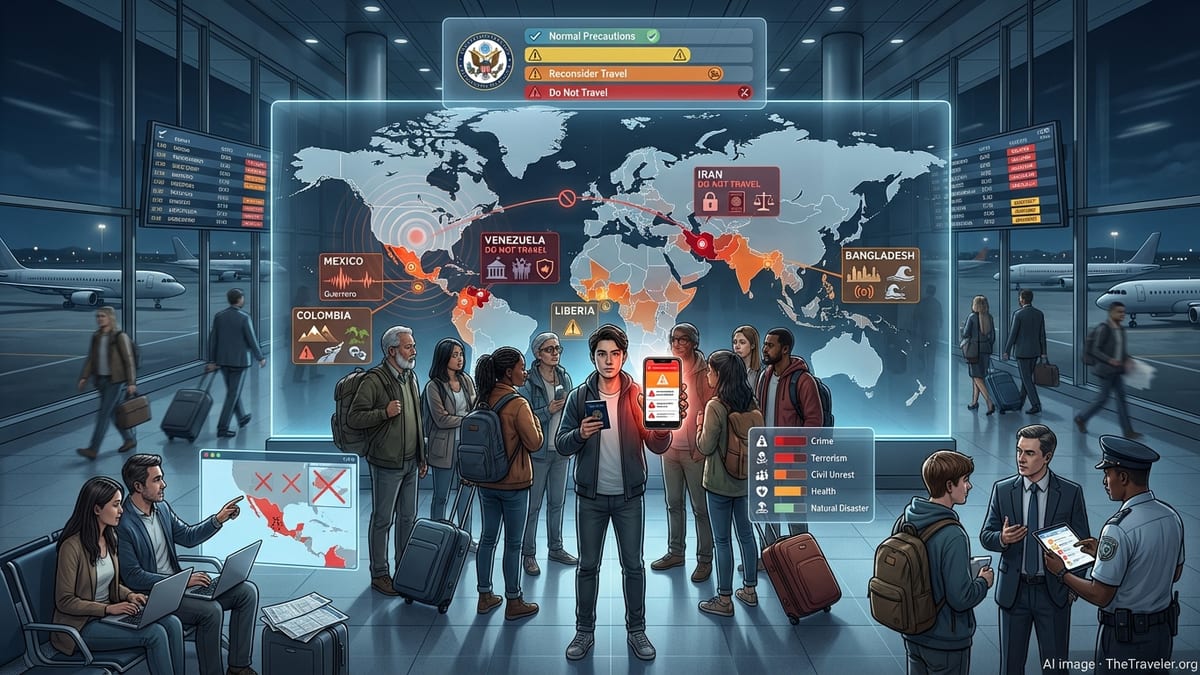
Latest Worldwide Caution Highlights Heightened Global Risk
The renewed worldwide warning, updated in late July 2026, outlines a broad spectrum of potential threats facing U.S. citizens abroad, including terrorism, political violence, unrest and targeted actions against sites linked to the United States. The advisory underscores that incidents can occur with little or no warning, particularly in public spaces and areas popular with travelers.
Publicly available information from the State Department’s travel advisory portal indicates that Americans are being asked to exercise increased caution worldwide, not only in specific conflict zones. The language mirrors earlier global alerts issued during periods of heightened tension, including the Israel Hamas conflict and other crises that drew protests and security responses in multiple regions.
While the Worldwide Caution is not a ban on travel, it functions as an overarching security notice layered on top of country specific advisories. The alert frames the current period as one in which risks may be elevated in diverse destinations, from major urban centers to transit hubs and tourist sites.
Travel industry observers note that similar worldwide alerts have been issued in past years during spikes in geopolitical tension or major terrorist incidents, but the latest warning comes after an extended period of overlapping conflicts and political volatility in several regions.
How the Global Warning Interacts With Country-Level Advisories
According to the State Department’s advisory system, the Worldwide Caution sits alongside the four tiered country ratings that range from normal precautions to “do not travel.” The global alert does not automatically change those underlying levels, but it does signal that travelers should read individual advisories more carefully and factor in the possibility of rapid developments.
Recent country specific notices show a patchwork of conditions. Some destinations remain at Level 1 or Level 2, where officials recommend either standard or increased caution. Others, including parts of the Middle East and selected conflict zones, are listed at Level 3, urging travelers to reconsider trips, or Level 4, advising against travel due to armed conflict, terrorism, civil unrest or limited consular access.
Security analysts point out that this layered approach allows the government to maintain detailed guidance for individual countries while also acknowledging that broader trends, such as transnational terrorism or regional spillover from conflicts, can affect Americans far beyond a single hotspot. For travelers, that means the new Worldwide Caution should be read in tandem with destination specific information rather than in isolation.
Travelers planning multi country itineraries are being encouraged by publicly accessible guidance to review each stop on their route, since a trip that combines low risk and higher risk countries may involve sharply different security environments and contingency planning needs.
Key Risk Scenarios Cited for U.S. Travelers Abroad
The updated Worldwide Caution points to several types of potential incidents that could affect U.S. citizens. Terrorism and violent extremism remain central concerns, particularly attacks targeting transport hubs, hotels, tourist attractions, places of worship and large public gatherings. Recent State Department materials on terrorism risk emphasize that such attacks can occur with no prior warning and may be designed to draw global attention.
The alert also references the possibility of demonstrations and civil unrest, including events that may emerge quickly in response to developments in ongoing conflicts or political disputes. Even when travelers are not the direct target, disruptions can affect airport operations, local transportation, and access to key services, posing indirect safety and logistical challenges.
Another area of focus is the risk of opportunistic crime and kidnapping in high risk areas, where weakened local security or strained public services can create openings for criminal groups. In some locations, limited U.S. diplomatic presence or security restrictions on U.S. personnel may reduce the government’s ability to provide in person assistance to citizens in distress.
Health emergencies, natural disasters and cyber incidents are also cited across State Department global events pages as potential disruptors for international travel. While these hazards are not new, the worldwide alert reminds travelers that multiple types of crises can overlap, complicating evacuation routes, communications and access to medical care.
Recommended Steps for Americans Planning International Trips
Public guidance associated with the Worldwide Caution outlines a set of practical measures for Americans who still plan to travel. Travelers are urged to review the full Travel Advisory for each destination, check recent security alerts from nearby U.S. embassies or consulates, and stay informed about local news in the period leading up to and during a trip.
One of the most frequently cited tools is the Smart Traveler Enrollment Program, or STEP, which allows U.S. citizens to register their travel plans and receive email updates about security developments in the countries they are visiting. Enrollment also provides a channel for U.S. missions abroad to contact citizens more easily during emergencies.
Security recommendations presented on official platforms stress situational awareness as a core habit. Travelers are encouraged to identify emergency exits in public venues, maintain a low profile where appropriate, vary daily routines, and avoid openly displaying items that may draw attention, such as expensive jewelry or prominently branded items associated with the United States.
Basic preparation steps such as sharing a detailed itinerary with family or friends, carrying copies of important documents, and understanding how to reach the nearest U.S. embassy or consulate can further reduce risk. The Worldwide Caution frames such measures as part of routine travel planning during a period of elevated global uncertainty.
What the Worldwide Warning Means for Tourism and Travel Decisions
For the global travel industry, the State Department’s renewed Worldwide Caution arrives at a time when international tourism has largely rebounded from pandemic era disruptions, but faces new headwinds from regional conflicts and economic pressures. Airlines, tour operators and hotels are monitoring advisories closely as they evaluate route planning and guest safety protocols.
Industry commentators note that many Americans are likely to continue traveling abroad, but may adjust their destination choices, insurance coverage and on the ground behavior in light of the alert. Some travelers could postpone trips to higher risk regions while maintaining plans for destinations perceived as more stable, even within the context of a global caution.
Travel insurers and corporate travel managers are also weighing the implications of the worldwide warning, reviewing policies on evacuations, trip cancellations and duty of care for employees on international assignments. In prior periods with similar alerts, companies have in some cases revised travel approval processes or required additional pre departure briefings for staff.
The Worldwide Caution does not specify an end date, and previous iterations have remained in place for extended periods with periodic revisions as conditions evolve. For now, the message to U.S. citizens is that international travel remains possible, but requires more deliberate preparation, closer attention to local developments and a willingness to adapt plans if the security picture changes.