


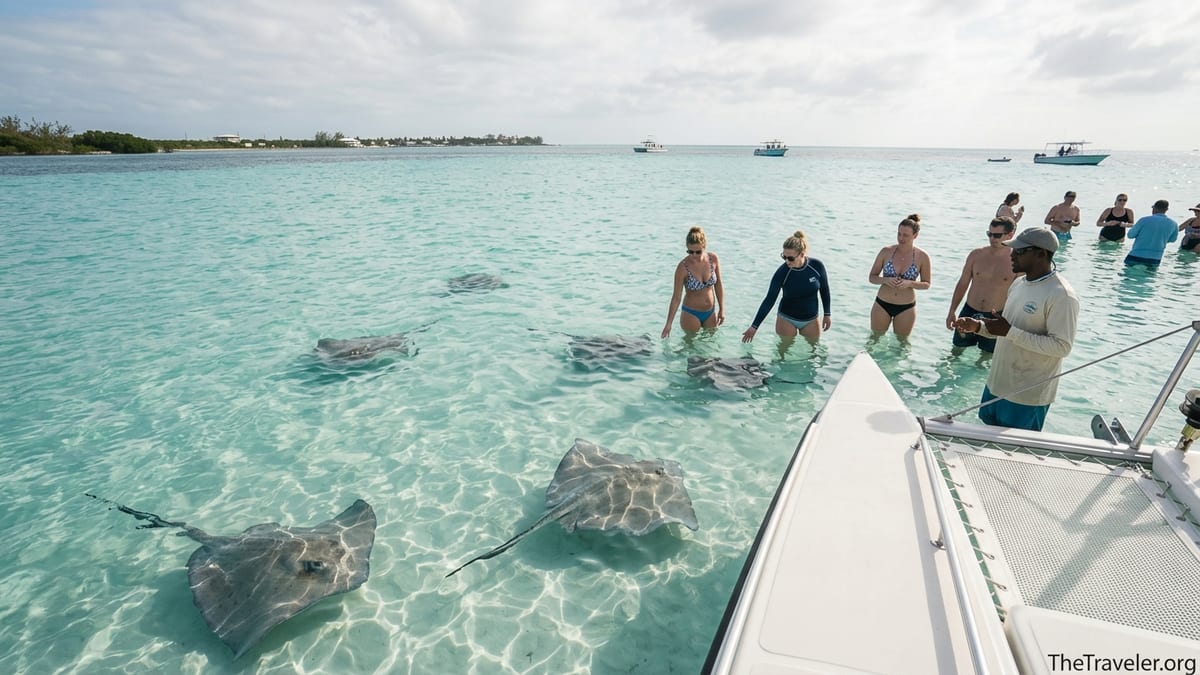
Standing in waist-deep turquoise water while wild southern stingrays glide around your legs is one of Grand Cayman’s defining travel experiences. Stingray City, a shallow sandbar in the island’s North Sound, remains a rare place where you can safely and responsibly interact with marine life in crystal-clear Caribbean water. This guide explains where Stingray City is, what the sandbar experience is really like, who will enjoy it most, and how to plan a smooth visit around time in George Town or along Seven Mile Beach.
Get the latest updates straight to your inbox!
Understanding Stingray City and the North Sound
Stingray City is not a single beach but a series of shallow sandbars in the protected North Sound lagoon on the north side of Grand Cayman. The lagoon is sheltered by a barrier reef, so the water is usually calm, shallow and clear, making it ideal for small boats and first-time snorkelers. Most visitors are headed to the famous sandbar section, where the depth is typically around 3 to 4 feet for adults at low to mid tide and a little deeper for shorter travelers or children.
The North Sound itself is a broad bay carved into the middle of Grand Cayman, bordered by mangroves and low-lying coastline. It is accessible from marinas near Seven Mile Beach and West Bay, from George Town’s cruise port via short transfers, and from quieter areas like Rum Point and Kaibo on the island’s North Side. Operators describe the ride from these marinas out to the sandbar as generally 20 to 30 minutes by boat, passing over bright sand patches and darker seagrass beds where you may spot sea turtles or eagle rays.
Stingrays began congregating in the North Sound decades ago when local fishermen cleaned their catch in the sheltered water and discarded scraps overboard. Southern stingrays learned to associate the sound of engines and boats with an easy meal, and over time the sandbar became a dependable feeding ground. Today, regulated tours bring visitors to interact with these wild stingrays in a controlled Wildlife Interaction Zone that the Cayman Islands Department of Environment monitors closely for animal welfare.
There are actually two main areas often discussed under the “Stingray City” name. The most popular is the shallow Stingray Sandbar, where nearly everyone can stand on the sandy bottom. A second, deeper site sometimes called “Deep Stingray City” is more appropriate for divers and confident snorkelers. When you book, make sure you are reserving a trip that specifically mentions the sandbar if your group includes children, non-swimmers, or anyone who prefers to stand rather than float in deep water.
What the Sandbar Experience Is Really Like
On a typical tour, you board a small powerboat or catamaran with 20 to 50 guests, depending on the operator and vessel size. Many tours leave from Safehaven Marina, the Cayman Islands Yacht Club, or Camana Bay for resort guests staying on the Seven Mile Beach corridor, while cruise passengers usually meet directly at the George Town tender terminal before a quick shuttle to the dock. Once underway, the crew uses the ride to explain how to move in the water, how to safely interact with stingrays, and why certain rules, such as shuffling your feet and avoiding sudden grabs, exist.
When the boat arrives at the sandbar, you will notice a cluster of other vessels moored in a line, each with small groups gathered around. From the deck, the water looks almost surreal, a pale turquoise plate with dark shadows gliding underneath. These shadows are the southern stingrays, some with wingspans approaching 1.2 to 1.5 meters, circling as they wait for the daily arrival of tour boats. Most operators provide snorkel vests for weaker swimmers, and the crew will check the depth and conditions before inviting guests into the water.
Once you step down the ladder or off the stern platform, your feet sink lightly into soft sand. The water lifts around your waist or chest depending on your height and tide. Within moments, the stingrays swim close, brushing against your legs and often sliding over your feet as they search for pieces of squid that the guides hold. Many tours give guests the chance to gently hold a stingray on the surface for a brief photo, always supported by a guide who cradles the animal’s body and reminds guests to keep fingers away from the underside where the mouth is located.
The overall in-water time at Stingray City is usually around 30 to 45 minutes. In practice, that feels full: you will have time to watch the rays from a distance, then grow bolder, pet their silky, rubbery wings, and possibly offer food under supervision. Some small-group or private charters may stay longer when crowds thin, especially in late afternoon trips. Many combo tours also include stops at Coral Gardens or a patch reef for snorkeling among tropical fish, and at Starfish Point, a shallow sandbar closer to Rum Point where large red cushion sea stars dot the sandy bottom.
Who Stingray City Is Best For
Stingray City is particularly well suited to first-time Caribbean visitors, families with school-age children, and travelers who value unique wildlife encounters over adrenaline-heavy activities. Because the water at the sandbar is usually shallow and calm, it works for multigenerational groups, from confident grandparents to kids who may only have basic swimming skills. Many operators highlight that children as young as four or five regularly join trips, with life jackets and attentive crew helping them feel secure.
The experience is also popular with cruise passengers docking in George Town for just a few hours. With total excursion times commonly around three hours door to door, it is feasible to tender ashore, join a morning stingray tour that includes a quick snorkel stop, and still have time for lunch or a short stroll through George Town before returning to the ship. Travelers staying on Seven Mile Beach can easily book early-morning or late-afternoon departures that slot between relaxed beach time and dinners at resort restaurants.
However, Stingray City is not ideal for everyone. Travelers who are very anxious around marine animals, who dislike crowds, or who have significant mobility limitations might find the experience stressful. While some luxury catamarans limit guest numbers, the sandbar can be busy when multiple cruise ships are in port, and you should expect other groups in the water around you. Those who are not comfortable standing unaided in moving water should consider a private charter or look for operators that advertise extra-high crew ratios and in-water support.
People with certain medical conditions, especially cardiac or respiratory issues, should speak with their doctor before booking any water-based excursion. Pregnant travelers generally join Stingray City tours without difficulty, as the activity is low impact and involves standing or gentle floating, but it is still sensible to choose shorter tours of around three hours and avoid the hottest midday sun. If you or someone in your party has a seafood allergy, mention it clearly at booking; while contact is usually safe, some travelers prefer to avoid handling fish bait directly.
Tour Types, Durations and Typical Pricing
Most Stingray City outings fall into two broad categories: express sandbar trips and multi-stop North Sound adventures. Shorter tours focus almost entirely on the stingray interaction, with quick transfers out to the sandbar, 30 to 40 minutes in the water, and a direct return. These are usually scheduled to match cruise ship times and appeal to travelers with a tight schedule. Longer trips add extra stops such as Coral Gardens for snorkeling, the barrier reef, and Starfish Point, and may include snacks, an open bar, or lunch.
As of mid 2026, publicly listed prices from well-reviewed local operators show three-hour group excursions that include Stingray City, a reef snorkel, and sometimes Starfish Point starting in the rough range of 65 to 85 US dollars per adult, with reduced rates for children. A five-hour “grand tour” with multiple stops and more relaxed timing can be priced closer to 110 to 130 US dollars per adult, again with discounts for younger guests. Private charters vary widely by boat size and inclusions, but a four-hour private trip for a small family or group commonly runs into the several hundred to low thousand US dollar range for the boat rather than per person.
Operators differ in style. Some run larger double-deck catamarans that can carry upwards of 40 or more guests and often include music, a bar, and a lively atmosphere. Others focus on small-group experiences with 10 to 20 guests and a quieter, nature-forward approach. For instance, several family-owned companies explicitly promote smaller groups and a strong focus on animal welfare, emphasizing limited touching, clear rules against chasing rays, and no stepping on the animals. Reading recent traveler reviews can help you distinguish between party-style outings and those that feel more like guided wildlife encounters.
Included amenities also vary. Many operators provide snorkel gear, flotation vests, drinking water and soft drinks, and sometimes light snacks. Some afternoon tours feature an open bar with rum punch on the return ride, particularly for guests staying along Seven Mile Beach who do not need to re-board a cruise ship immediately. Towels are rarely provided, so bringing your own from your hotel or ship is wise. It is common for crews to offer a professional photo package of guests holding or interacting with a stingray, with digital images typically sold at an extra fee per group.
Planning With George Town and Seven Mile Beach
For cruise passengers arriving into George Town, the logistics are straightforward but require attention to timing. Ships anchor offshore and tender passengers to the heart of town, where independent tour companies often meet clients just outside the port gates. Many tours departing from the West Bay Road and Seven Mile Beach area include round-trip transport from the George Town cruise terminal, with total tour times of approximately three to four hours, including transfers and safety briefings. This allows a morning or mid-day Stingray City experience followed by time for shopping or a short walk to nearby public sections of Seven Mile Beach.
Travelers based in hotels and condos along Seven Mile Beach have even more flexibility. Several marinas, such as Safehaven and the Cayman Islands Yacht Club, sit just inland from this resort corridor, meaning a taxi ride of roughly 10 to 15 minutes from most major properties. It is common to book an early-morning tour around 8:30 or 9:00, return by lunchtime, and then spend the rest of the afternoon enjoying the beach. Alternatively, some visitors prefer later afternoon departures to avoid peak sun and to enjoy a golden-hour ride across the North Sound.
Pairing Stingray City with other island experiences works particularly well on longer stays. One practical option is to plan a full North Sound day, joining a morning stingray and snorkeling excursion, then heading to Rum Point or Kaibo by afternoon for a leisurely shoreline lunch and time on their calm beaches. Another approach: dedicate one day to the water and another to exploring George Town’s small museum, cafes and duty-free shops, as well as Seven Mile Beach’s public access points and beach bars. Since the island is compact, driving times are modest, but traffic can build in late afternoon near George Town on workdays, so allow a buffer if you are heading back to a ship.
Whatever your itinerary, confirming exact pick-up times and locations is essential. For example, a visitor staying at a mid-range resort mid-curve on Seven Mile Beach might be collected in a minibus 30 minutes before the published boat departure time, while someone renting a car can drive directly to the marina and arrive just 15 minutes before. Cruise passengers should prioritize tours whose schedules clearly align with their ship’s all-aboard deadline and consider booking with providers who are accustomed to ship timetables and specify return times in their confirmations.
Safety, Animal Welfare and Practical Tips
Safety and respect for marine life are central to the Stingray City experience. Operators brief guests on the “stingray shuffle,” a way of sliding your feet slowly along the sand rather than stepping down hard, which helps avoid surprising a ray resting on the bottom. They also explain that while southern stingrays possess venomous barbs on their tails, incidents are extremely rare when guests follow directions, avoid stepping on the animals, and do not attempt to grab or corner them. Crews stay in the water to position guests and manage food so rays remain calm and interactions stay controlled.
The Cayman Islands Department of Environment designates the Stingray Sandbar and nearby Stingray City area as Wildlife Interaction Zones. This status supports rules on how many boats can be on site at once, what type of food may be offered, and how long tours may remain. Reputable operators follow these guidelines closely, and many voluntarily limit group sizes or schedule visits at less crowded times to reduce stress on the animals. As a visitor, you contribute to welfare by choosing companies that talk openly about their environmental commitments and by declining to support operators that appear to ignore basic best practices.
Practical preparation also improves your day. Sun in the North Sound can be intense, reflecting off shallow sand, so a long-sleeved UV rash guard, reef-safe sunscreen applied well before boarding, and a wide-brimmed hat are strongly recommended. Polarized sunglasses help you spot stingrays and other wildlife from the boat, but you will remove them once in the water. Most boats have shaded areas, but while you are at the sandbar you will be fully exposed. Lightweight water shoes can be useful if you dislike the feeling of sand underfoot, though many people prefer bare feet to better sense stingrays gliding past.
For valuables, bring only what you need: a waterproof phone pouch or small dry bag, a credit card or modest cash for tips and optional photos, and a hotel or ship card for re-entry. Many boats have basic storage areas or dry compartments, but conditions are inherently wet and salty. Standard tipping practices often mirror North American norms; a gratuity of around 10 to 20 percent of the tour price, adjusted for service quality, is common. Finally, if you are prone to seasickness, consider a motion-sickness remedy before boarding, especially if your tour also heads to the reef where the boat may move more in open water.
How to Choose the Right Tour for You
Choosing the right Stingray City tour largely comes down to three factors: timing, group size, and add-on experiences. Morning tours often benefit from slightly calmer seas and cooler temperatures, which can be more comfortable for young children or older travelers. Midday trips provide the brightest underwater visibility and can be easier to fit around cruise schedules. Late afternoon excursions sometimes see fewer boats on the sandbar and softer light on the ride back, appealing to photographers and those wanting a more relaxed feel.
Group size influences the tone of your trip. Larger boats with more passengers can feel lively and social, ideal for groups of friends or younger travelers looking for atmosphere and music on the ride. Smaller boats or catamarans keep groups more intimate, often giving each party more individual guidance in the water and better access to the stingrays without waiting in long queues for a photo moment. If personal space and quiet observation matter to you, prioritize operators that cap numbers and highlight this in their descriptions.
Think carefully about whether you want a simple sandbar visit or a combination tour. Travelers with limited time in port, or those traveling with toddlers or relatives who tire easily, might prefer a two- or three-hour focused outing with just Stingray City and one short snorkel stop. On the other hand, families with active older children often enjoy trips that include Starfish Point, where kids can wade in knee-deep water while guides explain how to observe sea stars without removing them from the water. Some premium excursions add a beach stop for a barbecue lunch, an on-board marine naturalist, or sunset sailing back toward Seven Mile Beach.
Booking in advance is strongly recommended during the busy winter and spring holiday periods, when multiple large cruise ships may call on Grand Cayman in a single day and high-season resort occupancy can fill smaller boats quickly. Direct booking with local operators allows more flexibility to ask detailed questions, such as whether they provide life jackets in child sizes or how they handle guests with mobility challenges. If you prefer the assurance of ship-sponsored excursions, especially if you are concerned about returning before sail-away, cruise lines also offer their own Stingray City packages that mirror independent options but may carry higher per-person prices.
The Takeaway
A visit to Stingray City is one of the experiences that most clearly captures the appeal of Grand Cayman: clear, shallow Caribbean water, abundant sea life, and a blend of adventure and accessibility that works for many types of travelers. The sandbar’s location in the protected North Sound makes it a practical half-day trip whether you are staying on Seven Mile Beach, exploring quieter corners of the island, or calling for a single day on a cruise ship.
By understanding how the sandbar works, choosing an operator that matches your style and values, and planning around sun, crowds and timing, you can turn a simple boat trip into a highlight of your Cayman itinerary. With a bit of forethought, Stingray City pairs seamlessly with afternoons on Seven Mile Beach, relaxed meals at waterside spots around the North Sound, or low-key exploration in George Town.
For many visitors, the lasting memory is not just the novelty of feeding a stingray, but the moment of standing still in warm, waist-deep water as graceful, wild animals circle calmly in their natural habitat. Treated with respect and care, Stingray City remains both an extraordinary wildlife encounter and a model for how popular marine attractions can be managed responsibly.
FAQ
Q1. Is Stingray City safe for children and non-swimmers?
Stingray City is generally considered safe for children and non-swimmers when using reputable operators. The sandbar is shallow, life jackets are widely available, and crews stay in the water to assist. Parents should stay close to young children at all times, and nervous non-swimmers may be more comfortable on smaller-group tours where staff can offer more individual support.
Q2. How long does a typical Stingray City tour take from George Town or Seven Mile Beach?
Most standard group tours last about three hours from pickup to drop-off when departing from George Town or the Seven Mile Beach area. This timing includes transfers to the marina, the boat ride across the North Sound, roughly 30 to 45 minutes at the sandbar, and any additional snorkel stop. Longer combo tours with extra stops, such as Starfish Point or reef snorkeling, can extend to four or five hours.
Q3. What should I bring with me on a Stingray City excursion?
Plan to bring a swimsuit, reef-safe sunscreen, a long-sleeved rash guard or sun shirt, a hat, and a towel from your hotel or ship. Polarized sunglasses and a waterproof phone pouch are useful for photos, and light water shoes are optional if you prefer not to be barefoot on the sand. Most operators provide snorkel gear and flotation devices, as well as drinking water or soft drinks, but it is wise to confirm inclusions when booking.
Q4. Are there restrictions for pregnant travelers or people with medical conditions?
Pregnant travelers and those with mild medical conditions often join Stingray City tours without difficulty, as the activity primarily involves standing or floating gently in shallow water. However, it is important to consult a healthcare provider before participating, especially for anyone with heart, lung, or balance issues. Choosing shorter tours, avoiding the hottest part of the day, and informing the operator of any concerns in advance will help ensure a comfortable experience.
Q5. Can I visit Stingray City on my own without a tour boat?
In practice, most visitors reach Stingray City only through organized tours. The sandbar lies offshore in the North Sound, and regulations, navigation hazards, and boat traffic make it unsuitable for casual paddling from shore. Some experienced locals and long-term residents access the area in their own boats, but tourists are strongly advised to join licensed operators who understand the marine park rules and how to manage safe interactions with stingrays.
Q6. What is the best time of day to visit Stingray City?
Morning and late-afternoon tours are often preferred. Early departures can enjoy slightly calmer seas and cooler temperatures, while late-afternoon trips may encounter fewer boats and softer, more flattering light. Midday tours provide the brightest conditions underwater but can feel hotter and more crowded, particularly on days when several cruise ships are in port. Checking port schedules and asking your operator about typical crowd patterns can help you choose a time that fits your priorities.
Q7. How close is Stingray City to Seven Mile Beach and George Town?
Stingray City itself is located offshore in the North Sound, but by boat it is roughly 20 to 30 minutes from marinas that serve Seven Mile Beach and George Town. Most guests staying along Seven Mile Beach will reach the dock in about 10 to 15 minutes by taxi or hotel shuttle, while cruise passengers usually meet their tour representatives near the tender terminal and transfer to the marina together. The overall travel time is short enough that Stingray City easily fits into a half-day outing.
Q8. What happens if the weather is bad on the day of my tour?
Operators continuously monitor sea and weather conditions, and trips may be modified or canceled if wind, waves, or storms make the North Sound unsafe. Light showers often pass quickly and may not affect operations, but strong winds can create choppy seas and reduce underwater visibility. In cases where the operator cancels for safety, standard practice is to reschedule guests for another day or offer a refund, though exact policies vary and should be checked at booking.
Q9. Is feeding and touching the stingrays considered ethical?
The ethics of interacting with wildlife are an ongoing conversation, but Stingray City is managed under government regulations designed to protect the animals. Licensed operators follow rules on appropriate food, interaction limits, and time spent at the sandbar. Choosing companies that emphasize gentle, calm interactions, avoid rough handling, and educate guests about stingray behavior helps support more responsible tourism. Guests can do their part by following crew instructions, avoiding chasing or lifting rays, and prioritizing observation over constant handling.
Q10. Can I combine Stingray City with other Grand Cayman attractions in one day?
Yes, Stingray City combines well with several nearby attractions. Many visitors pair a morning sandbar and snorkel tour with an afternoon on Seven Mile Beach, where public beach access and restaurants are close at hand. Others add a visit to Starfish Point, Rum Point, or the Cayman Turtle Centre, depending on interests and time. Because travel distances on Grand Cayman are relatively short, it is realistic to enjoy Stingray City in the morning and still explore George Town, local beaches, or a coastal restaurant later the same day.