

More news on this day
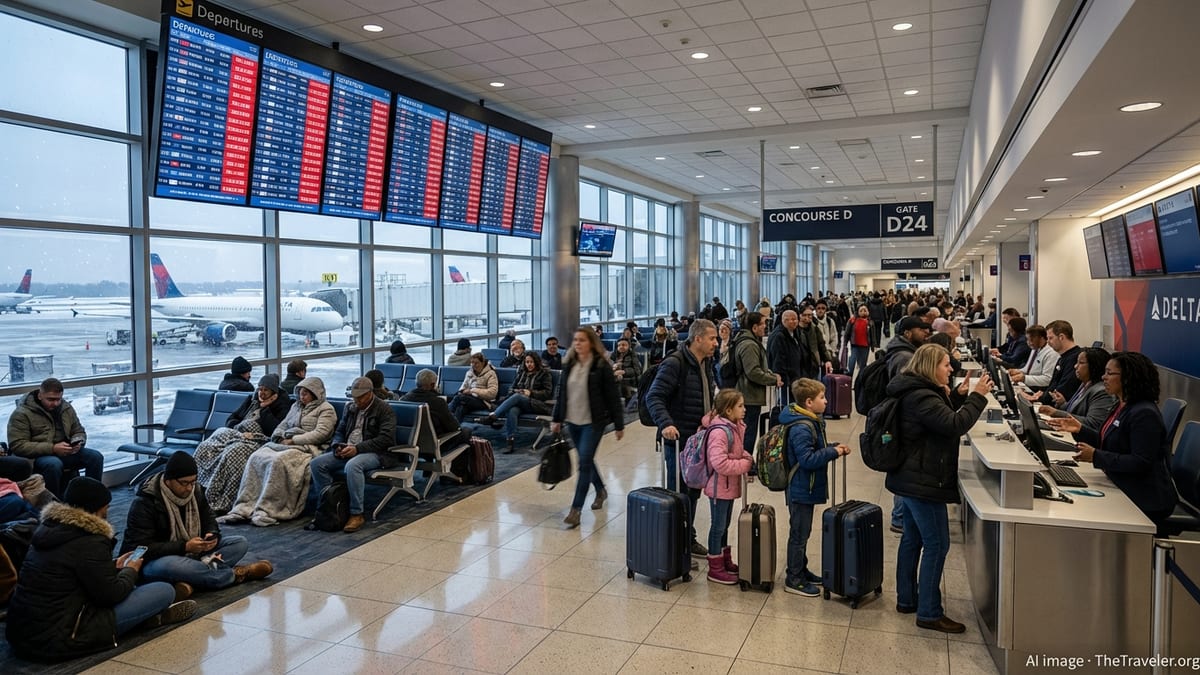
Travelers at Minneapolis–St Paul International Airport faced mounting frustration on Friday as a wave of delays and cancellations affecting major U.S. hubs left passengers stranded, with more than 100 flights reportedly delayed and a growing number of services canceled across key routes to Chicago, New York, Dallas and other cities.
Get the latest news straight to your inbox!
Widespread Disruptions Across Major U.S. Hubs
Operational data from flight tracking dashboards on Friday indicated at least 112 delays and 11 cancellations tied to Minneapolis–St Paul services operated by large U.S. carriers, including Delta Air Lines, American Airlines and Southwest Airlines. The disruption rippled across some of the airport’s busiest domestic corridors, notably connections with Chicago, New York and Dallas, where congestion quickly translated into longer ground holds and missed connections for many passengers.
Publicly available tracking boards showed Minneapolis–St Paul departures holding at gates well past scheduled times, with some flights repeatedly pushed back in short increments before either departing late or being removed from the schedule entirely. As the morning peak gave way to the afternoon bank of flights, compound delays meant that a late-arriving inbound aircraft could knock an entire day’s schedule off balance.
On routes to Chicago and New York, which rely heavily on tight turnarounds and connecting passengers, even relatively brief disruptions translated into full gate areas and rebooking lines. Dallas services also reported extended delays, with aircraft and crews tied up on earlier segments and unable to reach Minneapolis–St Paul in time to operate later departures.
Weather, Congestion and Crew Issues Combine
Reports from aviation weather services and federal aviation dashboards pointed to unsettled conditions across parts of the Midwest and East Coast, which contributed to air traffic flow restrictions around several major hubs. When key nodes in the national airspace system slow down, airports such as Minneapolis–St Paul, which serves as a central connection point for multiple airlines, often experience a chain reaction of delays.
Industry data and historical performance statistics from the U.S. Department of Transportation show that while major carriers like Delta, American and Southwest generally complete the vast majority of scheduled flights, a small share is consistently affected by cancellations, late-arriving aircraft and air traffic system issues. When storms or low visibility coincide with peak travel periods, that small percentage can represent hundreds of flights nationwide in a single day, amplifying the impact for travelers in hub airports.
Aviation analysts note that crew availability can become a critical secondary factor during widespread disruption. Flight attendants and pilots are required to comply with strict duty-time limits, and when early morning flights operate late, crews may reach their safety thresholds before completing assigned schedules. That can force airlines to cancel or heavily delay later segments, even after weather has begun to improve.
Passengers Face Long Lines and Limited Options
At Minneapolis–St Paul, travelers on the affected airlines reported long queues at customer service counters as they attempted to secure alternative itineraries or overnight accommodation. With multiple carriers adjusting schedules at the same time, rebooking options to Chicago, New York and Dallas became increasingly constrained, particularly for same-day travel.
Publicly available accounts from recent disruption days at large U.S. hubs suggest that travelers often face hours-long waits when operational problems affect several airlines simultaneously. In such scenarios, stand-by lists grow quickly and remaining seats on later flights or on competing carriers can sell out, leaving some passengers waiting until the following day to depart.
Families, business travelers and international passengers making onward connections were among those hardest hit. For travelers with nonrefundable hotel bookings, event tickets or cruise departures at their destination, even a single missed flight can carry significant financial and logistical consequences.
Minneapolis–St Paul’s Role as a Major Connecting Hub
Minneapolis–St Paul International Airport is one of the country’s larger hubs by passenger volume, serving tens of millions of travelers annually and providing critical connecting traffic for airlines such as Delta, American and Southwest. The airport’s network includes dense schedules to other major hubs, regional cities and leisure destinations, making it especially sensitive to disruptions elsewhere in the system.
Airport planning documents and recent traffic reports highlight the complexity of managing operations at a hub with overlapping bank structures for multiple airlines. When a significant number of flights in a bank are delayed, aircraft may arrive at the same time rather than in a staggered pattern, which can strain gate capacity, baggage systems and airfield movements. The resulting congestion often leads to further delays, even for flights that were initially scheduled to depart on time.
Contingency plans published by airport authorities outline procedures for handling extended tarmac delays, diversions and mass disruptions, but those measures are primarily designed to mitigate the most serious passenger impacts rather than to prevent delays outright. On busy travel days, a combination of weather, national airspace constraints and airline-specific issues can still leave thousands of passengers experiencing significant schedule changes.
What Travelers Can Do During Irregular Operations
Consumer advocates and frequent flyer groups often recommend that travelers build additional time into itineraries involving critical connections, particularly during seasons when storms are common around hubs such as Chicago, New York and Dallas. Booking earlier flights in the day and allowing longer layovers can provide a buffer when operational problems emerge.
During active disruptions like those seen on Friday, passengers are generally advised to monitor flight status through airline apps and official airport dashboards, which typically update more quickly than departure boards in the terminal. Same-day change tools and self-service rebooking features, where available, can reduce the need to stand in line at customer service counters.
Travel insurance with trip interruption coverage, as well as credit card benefits that reimburse for delays and cancellations, can also help offset the cost of last-minute hotels, meals or alternative transport. While no preparation can fully eliminate the inconvenience of large-scale flight disruptions, travelers with flexible plans, backup options and easy access to digital tools may find it easier to navigate days when airlines across the network are struggling to keep schedules running on time.