


More news on this day
Thunderstorms, saturated airspace and peak summer traffic converged at Chicago O’Hare International Airport on June 21, triggering at least 340 flight delays and nine cancellations that rippled across routes linking the United States with Canada, Germany, France, Japan and other international destinations.
Get the latest news straight to your inbox!
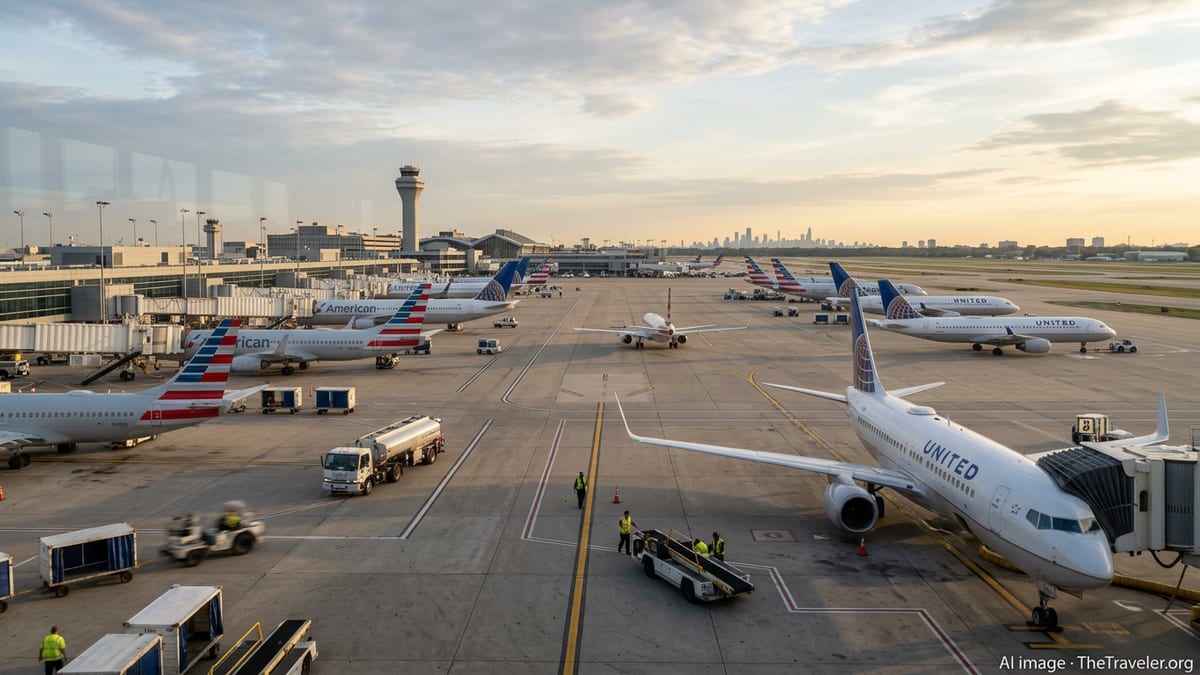
Weather Turbulence Turns O’Hare Into a Chokepoint
Chicago O’Hare’s role as a central hub for transcontinental and transatlantic networks meant that localized storms around northern Illinois quickly translated into widespread schedule disruptions. Publicly available aviation data and airline status boards on June 21 showed rolling ground delays and extended tarmac waits as thunderstorms moved through the region and saturated arrival and departure corridors.
Recent weather patterns across the Midwest have set the stage for these disruptions. Earlier in June, severe storms and torrential rainfall prompted ground delay programs at O’Hare, with average holds of one to two hours and some flights waiting considerably longer to depart or arrive. Those conditions, combined with already heavy summer traffic, left little slack in the system when new storm cells developed on June 21.
O’Hare’s congestion issues are not new, but the combination of record passenger volumes and storm-driven capacity cuts is sharpening their impact. Travel industry reporting for June indicates that the airport has recorded some of its busiest days on record, with more than 100,000 travelers passing through security in a single day. As planes queue on taxiways and at holding points, even brief weather interruptions can suddenly cascade into missed connections and rolling delays across airlines and alliances.
Reports from flight-tracking services and consumer aviation platforms show that on days when thunderstorms settle over the Chicago area, average arrival and departure delays can stretch well beyond an hour. For many connecting passengers, that is enough to break carefully timed itineraries and force rebookings onto already crowded later flights.
United, Republic, American and Jazz Bear the Brunt
United Airlines, with its largest hub at O’Hare, appeared among the most heavily affected carriers on June 21. Live status boards for multiple United mainline and United Express flights showed extended departure holds and revised arrival times, with some operations pushed deep into the evening. Regional partners flying under the United Express banner, including Republic-operated services, absorbed a significant share of the disruption as they are often scheduled with quick turns and tight connection banks.
American Airlines, which maintains a substantial operation at O’Hare, also contended with knock-on effects from the weather and airspace constraints. Flight trackers for American’s long-haul and domestic services into and out of Chicago showed a pattern of moderate to severe delays during peak storm periods. Regional feeder operations that connect smaller Midwest and East Coast cities into American’s Chicago network were particularly vulnerable when arrival metering programs slowed traffic into the airport.
Canadian carrier Jazz, which operates regional services for a major Canadian network, was drawn into the turbulence through its cross-border schedules linking Canadian hubs with O’Hare. With capacity at the airport constrained, some Jazz-operated flights experienced holding patterns or departure delays as they awaited available slots. These delays, though smaller in absolute number than those affecting the largest U.S. carriers, contributed to the overall tally of 340 delayed flights and compounded connection risks for travelers heading deeper into the United States.
Regional airlines such as Republic and Jazz play an outsized role during disruption events because they feed passengers into large hub banks operated by United and American. When a thunderstorm shuts down arrivals even briefly, these regional flights can be among the first to be postponed or canceled, as operators work to protect long-haul departures and aircraft positioning.
International Links to Europe and Asia Feel the Strain
The June 21 disruptions at O’Hare extended well beyond domestic routes. According to public schedule data and flight-status services, transatlantic services from Chicago to major European gateways, including Frankfurt in Germany and Paris in France, experienced measurable knock-on delays as crews, aircraft and departure slots were shuffled in response to changing conditions.
Chicago’s importance as a North American gateway to Europe means that delays at O’Hare can quickly ripple across the Atlantic. When departures from Chicago are held on the ground, arrival times in European hubs are pushed back, compressing turnaround windows and potentially affecting onward connections to other European and Middle Eastern destinations. In some cases, operators may opt to swap aircraft or reassign gates to keep at least part of the schedule moving.
Japan also figures prominently in O’Hare’s long-haul network, with established services to Tokyo and additional seasonal and codeshare operations linking the Midwest to East Asia. Weather-related disruptions in Chicago can alter departure sequences on these routes, sometimes forcing late-night or next-day departures when crew duty-time limits or airport curfews at overseas destinations become a factor. Even when flights are able to depart, extended delays can affect cargo handling and onward domestic connections within Japan.
While only a small fraction of the nine cancellations recorded on June 21 related directly to long-haul international routes, the timing of those cancellations often concentrated hardship on passengers traveling the farthest. With summer transatlantic and transpacific flights already running near capacity, rebooking options for stranded travelers were limited, and some passengers faced overnight stays or multi-stop alternative routings through other hubs.
Systemic Vulnerabilities Highlighted by Summer Surge
The wave of delays and limited cancellations at O’Hare underscores a broader pattern in North American aviation performance. Recent consumer-focused analyses of federal on-time data indicate that 2025 produced the weakest punctuality rates in more than a decade, with significant growth in tarmac waits and extended ground delays. Chicago O’Hare has consistently appeared among the large airports with lower on-time arrival percentages, reflecting its heavy traffic load and susceptibility to weather-related constraints.
Industry observers point to several structural challenges that magnify the impact of storms over Chicago. First, O’Hare functions as a primary hub for multiple large carriers and alliances, concentrating thousands of daily arrivals and departures into defined bank structures. Second, the airport sits in a region prone to rapidly changing convective weather in late spring and summer, forcing air traffic managers to implement ground delay programs or reroute traffic with limited notice. Third, robust recovery plans require spare aircraft and crew capacity that can be difficult to maintain during peak travel months.
The June 21 event unfolded against a backdrop of what local aviation agencies describe as a record or near-record summer at O’Hare and nearby Midway Airport, with millions of seats scheduled between June and August. High passenger volumes mean that even a modest number of delayed or canceled flights can quickly fill customer service lines, overwhelm rerouting options and strain airport infrastructure from baggage systems to ground transport access.
Travel advocates note that while airlines have invested in upgraded technology and better communication tools, many passengers still face uncertainty during dynamic disruption events. Status applications can lag real-time operational decisions, and information may differ between airline, airport and third-party tracking platforms. On days like June 21, travelers often must navigate a patchwork of updates while seeking rebooking options that fit their individual needs.
What Travelers Can Expect in the Coming Weeks
The June 21 disruptions at Chicago O’Hare arrive just as the peak of the Northern Hemisphere summer travel season begins, suggesting that similar episodes may recur in the weeks ahead. Historical patterns show that late June and early July are among the busiest periods for U.S. air travel, and forecasters anticipate additional rounds of thunderstorms across parts of the Midwest and Great Lakes regions.
Publicly available airline advisories in recent days have already highlighted travel waivers tied to Chicago-area storms and broader Midwest severe weather. These waivers generally permit affected passengers to change flights within a specified time window without incurring change fees, provided they travel between designated origin and destination pairs. While such measures offer flexibility, they also signal that carriers expect further operational challenges in and out of O’Hare.
For transborder and long-haul travelers, the implications extend well beyond Illinois. Delays and cancellations at O’Hare can affect flights linking the United States with Canadian cities, major European hubs in Germany and France, and Asian gateways such as Tokyo. Travelers beginning their journeys in those overseas markets may experience last-minute schedule adjustments as operators adapt to evolving conditions in Chicago.
Travel experts advise passengers flying through O’Hare during peak storm periods to build additional time into itineraries, particularly when planning tight international connections. While June 21’s total of roughly 340 delays and nine cancellations reflects only a slice of the airport’s daily operations, it illustrates how quickly localized weather and heavy traffic can combine to produce widespread disruptions across North American and international networks.