


More news on this day
Passengers traveling through Amman’s Queen Alia International Airport on May 25 faced mounting disruption as publicly available flight data showed 39 delays and two cancellations involving Royal Jordanian, Jordan Aviation, Qatar Airways and other carriers on routes linking Jordan with Dubai, Riyadh, Doha and additional regional cities.
Get the latest news straight to your inbox!
Regional Hub Struggles With Knock-On Disruptions
Queen Alia International Airport, Jordan’s main gateway and hub for Royal Jordanian and Jordan Aviation, has been under renewed strain as delays stacked up across its busy regional network. Timetables and live tracking boards for routes between Amman and Gulf cities such as Dubai, Riyadh and Doha showed a pattern of services departing behind schedule, with a smaller number scrubbed entirely.
Operational data for flights between Doha and Amman on May 25, for example, displays multiple services by Royal Jordanian and Qatar Airways, with retimed departures and adjusted arrival estimates against the published schedules for the month. While many flights ultimately operated, the shifting timings contributed to crowding in departure areas and uncertainty for connecting passengers.
Queen Alia’s role as a regional transfer point magnifies the impact of even modest schedule changes. Royal Jordanian alone operates hundreds of weekly flights from the airport, and Jordan Aviation also uses the facility as a base, meaning delays on short-haul Gulf sectors can spill over into longer-haul departures to Europe and North America when aircraft and crews fall out of position.
Delays and Cancellations Ripple Across Gulf Routes
The day’s disruption was most visible on high-frequency routes linking Amman with nearby hubs. Services between Amman and Dubai, Riyadh and Doha form some of the core regional corridors for Royal Jordanian and its partners, and schedule changes on these routes were reflected in longer queues at check-in, security and boarding gates.
Comparable episodes in recent months have already underscored the vulnerability of these corridors. Earlier waves of cancellations and prolonged delays at Queen Alia were linked to wider airspace restrictions and operational adjustments around the Middle East, and reports from travel forums indicate that passengers once again encountered retimed or consolidated flights on May 25, even when their services were not formally canceled.
On the day in question, two flights involving the Amman hub were recorded as canceled, while 39 experienced notable delays. Although many of those flights eventually departed, rolling updates to estimated times of departure and arrival complicated planning for travelers with onward connections both within the region and on long-haul sectors.
Royal Jordanian, Jordan Aviation and Qatar Airways Under Pressure
The disruption placed particular attention on Royal Jordanian, Jordan’s flag carrier and Queen Alia’s primary tenant, as well as on Jordan Aviation and Qatar Airways, which collectively account for a significant share of regional traffic through the airport. Royal Jordanian’s published contingency and conditions-of-carriage information sets out procedures for handling delays and cancellations, including efforts to provide updated information and options for rebooking when schedules are not met.
Travel-industry resources that track airline performance note that Royal Jordanian, like many regional carriers, has faced recurring operational challenges in recent months as it balances dense regional schedules with ongoing airspace constraints. Advisory material for passengers emphasizes the importance of monitoring flight status closely and allowing extra time at the airport when weather, traffic control measures or security conditions raise the risk of disruption.
Qatar Airways and Jordan Aviation have also appeared frequently in online discussions surrounding schedule volatility since late winter, as travelers share experiences of rerouting, refund requests and last-minute timetable changes on flights that connect through Doha or use Amman as a transit point. While many of these accounts relate to earlier airspace-closure episodes, they illustrate the wider context in which the latest delays at Queen Alia are unfolding.
Passenger Experience: Crowded Terminals and Uncertain Connections
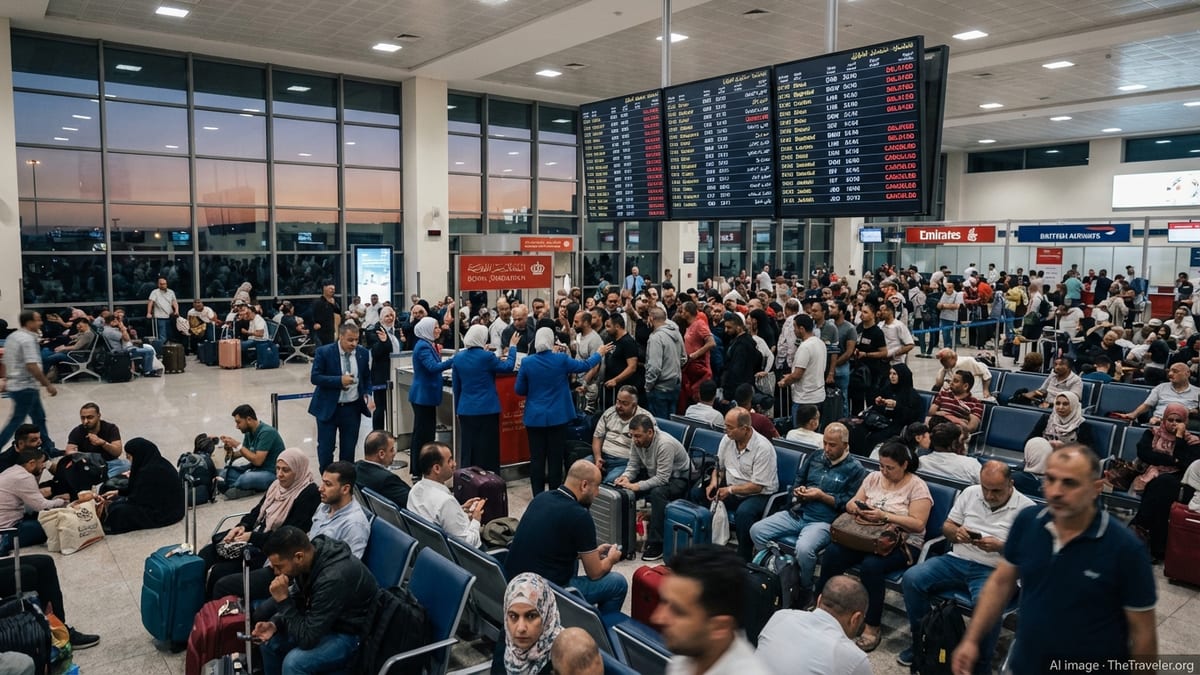
Accounts circulating on social media platforms and travel forums describe scenes of crowded seating areas and long lines at customer-service counters in Amman as passengers sought clarity on revised departure times and missed connections. Similar narratives emerged during earlier disruption events at Queen Alia, when travelers reported spending extended periods in the terminal waiting for updates as departure boards repeatedly shifted.
For some passengers, especially those connecting from regional flights to long-haul services, even relatively short delays created further complications. Missed onward connections can trigger rebooking onto later flights, overnight stays or complete itinerary changes, particularly when demand is strong and alternative seats are limited. Industry guidance commonly advises travelers on such itineraries to build in longer connection windows at hubs prone to regional knock-on effects.
Families, elderly travelers and visitors unfamiliar with the airport layout are often the most affected by schedule instability, as they may be less comfortable navigating changing gate assignments or rebooking options. Publicly available travel advisories for the region have therefore stressed the value of checking flight status repeatedly in the hours before departure and upon arrival in Amman, rather than relying solely on printed or earlier digital itineraries.
What Travelers Should Do Next
Travel specialists who monitor airline operations recommend that passengers due to travel through Queen Alia in the coming days take a proactive approach to potential disruption. This generally includes confirming flight status directly with the operating carrier on the day of travel, using airline apps or contact centers, and arriving at the airport earlier than usual for busy regional departures to and from Dubai, Riyadh and Doha.
Under common air-travel practices, travelers affected by significant delays or cancellations may be offered rebooking on later flights, refunds or, in some jurisdictions, compensation, depending on the exact route, ticket type and cause of the disruption. Consumer-rights resources highlight that eligibility can vary widely, so passengers are encouraged to review their airline’s published conditions of carriage and any relevant regional regulations.
With peak summer travel approaching, observers expect continued pressure on Middle Eastern hubs, including Amman, as airlines attempt to operate dense schedules amid shifting operational constraints. For now, the latest wave of delays and cancellations at Queen Alia International Airport serves as another reminder that passengers flying through regional hubs may face an elevated risk of schedule changes and should plan their journeys accordingly.