


More news on this day
Air travel across the United States faced fresh disruption today as severe weather and congestion around major hubs including Chicago, Philadelphia, Dallas and New York contributed to at least 616 delays and 144 cancellations, affecting operations at carriers such as JetBlue, American, Envoy, Southwest, Republic and others.
Get the latest news straight to your inbox!
Storms And Congestion Grip Major U.S. Hubs
Publicly available tracking data shows that storms sweeping through parts of the Midwest and Northeast on June 11 have been a key driver of delays and cancellations at major airports. Chicago O’Hare and Midway, New York’s LaGuardia and John F. Kennedy, Dallas Fort Worth, Philadelphia and New York’s Queens-area airports have all reported elevated disruption levels compared with a typical midweek travel day.
Coverage of the severe weather system over the Midwest indicates that strong winds, lightning and heavy rain have periodically halted departures and arrivals into Chicago, forcing aircraft to wait on the ground or divert. These pauses, combined with ongoing recovery from earlier storms, have left airlines with tight margins on aircraft and crew availability.
As conditions shifted east, constraints built along the busy corridor linking Chicago, Philadelphia and the New York region. Air traffic management programs limiting the rate of takeoffs and landings at affected hubs contributed to rolling delays, creating bottlenecks that rippled outward to smaller cities connected through these airports.
Operational pressures have been compounded by the need to reposition aircraft and keep crews within federally regulated duty-time limits. When storms or congestion push flights late into the evening, some departures have been canceled outright rather than risk crews exceeding legal work hours.
Chicago, New York And Dallas See The Heaviest Impact
Among U.S. hubs, Chicago and New York have again emerged as focal points of disruption. Flight-tracking dashboards show Chicago O’Hare recording hundreds of delayed departures and arrivals today, with dozens of cancellations as airlines trim schedules to stabilize operations into the night. Chicago Midway, a key base for Southwest Airlines, has also seen elevated delays as thunderstorms move through the region.
In the New York area, LaGuardia and JFK have reported a surge in delays as storms, congestion and airspace constraints intersect over one of the country’s busiest aviation corridors. Many affected flights are shuttles and short-haul services that normally operate multiple times a day between New York and other hubs such as Chicago, Dallas and Boston, amplifying the knock-on effects of each cancellation.
Dallas Fort Worth, one of American Airlines’ primary hubs, has likewise experienced mounting delays as storms disrupt inbound traffic from the Midwest and Northeast. When aircraft arrive late into Dallas, outbound services often push back behind schedule or are cancelled if crews approach the end of their duty windows. These schedule adjustments ripple into overnight and next-morning departures across the system.
Philadelphia, another significant connecting point, has recorded a smaller but still notable share of delays. As a connecting hub for transcontinental and regional routes, lagging departures here have contributed to missed connections and extended layovers for passengers heading onward to the Midwest and South.
JetBlue, American, Southwest And Regional Partners Affected
The disruption has affected a wide cross-section of airlines, from large network carriers to regional operators that fly under their brands. American Airlines, with major hubs at Chicago O’Hare, Dallas Fort Worth, Philadelphia and several New York–area airports, has seen a significant number of delayed flights today, particularly on short-haul routes where multiple rotations are scheduled with the same aircraft.
JetBlue, which maintains a strong presence at New York’s JFK and LaGuardia as well as Boston, has also reported elevated delays and cancellations. When weather and congestion slow operations in the New York region, JetBlue’s point-to-point network can quickly feel the strain, especially on popular routes along the East Coast and to the Midwest.
Southwest Airlines, heavily exposed to weather-related constraints at Chicago Midway and other central U.S. airports, has faced rolling delays that can cascade throughout its high-frequency network. Because Southwest generally relies on quick turnarounds rather than hub-and-spoke connections, disruptions early in the day can leave aircraft and crews out of position by afternoon.
Regional carriers such as Envoy and Republic, which operate flights on behalf of major brands, have likewise been affected as their schedules are closely tied to hub operations. When mainline flights are delayed or canceled, regional connections are often adjusted as well, leading to longer waits and itinerary changes for travelers on smaller jets and turboprops.
How Today’s Numbers Compare To Typical Disruption
The tally of roughly 616 delayed flights and 144 cancellations nationwide sits below the most extreme disruption events seen during peak summer storms but remains well above what passengers might expect on a normal weekday. On a typical day with cooperative weather, U.S. airlines still experience hundreds of delays and a smaller number of cancellations, often tied to isolated storms, maintenance issues or air-traffic constraints.
What sets days like today apart is the concentration of problems at a handful of high-traffic hubs. When airports such as Chicago O’Hare, Dallas Fort Worth and the New York–area fields experience sustained weather or airspace restrictions, the number of late and canceled flights climbs quickly because so many routes and connections rely on these nodes.
Industry analyses of previous multi-hub disruption days show that once cancellations reach triple digits, airlines usually focus on protecting longer-haul and international services while trimming shorter domestic segments. This approach preserves connections for as many travelers as possible but can result in multiple cancellations on high-frequency routes, especially when several departures per day are scheduled between the same cities.
Today’s data suggests a familiar pattern playing out, with carriers prioritizing transcontinental and international flights and selectively canceling some of the shorter segments linking Chicago, New York, Dallas and Philadelphia. Passengers booked on those shorter routes are more likely to face rebookings, longer connections or, in some cases, overnight stays.
What Travelers Are Experiencing On The Ground
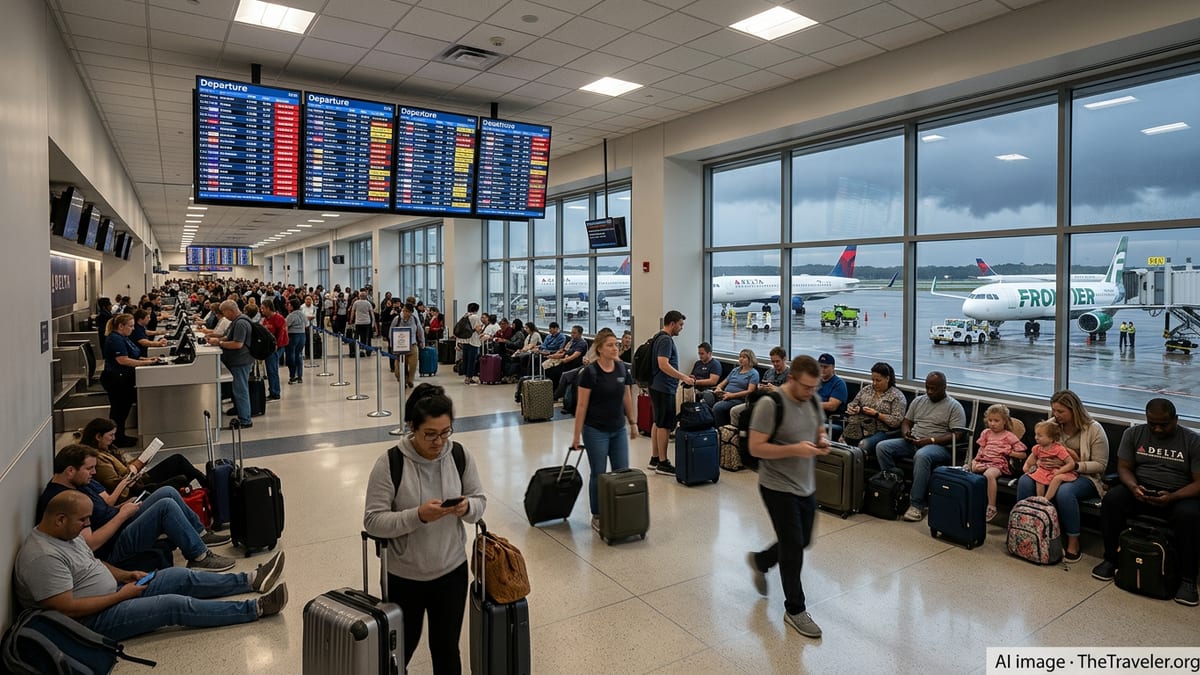
For passengers, the numbers translate into long lines at customer service counters, crowded gate areas and shifting departure times. Publicly available accounts from travelers on social platforms describe hours spent in terminals as flights move from on-time to delayed, then to further delayed or canceled, sometimes with multiple schedule changes over the course of a single afternoon.
Because much of today’s disruption is attributed to weather and airspace management rather than airline-specific mechanical issues, options for financial compensation can be limited. U.S. regulations do not generally require airlines to provide vouchers or hotel stays when weather is the primary cause, though carriers may still offer meal credits or hotel assistance on a case-by-case basis.
Travel experts reviewing today’s pattern of delays suggest that affected passengers monitor airline apps and airport departure boards closely, as status updates can change quickly when storms form or dissipate. In some cases, early-morning flights have operated close to on time, while late-afternoon and evening departures have borne the brunt of the disruption as weather intensifies.
As storms continue to move across key regions, further delays and cancellations are possible into the night. Travelers with itineraries touching Chicago, Philadelphia, Dallas or the New York area are being advised by airlines and airports, through public channels, to allow extra time, keep contact information current on their reservations and consider flexible plans in case schedules shift again.