

More news on this day
Severe thunderstorms and tornado warnings around Chicago on June 11 and June 12 have severely disrupted operations at O’Hare International Airport, triggering mass cancellations, lengthy ground stops, and diversions that are now cascading through airline networks worldwide.
Get the latest news straight to your inbox!
Ground Stops and Cancellations Snarl One of the World’s Busiest Hubs
Chicago O’Hare, a primary hub for both domestic and international traffic, has seen repeated ground stops and rapidly changing restrictions as successive storm lines moved across northern Illinois. Publicly available data from flight tracking services and airport reporting shows hundreds of flights canceled or delayed since late Wednesday, with disruption intensifying as tornado watches and warnings were issued for the Chicago metro area.
Coverage from local outlets indicates that between Wednesday evening and Thursday night, O’Hare recorded well over 800 cancellations, with additional waves of disruption early Friday as new storms, high winds, and lightning again affected airport operations. A further round of cancellations and delays was reported Friday morning, as airlines attempted to restart schedules in the wake of earlier storms even as new warnings were issued for parts of the region.
While Midway International Airport has also been affected by severe weather and brief ground stops, the concentration of long-haul and connecting traffic at O’Hare has made its operational paralysis particularly consequential for the global network. Airlines are juggling crew-duty limits, displaced aircraft, and gate shortages after hours of halted arrivals and departures.
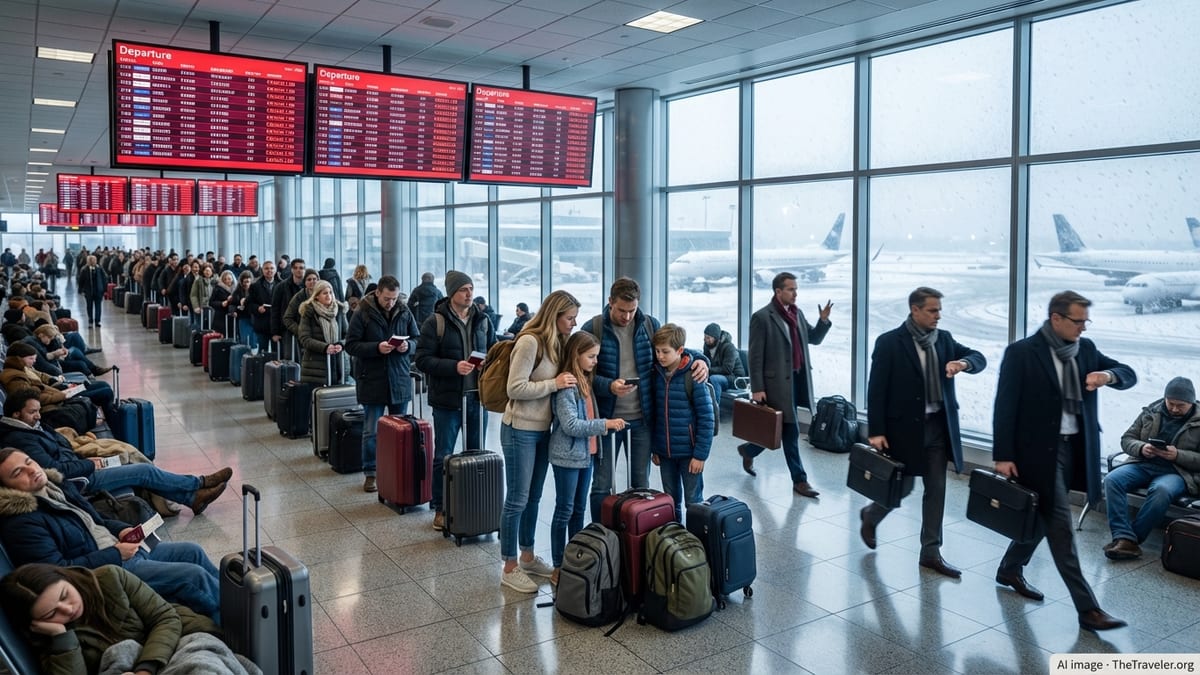
Passengers have described chaotic scenes inside terminals, with departure boards cycling through rolling delays, gate changes, and last-minute cancellations as operations staff respond to rapidly evolving weather and airfield conditions.
Tornado Warnings and a High-End Severe Weather Setup
The air travel turmoil coincides with an unusually volatile early-summer storm pattern across the Midwest. Forecast discussions and storm outlooks from federal meteorological agencies placed the Chicago area under an elevated severe weather risk, with a combination of intense thunderstorms, damaging straight-line winds, and the potential for tornadoes.
On Thursday and into Thursday night, multiple tornado warnings were issued in parts of northeastern Illinois and northwest Indiana, including areas close to Chicago and its southern suburbs. Published coverage describes radar-indicated rotation in storms passing near the city, as well as confirmed tornadoes striking communities farther south and southwest, where homes and businesses sustained significant damage and power lines were brought down.
By Friday, reports indicated that hundreds of thousands of customers across Illinois and Indiana had lost electricity at some point during the outbreak. In Chicago, fallen trees, localized flooding, and scattered damage added complexity to the task of moving passengers and staff to and from the airports, compounding delays caused by airspace restrictions.
Meteorologists have noted that the region has already endured multiple high-impact severe weather episodes this year, and that this latest round combined heavy rain, high winds, hail, and tornado potential in a way that is particularly disruptive to aviation.
Shockwaves Across Domestic and International Airline Networks
The scale of O’Hare’s disruption is being felt far beyond Chicago. As a major connecting hub for large US carriers and a critical gateway for transatlantic and transpacific flights, the airport’s slowdown has created knock-on delays at airports throughout North America, Europe, and parts of Asia.
Publicly available schedule data and airline advisories indicate that carriers have been forced to cancel or reroute flights into alternate hubs to avoid the worst of the storms. Aircraft and crew that were scheduled to pass through Chicago are now out of position, leading to “downline” cancellations hours or even days after the most intense storms have passed the city itself.
Travelers connecting through O’Hare have reported missed long-haul flights, overnight airport stays, and unplanned diversions to cities such as Minneapolis, Detroit, and Denver as airlines seek available gates and better weather windows. With many evening departures canceled outright on Thursday, some long-haul services have been rescheduled into narrow operational gaps, raising the risk of further disruption if additional storms redevelop.
Global alliances are also feeling the strain as partner airlines depend on Chicago connections to feed onward international routes. Even when destination weather is calm, flights may be delayed or canceled simply because an inbound aircraft or connecting passengers remain stuck at O’Hare.
Airlines Activate Waivers as Passengers Scramble to Rebook
In response to the severe weather pattern, major US carriers have issued weather waivers for travel to, from, or through Chicago on June 10, June 11, and June 12. Publicly posted notices outline options for customers to change itineraries without typical change fees, provided they rebook within specified date ranges and maintain the same origin and destination.
Reports shared by travelers indicate that call centers, airport ticket counters, and airline apps have all come under intense strain, with long hold times and limited seat availability on alternative routings. Some passengers have opted to scrap connecting plans through Chicago entirely, asking to be rerouted via other hubs where possible, even if it adds extra stops or longer travel times.
Travel advice circulating across airline and aviation forums emphasizes acting quickly when a waiver appears, monitoring flight status frequently, and considering overnight hotel stays rather than waiting at the gate for multiple rolling delays. Passengers are also being urged to keep essential items in carry-on bags in case of unexpected overnights at intermediate airports.
For airlines, the challenge is balancing customer accommodations against already tight summer capacity, with many flights across the US already operating close to full. Once a large block of flights at a hub like O’Hare is canceled, finding spare seats for stranded travelers across the network can take days.
What Travelers Should Expect in the Coming Days
Short-term forecasts indicate that while the most intense thunderstorms may become more scattered, additional rounds of rain and strong storms remain possible across the Chicago region into the weekend. That means airlines are likely to continue building extra time into schedules, and air traffic control may retain flow restrictions if convective activity redevelops along key approach and departure paths.
Travel analysts note that even if weather conditions improve quickly at O’Hare, the recovery process for airlines can stretch well beyond the end of the immediate storm threat. Aircraft and crew must be repositioned, maintenance checks rescheduled, and complex crew-duty rules observed, all while trying to operate busy summer schedules.
Passengers traveling through Chicago over the next several days are being advised, in widely shared guidance, to allow longer connection times, check in online as early as possible, and keep a close watch on airline apps and airport information boards. Those with flexible plans may wish to explore voluntary rebooking around peak storm periods or shifting to less affected hubs.
For now, the combination of severe storms and the critical role of Chicago O’Hare in the global aviation system has turned a regional weather outbreak into a worldwide travel challenge, highlighting yet again how vulnerable modern air travel remains to sudden and extreme shifts in the atmosphere.